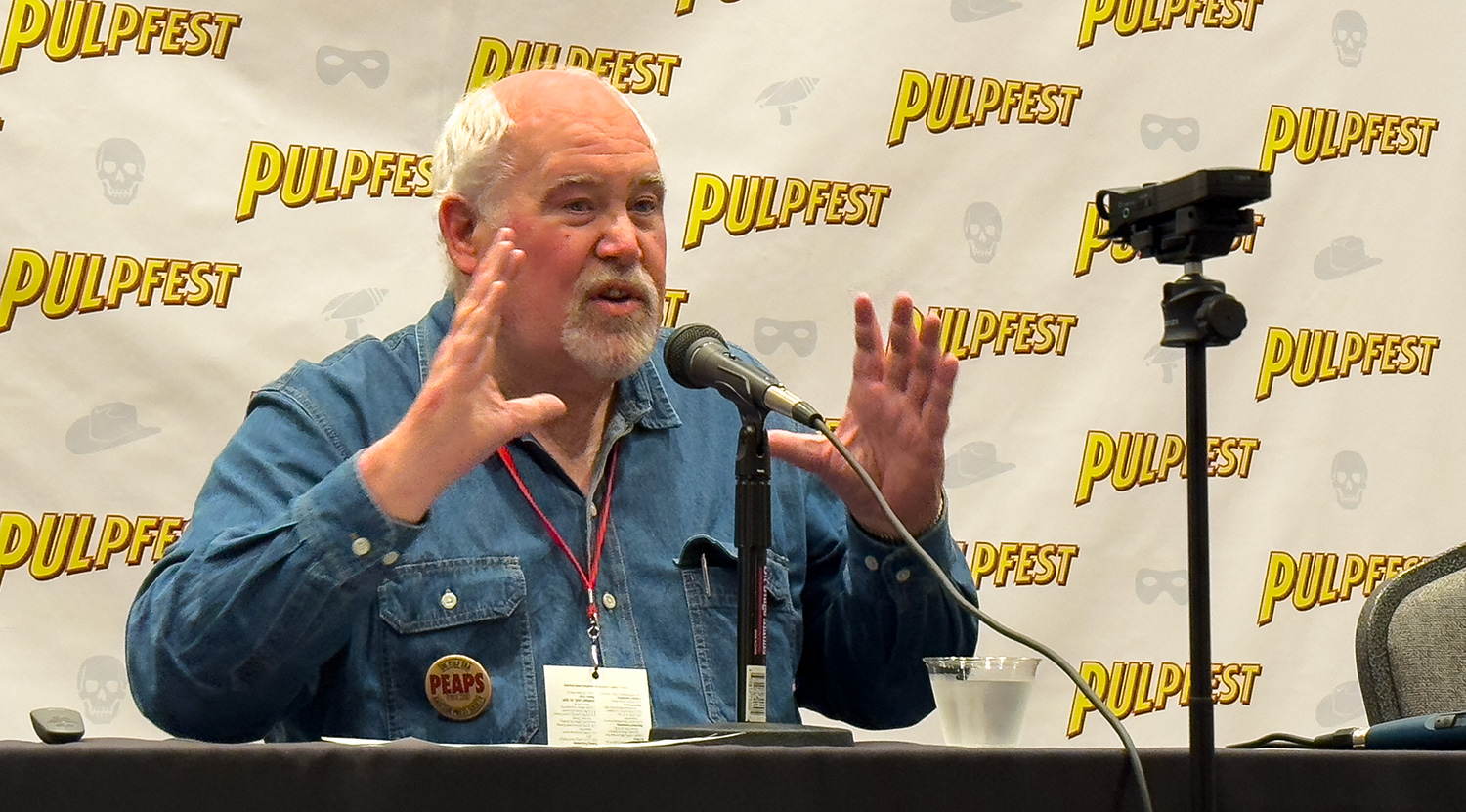
Ed Hulse, publisher at Murainia Press, looks at the life and times of author Edgar Wallace, a master of blood and thunder, on the 150th anniversary of his birth. This Pulp Tales was recorded at PulpFest 2025 in Pittsburgh on Thursday, Aug. 7.
Click to expand the transcript.
Pulp Tales Announcer: Welcome to Pulp Tales, fascinating stories of the pulp magazines and the creative minds that brought them to life. The fictioneers, the artists, the editors, and others. Brought to you by ThePulp.Net. Learn more about the pulp magazines through articles, blogs, bibliographies, links, over 100 episodes of this podcast, and much more at ThePulp.Net. Your link to the pulp magazines for almost 30 years online at thepulp.net.
Ed Hulse: We had an idea about a group of vigilantes who would work outside the law. They would work theoretically in the cause of justice, in the service of justice, but they were very definitely considered outlaws. They called themselves the four just men, and they were absolutely ruthless about killing people that they thought the law couldn’t reach. Now, does that sound familiar? That’s like every other pulp hero we’ve ever heard of, right?
Pulp Tales Announcer: In this episode of Pulp Tales, Ed Hulse, publisher at Morania Press, looks at the life and times of author Edgar Wallace, a master of blood and thunder, on the 150th anniversary of his birth. This Pulp Tales was recorded at PulpFest 2025 in Pittsburgh on Thursday, August 7th, 2025.
Ed Hulse: We’re celebrating 150th birthdays this year, And of course, Edgar Rice Burroughs, you’ve just heard about. And Raphael Sabatini, the author of Captain Blood and the Seahawk, he’ll be coming up. But the other guy who was born 150 years ago is, I would say, the least likely person ever to become a literary phenomenon, based on his background and his upbringing.
And yet he was. Upon dying in 1932 at the relatively young age of 56, Edgar Wallace left behind more than 170 novels, full-length novels. Now, I have to say more than, because even at this late date, almost 100 years after he died, we’re still not sure because there were some novels that had more than one title in different territories in the world.
so nobody seems to be exactly sure, but it’s definitely more than 170, but that wasn’t all. In addition, he wrote 957 short stories, many of which were collected in his books, and many of which appeared in pulp magazines for the first time. He also wrote 18 stage plays, he was quite an accomplished dramatist, and seven screenplays.
Now, of course, in addition to the screenplays he wrote, Wallace was adapted to the screen by many other writers in countries all around the world. Americans have made movies out of his books, the British, of course. The Germans made a wildly popular series of Edgar Wallace adaptations beginning in the late 50s and going into the 60s and even the 70s. The Italians, his novels were extremely popular there, and they had a form of movie called the giallo.
Giallo being the Italian word for yellow because the books, when they were published, came out in these yellow-bound paperbacks. And a lot of the conventions of the giallo, which is kind of a thriller, originated with Wallace but were refined and carried on by other writers well into the 70s and 80s. But again, for you to know just how incredibly popular this guy was, for many years, one out of every four books sold in the United Kingdom was an Edgar Wallace book. He wrote books at a phenomenally fast pace, many of which he dictated.
He was one of the early big producers of commercial fiction to dictate his stuff rather than type it, because it was quicker for him to do it. And he just rattled things off, and he had a secretary who transcribed them and typed them up and did some minor copy editing before he would submit them to his editors. And he needed to submit a lot, because Wallace was nothing if not a spendthrift.
And he was also a gambler, and that got him into a lot of trouble. But we celebrate him here as a pulp writer, and indeed a lot of his stuff appeared not only in the American pulps, but in the British pulps first, and also in British story papers like The Thriller. I don’t know how many of you are familiar with The Thriller, but it was like a 16 to 24 page story paper.
It always had at least one novelette of about 20,000 words, and usually a couple of very short stories. Well, the thriller was published by Amalgamated Press, which was owned by a guy named Alfred Harmsworth, who was one of Wallace’s first employers. And when they started the thriller in 1929, they decided, we really have to get a top name to get this publication up and running.
So who can we get? So they got Edgar Wallace. And he wrote a lot of stories for them, which subsequently were published in America.
His American books, his original American publisher was Small Maynard and Company, which was kind of a small outfit. In 1926, he shifted his allegiance to Doubleday. And originally, they just appeared in the mainstream Doubleday listening.
But when Doubleday instituted their book club called the Crime Club in 1928, Wallace stories that had been purchased by the company, really by the suitcase full, as it turns out, literally suitcases of Wallace manuscripts. They decided to make Wallace one of the primary authors of the Crime Club, which for those of you who don’t know, you could buy the books in stores, but it was also a subscription service. So typically they would release four titles a month, although there were a lot of months where that varied.
And one of the four titles would be deemed the best novel of the month, the best mystery of the month. And that would be sent, instead of subscribers going to a bookstore to pick it up, it would be sent to their homes the first of every month. Wallace, being such a phenomenon, and Doubleday having purchased so many of his stories, they decided we should make one of our four monthly releases every month in Edgar Wallace.
Now this was almost unheard of because nobody was churning out book-length novels at the rate of one a month. Now I should say nobody in the Doubleday line. There were plenty of pulp people, Max Brand, H. Bedford-Jones, that were capable of writing 50,000 or 60,000 word novels in a very rapid clip.
But Wallace did it effortlessly, and with the help of his secretary, Robert Curtis, he kept the Crime Club. He helped make the Crime Club a phenomenon. Again, if you’re not familiar with the Crime Club, that was a label that existed until 1991.
That wasn’t just something that lasted through the Depression years. It was a hugely popular thing for Doubleday at the time. So many of Wallace’s tales appeared in pulps first, American and British pulps, but also slicks.
And even though he’s best known for his thrillers and his mysteries, he wrote just about everything at one time or another. He wrote stories that were domestic comedies. He wrote adventure stories.
He had a very popular series set in British colonial Africa about a character called Sanders of the River, who was a British commissioner who was sent to Africa and tried to overlook the various, you know, wars between native tribes and things like that and keep things on an even keel for Her Majesty’s Empire. So those were very popular, and as a matter of fact, when Wallace first started appearing in American publications, it was really for the Sanders story, some of which appeared as early as 1912 in Adventure Magazine, one of the great popes. So in the teens, he wrote a lot about World War I, and especially about aviators.
And he had a series that appeared in Street and Smith’s, the popular magazine, called Companions of the Ace High. And some of those were later collected in book form. He also had a series about a guy named Tam of the Scoots.
It really should be Tam of the Scouts, but because he was Scottish, he pronounced it Scoots. And you would think, well, wow, for a guy to be this productive, to write this much great stuff, what kind of an education? He must have had a great education.
He must have been phenomenally well-trained. No, not really. He was born on April 1st, 1875, quite the April Fool’s joke.
And he was an illegitimate child, born to British stage performers, whose, you know, peripatetic lifestyle did not lend itself to good parenting. So they gave the child up for adoption, and he was taken into the family of what they used to call a fishmonger. He was basically a salesman of fish.
It was a guy named George Freeman. And Wallace grew up in poverty, and he lived in a cramped home with ten siblings that Mr. Freeman sired on his own. And it was, to say the least, a modest upbringing.
And he decided to seek employment at an early age rather than stay in school. So bear in mind that this literary giant, and I’m putting literary giant in quotes, but this guy, this incredibly prolific writer, had almost no formal education. We’re talking about a guy who dropped out when he was still of grade school age.
Yeah, he left school at 12, and he had all kinds of jobs. He did join the British Army at 18, and he actually found out his real identity and his real name because he had to apply for a job after he got out of the service, and he had to get a birth certificate presented, which he didn’t have, but he had to have his father go get it, And that’s how he found out his real name was Wallace and that he had been given up for adoption. So he wangled a job as a South African correspondent for the news agency Reuters.
And of course, it was in this capacity that he learned so much about the British Empire and its holdings in Africa and how they dealt with the indigenous peoples and whatnot. And that was the basis, the knowledge that he gathered as a foreign correspondent working out of Africa was the basis for situations that he later used in his Sanders of the River series. And this was really important because working as a journalist, again, even though he didn’t have formal training in writing, he learned how to write tersely, concisely, to use a minimum of flowery language and descriptive phrases.
that was conveying the most information in the least possible amount of words. And he became expert at that. And as a matter of fact, he had good repertorial instincts.
He broke several very important news stories. It’s kind of outside the province of this talk to go into him. But he had quite a reputation as being an ace reporter.
So he finally returned to England. He was hired by the London Daily Mail and worked there as a reporter. Wallace’s great strength, I guess he was what today we call a people person.
And he had very small D democratic ideas about people. He mingled with the upper class, the working class. Some of his friends were racetrack touts and petty criminals.
He also knew more than his fair share of local constables and even met Scotland Yard people as a reporter working in London. All of this stuff, all of these experiences, talk about casting bread on the waters. It came back a hundredfold, all these experiences, because he used them all as situations in his stories.
And a lot of the characters that he met in real life, he used as composites for his fictional characters. I don’t really know why, and I’m not sure anybody knows why he decided to start writing fiction, other than just to increase his income. But he did, and in 1904 he began writing his first novel.
And again, he was flying by the seat of his pants. But he had an idea about a group of vigilantes who would work outside the law. They would work theoretically in the cause of justice, in the service of justice, but they were very definitely considered outlaws.
They called themselves the Four Just Men, and they were absolutely ruthless about killing people that they thought the law couldn’t reach. Now, does that sound familiar? That’s like every other pope here we’ve ever heard of, right?
And as a matter of fact, these four just men, and it was, by the way, it was kind of an international group. There was a Spaniard, a Frenchman, and two Englishmen, one of whom actually dies in the course of the book. So very quickly, the four just men became the three just men.
But that first novel caused quite a sensation, not just because it was a rattling good story, But because, as Mike was talking about, Wallace decided, well, the best way I can promote this novel is to come up with a contest that will make it irresistible. So when he self-published the book, he put up the money to print the book, he actually had a contest blank, which you would tear out of the book. You’d fill in.
And what happened was a particularly odious character is murdered by the four just men. and Wallace had what he thought was a very novel means of dispatching this character. So I said before it was 50 pounds.
I was wrong. It was 500 pounds, which was a hell of a lot of money in England in 1905. And that’s when he published it.
He called himself Talus Press. And that was the deal. If you filled out that blank, if you figured out how the murder was committed, how the just men committed the murder, you could theoretically win 500 pounds.
Now, I should say, the 500 pounds, that wasn’t per winning entry. That was the total amount of money he was willing to give away. So there were 50-pound prizes, 10-pound prizes, and whatnot.
But anyway, the problem was that the good news was he sold a hell of a lot of copies of this book. The bad news was many more people correctly guessed the solution than he had ever thought possible. Consequently, he had to pay the whole 500 pounds, which, like I say, was a small fortune in those days.
Well, Alfred Harmsworth, the publisher of the Daily Mail and also of a lot of British pulps as amalgamated press, he came to Wallace’s rescue, and he felt that he had to because he felt that since Wallace was still employed by the Daily Mail, that it would be a poor reflection on the newspaper to be running stories about this author who was stiffing prize winners out of their money. So Harmsworth agreed to cover the 500 pound loss, and he said, "Edgar, you owe me big time, "and sooner or later you’re gonna have to pay off." And he did.
But the point is that with one book, just his first story, Wallace became a nationally known figure, and he kept writing. So again, after the Four Just Men debacle, I say debacle because of the prize situation, as a book it was very well regarded. Much of his early stuff that he wrote after that drew on his experiences in Africa, and that’s when he got the Sanders of the River story going along.
And those stories, which are really quite good for their type, unfortunately because of racial reasons and the kind of sensitivity that we have these days, especially when it comes to colonialism, I don’t think you can print them today. I don’t think a publisher today could print them without engendering great controversy. But they were, again, extremely popular, and a lot of them appeared originally in a British magazine called The Weekly Tale Teller, and some of those very same stories then were reprinted here in this country in Adventure Magazine.
And by the way, he also sold stories to other magazines and pulps, including Doubleday’s short stories, which had recently become a pulp. It was originally a literary magazine of short stories, and when Doubleday bought it in 1910, they turned it into an all-fiction magazine. So some of Wallace’s stuff appeared there, and also in Street and Smith’s New Story magazine, which some of us will know as the magazine that serialized The Return of Tarzan, and the popular magazine.
That was the name of it. That was Street and Smith’s, really their flagship in those early years. And of course, in the British periodicals, he was writing for the Strand Magazine, which, as most of us know, was where most of the Sherlock Holmes stories and a lot of other great British popular fiction made its first appearance.
The Grand Magazine, another one called The Detective Magazine. And what happened was when he realized that his stuff was popular in the States, he kind of expanded the same basic strategy. There were certain publishers, both publishers and book publishers, that wanted exclusivity from him because they figured, well, he’s a cash cow, we can make a fortune with this guy.
But he refused to do that. He refused to sign solely with one publisher or one company. So he spread his stories out as much as he could.
So in the 20s, his crime fiction, he wrote for Muncie’s Flynn’s magazine, which became Flynn’s Detective Fiction and then Detective Fiction Weekly. So in the 20s, a number of his stories were serialized. You know, the novel lengths were serialized, and then, of course, he had various short story series.
And Detective Fiction Weekly, of course, he kept going. But his biggest market for his crime stories was Street and Smith’s Detective Story magazine, which was a weekly. And he started initially by selling books that had already been published in England.
A lot of his detective story fiction originally appeared in Britain, and it was seeing its second go-around. And, of course, typically what would happen is the story would be serialized if it was a novel and detective story, and then it would be published in hardcover, either by Small Maynard or later in the 20s by Doubleday. But he had a number of recurring characters.
I mean, the Just Men actually appeared far less, even though they were tremendously popular, they didn’t appear nearly as often as some of his other characters. He was very big with a Scotland Yard detective named Inspector Elk, another one called Sergeant Sir Peter. By the way, Wallace set some kind of record for members of the peerage who happened to work for Scotland Yard, I guess because they were bored.
They didn’t want to manage their estates, So they were incredibly wealthy, and yet they were Scotland Yard. And they were invariably young and handsome and very bright. Not that they really needed to be, because Wallace’s stories were often so contrived that no detective on the planet could have guessed how some of these things were going to end.
Yet he did it. But what made him a good pulp writer, what made him especially desirable, is the fact that, again, because he had absolutely no literary pretensions. I mean, in this respect, he was like guys like Burroughs and Max Brand.
These were, well, Max Brand had his own literary pretensions, but the point is they were storytellers first and foremost. They considered themselves entertainers. They were writing for pleasure.
They weren’t writing to be taught in schools. They were strictly writing to give their readers pleasure. And if they could afford a book, which, you know, when Wallace came over here, the average price of a hardcover was $1.35.
By the late 20s, it was $2. So you either read his stuff in books or you bought him in pulps for $0.10, $0.15, $0.20. One of his most famous characters, and this is the guy who started in the, he didn’t start, but he first appeared in the aforementioned thriller magazine, that British story paper, was called J.G.
Reader. He was an eccentric guy. Basically, he was just a functionary in London’s Office of the Public Prosecutor.
But he was involved in all kinds of crimes. I should point out at this point that even though Wallace wrote a lot of stories that we could call mysteries, he had no interest in doing what’s known as the classic fair play mystery, like something you would read in Agatha Christie or Rex Stout or Ellery Queen. In other words, he didn’t have the patience to devise plots with incredibly obscure clues that were placed throughout the…
He couldn’t do that. He couldn’t construct that kind of a plot if you put a gun to his head. By the way, there were lots of metaphorical guns put to his head because he constantly owed money.
So, when he had one creditor who would say, "You owe me X number of pounds and I got have it on Monday more than once he dictated an entire novel on over a weekend with the promise that if he delivered it to the editor on Monday he could get a check right away which he would then turn over to the gleeful creditors who were getting this stuff but again what he had was he had the true storytellers instinctive feel for what entertained people for what made them feel suspense for what playing on their fears and playing on mysteries. And in one respect he had a lot to do not only with pulp writers but the writers of the cliffhanger movie serials of the silent era. Because his stories are loaded, you know, taking place in the UK.
A lot of them are located in crumbling old castles and all of which have secret panels and secret passages and torture dungeons and all kinds of things. So he was no stranger to that kind of thing. It didn’t really matter that many of his characters were basically two-dimensional.
His heroines were always impossibly virtuous and pure, and his heroes are all gallant and chivalrous to a fault. They were types. But, and he was notorious for using certain narrative devices without limit, you know, ad infinitum, that just recurred in book after book after book.
Because as he was dictating these things, occasionally he would fall back on tried and true things that have worked well for him in earlier books. So he would just be talking and talking and talking, and he’d say, well, it’s time for us to put somebody through a trap door. and have them plunge into the Thames River.
You know, that was the type of thing that he often did. But again, when you read his prose, the interesting thing is, with all his notions of what he thought constituted good escapist fiction, he created a world of his own. So his London is like nobody else’s, including Sax Romers.
And he was constantly inventing things that were credible because they had some basis in an experience or in people that he had met years ago. And so he expanded something. If it was a 1 to 10 kind of thing, he wouldn’t go to 10.
He’d go to 13. And he could get away with it because he had that… He was very facile in his storytelling.
And we hardly need to add that also in common with American publishers, his heroes rub shoulders routinely with the most grotesquely disguised villains. One of his best books is called The Fellowship of the Frog. Now the whole point of the frog, who is a master criminal, is called that because he has a frog tattooed on the back of his hand.
Why anybody thought that was a good idea, I don’t know. But this master criminal, being a master criminal, was smart enough to realize that it’s probably going to be tough for me to walk around and not get caught because everybody knows I have a frog on the back of my hand. So in Wallace’s world, there was only one way to get around this.
The frog had all his henchmen get frogs tattooed on the back of their hands. So they might be known as crooks, but nobody would know which one of them was the frog, just a frog. And like I say, that had to be one of his best books, so much so that it was made into movies several times, including in America in 1928 as a silent movie serial.
and they did it very simply because Wallace’s melodramatic devices were so common and had so much in common with American movies, all they really had to do is shift the locale from London to New York and they could use all the same characters in most cases the same character names and the same situations and all they had to do was make allowances for the differences between British and American culture my favorite, and it’s the favorite, I should say, of many Edgar Wallace fans. And when I say many, that’s a relative term, because today Wallace is very little read. Most of his books are not in print.
I mean, there have been scattered reprints. Dover Publications, for example, which used to do trade paperbacks, they did a trade paperback version of his first book, The Four Just Men, a number of years ago, and I think that might be still in print. But again, for the quantity of that we’re talking about, very little of his stuff is in print in this country.
There is still a market overseas. He’s still popular in Europe, and there are paperback versions of some of his best books that are still floating around. They dust one off every few years, slap a new cover on it, and bring it out again.
But of the people who do follow him and who collect him, as I do, A lot of them think that his best book is The Green Archer, which was serialized in 1923 issues of the Detective Magazine. Not Detective Story, but Detective Magazine, which was a British pulp. The plot, just to give you an example, a guy named Abel Bellamy, who is an American millionaire, cruel, ruthless type of guy, Obviously has a shady background, although it’s never really spelled out.
He purchases a medieval Scottish castle and lives there alone with only a few servants. Who consider him very eccentric because he always takes his meals alone and he eats enough for two people. So they’re saying, well, this American guy is a nut, but he pays well and we don’t care how he got his money.
But Bellamy has a shady past, and he came from Chicago. And there’s some talk that Wallace was inspired by Al Capone when he created Abel Bellamy, but I personally don’t buy that theory, that the similarities are very basic and broad, and I really don’t think it’s that big a deal. Nonetheless, his new home is haunted, And it’s haunted supposedly by the ghost of a 15th century archer, kind of a Robin Hood’s Merry Men type, who was caught poaching on the castle, you know, on the grounds, on the estate, and was hanged.
And as Bellamy is enjoying his new castle, his new old castle, he’s being haunted. The green archer is turning up even in his own bedroom at night. at midnight.
Never really does anything, but he’s threatening, and there are people, there are green arrows all over the place. So it’s clear that there’s a secret. So it turns out, and this is another familiar Edgar Wallace plot gimmick, dozens and dozens of his books and stories have their foundation in a crime that took place a long time ago, like 20, 25 years ago.
And there’s a lot of second generation characters, you know, daughters and sons whose parents had been caught up in these schemes, or maybe it was a robbery and the money was stolen 20 years ago and it’s never been found, and etc., etc. So the Green Archer, I don’t want to give any spoilers away, give you spoilers, that is, but that’s the same kind of thing. The key to the Green Archer’s identity, because as you could guess, he’s not a ghost, it’s a real person masquerading as a 15th century archer. That is the dust jacket art to the American first edition.
That was one of the books that was published here by Small Maynard and Company. That’s a 1924 first edition. So you can see the archer.
The pale white face is actually described at some length by Wallace in the book. But it later turns out that it’s a mask so that it will conceal the true identity of the green archer. who is someone in Abel Bellamy’s circle.
So it’s a very long, it’s a very detailed novel, it’s very complicated, and the solution in the end, I must say, is a cheat, because when another one of these wealthy Scotland Yard inspectors that populate Wallace’s novels, at the end he explains to a secondary character who the Green Archer really is, And of course he does this not by virtue of any clues that have been scattered throughout the novel. He delivers a long recitation of facts that the reader does not know and could not know. And just like, well, this is just the way it happens to be.
Another convention that was not looked upon by favor with American publishers, although he often got away with it in his English work, Wallace allowed the Green Archer, even after he was unmasked, to get away with his crimes. And during the course of the book, he murders no less than four or five people. And yet, because he’s working in the larger interests of justice, Wallace permits him to get away unpunished.
That may be, and I’m just guessing, that may be why that particular novel, which again was hugely popular in England when it was serialized in England, That may be why it never appeared in American Pulp Magazine, because the fact that the lead character was blithely shooting miscreants with his bow and arrow, that was probably frowned upon by Street and Smith, which was pretty straight-laced when it came to the morals of their pulp heroes. So Wallace, by the late 20s, had attained the peak of his popularity. His byline appeared in literally dozens of magazines.
And even though so much of his work was pulpy, he sold to slick magazines too. I’ll give you an example. I mean, titles you wouldn’t… He sold to Cosmopolitan magazine.
Now, of course, that’s not the Cosmopolitan that Helen Gurley Brown edited. We’re talking about Cosmopolitan when it was owned and published by William Randolph Hearst and printed a lot of great fiction. Two of his early works were released at Decade End to help launch a hardcover line called The Mystery League, which was not so much a big favorite in bookstores, but it was sold in locations like cigar stores and other places where men congregated to buy certain products.
It was a very oddly distributed line. It was mostly the cigar stores. But anyway, they said, well, we want to launch this new line, and we got to get a name author.
Who should we get? And it’s interesting that they chose Wallace rather than an American author. And then there were, even though Doubleday by this time was his main publisher, there were others that brought rights to some of his old stories, retitled them, and they did some of their own anthologies.
Doubleday didn’t really care because these were, in many cases, stories that were 15 or 20 years old. and as I mentioned before he was not just a writer of prose he was a dramatist he churned out stage plays again he wrote very fast and again like any writer who wrote for money as all pulp guys did he might write a play which would be produced on London’s West End and then say you know what I can get more money out of this thing so I’m going to novelize it and sell it as a book so in often cases he would just type the dialogue from the play and add a little bit of prose to the sparse stage directions of the play and sell it to somebody who would then bring it out as a book and if he was lucky enough to get a magazine serialization in addition to that now he’s gotten the same money three times for doing the same story first as a play, then as a book and a magazine serial But, as I mentioned before, he was perpetually one jump ahead of his creditors, very fond of playing the ponies, and he was a soft touch for people who were kind of down on their luck. And he knew a lot of these people from his days as a reporter, and it should be pointed out that as big as he was, he never hung out with literary giants.
He hung out with pretty much ordinary people in England. But he also knew where the big money was. And in 1931, he came to Hollywood under contract to RKO Radio Pictures and the producer Marion C. Cooper, who was working on a movie about a giant gorilla.
Now, when Wallace came on board, they did not yet have a title for the movie nor a name for the gorilla. But Wallace helped work on a script called King Kong. And I’m sure most of us have seen King Kong, and if we haven’t, we can do so later tonight after the final panel.
But King Kong is basically an adventure story. It’s really not very much like most of Wallace’s typical fiction. And yet, Marion C. Cooper, the producer, you’re now seeing pages courtesy of Bill Lampkin, who found these on the internet.
These are actual script pages from the first draft. And you’ll notice the title of the movie at that point is "The Eighth Wonder" ’cause later in the movie, when Khan comes to New York, he’s referred to as the "Eighth Wonder of the World." Cooper in later years tried to downplay Wallace’s connection to King Kong.
Wallace actually worked on it pretty hard, hard enough that it may have helped kill him because while he was writing the script, he contracted double pneumonia and was diagnosed for the first time when in hospital with pneumonia as being seriously diabetic. How he didn’t know that before, I don’t know. But as you can imagine, and treatment then was not nearly as effective, efficacious as it is today, He eventually died before the script could be completed.
So Cooper, like I say, later years, tried to distance himself from Wallace’s script. But that script exists. A big chunk of it was printed in a book about the making of King Kong about 50 years ago, a book that’s long out of print now.
And I believe its name was The Making of King Kong. And you can see exactly how much Wallace contributed. And it was a big chunk of the final movie.
There were differences. Ultimately, when Kong is unveiled to the American public in New York, it’s done so at a huge theater where he’s brought out on stage in chromium chains. Well, for visual purposes, Wallace’s idea was to have him paraded in the middle of Yankee Stadium with people sitting all around in the bleachers.
But again, the point is the same. I mean, he was looking for a picturesque way of revealing Kong in front of these thousands of shocked onlookers. In any event, I mean, we can argue, you can still argue, just how much Wallace is in the Kong script.
But it is interesting that he gets credit on the photo play editions when the Delos Lovelace novelized King Kong after the movie had come out. and Wallace gets credit on that book along with Marion C. Cooper. At the time that he died, and again this is a reflection of how prolific he was, when he died in 1932 he had just written a script for another RKO movie which had yet to be released called Before Dawn.
Every once in a while you can see that on Turner Classic Movies and again that’s based on one of his short stories, but he wrote the script in addition to the story, having already worked for RKO Radio. He had several books in the Hopperwood Crime Club where the manuscript had been turned in, but they hadn’t printed them yet. So even though he died in 32, the Crime Club was still publishing brand new Wallace novels as late as 1934.
And then his secretary, Robert Curtis, took a bunch of fragments that Wallace had started working on at various times, but had never finished, especially after he came to Hollywood and started working on King Kong. Well, Curtis himself, based on notes and fragments that Wallace left behind, actually finished those books. So there are several more books published in the mid-30s under their joint byline.
So you can see this is just an incredible person. He went through a period where his stuff was not as popular, and a lot of that has to do with the 40s, even though the books were constantly being reprinted. And he went through several publishers in Britain.
His stuff was published by Ward, Locke & Company, by Hodder & Stoughton, and of course all kinds of magazines from various publishers. But he never really had the kind of success, the kind of what we would today consider New York Times bestseller kind of success. He wasn’t that kind of writer.
He was a working professional. And again, more than anything else, he was a storyteller. And to this day, I mean, I consider Edgar Wallace novels the literary equivalent of comfort food.
You know, whatever kind of mood I’m in, if I’m down about something, if I’m exhausted, if I’ve got a lot of junk on my mind, all I’ve got to do is pull an Edgar Wallace novel off the shelf, even if it’s one I’ve read several times, and there are some I’ve read several times. I can pull it. That’s, you know, like visiting with old friends.
I should point out that also some of his characters, in addition to being popular in and of themselves, were also imitated. The Four Just Men, for example, in American Pulps, if you’ve ever read the series The Park Avenue Hunt Club by Judson Phyllis, a.k.a. Hugh Pentecost, that’s a group of wealthy New Yorkers who get together and fight crime outside the law and as such find themselves being hunted by the police as well as the criminals they’re trying to apprehend.
That’s the four just men. There’s another group. Those of you who read the popular publications magazine, The Secret Six, same deal.
Six people from various walks of life band together to fight crime and et cetera. etc etc so the wallace influence lasted for many years and many things oddly enough in the 50s he became incredibly popular all over again now this is a guy but by now his books have so his books in total all of them have sold an estimated 50 million copies worldwide that’s a lot of books but in the late 50s he had a resurgence of popularity especially in Germany and a West German movie producer had a very novel approach to building his film studio. He had been in a concentration camp during World War II and after the conflict he somehow was able to sue and get money for his suffering, pain and suffering during the war, which he then turned into a movie studio.
And what did he do? He began making versions of Edgar Wallace Mysteries. Now, these were books that were written mostly in the 20s, some in the teens, and a few in the early 30s, but they decided to update them.
So they all took place in the year in which they were made, beginning in 1959 with The Fellowship of the Frog and going through a lot of the classics, classic Wallace titles. The Green Archer, The Terrible People, Terror Keep, etc., etc. Case of the Frightened Lady. So, I just lost my train of thought again.
Anyway, these films were incredibly popular. And they played all over Germany, they played all over Europe in various dubbed versions. They even made it to America where they didn’t really have theatrical success, but they were picked up by a TV distributor dubbed into English, and they appeared on TV.
I saw many of those West German movies in the 60s shortly after they made. Now, you don’t have to go very far to realize it was quite incongruous to have all these stories with elements like old castles and trap doors and secret passages and all that stuff appearing in movies that were taking place in 1960. I mean, you have to say they were anachronistic, to say the least.
And yet, they were so popular that they inspired other filmmakers to make their own versions of Edgar Wallace stories, some of which they went pretty far afield from the original stories. The British themselves did a series of hour-long TV adaptations of Wallace stories, both novelettes and full novels. Those also were very popular.
His son, Brian Edgar Wallace, made something of a cottage industry of writing books that were very similar to those his father had written, and he too sold his books to the movies, but a lot of those movies, when they were finally made and reached the screen, were billed as Edgar Wallace properties rather than those by Brian Edgar Wallace. But in this fashion, and of course with the numerous paperback reprints, as I said before, I think his books are in like 23 different languages, not all of them, but some of his books are in a couple dozen languages. So this was a guy who still, and we’re now coming up on close to 100 years after he passed away, he still has influence.
There are still little pockets of Edgar Wallace fandom. His daughter, Penelope, at one time was very, I mean, she kind of made it her life’s work to preserve her father’s memory. And she was the head of the Edgar Wallace Fan Club, which was worldwide.
It had members from numerous countries. And you can go on Amazon right now and type in Edgar Wallace, and you will find e-book versions, some of them available for free download, especially those in the public domain. of some of his best books.
So even though you can’t find them at your local Barnes & Noble, they’re still around. You can still read them. Some of them are on archive.org.
You can download those or read them online. So I would urge all of you who are here because you’re pulp fans, read some of these books, read some of these thrillers, and you’ll be amazed how much you recognize. Not because you’ve read his work before, but because you’ve read other works that were influenced by him and other writers that used the same melodramatic story devices that he used to charge his fiction with action and excitement and mystery.
So with that, I’ll leave it and take questions, if we have some questions. Yes, sir. Is that where we got Scooby-Doo?
Audience 1: You said trap doors and castles and secret stuff?
Ed Hulse: That’s actually a very interesting discussion to have because the short answer is no, but Scooby-Doo is said by numerous people who really know what they’re talking about to have been inspired by an old radio show called I Love a Mystery, which had a lot of the story type elements that are in the Scooby-Doo things, especially in terms of seemingly supernatural villains who at the end are revealed to be all too human and pretty easy to suss out once you’ve got to. But like I say, that’s another 20 minute conversation. Yes, Sheila.
Audience 1: I was gonna point out that in the ’60s, Sheila’s fame, even then, there was a Pinker Wall’s mystery magazine
Ed Hulse: Yeah, Digest Magazine. Yes. Right.
It’s not normal. It’s a normal kind of thing. You’re right.
That’s very different. That has been reprinted in recent years by Stark House Press. And I know this because I wrote the introduction for that book.
So, yeah, that has kind of, I don’t want to say spiritual, but certainly supernatural elements. And that was the kind of thing that pushed his comfort zone. Yeah.
Captains of Souls. So thanks very much for coming. I appreciate it.
And we’ll see you soon.
Pulp Tales Announcer: You’ve been listening to Pulp Tales, fascinating stories of the pulp magazines and the creative minds that brought them to life. Brought to you by ThePulp.Net. Learn more about The Pulp Magazines through articles, blogs, bibliographies, links, over 100 episodes of this podcast, and much more at ThePulp.Net.
Your link to The Pulp Magazines for almost 30 years. Online at thepulp.net. Subscribe to Pulp Tales on your favorite podcast platform or listen to us on the web at ThePulp.Net.
If you enjoy our content, please like us or leave us a review. And tell your fellow Pulp fans about Pulp Tales. Thank you for listening, and keep reading the Pulps.
Pulp Tales is copyright 2025 by William P. Lampkin.
This transcript was generated automatically, so it may include typos and other errors.