

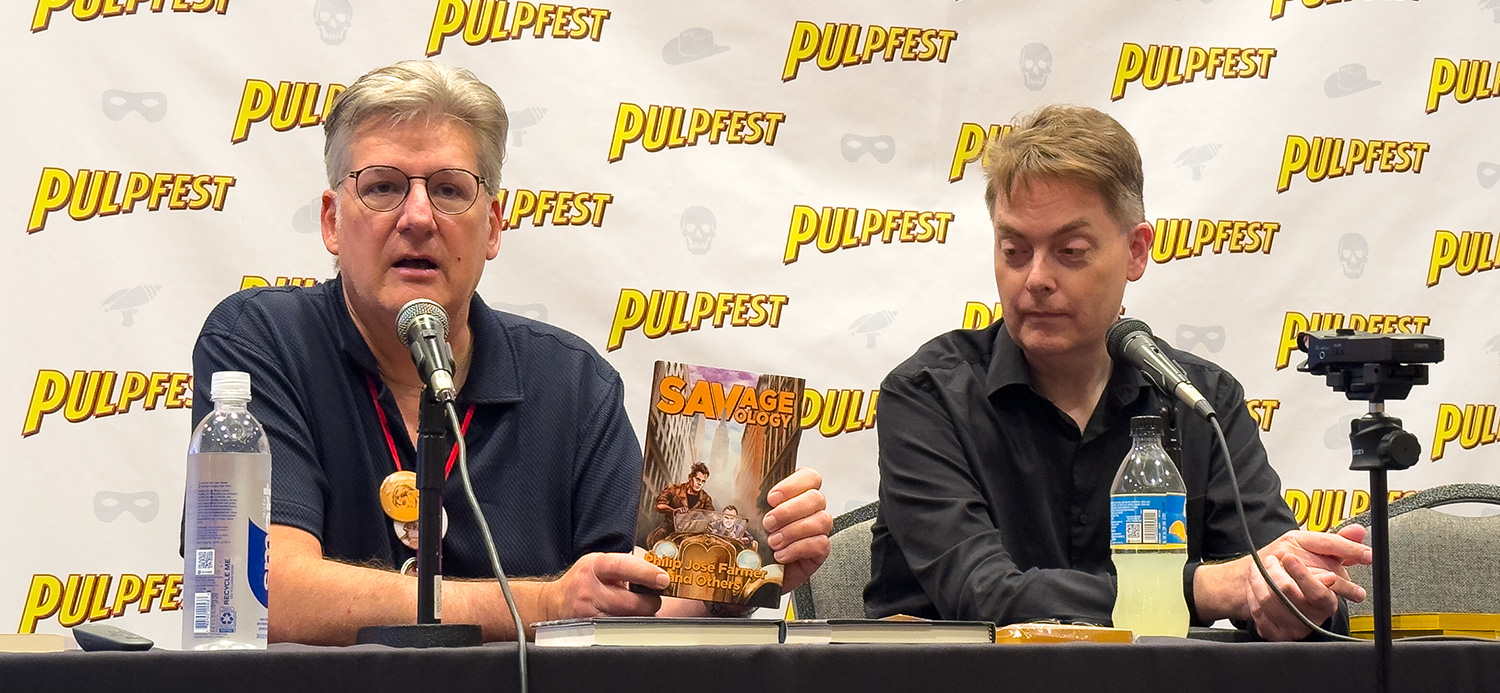
Christopher Paul Carey, vice president of publishing at Edgar Rice Burroughs Inc., and author Win Scott Eckert explore Tarzan the time traveler from Philip José Farmer’s novel Time’s Last Gift and examine Farmer’s writings and speculations concerning Doc Savage, the Man of Bronze. This presentation was part of FarmerCon, held in conjunction with PulpFest 2025. This Pulp Tales was recorded in Pittsburgh on Friday, Aug. 8.
Click to expand the transcript.
Pulp Tales Announcer: Welcome to Pulp Tales, fascinating stories of the pulp magazines and the creative minds that brought them to life. The fictioneers, the artists, the editors, and others. Brought to you by ThePulp.Net. Learn more about the pulp magazines through articles, blogs, bibliographies, links, over 100 episodes of this podcast, and much more at ThePulp.Net. Your link to the pulp magazines for almost 30 years online at thepulp.net.
Win Scott Eckert: I consulted the date that Dave Stevens had dated the Rocketeer to April 1938. There was a two-month gap there. So Dave Stevens had Doc Savage, His Apocalyptic Life. He knew what he was doing. He consulted it.
And that was proven later when we found among the thousands of books of Phil’s estate, the copy of the Rocketeer graphic novel and inscribed to him is "To Philip José Farmer, with great respect, Dave Stevens." The point isn’t just, "Oh, it’s so cool that Doc Savage got included in the Rocketeer." That’s cool.
That’s definitely cool. It’s also cool that Dave Stevens was a Doc Savage fan and a Philip José Farmer fan and and acknowledged Phil’s contribution to the mythology.
Pulp Tales Announcer: In this episode of Pulp Tales, Christopher Paul Carey, Vice President of Publishing at Edgar Rice Burroughs, Inc., and author Win Scott Eckert, explore Tarzan the Time Traveler from Philip José Farmer’s novel Time’s Last Gift and examine Farmer’s writings and speculations concerning Doc Savage, the Man of Bronze. This presentation was part of FarmerCon, held in conjunction with PulpFest 2025. This Pulp Tales was recorded in Pittsburgh on Friday, Aug. 8, 2025.
Win begins.
Win Scott Eckert: Thank you everyone for, this is an amazing full house. So our panel for FarmerCon this year is called Tarzan the Time Traveler and Discourses on Doc, ’cause we’ve got some Tarzan-themed discussion items and some Doc Savage themed discussion items, which really fits right in completely with Philip José Farmer and FarmerCon because those were his two absolute favorite pulp heroes. And that’s kind of really the theme of what we want to talk about tonight is that Phil was a fan, just like me, just like Chris, just like everyone sitting in the audience.
He was a fan’s fan. He was published in the fanzines, both in the Burroughs fanzines and in Doc Savage fanzines. And that’s where we draw some of these essays from in the book that Greg just won, Savageology.
So Savageology, as Mike mentioned, is our new release, one of our new releases for this year. And it is, it brings together all of Philip José Farmer’s short writings on Doc Savage. So not including his authorized novel, Escape from Loki, and not including his biography, Doc Savage, His Apocalyptic Life.
But essays and associated short fiction, we brought it all together here. And then in addition we’ve included a few other pieces by some of us and Phil’s followers and fans, kind of extrapolating on some of the hints that he may have dropped in some of his writing and kind of continuing his mythological speculations. Did you want anything to that before I kind of start going over the contents?
Okay, cool. So, Meteor House does signed limited editions as well as trade paperbacks. And just to let you know, we tried to put something cool or clever on the endpapers of all of our books.
So this actually is a blow-up of the family tree that Phil created for Doc Savage and all the other associated heroes. It’s not meant to be read or referenced, it’s more of just sort of an artistic thing that we dropped in. I’m going to go over basically the contents of this, you know, not in excruciating detail, but kind of give you a high-level overview of some of the writings here and why we picked them.
And again, this book is about fandom, both Phil’s fandom and our fandom of Doc Savage and Phil. So we have the first piece, "Philip José Farmer: An Anaglyphic Look," which is by Chuck Welch, who most of you probably know from his association with the Bronze Gazette, as well as the Flea Run fan group. And Chuck, unfortunately, could not be here, but I’m aware that he came to fandom actually by reading "Philip José Farmer" first.
And Phil Farmer got Chuck Welch into Doc, and then Chuck has become one of the preeminent Doc Savage fans and scholars. Both editions of the book are illustrated with scans. The hardcover has color scans.
The softcover will have black and white scans. And we actually are including, you know, with Chuck’s permission, correspondence that he sent to Phil Farmer when he was a young man and Phil’s replies. And it’s just kind of to demonstrate, you know, a young fan’s journey and how Phil actually contributed to the next generation of Doc Savage fans beyond the pulps.
Something that I have spoken about, And the next piece is called Book of Magic, which is by me. And it was originally used as the introduction for our Meteor House edition of Doc Savage’s Apocalyptic Life, in which we kind of reconciled all the different editions and brought them together into one deluxe edition. One thing that really struck me, and it was kind of how I came to some of the fandom, I received Doc Savage: Apocalyptic Life when I was eight.
And, you know, was captivated both by Doc Savage, ’cause I also got like 20 Bantams and read them all in the car on the drive across the country and read Apocalyptic Life all in one, you know, couple of weeks sitting, I mean, I was eight. I immersed myself in it and it made, it imprinted on my brain. And I started thinking about, you know, well, Doc exists in this universe, because on the back of the book, the Bantam edition, it says Fu Manchu and James Bond and Travis McGee and Sherlock Holmes.
How is Doc Savage related to these characters? And I thought that was really cool. I sat on that for a couple of years.
And then I was reading a lot of comic books also, as one does. And this was my migration from superhero comics to pulp-related comics. This is Dave Stevens, The Rocketeer.
And I actually was right there at the beginning. I got the backup chapter one in the back of one of the Pacific Presents issues, and my mind was blown. I’m like, what is this?
This is so cool, 1930s, you know, Rocket Pack and stuff like this. Well, a couple chapters later, if you were aware, unnamed but very obvious, Monk and Ham show up, and then a chapter after that, unnamed Doc Savage, you know, appears. And they’re background players. The Rocketeer is the main character.
I consulted Philip José Farmer’s chronology of the Doc Savage books in the back of the Apocalyptic Life, and I consulted the date that Dave Stevens had dated the Rocketeer to, April 1938. There was a two-month gap there. So Dave Stevens had Doc Savage, his Apocalyptic Life.
He knew what he was doing. He consulted it. And that was proven later when we found among the thousands of books of Phil’s estate, the copy of the Rocketeer graphic novel.
This is a scan of Phil’s actual copy from his library. And inscribed to him is, to Philip José Farmer with great respect, great respect, Dave Stevens. So the point isn’t just, oh, it’s so cool that Doc Savage got included in the Rocketeer.
That’s cool, that’s definitely cool. It’s also cool that Dave Stevens was a Doc Savage fan and a Philip José Farmer fan and acknowledged Phil’s contribution to the mythology. And that’s kind of, if there’s one story, and I’m not gonna tell the story about every single chapter in this book, right?
But if there’s one story that kind of just encapsulates what the theme of this book is, that’s what it is. Shared fandom, shared experiences. And yeah, really cool.
And Dave Stevens, if you’ve seen The Rocketeer and his other work, is just stunning. He’s gone far too soon. I’m not going to cover everything.
We do have a scanned letter in here from George Pal. who was the director of Doc Savage, the Man of Bronze in 1975. Say what you will about the movie.
They had high hopes for it 50 years ago. This is a letter from George Pal to Phil reproduced in here as part of the press packet for that movie that they sent to Phil. And some other scans, really cool stuff that is really historically interesting and important.
One really cool thing that is included, and I’m going to call out Glenn Held because I remember him asking probably about six months ago on the Flea Run about this screen treatment that Philip José Farmer did for the second and eventually unmade Doc Savage movie, which originally would have been called Doc Savage, Arch Enemy of Evil. The screen treatment for this edition has been retitled Doc Savage and the Cult of the Blue God. I think it’s based on Meteor Menace, loosely based on Meteor Menace.
And it’s a screen treatment, so it’s not a full screenplay, but it’s kind of like one step back from a screenplay. And he wrote this full screen treatment where he was asked to write it. and with the permission from Condé Nast and a series of emails that took probably six to nine months to accomplish, and thank you Mike for taking the lead on that, we got permission.
Phil holds the copyright to this story, but Condé Nast holds the trademark to Doc Savage, and so we came to an agreement with them to reprint. This has not been reprinted in 19 years. It was reprinted 19 years ago in a volume called "Pearls from Peoria" and also in Subterranean Press Magazine.
So hard to find, pretty cool piece that I’m really happy to include.
Christopher Paul Carey: Was it "Murder Melody," not "Meteor Menace?"
Win Scott Eckert: You’re probably right, sorry. Okay, that’s my memory. No, thanks. I haven’t read it in a while.
Yeah, yeah, that’s why you’re here. We include a couple of other pieces, like one called Savage Shadow that Phil wrote where, let me get this straight. Maxwell Grant, who is really the pen name of the writer of most of the shadows, not all of them, Maxwell Grant is writing a story about Kenneth Robeson’s adventures, I think.
So Phil didn’t come at Doc Savage just like from one narrow perspective or one way. He’s like, "Oh, this would be cool, this angle. Is it consistent with this other angle I took five years ago?"
No, who cares, right? He would do it. And that’s why he did Doc Caliban, who is not Doc Savage.
It was alternate versions, there are alternate takes on the characters and the mythology. And I think what I just wanna wrap up with in terms of the contents, And we’re happy to talk more about the contents at the Meteor House table. And really, you know, you can take a look at the book and flip through it.
One super historically important piece that we’ve included in here. In 1989 at Pulpcon, Will Murray conducted a lengthy interview with Phil and recorded it. And it later appeared about half a year later, maybe almost a year later, in the June and July 1990 issues of Starlog.
It’s really one of the best interviews with Phil in existence. Yes, agreed. And even the Starlog, in and of itself, which is a small piece of the interview, is excellent.
Agreed. Now, that was approximately 8,000 words, I believe, as published in the two parts. We had the tapes kindly provided, pardon me, by Will.
And the undying efforts of our publisher, Michael Croteau, who sat for two months transcribing it and includes an additional 10,000 words of interview beyond the original 8,000. So we’ve got 18,000 words now of interview, and never before, you know, the 10,000 words are never before published, right? And it’s fascinating.
It’s a fascinating conversation between two very accomplished men, You know, sometimes debating things and not always agreeing, but really insightful questions and really insightful answers and a really important historical document. And I just can’t thank Mike enough for agreeing to do all that legwork and include it in the book. And Will.
And Will for conducting the interview in the first place. Exactly. Providing the tapes.
Yeah, and providing the tapes. All of that. So, you know, with that said, I think I’ll, you know, kind of cease my ramblings.
There’s some other contributors, and if you guys are familiar with Doc Talos from online, who does a slightly different take on kind of the Doc Savage. He’s written, you know, a piece in here, a nonfiction piece. So please drop by the table.
We’re happy to show you the book. And again, just in case, you know, I think I forgot to show you the actual book under the jacket itself. But this is, you know, leatherette bound and bronze stamped foil here.
So we try to put together a good package. This book is sort of a companion to a book that we put out four years ago called The Man Who Met Tarzan, which is similar in theme, right? It’s Phil’s shorter writings on Tarzan essays, and again, just a great insight into Phil as the fan and pulp expert and scholar.
So with that, I think, did I cover everything with that? Did I forget anything that you think I should have mentioned? For the book?
For this one. Yeah, for this particular one. Okay, great, thanks.
So our second release, Meteor House’s other release for this year, is the first ever hardcover edition, except for an Italian hardcover, the first ever English hardcover edition, believe it or not, of one of his preeminent novels, Time’s Last Gift. Time’s Last Gift is a science fiction novel, a time travel novel, about four time travelers from the future, our future, still our future, maybe another, what, 20, no, wait a minute, 50, 65 years, right? 65 more years, they will be going back in time, 65 years from now, right?
So 2070, four time travelers go back in time to 10,000 BC, right? 12,000 BC. 12,000 BC.
And they end up in prehistoric Europe. And it’s really about the challenges of four people who are kind of back in time for a two-year period before they are, you know, going to be sucked back into the future. And the relationships between those characters, the adventures they have, and also why, one, the leader of the expedition, why he is so strangely at home among the woolly mammoths and why he’s so, you know, sort of pleased to be in that environment and maybe not really that, maybe not even really that interested in going back to the future.
You know, I don’t really want to say more, too much more than that. I hate to spoil the ending. A lot of you may have already read it and already know, you know, how it turns out.
But it’s actually, it might just be hands down my favorite Philip José Farmer novel. And it works very well as a standalone novel. It is a standalone novel.
It was always thought to be a standalone novel. Because Phil was a trickster. He was a prankster.
He actually did hidden series. His series weren’t declared as a series. Like number one, number two, number three.
When you put them all together, they’re like, oh my God, that’s a series. So this book is actually a prologue. But it stands alone.
Because the rest of the saga picks up several thousand years later. It’s a prologue to his Ancient Opar series. These were first published by DAW Books in the mid-70s, Hadon of Ancient Opar and Flight to Opar.
And so they’re in the same continuity. They’re related. And it’s safe to say that perhaps if this time travel expedition had not occurred, that perhaps this civilization of ancient Opar might not have come to be.
Is that fair? I think it’s a certainty. Okay, there you go.
And so we have with us Christopher Paul Carey, who is not only the VP of Publishing at Edgar Rice Burroughs, Inc., not only, but also the preeminent expert on the whole ancient Opar series by Philip José Farmer and the collaborator with Philip José Farmer on the third book. This is the second book. We don’t have the third book sitting here.
The third book, The Song of Kwasin, because Phil left that unfinished and Christopher was allowed by the estate to finish it. And it’s a very highly acclaimed book. And then he’s also written two more novellas set in that world.
Three. three more. Sorry.
Uh, so, you know, with that said, you know, what, what do you love about Time’s Last Gift? You know, both on its own as a novel and also, you know, how it kind of leads in to, to the ancient Opar series.
Christopher Paul Carey: Yeah. Well, it’s hard to do without the spoiler. It’s tough.
I recommend if you read Time’s Last Gift well, Phil actually alludes to it in the chronology of here. There’s a note where he says see my Time’s Last Gift. There’s a mysterious character who appears in the Ancient Opar.
So first of all, the Ancient Opar series was again, going on the theme of Phil being a fan he had read a monograph an unpublished monograph that was going to be published in the Burroughs Bulletin called The Heritage of the Flaming God and it was by Frank Brueckel and John Harwood it never did end up getting published in the Burroughs Bibliophiles but it did later get published by Alan Hansen’s Waziri Press much, much later but Phil read it in manuscript form in fact we have the manuscript that manuscript which is a little bit different than the published article actually
Win Scott Eckert: when you say we you mean Edgar Rice Burroughs no no Mike
Christopher Paul Carey: we have it from Phil’s which royal we are you talking about we have it from Phil’s files Phil’s files the magic filing cabinet as we call it things mysteriously appear
Win Scott Eckert: that’s right after you look at them and you look again a year later
Christopher Paul Carey: yeah exactly but so there was this idea by these fans they wanted to like kind of justify what was Opar what was the motherland civilization because Burroughs called it Atlantis but he didn’t start calling that until the second Opar book until Tarzan and the Jewels of Opar and so they believed that Atlantis that Burroughs was referring to was actually in these two inland seas of prehistoric Africa because it was much wetter environment back then. And so they, Brueckel and Harwood, wrote this giant monograph detailing in a very Farmerian way, honestly, how Opar could have existed and who were these frightful men of Opar, the beast men of Opar, and they concluded that they were Neanderthals or you know and Phil got really smitten with this idea and so he got in contact with them and then approached Hulbert Burroughs and Hulbert Burroughs gave Phil permission to write his own series ancient Opar series so back in the 70s and but there’s a mysterious character in here called Sahhindar, who is the god of time and bronze. He’s recognizable by, he uses a bow, has a hunting knife.
He introduced metallurgy to ancient Opar. He actually founded the Oparian civilization, essentially, and gave them more advanced technology and agriculture and stuff like that. And he’s the gray-eyed archer god.
And you might guess who he is, but it’s, again, a cloaked reference to a major, major character who is very, very dear to Phil’s heart. but it ties in massively with time’s last gift because this mysterious figure the god of time is actually the same character from time’s last gift so what else do we want to talk about that ask me a question So Phil wrote the first two books and left it unfinished. He wanted to write as many as 12 books.
And when I used to be the co-editor of Farmerphile, Mike Croteau was the publisher, Paul Spiteri was originally the other editor, eventually Win replaced me because I got too busy and went to grad school. But while we had permission to go through Phil’s files, we found the outline and partial manuscript to the Song of Kwasin. The third book.
The third book. It was at that time called Kwasin of Opar. Phil didn’t like the title because Kwasin was not from Opar.
So we decided to change it to the Song of Kwasin. And I got permission from Phil to finish that and took a long time. Phil did get to see it, get the manuscript.
He was not doing great health-wise at the time, but Bette Farmer read it out loud to him. And she told me how he just really smiled at hearing it. He was really, really glad to see the major trilogy come to a completion.
He told me how he wanted to end it. He’s like, because the outline kind of petered out at the end, even though it was a substantial outline, and it kind of went off. It’s like, you could do this, or you could do that.
And he’s like, do this. I want you to do this. I wanted to wrap up this cycle.
So I got to have a major epic end to that novel. Yes. And it was an unparalleled gift from Phil that he would be so gracious to let me finish that And later, you know, Win also had that experience with The Evil in Pemberley House.
Right.
Win Scott Eckert: Yeah. And I think that’s a key point. Phil and Bette were extremely gracious.
Yeah. And did not put on airs, you know, at all. They were very straightforward, down-to-earth people.
Christopher Paul Carey: Demanded that we got paid the same amount that Phil did.
Win Scott Eckert: Yeah. Very fair-minded. Yeah.
Christopher Paul Carey: Yeah.
Win Scott Eckert: Yeah. Yeah. even though we were, you know, newcomers. We were newcomers.
Christopher Paul Carey: We were very green.
Win Scott Eckert: Yeah, yes.
Christopher Paul Carey: Yeah. But did you mention the uniform covers and stuff like that? I did not.
Yeah, that’s a great point. So Meteor House has been putting out the Ancient Opar series with beautiful Bob Eggleton covers. And, you know, this is another Bob Eggleton cover.
And the only other one that hasn’t been printed yet is Hadon of Ancient Opar, the very first one. Crazily enough, the first one. There was a strange, the rights were assigned to another publisher, and so we weren’t able to get uniform editions.
But now we will. But now we will. Now we will.
So that’s going to be amazing. And Bob’s going to be doing the cover art to it.
Win Scott Eckert: Bob is on board for the cover art for Hadon of Ancient Opar. Do you want me to announce?
Christopher Paul Carey: Yes, please. Yeah. So.
Yeah, please do. The other works that I wrote were Exiles of Kho, which tied in very majorly with the whole Sahhindar character, and Hadon, King of Opar, and then Blood of Ancient Opar, which wrapped up really the storyline of Opar, and it gets Opar to where, basically, it was in the Burroughs novels. Like it leads to close to that.
It sets up the scenario for what Opar will eventually become. Right. And those books are all, are they all, both, is Blood out of print now too?
Okay, they’re all out of print. And so they’re much sought after. I get lots of people asking me, especially Exiles of Kho, the oldest one.
So Meteor House is going to be putting out a collection of them called The Rise and Fall of Ancient Opar ’cause Exiles of Kho was a prequel. It was set before the founding of Opar, before Khokarsa, the Khokarsan civilization, which is this civilization that rose up on those two inland seas that I mentioned. And so that’s the rise is Exiles of Kho and then the fall of Ancient Opar is Hadon, King of Opar and Blood of Ancient Opar which wraps up the Hadon storyline right the hero the hero of
Win Scott Eckert: of a series right so we’ll be doing um probably the rise and fall compilation next not committing to a specific year of release but it’s very high yeah on our production list and then Hadon of Ancient Opar after that. And they will all have the uniform logo, trade dress, size, so the size of the hardcovers and the paperbacks will all be uniform on your shelf with uniform Bob Eggleton covers. So finally, one complete uniform saga.
Christopher Paul Carey: Yeah, uniform fonts. Exactly,
Win Scott Eckert: exactly. So, yep.
Christopher Paul Carey: And if I can wrap up the Victory Harben novel I’m writing right now by the end of the year I’m hoping that I’ll be able to write a bonus story that’ll go in there. Did you hear that Mike? A new uh, a Carso story. So all right. But we’ll see.
Win Scott Eckert: Yeah, we’ll see. I really want to. Yeah.
And we want you to. Yeah. Yeah, we want, I mean that would be a great, you know, a great piece to include one, one more short story to kind of. For several years
Christopher Paul Carey: I was obsessed with ancient Opar. Yes. And that’s all.
I lived and breathed it. And I knew every single detail. Yes.
Some of it’s filtered out of my mind. I need to go back and reread and get back to that state before I write anything else. I’m going to have to read everything.
Win Scott Eckert: Fair. Again.
Christopher Paul Carey: Fair.
Win Scott Eckert: But, yeah. Good. Thank you.
I just also wanted to mention, actually, because I neglected to mention that, and I apologize. But Chris also has a major piece in the Savageology book. I’m coming back to that, it’s called The Green Eyes Have It or Are They Blue?
And it really digs in to the hidden mythology and some of the hidden clues in Farmers Authorized Doc Savage novel Escape from Loki. And without giving away, Chris does a magnificent job at identifying clues and things that Phil dropped in the novel and going, well, why? Why were they playing bridge specifically here?
or why was this, I mean, what drove that detail? And he weaves a speculative mythology that kind of lays under Escape from Loki. It’s very, very strong and makes a lot of sense.
His speculations make a ton of sense, both within, you know, Farmer’s Take on Doc as well as the whole Doc Savage super saga of 180 original pulp stories.
Christopher Paul Carey: essentially I wanted to do to fill what Phil had done to uh, Lester Dent and Edgar Ace Burroughs. Uh-huh, deconstruct them a little bit and kind of pick apart. Exactly, so I called it at the time the Farmerian Monomyth because he connected everything, you know.
And, um, I just read when Escape from Loki came out, I was in a big Doc Savage phase of my life at that time and a big farmer, I was rereading all of Farmer’s works at the same time. and I read it the first time and I’m like, there’s something going on behind the scenes in this novel and I just can’t figure it out. So I read it again and then I noticed, I don’t know how much I should reveal, but I noticed this one detail that was very much- Mention the one detail.
So I mentioned, so there’s a countess in it and who’s sort of the femme fatale of the book And, you know, Doc is very taken by her.
Win Scott Eckert: Remember, Doc was only 16. Okay, this is before the unemotional. Yeah.
Christopher Paul Carey: And there was a strange detail about her, which he said that her fingers were extraordinarily long. And if any Doc Savage fan knows that Doc Savage’s nemesis, John Sunlight, he had extremely long fingers. And I’m like, wait a minute.
So the second time I caught that detail when I read it and I’m like, there’s something going on here. And then I proceeded to read Escape from Loki five times in a row. And each time I would pull out more and more.
And then I realized there was a major connection with "Farmer’s The Other Log of Phileas Fogg," which is a book that Meteor House put out just last year, right? The full account? Was it last year?
Last year or two years? Year before. recently when you get into publishing it all starts blurring together but and that was about the strange conspiracy going on behind the scenes of around the world in 80 days an extraterrestrial conspiracy between two factions of aliens or humans who were who were influenced by factions of aliens right and and they communicated by secret codes and things like that and i realized that that they communicated by the game of whist in "The Other Log of Phileas Fogg."
Well, there’s a strange scene that occurs around a card game. There’s characters who play bridge in it. And when the big climax happens, some of these characters are playing bridge.
And there’s mysterious facts about these characters. One of the characters whose name was Murdstone, who Phil later told me was derived from the Charles Dickens character, Murdstone. But, and I realized there, this is the alien conspiracy going on here in here.
And not only that, he, he, at one point he explores this French chateau and Baron de Massard. And he finds this strange white worm kind of on this like altar like thing, squirming around and he realizes that it was a worm unknown to science. And anyone who knows the Sherlock Holmes canon realizes that that’s a Sherlock Holmes reference to one of the unsolved cases of Sherlock Holmes, which Phil wrote a story about.
Right. Called The Problem of the Sore Bridge. Among others.
Among others. Right. Yeah.
And which also had to do with a strange alien thing going on. Yes. And so then I realized that this actually, Escape from Loki is a cloaked science fiction novel, basically.
And my article is all about that. I won’t go into all the details of it, but it’s kind of my masterwork in the area of Farmer, that Farmer Wold Newton scholarly thing. Mythology.
It’s like what put me on the map. Yes. And Phil…
Win Scott Eckert: It was originally in the Bronze Gazette, right?
Christopher Paul Carey: Yeah, yeah. And Phil loved it. Phil loved it.
I wrote an earlier article that I sent him, And yeah, when I met him, he was like, oh, you’re that guy. But he loved it. And he later, like, at one of the public gatherings, complimented me on my writing on his work.
And I was later told that by, I think it was Paul, that he told Paul that I was his favorite writer who wrote about his work, which was like, blew my mind. And justifiably. But I can’t thank Phil enough because he really kind of launched my career as a writer and gave me the confidence really to be a writer.
Win Scott Eckert: Same. Same. Yeah.
We have two to three minutes. We can take questions if there are any questions. Don.
Christopher Paul Carey: I was just curious, you mentioned the Arch Enemy of Evil.
Win Scott Eckert: Yes.
Christopher Paul Carey: not used? Why was that not used?
Win Scott Eckert: Well, I think there were actually several screen treatments, and someone else in the audience may know more historically, and correct me if I’m wrong, but I think there were several screen treatments by others that were also under the umbrella title Doc Savage, Arch Enemy of Evil, and so we just wanted, we retitled it to distinguish from that.
Paul Spiteri: It was retitled in Pearls from Peoria. Yes, yeah. I actually retitled it when I edited that book. Because I felt it was more descriptive of what was actually happening in the story.
Christopher Paul Carey: Good. It’s interesting that there’s a fair degree of camp in that, because Phil criticized the Doc Savage movie heavily because of the camp.
Win Scott Eckert: I’m not sure that Phil knew ahead of time how campy the original movie was going to turn out to be. when he was associating himself with the project. Yeah. Other questions? Yeah.
Christopher Paul Carey: Yeah, I saw a number of years ago, I saw a copy of the screenplay of Artanian View on the internet. I downloaded it. It’s a number of pages.
It’s complete. I never read it. Is it the same thing that Farmer did, or was that another one?
Win Scott Eckert: If it says it’s by Farmer, then… It’s probably not. There’s another one by Morhaim?
Christopher Paul Carey: I’m not sure.
Win Scott Eckert: There’s another one that’s also floating around that is also named the same thing. Doc Savage, Arch Enemy of Evil. Because there were multiple screen treatments, is my understanding. I mean, this stuff does float around Booglake.
Christopher Paul Carey: It’s more like a script than a treatment.
Win Scott Eckert: Okay.
Christopher Paul Carey: Yeah, I know it’s been pulled down, I believe it has. I got it somewhere.
Win Scott Eckert: You got it somewhere, right? We got watches. Any other questions? Any other?
Christopher Paul Carey: I just bought the Kwasin book. Should I read that now or wait until the other Ancient Opar books?
Win Scott Eckert: I would heavily advise waiting to read it. Sorry. I’m sorry.
No, you should go. I’m sorry. Gentlemen, I’m sorry.
Okay.
Christopher Paul Carey: I would read Hadon of Ancient Opar and Flight to Opar first.
Win Scott Eckert: Yeah, definitely. Thank you, everyone. Appreciate it.
Pulp Tales Announcer: You’ve been listening to Pulp Tales, fascinating stories of the pulp magazines and the creative minds that brought them to life. Brought to you by ThePulp.Net. Learn more about The Pulp Magazines through articles, blogs, bibliographies, links, over 100 episodes of this podcast, and much more at ThePulp.Net.
Your link to The Pulp Magazines for almost 30 years. Online at thepulp.net. Subscribe to Pulp Tales on your favorite podcast platform or listen to us on the web at ThePulp.Net.
If you enjoy our content, please like us or leave us a review. And tell your fellow Pulp fans about Pulp Tales. Thank you for listening, and keep reading the Pulps.
Pulp Tales is copyright 2025 by William P. Lampkin.
This transcript was generated automatically, so it may include typos and other errors.


