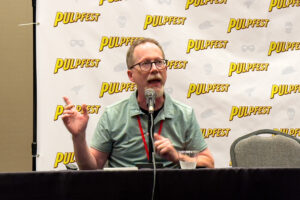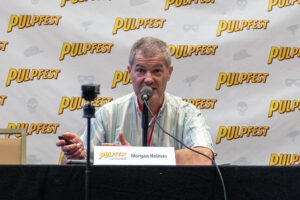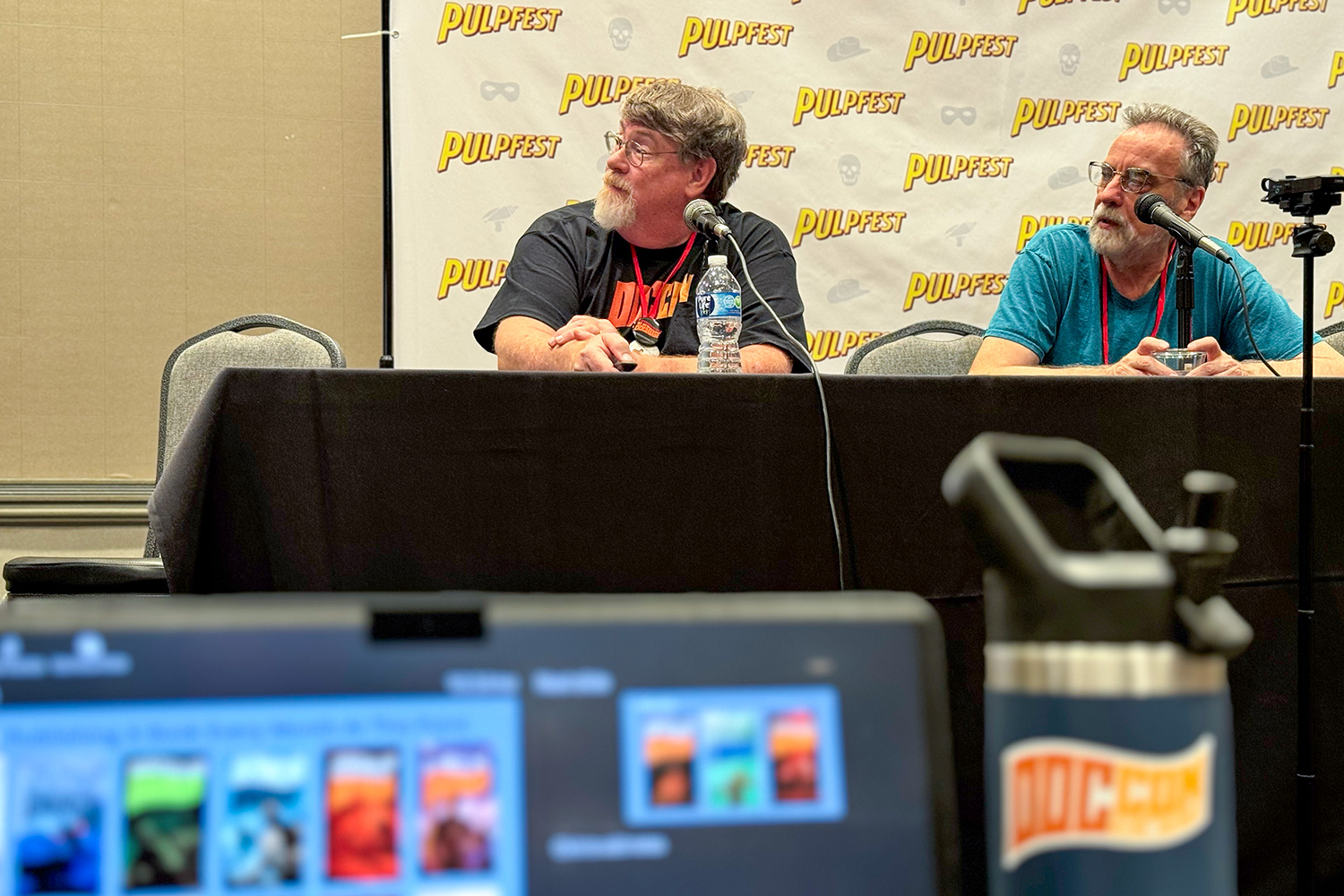
Artist and filmmaker Ron Hill and author and pulp historian Will Murray examine the Bantam Books line of Doc Savage paperbacks, which began in 1964 and continued until 1990. This presentation was part of Doc Con, held in conjunction with PulpFest 2025. This Pulp Tales was recorded in Pittsburgh on Friday, Aug. 8.
Click to expand the transcript.
Pulp Tales Announcer: Welcome to Pulp Tales, fascinating stories of the pulp magazines and the creative minds that brought them to life. The fictioneers, the artists, the editors, and others. Brought to you by ThePulp.Net.
Learn more about the pulp magazines through articles, blogs, bibliographies, links, over 100 episodes of this podcast, and much more at ThePulp.Net. Your link to the pulp magazines for almost 30 years. Online at thepulp.net.
Will Murray: Incidentally, the brand of the werewolf was the top-selling Doc Savage paperback because of the werewolf. And of course, this was 65 when the baby boomers were watching the Universal monster movies on TV and buying famous monsters of Filmland, etc. So tons of people bought that book in the hope to see Doc Savage fighting a werewolf. And as you know, no such scene exists.
in the books. And that’s a cover that’s a lot like the James Bama Aurora model of the Wolfman that was coming out at that time. So there’s a confluence of monsters and heroes at that time.
Pulp Tales Announcer: In this episode of Pulp Tales, artist and filmmaker, Ron Hill and author and pulp historian Will Murray examine the Bantam Books Doc Savage paperback line, which began in 1964 and continued until 1990. This presentation was part of DocCon, held in conjunction with PulpFest 2025. This Pulp Tales was recorded in Pittsburgh on Friday, August 8th. Ron begins.
Ron Hill: Okay, well, thank you, everybody. And yes, I was really excited to be asked to share the stage with Will. We are going to talk about the history of the Bantam revival, which many people certainly believe was the first time a pulp property, a hero pulp, was taken to paperbacks and numbered, and we will talk about other ramifications of that as well. I’m an artist, I was totally blown away by the Bantam covers, the stories obviously as well, but the covers were amazing to me, so we are going to have a real smorgasbord of cover pouring here tonight. So, with no further ado, do you have anything you wanna say before we start?
Will Murray: No, I think we can, I know what we’re gonna show,
Ron Hill: so I think I’m just gonna wingman this little adventure. Well, more than wingman, you’ve got the behind the scenes stories. Navigate, I’ll be the best. Okay. In 1964, Bantam made history in October, probably actually September because they always predated the books, by launching three books at once of this guy named Doc Savage.
Will Murray: Now, this came about in a backwards kind of way. In 1963 or so, a few years after Condé Nast acquired the Street & Smith properties, which were just moribund at that time, and had been for a number of years, a businessman whose name I’m blanking on, Arthur something, approached Condé Nast. He was a fan of Frank Merriwell, the dying novel Smith hero of the generation or so before Doc Savage, and he thought Frank Merriwell could be revived in paperback.
And he was given permission by Condé Nast to shop it around. Nobody wanted Frank Meriwell. But, and when that fizzled, there was the question came of what else does in the Streetsmith properties, you know, would work?
And this was around the same time that Lyle Kenyon-Engel, a packager, started packaging modern shadow novels with Walter Gibson writing "The Return of the Shadow" and Dennis Lins writing some Man From U.N.C.L.E. and James Bond style shadow novels. So they brought Doc Savage to Bantam Books and fortuitously one of the editors, Mark Jaffe, who was high up, I think he was more than an editor at that time, had worked at Street and Smith in the pulp days and was a pulp guy in terms of his editorial background.
So he knew who Doc was. And he read a few and he thought, you know, I think this could go. And they did a very smart thing.
And I don’t know where he got the idea from, but they released three books simultaneously. And the reason you do that is you have more self-impact than one book. One book sits there and you have, it might be a great title, whatever, but three books suggest something, you know, it covers the racks in a different way.
This was a technique used by Gross and Dunlap when they released the first three Hardy Boys, the first three Nancy Drews back in the 20s and 30s. So it was a time-tested approach. Put out three so that readers will notice this new series and see what happens. Well, they sold.
So six months later, they released three more. Let’s see if we’re going to catch lightning in a bottle again. Now you’ll notice these three and one of the other ones aren’t by James Bama.
They’re different artists. When Bama got the contract or whatever, the assignment to do Doc Savage, he was just getting married. He went on his honeymoon.
So he didn’t do four Doc Savages, or maybe just five. So Doug Rose said Mort Kunstler, and we’re not sure who that guy for the Polar Treasure is. There have been different theories.
Audience 1: What’s that? The two theories that I’ve heard most often is Lou Feck or James Avadi.
Will Murray: Okay. Avadi, I think, is the one that’s most likely. Now, what’s interesting is on the land of terror cover, that’s supposed to be, I think, Don Rosa, but the painting has Lou Feck on the back.
Okay? So that could be the confusion of filing, but who knows? So there’s that confusion.
Ron Hill: I look at this and I see Doug Rosa, because I’ve read where Doug Rosa used toy soldiers as models. And so if anyone in the audience remembers the little plastic toy soldiers, you can imagine the base under this Lost Oasis guy. And the same thing with this guy.
Will Murray: Incidentally, the brand of the werewolf was the top selling Doc Savage paperback, either of all time or in the context of the early run because of the werewolf. And of course, this was 65 when the baby boomers were watching the Universal monster movies on TV and buying famous sponsors of Filmland, etc. So tons of people bought that book in the hope to see Doc Savage fighting a werewolf. And as you know, no such scene exists in the books.
That’s a cover that’s a lot like the James Bama Aurora model of the Wolfman that was coming out at that time. So there’s a confluence of monsters and heroes at that time. So they did two more.
And of course, Bama’s back with the monsters, which is a tremendous cover. And people have asked, why are the books out of order? Well, except for the first one, which was obviously the first one, they’re out of order because they were cherry-making the best books.
Because if you’re going to run a series and you don’t know how long it’s going to go, you want to not be firing any blanks, which is why we don’t see the third novel, Quest of the Spider, until the early 70s, because it was not considered that good a story. So here we have 1969. This is when I came in.
In January of 69, near the end of the month, Dust of Death was published, and that’s the cover that grabbed me. I had seen dark covers before then, and I had somehow thought this character was kind of like those men’s sweat magazines where the guy in the ripped shirt and the girl with very little clothes fighting Nazis and being tortured. I thought it was that kind of stuff, and I should have known better.
So I bought this Dust of Death and loved it, and within a few weeks, Terror in the Navy’s out. And between that, I bought a bunch of docs that had been already published. I know that Death in Silver was the second one I read.
And I read Mystery Into the Sea, Zara Fear, and Spook Legion. Those were the ones I grabbed first. And so at the point I’m coming in, it’s a monthly release schedule.
And we have some great covers. Some of my favorite covers are from this year. Squeaking Goblin, Hex, World’s Fair Goblin, those are all tremendous covers.
I mean, they’re all excellent, but some are better than others.
Ron Hill: Well, to me, it’s just amazing. They’re just like the Pulps. They’re ramped up to speed, one a month. One a month, yeah. Do you have any idea how many they were publishing?
Will Murray: How many copies? Yeah. You know, I don’t know, because they did go back to press. So no, I may have come across a number at one point that was an approximate, but I really don’t know because I’m sure these books here, most of them went back to press a time or two.
Ron Hill: ’Cause this was the height of it. But by this time they knew they had something.
Will Murray: Oh, absolutely. I think they knew in ’68. But in ’69, the sales must have been so strong, they said, "Let’s ramp this up." I mean, this series kept, This series fueled Bantam Books’ ability to pay large advances to up and coming or major authors. And it was like one of the linchpins, one of the pillars of this company.
Ron Hill: But here they had to pay peanuts.
Will Murray: And they had to pay, they paid peanuts ’cause Condé Nast didn’t think anything of these properties. Condé Nast was into fashion magazines and magazines with advertising. This is small potatoes, they thought. They didn’t think, you know. So the royalty was very modest and as sales skyrocketed, Conde Nast people became concerned that they’d made too cheap a deal and wanted to renegotiate the contract and Banta Books did not want to do that, a contract to contract.
Ron Hill: See now we’re up to Fred Pfeiffer from ’72 to ’75, did 13 covers. This is when I discovered Doc Savage and back to the numbering system. I saw Derek Devil and I thought, 74, I got some catching up to do. I was 13, I had more lawns to mow and make some paperback cash.
Will Murray: And here you see where they start to get into books that were early that they didn’t think were as strong. Quest of the Spider was the third one. The Kingmaker, I think, was around 12 or so.
South Polter is a pretty good book, but they were having problems sometimes getting the magazines because Condé Nast either didn’t have good files or they ceased cooperating with Bantam Books because it was around this time, yeah, around this time, I came into contact with Paul Bonner, Jr., who was the book director at Condé Nast. I met him through Mark Hannerfeld, the DC Comics guy, who was the model for either Cain or Abel in House of Mystery. And Mark was a Doc Savage fan.
And he brought me, I went down to New York City, and he introduced me to Paul Bonner, and I got into the Street and Smith files that was there. That’s when I discovered the card file for In Hell, Madonna, which turned out to be the unpublished Doc Savage novel while nobody knew existed, that eventually I got into print. We’ll get to that, I imagine.
And they, I struck up, I again did do occasional correspondence with Paul Bonner, and sometimes he’d have a question about Doc Savage and I would help him answer it. And so we became friendly on that level. And I don’t know which happened first, but they wanted the Roar Devil, and they couldn’t get a copy.
So I photocopied my pulp and sent it to them. And then I suggested, you know, there’s a couple of really good stories you haven’t printed yet. Well, we don’t have them.
Well, let me send you photocopies of, I think it was "The Red Terrors" and what became "Aust." And somewhere in this, I got in contact with Bantam Books. And the other day was Beverly Suswine who took over the series.
And occasionally they’d have a title they didn’t like. And they’d ask me to suggest an alternate title. And I remember suggesting The Hate Genius instead of Violent Night because they didn’t like that title for some reason.
And for Aust, which they didn’t like, I gave them a number of titles and they, what did they call that? The Magic Island. Well, I called it The Magic Land.
It was a land on an island. So they changed it to Island, I don’t know why. And there was some, in the original pulp, which I copied from them, there was some dropped lines and we didn’t know what they originally read, but I tried to put in something.
And later I found the manuscripts and found I wasn’t that far off and some cases very, very close to it. So I started feeding them books. And I know that this was at a point which sometimes a Condé Nast secretary would have to type up a manuscript from the pulp.
And occasionally, we’d drop a few lines or screw up a word. Like one book, The Feathered Octopus, I know this is minutia, but The Feathered Octopus had, you know, Doc Savage having pale gold eyes. And I remember someone coming to me, that must be a ghostwriter.
It says pale gold, not flake gold. I said, no, that was a Condé Nast secretary typing the wrong word for whatever reason, deliberately or not.
Ron Hill: Okay, so that’s interesting to me. You’re working with Condé Nast on these manuscripts. But also Bantam books. And then you’re the conduit over the connection to Bantam. Did you know Len Leon?
Will Murray: No. Okay. No, I never had any contact with him. I do remember Mark Jaffe writing me a letter once saying, you know, you’re very knowledgeable at Doc Savage.
We have some plans. We’d like to talk to you about some plans of ours. I wrote back short.
I never heard from him again. I should have followed up, but, you know, I figured he’d get to me when he got to me. Or maybe the plans fell through.
Ron Hill: Len Leone is the legendary art director that, as everybody knows, art directed Bama. The stories I’ve heard, he designed the logo, which really was, to me, earth-shattering in that time. things did not look like that back then. It’s amazing. But I always wondered about the selection of the artist.
Will Murray: Well, you know, Fred Pfeiffer. Yeah, Fred Pfeiffer was an odd choice. You know, he died young.
I think he got into drugs or something. And I think they’re looking for someone to do something Bama-esque in terms of the monotone colors. But, you know, people like his work.
I don’t much. I think Kingmaker might have been his best cover. But they underwhelmed me.
Ron Hill: See, they did me at the time as well. You can’t compare to Bama. And I think that’s partly why they may have gone with Fred Pfeiffer as a designer.
If you’re not going to get Bama, why try to fake it? miss. Do something striking.
To me, at least, Doc always looked metallic in Pfeiffer’s covers. So, yes, Fred Pfeiffer. And then, after The Kingmaker, we had to wait almost a year for the next book.
Will Murray: Yeah, the series was either hiatus or canceled. It was canceled at one point, and reader fan mail generated by fanzines and just spontaneous letters brought it back. there was just such a demand.
Ron Hill: And they brought back well no 75 is to me let’s let’s pause for a minute we’re still waiting for the next number 81. They reissue the first one with the movie photos and when I discovered and then I discovered on the newsstands that Phil Farmer book and there’s that amazing logo and there’s, I had to have that one too. And to me, that helped revive it. I always thought maybe the timing had to do with the movie.
Will Murray: I don’t think so.
Ron Hill: No?
Will Murray: Because they had so many books still to be reprinted, there was no sense in holding them off until the movie. You know, there was such a thing as timing, but if you’re always got Doc Savage books out there and they are selling something, I don’t think there’s any reason and go, you know.
Ron Hill: And then there’s what we get, number 81. We get a repeat cover. Yeah. And a Fred Pfeiffer to boot.
Audience 1: Same thing with Evil Cone.
Ron Hill: Yeah. Yep, that’s the Red Snow cover. I always wondered about that, two repeats.
Will Murray: Now, we think, and then this one. We think that’s Pfeiffer’s original cover for The Stone Man, that for whatever reason, when the series went on hiatus, they recycled it for this book, which is why I think the series was cancelled, because they weren’t delaying the next book.
Ron Hill: They were actually going to cancel, so they had the painting done, they had to use it.
Will Murray: They probably modified it a little bit. It looks pretty much the way Pfeiffer would have done it. It’s not a bad cover.
It’s interesting. And so we ended up with this reprint cover, and then they brought in Boris Vallejo, who was an interesting choice. I don’t like his doc, but they were much better covers.
I mean, I don’t dislike his doc. He used himself as a model, so that was a mistake. He should have stuck with Steve Holland.
Everybody else did. And I remember this is when I suggested The Red Terror, because that was a sequel to Mystery Under the Sea, and it had been many years since that book was published. They wanted me to photocopy my Roar Devil, I did that.
And this is when I’m pretty fully involved with Bantam Books and Condé Nast as far as being some kind of assistant to the process of Doc Savage. there’s probably more to this than I’m remembering. But they became aware that, you know, fans are, okay, thank you.
Fans are driving things, and they want more Doc Savages. And the sales don’t matter to the fans, they just want their copies. And this is the Magic Island, which I gave several titles.
And this is the first Bob Larkin. And one of the best he did, his first effort was really strong. I liked that cover.
And he hired Steve Holland. So Steve Holland is back as Doc Savage with the new torn shirt or the same old torn shirt. And I copied that pulp because I thought it was one of my favorites of the entire series.
And that came out, so we’re cooking again. And this is the Red Spider. What happened just before that is I was talking to Beverly Susswan and said we’re getting close to the era where the Doc Savage Digest start, the books are shorter.
And they’re wartime stories. You might wanna start introducing some wartime stories as a counterpoint to the pulpy 30 stories so there’s some variety, and it doesn’t go old World War II or post-war, and maybe readers who aren’t familiar with the characters’ evolution would get turned off. And so I suggested "Violent Night," and they wanted a title change, and I suggested "The Hate Genius," and Larkin did the cover, and that was the last single.
And was that the last single, or was "The Red Spider" the last single? I, no, these aren’t the last single. Go back to the Red Spider.
Ron Hill: The Red Spider is number 95. Okay. And Hate Genius is… Hate Genius is… 94.
Will Murray: 94, right before that. Mystery on Happy Bones. Oh, yeah.
Mystery on Happy Bones is the last one. And that was a… Yeah. Yeah.
So, I don’t remember whose idea it was, because I’d forgotten. It might have been mine, but I don’t swear to it. where I said, they realized the books were getting so short, they couldn’t justify the price.
And they came up with this concept, which I didn’t care for, of the split cover. And the reason behind the split cover is they thought maybe in the future these books could be reprinted as singles and these covers could be used individually. They were thinking far ahead.
Nobody ever thought Doc Savage would be canceled. So they came up with these. And I was advising on all these doubles.
I would send them every few months, here’s the next two or three doubles. And unfortunately, the other fans started suggesting things. I had suggested "The Pharaoh’s Ghost" and "The Man Who Was Scared" as one book because "The Man Who Was Scared" was a sequel to "The Pharaoh’s Ghost."
And someone had suggested a different sequence and the editor went with them instead of me. Now the good thing is "The Man Who Was Scared" would have published the book later so the continuity wasn’t disrupted, But when we did the Sanctum Books edition, I made sure that those two books were one volume. So these are a combination of wartime stories and pretty much all wartime stories here.
And I liked those stories, and I thought it was time to get into them.
Ron Hill: Let me just ask real quick. You said you weren’t a fan of this double setup. Myself, as a reader, as just a fan buying these, I loved it. You got two of them. No, no, that’s fine.
Will Murray: I suggested that, or at least I think I did.
Ron Hill: You didn’t like the design.
Will Murray: I didn’t like the covers, the split covers, because each illustration suffered by being cramped. My thought would have been just one cover illustrating one story for maximum impact. I can see why two for one would increase sales.
hypothetically. But you know, I think the art suffered. I mean the Time Terror looks like a really poor painting.
Well,
Ron Hill: it definitely, I did hear from Bob Larkin a number of years ago, "They didn’t pay him extra," was what he said. Wow. For the two, and that’s why he went to smaller size and he went to acrylics.
Will Murray: Mm-hmm. So, you know, these books came along and they rolled along and sales went up, And I think they also shut down again. They made a shutdown after Mystery Unhappy Bones, I don’t recall.
Ron Hill: I think you’re right. I think that was the last one for a while. It was a while. And then they went back, tell us about these.
Will Murray: They decided, and again, I half remember the conversation about reprinting some of the older ones in doubles, And I thought, well, you know, most of the older ones have been in print multiple times, but they thought it was worth experimenting. I think it’s a counterpoint to the World War II stories. These were longer and pulpier.
And they did those, but I guess they didn’t sell that well. And they used the original covers except for the Fortress of Solitude, where I guess they couldn’t find the original image, and they had Larkin paint one, which is good. We got a bonus cover.
That’s fine.
Ron Hill: They didn’t sell that well. All I can say to that is I didn’t buy them when they first came out because I had them already.
Will Murray: Yeah, exactly. There didn’t seem much point to it when the demand was more unreprinted Dark Savages. And this was the last double.
They had planned another one which was the running skeletons and what was the other one? The All White Elf. The All White Elf.
The All White Elf. Thank you. The covers were painted, they’ve been printed,
Ron Hill: but they didn’t do that book. Because on the inside first page they said coming in, and it was about three months between each of these if I remember correctly. And I was waiting, waiting, waiting, how many out there were waiting. It was more like seven or eight months.
Will Murray: I wish they’d done it because those covers were never on abandoned books. It was a waste. Yes, and there they are.
And they’re good. I like them. Well, I like them both for different reasons.
But why not just print that damn book and move on from there? Because you’ve got the covers and covers sell.
Ron Hill: And I want to just bring everybody’s…we’re up to 1985. This is 21 years they’ve been doing this. I mean for me, I was 13 when we started, when I discovered them. And I’m in my 20s now, in 1985, and still buying these things. Were they, at this point, were they ever totally committed to do every one of them?
Will Murray: You know, I don’t know at what point they were committed to that, but they understood that every time they stopped or paused, there was reaction. And it was so, they were always profitable, it’s just that there were other books they could publish that were more profitable. Now, the omnibus books, I wish I could remember how that came about.
But they decided to go for books because the stories continued to shrink. And they thought, well, I think part of it was, well, the fans won’t shut up about it. They won’t let go.
So let’s accelerate the publication schedule but minimize the presence on the production schedule. So they took the last double and they rejiggered the Phantom City cover that Bama did when he moons ago. And they, you know, I remember picking the Angry Canary and the Spooning Lady because one was a sequel to the other. There was some follow-up. So I wanted those two together.
So I know I was involved with those on that level, I’m pretty sure. Unless those were two doubles that, you know, just never happened. And I remember telling Beverly that, you know, Fans like new covers.
And, you know, I asked, is there a color version of the Bama back cover to the original series? And there wasn’t. It was done in black and white, or tones. I didn’t know that.
So they hired an artist, whose name I forget, to do a version of the background. And it’s not a very good painting. It’s not a very good doc.
But it’s at least a back cover in color. So it was something. So that’s what they did for that one.
and I continued like this one these were all the first person Doc Savages and this is the advantage of having someone like me do this which is let’s do all the first person stories in one volume, it’s a nice cover and fans liked it and the books continued to sell on whatever level they sold so we kept on rolling here is all William Bogart stories you know two earlier pulpy ones and two later digest ones and I try to balance them out in terms of the subject matter locales and things like that I was feeling unhappy with these covers because as good as Larkin was they became like calendar images they didn’t tell a story you know and I remember saying I think I said it that you know you should just pick one story and illustrate it just like in the doubles but for whatever reason they wanted a generic cover and generic background and just change the backgrounds change the colors and you know I mean this isn’t telling a story this isn’t making you necessarily want to buy a book if you haven’t read Doc Savage because you don’t know what this guy’s about. You know he’s an adventurer, but you don’t get a sense of what he faces and how he faces it the way you do with the Bantam covers. You need a villain or an opposing force of danger.
This is Doc Savage getting a tan.
Ron Hill: As if he needs one. I never thought of that. So these are the Doc Savage pinups.
Will Murray: Yeah, look, they’re like calendar. You know, you could make a Doc Savage calendar out of these if you had enough of them, but they don’t tell a story. But some of them are excellent paintings.
And this is the last one. And this was good because at least it suggests up from our center. But it’s still, you know, Doc Savage, you know, posing against something weather-related.
And I deliberately saved the last three pulp issues for this and put in the first doc, first digest doc, and then a random doc for a kind of a mix. And it was unlucky or lucky 13. And I did it afterward because by the time this book came out, they had approached me to do new Doc Savages.
I’d already submitted "Python Isle" in 1980. And that’s when they started the digest, so I did "Frightened Fish" and saying, "Well, you could do my book as a digest." Because they said, "Well, we don’t want to do a single book, we’re doing digests." But they liked the book and they kept it, the manuscript.
Ron Hill: So yeah, I think that’s important. We kind of glossed over that. Tell us about… Well, no, let’s go through this one. This was the first brand new Doc Savage.
Will Murray: First published. Yes. But I had beaten Phil by 11 years at that point.
But that’s neither here nor there. The point is I had already pitched this stuff and started the ball rolling. Unfortunately for Phil, it was the early days of personal computers.
And he wrote this book on a personal computer. And he lost a good chunk of it electronically and had to start over under a tight deadline. I think the book was originally going to come out a few months before it did.
And I think the book may have suffered because he lost a big hunk of the draft. I can’t remember what he told me, but it was a very large, maybe more than half of the book evaporated for whatever reason. Wow, what a nightmare, huh?
And they reached out to me in 1990 to say that, you know, the last omnibus was coming out. we want you to write an afterword, and we want you to write more Doc Savages, but Philip Jose Farmer will be doing one, and his will be first, and he said,
Will Murry: fine.
Will Murray: And so "Python Isle," which they had, I dusted off, I might have edited a little bit. And I remember being involved in the art direction because they asked me for cover ideas, and I suggested a few. And they brought in Joe DeVito, who I’d never heard of.
I know Jim Steranko wanted to do these covers ’cause he asked me about the possibility, but they’d already assigned it to Joe, and I didn’t have the cloud. I would love Steranko covers, but I didn’t have any contact with the art director. What was interesting is that cover painting went on sale at a Windy City convention that same year, and Doug Ellis was there, and he said, "Your Python art painting is there."
"Well, how much is it?" "Well, it’s this many thousand." can you buy it for me?
So, you know, he bought it, and that put me in touch with Joe DeVito. And Joe started talking to me about these covers, and he was a big Panama fan. So, somehow, miraculously, and I think because Bantam Books were doing these books because there was a demand, but they weren’t prestige books, and they weren’t things they really wanted to do.
There was no great publicity or anything. We promoted the hell out of The Red Spider. They said it never sold better than, you know, any other doc up to that point.
So the art director told Joe, "Well, you’re in touch with this guy who’s writing the books. You guys seem to know what you talk about. Why don’t you guys work out the covers?" So I started being the art director and one of the things that happened, and I don’t remember how involved I was in that, but because I’m blanking on it right now, it’s a long time, but there was a decision to do a new back cover and I suspect that I may have wanted that Joe would do a very different version and I wanted Pat in there and I thought we got a very good image that wasn’t a rip off of the Bama, you know, back covers.
And Joe could probably remember better but he’s not here but I thought this worked out real well. The guy who was the model for Monk in this painting, the back cover, Joe’s back cover, was the model for Doc in Philip O. Zay Farmer’s front cover. His name was James Small, if I’m not mistaken.
And White Eyes was the first cover I worked on with Joe. He shot a bunch of Steve Holland poses and I suggested the towering figure in the background, all white. He thought that was cool.
And it didn’t come out too well in the Bantam, but when we reprinted it a few years later as a Wild Adventures, it was a much stronger looking cover. And the one where Joe and I were talking about doing things differently, breaking the mold. And for the Frightened Fish, which was my second doc, but we delayed it for the third because it was shorter than the other books, let’s put doc in a bathing suit, no ripped shirt.
And that was the last time Steve Holland posed as Doc Savage. And that shark in the background is the same shark from the Museum of Natural History in New York that was used for the model for the famous Jaws painting.
Ron Hill: And this also is when you started, like with the Wild Adventures, writing stories in certain eras. White Eyes is more of the classic earlier ones, the bigger ones, and this one’s a war story.
Will Murray: Yeah, well I was going with the debt material I had and whatever that time frame was, that’s where I went with. And we wanted to put Pat Savage on the cover. Bama said they would never let her put her on the covers.
And I don’t think there were any females on the Bama covers at all. And we wanted to put Pat there. We found a model and we got Pat on that cover.
And James Small I think is back here in the Jade Ogre cover as the model and I think he posed here with maybe a sort of Steve Holland head. And they’re Small as Monk there and the same Pat, girl who was played Pat Savage and different people posing as different characters. And these were the last two we did at the original Phantom Run.
Sales were good and in fact my first doc and Phil’s doc went back to press so they had to be pretty good. But what was happening in those days is corporations, mega corporations were taking over paperback houses and trying to demand higher and higher profits. So what used to be evergreen books, solid sellers, that would maybe never make a million dollars but always comfortably make a profit, were being phased out.
This wasn’t just Doc Savage, but at the same time, the same year, The Destroyer, which I was ghostwriting, was dropped by a new American library, Signet, and had to find a new publisher. And even though those were profitable, it was like, no, we don’t want to do these kind of books anymore. And we’re now into hot books that are, you know, read by more adults or whatever it was.
So it was all like an increase. That’s when the Edgar Rice Burroughs books stopped appearing in paperback and a lot of science fiction stopped appearing and the pulp stuff stopped appearing. All that stuff was always profitable.
But new ownership came in and there was a new edict of what kind of books we’re doing.
Ron Hill: 1993, quick fanboy moment here. This was the AOL years. I found your email, I believe, House of Sinanju in the Destroyer books and emailed you and asked, when is the next Doc Savage coming out?
And you know what you replied? You don’t remember, it was a very brief statement. I think Bantam likes printing Indiana Jones books.
They were doing Martin Caden’s books, Indiana Jones and things like that.
Will Murray: Bantam offered me an Indiana Jones, but I was doing two or three docs and four destroyers a year. I just couldn’t find the time. So yeah, the Indiana Jones books were being published at that time, but look where are they now?
Ron Hill: Yeah, that’s right. That’s right. So that brings us to the Bantam revival.
And of course, when that started, soon after, Pyramid was doing The Shadow, Warner did The Avenger. Who was the company that brought out G-8? A couple paperback companies.
Who? We heard G-8. Okay.
So this was the first, the revival. So many of my generation, our generation, got, if this never happened, we probably wouldn’t know anything about Doc Savage. Yeah.
So we have a few minutes. Anyone have any comments, questions?
Will Murry: Yeah, when I was 16 in October of ’64, I was a junior in high school, and they did come out in October because one of my jobs was to monitor the local drug stores, comics and magazines, and get paid for racking them and unwrapping them. And they did come in in October, and I immediately, I didn’t know about it, But when I saw them, I was flabbergasted. And I bought all three at the same time.
And they, I decided to write, in high school, we could write a book report. We didn’t even wanted to as long as it wasn’t pornographic. And I wrote about the First Doc Savage reprint.
And I explained what it was and why it was appearing and all this. And the teacher thought I was utterly crazy. what are you writing about this trash for?
This is old magazines reprinted from the 30s. This isn’t relevant anymore. And the reaction was like 100% negative from every kid in the class, every teacher in the school. And I got a reputation for being like the ultimate nerd.
It was so bad. Yeah, but it was so bad. And I just thought you’d like to know that the…
I did find out, though. I asked a bunch of newsstands in San Jose, California, where I was living, and they all told me that all of the Doc Savage books sold out, all three of the first three, they all sold out at every newsstand. And I could never find any of those again on a newsstand after a few weeks.
Ron Hill: They were gone. And then we had to wait a year until they had the next three in ’65.
Will Murray: Was it a year? Six months.
Ron Hill: Okay, well, it went into 65 then. It was more like six months. Okay.
Interesting comment, yeah. When I was in high school, my English teacher saw me reading Mystery on Happy Bones, and he said, I remember specifically, he said, we’re going to get you reading some real literature. Yep.
Any other questions?
Audience 1: Well, comment and question. I think I ruined my eyesight with the flashlight under the covers at three in the morning reading all those paperback books in the mid 60s and continuing to buy them for like five, six years and reading them under the covers at three in the morning with a flashlight. Since this is a Bantam and we haven’t gone into the Altus, which would be a nice cap, and I’m sure everybody’s waiting for the wonderful Doc Savage movie to be shown.
If we’re gonna focus on Bantam, and you are there as the art half of this, Let’s talk about how they stored the art in the basement of 666 Fifth Avenue. Usually when artists bring in paintings, they’ll put a tissue over it. Somehow those tissues disappeared, fell off, and they were storing them, leading against the wall, front to front, so when they went to get them, they’d have Christmas parties and they’d say, you know, you can have a cover to somebody.
They’d go down and they’d pull a cover. And I think, what’s his name from Graffiti Designs? Bob Chapman?
Chapman, yeah. Right, you know, made his personal mission to try and save and find as many of those as possible and own them, and then did the series of signed prints,
Ron Hill: or unsigned prints. Absolutely, and Bob Larkin has shared many times over the years on social media about going into the leaky basements and trying to rescue things. Scott Cranford’s here, he has the Men Who Smiled No More painting, and before that What are you doing? And Larkin mentioned how he had to repair that painting before anyone else had it. Yes.
Audience 2: For people new to the Doc Savage novels, especially some of the younger people just now discovering it, is there a version of the paperbacks recommended especially?
Will Murray: Well the Sanctum Books reprints, also the earlier Nostalgia Books reprints where they did two and one, and put one cover in the front and both covers in the back. They were, they included the original covers, the original illustrations, as well as afterwards and interludes and intermissions by me, so you could not just get the stories, you get the back stories to the degree we know them. So that’s like for the collector and for someone who wants to do more than read the story, those are probably the ultimate additions.
Audience 1: This also bypasses the getting the text wrong from the typist of cut. Yeah,
Will Murray: although I think they did a little editing that wasn’t consistent, it wasn’t minor stuff.
Audience 1: Right, but I’m just saying, do you wanna have it like
Will Murray: Yeah, yeah, we kept the, some of the early novels ended with a teaser for the next issue and that was cut in bantam, including sometimes they cut off the real ending, a few paragraphs, you know. So we made sure the texts were as pure as possible.
Audience 1: I remember liking one particular book, and it wasn’t by Dent, I forget, it was a writer who did a good number of Savages, Mad Eyes.
Will Murray: Oh yeah, Lawrence Dunneman, yeah, I liked that one too. Yeah,
Audience 1: it was kind of like, I don’t think Dent would have ever gone there, and it was very amusing to, I don’t want to give it away, but it’s a concept that it was after reading like 50 of them, I didn’t read them in their order either. I came across this one, I said, wow, this is what I’ve been waiting for, a take that steps outside.
Will Murray: On The Shadow with Ted Tinsley and then Doc with Lawrence Donovan, they would use the alternate writer to explore some themes or some ideas.
Audience 1: Well, Tinsley was the voodoo master stories.
Will Murray: Yeah, well, no, Tinsley was not the voodoo master. He was the Benedict Stark Prince of Evil stories. But basically, those guys tended to do a little bit of a rougher, more daring, more experimental, more risky kind of story.
You know, like, you know That they’ll be loose. Yeah, yeah, and it was good to have that kind of variety. ’Cause any writer is going to be flexible to a point, but not necessarily always comfortable with exploring a theme that maybe a different writer would be saying, "I’ll explore that theme."
Ron Hill: Okay, well, thank you all for coming. And I know we We’re off against it.
Pulp Tales Announcer: You’ve been listening to Pulp Tales, fascinating stories of the pulp magazines and the creative minds that brought them to life. Brought to you by ThePulp.Net. Learn more about The Pulp Magazines through articles, blogs, bibliographies, links, over 100 episodes of this podcast, and much more at ThePulp.Net.
Your link to The Pulp Magazines for almost 30 years. Online at thepulp.net. Subscribe to Pulp Tales on your favorite podcast platform or listen to us on the web at ThePulp.Net.
If you enjoy our content, please like us or leave us a review. And tell your fellow Pulp fans about Pulp Tales. Thank you for listening, and keep reading the Pulps.
Pulp Tales is copyright 2025 by William P. Lampkin.
This transcript was generated automatically and may contain transcription errors, typos, or other inaccuracies.