

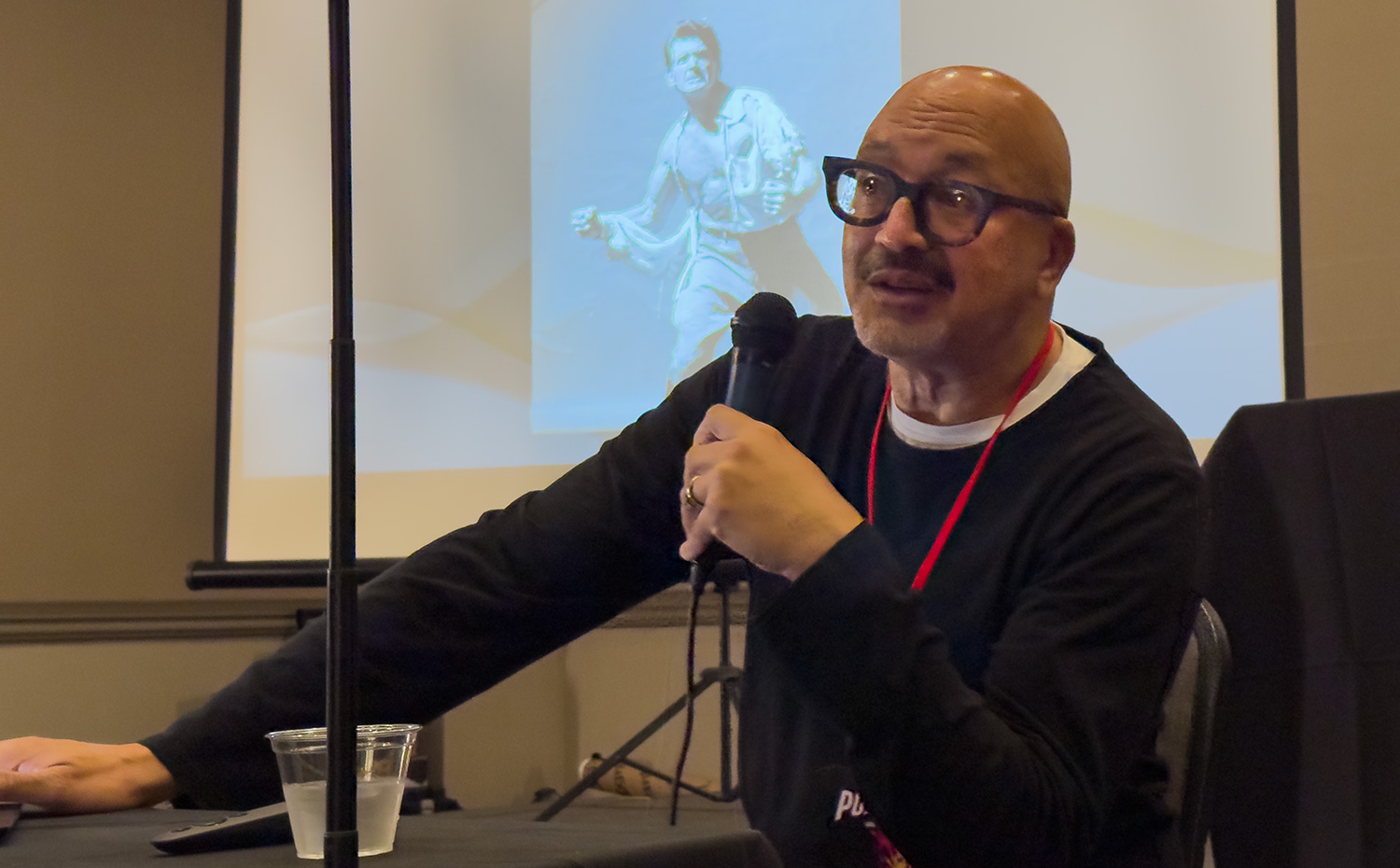
Author Michael Stradford looks at actor and model Steve Holland, who became the face of Doc Savage, the Man of Bronze, for Bantam Books’ paperback line from the 1960s through 1990. This presentation was part of Doc Con, held in conjunction with PulpFest 2025. This Pulp Tales was recorded in Pittsburgh on Saturday, Aug. 9, 2025.
Click to expand the transcript.
Pulp Tales Announcer: Welcome to Pulp Tales, fascinating stories of the pulp magazines and the creative minds that brought them to life. The fictioneers, the artists, the editors, and others. Brought to you by ThePulp.Net.
Learn more about the pulp magazines through articles, blogs, bibliographies, links, over 100 episodes of this podcast, and much more at ThePulp.Net. Your link to the pulp magazines for almost 30 years. Online at thepulp.net.
Michael Stradford: Following the success of Doc Savage, other companies began resurrecting other pulp heroes. Warner paperbacks threw their hat in the ring with Richard Benson, The Avenger. In addition to creating Conan the Barbarian, Robert E. Howard also created the Puritan warrior Solomon Kane, and Bob Larkin cast Steve as Kane.
He ran the gamut when it came to paperback covers. In this, if you look closely, He’s all three Three Musketeers. He’s a secret agent, Nick Carter, Killmaster, and adventurer Richard Blade.
Pulp Tales Announcer: In this episode of Pulp Tales, author Michael Stradford looks at actor and model Steve Holland, who became the face of Doc Savage, the Man of Bronze, for Bantam Books’ paperback line from the 1960s through 1990. This presentation was part of Doc Con, held in conjunction with PulpFest 2025. This Pulp Tales was recorded in Pittsburgh on Saturday, Aug. 9.
Michael Stradford: Hi, thanks for coming. I’m Michael Stradford. I’m author of several books on Steve Holland.
So what I’m going to do is take you through his career, Doc Savage, History of the Torn Shirt. So, Steve Holland has been called the man of a thousand faces. The man of a thousand covers because he’s done thousands of paperback, magazine, comic book covers, in addition to movie posters.
I mean, he’s from the ’60s and ’70s, he was all over the place. So when you think of the name Steve Holland, an image like this might be what comes to mind. And that was James Bama from World’s Fair Goblin, 1969, one of the Bantam paperbacks.
Broad-chested, torn shirt, ready for action, classic Doc Savage. Or maybe you think of this patriotic take on Doc by Bob Larkin. He illustrated more than 30 Doc Savage paperback covers and they were good friends as well.
This was an illustration that he did for, he was commissioned for graffiti designs in 1993. Or maybe this fine piece from the final artist to paint Steve Holland as Doc Savage, Joe DeVito. This is the cover of The Secret of Satan’s Spine.
It was written by Will Murray, who’s also here at the show, under the Doc Savage author alias Kenneth Robeson. Now Will’s Doc Savage books are true to the spirit of Lester Dent’s original stories, but with the depth and complexity to give them a unique place in the Man of Bronze Canon. And his books are really, really good.
They’re a lot of fun. The Sinister Shadow is probably my favorite of the Doc Savage books. But he’s got a lot of his books on sale and he’s definitely worth checking out if you haven’t before.
And this is the original reference photo that was taken by Robert Osanich that was used by Joe DeVito. But this was the first time I ever saw Steve Holland. I was a kid, even though I didn’t know who he was at the time.
I was struck by this illustration. And this is the reference photo that James Bama took for his painting. And the cover was the Giggling Ghost.
When I was a kid in Cleveland, I used to visit this gigantic used bookstore called K’s Books, and they had a sign that said, world’s biggest bookstore, which probably wasn’t true, but it was a huge bookstore. And I used to go in there to buy old comics and books on movies. And one day I was at the register and I saw this Giggling Ghost cover.
And I was just struck by it because it was the first time that I saw something where what I thought was a superhero looked like it could be real. I thought it was a painting. I wasn’t sure because it looked so lifelike.
And then down the Doc Savage rabbit hole I went. Little did I know, back then, this particular reference photo inspired James Bama to create 62 covers of Bantam paperback Doc Savage adventures from 1964 to 1971. This iconic illustration for the first Bantam paperback release, The Man of Bronze, features the initial controversial hairstyle that Bama came up with, until art director Len Leone told them to give it more of a sci-fi look and take the skullcap description literally.
At the time in the early mid-60s sci-fi was on a roll and Leone thought that that would give them an edge in terms of having a cover in the paperback bookstores that would kind of jump off the rags. So this is what they came up with. This has been controversial for over 50 years.
skull-capped look was my introduction to Doc Savage and honestly for me if he had a normal all-American hairstyle like the initial painting I doubt that I would have paid the book much attention. Great painting but it just wouldn’t have stood out. To be sure it’s not for everyone but you know like they say they say the James Bond that you grew up with is generally your favorite James Bond I think maybe the same thing can be applied for Doc Savage. The Doc you grew up with is your favorite.
I don’t know. A little bit about James Bama. He painted dozens of covers for Bantam. He was art director Len Leone’s first choice to illustrate this new iteration of Doc Savage.
Bama had been a Doc fan since he was a kid and he jumped at the opportunity. He and Holland had been friends for years and he brought Steve on board to be the Man of Bronze. This is a quick aside.
Steve Holland posed for literally thousands of western paperbacks and among the most popular are these painted by James Bama, The Adventures of Nevada Jim. Bama called him Doc Savage out west and he painted him with the familiar Doc Savage monochromatic colors and beefed up the rangey but lean Steve Holland to bring the cowboy to life. This is the first reference photo for the first Nevada Jim novel, Big Lobo.
And that’s the photo. And you can see Nevada Jim’s a lot bigger than Steve Holland. And this is another Holland reference photo for Nevada Jim that was taken to James Bama’s New York apartment.
Nevada Jim was originally named Big Jim Rand in the novels by Australian author Leonard F. Meares under the pen name Marshall McCoy and 16 volumes were published and Bama painted the bulk of them. Now Bama in 1971 he gave up New York. He moved to Wyoming, decided to establish a career as a Western fine artist and was very successful at it.
This is a painting he did of Paul Newman as Butch from Butch Cassidy and Sundance Kid. He did this in 1989. Now a little bit about the Torn Shirt.
Bama loved Flash Gordon. He thought the Torn Shirt concept would be a good one for his version of Doc. This panel is from the very first Flash Gordon Sunday Strip from 1934 with the Torn Shirt.
Buster Crabbe was the original cinematic Torn Shirt hero in the first Flash Gordon serial from 1936. The look inspired Doc Savage and many other heroes over the years. The same year that Flash Gordon debuted in August of ’36, western hero Ken Maynard sported the torn shirt look on the cover of "Wow, What a Magazine." And while Action Comics is best known for Superman, the Man of Steel wasn’t on every cover in the early days as issue five illustrates with Pep Morgan sporting the torn shirt style in 1938.
Jumping ahead to 1984, Harrison Ford took up the torn shirt mantle in Indiana Jones and the Temple of Doom. Even Jackie Chan got in on it. He did a variation of the torn shirt for his return to U.S. movie theaters for the poster of Rumble in the Bronx.
And the iconic look wasn’t restricted to men. Heroines also worked the torn shirt angle as Doc Dare does on the cover of this vintage 1996 issue of Penthouse Comics. Holland himself repurposed Doc’s torn shirt in this cover painted by Sol Korby for a Western novel.
They had done the shot of the photo session and Holland felt like something was missing and Korby did too and he wasn’t sure what and Holland said well you know I keep this Doc Savage shirt you want to give that a try. They threw it on and that was the cover. Back to Doc in the torn shirt.
Roger Kastel painted this illustration that would be used for the poster of the 1975 movie. He used Holland’s physique, beefed him up, replaced his head with star Ron Ely. In 2013, Dynamite Entertainment did a revival of Doc in comic book form and brought on noted James Bama fan Alex Ross to do the covers.
Ross used Steve Holland as his version of the Man of Bronze. This first cover is Ross’s homage to both Bama’s take on Doc Savage and Steve Holland himself as the large face in the upper left shows Holland looming in the background. And here are a few other Alex Ross covers all referencing Bama’s monochromatic approach and Holland’s likeness.
I interviewed Alex Ross for my book Steve Holland: World’s greatest illustration art model and he was very enthusiastic about how Bama had impressed him in his career and how he’s influenced his painting style and it’s really obvious there. And this is Alex Ross’s interpretation of three of the greatest pulp heroes of all time for the Dynamite Team Up mini-series Justice Inc. from 2014.
You’ve got the shadow, the Avenger, and of course the Man of Bronze. Unfortunately, like many of Dynamite’s books, the interior rarely lives up to the amazing covers. I’m going back to this painting to show you an homage that Alex Ross did when he painted the cover of Shadow #11.
And I’m proud to say this shadow painting is framed and hanging in my home office. Steve Holland was born Thomas P. Hollands with an S in 1925. He changed his name once he began his career as a model and an actor.
This Merchant Marines idea is courtesy of his daughter Nicole, who was really helpful throughout my whole research process on Steve Holland. Here are a few different headshot composites when he was pounding the streets of New York in the early 50s trying to get his acting career going. You see he had that classic American profile of the era, square-jawed guy.
And I thought this was particularly cool. This is the back of one of his headshot sheets when he would go out to try to get work. See at the top, he’s got his address, his phone number, his height, his weight, some of his credits currently on Broadway in South Pacific.
leads in RKO, This is America, and Ground Force at Work, and he listed some of his TV credits. But it’s all handwritten. Just something about that I think is just really, really kind of cool.
Now, his acting career never really caught fire. He does have the distinction of being television’s first and only live-action Flash Gordon as a star of a 39-episode season filmed largely in West Berlin in 1953, and it aired in the US in 1954. You can find episodes of varying qualities available on YouTube.
This is an advertising sell sheet that was used to entice potential sponsors and advertisers to support the show. And here’s a rare autographed photo of Steve as Flash Gordon inscribed to Sharon. When acting work was slow, Holland found himself working in modeling with other up and coming actors, such as Tippi Hedren, shown here from the birds.
This photo was taken by illustrator William A. Smith, probably used in a story for the Saturday Evening Post, which Smith was a regular contributor to. The photo was courtesy of his daughter, Kim. She met Holland when she was very young.
She said he was so handsome, she couldn’t talk any time she was around him. And he was really friendly, but she just couldn’t talk to him. This portrait was taken by illustrator Robert Maguire from 1974.
This is when he and Holland revisited a new take on the pulp character, the spider. That would reside at the top of the covers of all the four spider paperbacks that were released. This is one of the covers painted by Robert Maguire.
That’s Holland as the hero, it’s the reference photo. That’s Holland as the villain. It wasn’t uncommon for Steve Holland to pose for almost every character that you would see on the cover of a magazine, paperback, or movie.
Following the success of Doc Savage, other companies began resurrecting other pulp heroes. Warner paperbacks threw their hat in the ring with Richard Benson, The Avenger. They were unable to get James Bama for their covers, so they hired Peter Caras, who had studied under Bama and as a young man was also an assistant to Norman Rockwell.
In addition to creating Conan the Barbarian, Robert E. Howard also created the Puritan warrior Solomon Kane and Bob Larkin cast Steve as Kane. He ran the gamut when it came to paperback covers. In this, if you look closely, he’s all three Three Musketeers.
He’s ace secret agent Nick Carter, Killmaster, and adventurer, Richard Blade. And this photo of Richard Blade, of him as Richard Blade, was taken by illustrator Jack Faragasso in his New York apartment. And the woman holding onto him is Shere Hite. Shere Hite wrote the classic report on sexuality called The Hite Report sold millions and millions of copies and did I mention Steve Holland was married three times he and Sherry Hart had a relationship that lasted for many years and he didn’t really have a lot of trouble having company but Frank McCarthy also used Steve Holland on some of the most popular movie posters of the sixties and seventies as well as dozens of paperback back covers.
Accordingly, Steve was his first James Bond when McCarthy got the call to illustrate a new run of Bond covers. This is Dr. No, Casino Royale, from Russia with Love. Now, art directors all over New York told their illustrators try to change the likeness of Steve Holland when they painted him because he was on so many covers.
McCarthy tried, but the Steve Holland look still came through as this painting for Goldfinger shows. Bob Larkin also used his buddy as Conan the Barbarian, as well as all the pirates. Bob Larkin loved using Steve Holland for everything.
He said they would work, it would take 15 minutes to actually get the photos that they needed, and then Steve would take another 20 minutes and come up with different ideas that were generally better than Bob’s. and then they take the final 20 minutes to sit on a stoop and smoke cigarettes and drink coffee. But he loved using them for everything, whether it was the Hulk, townspeople, KISS, or even their antagonists that bore a striking resemblance to Ming. Bob and Steve, they were a potent team.
Now Tom Palmer is best known as one of the greatest comic book inkers of the last 50 years, but he was also a noteworthy painter. He sent me this print where Steve essays every character in the scene. The guy behind him is Killer Creel, the Absorbing Man.
The guy in the foreground with a crowbar is the wrecker. The guy screaming with the mask in the upper right is the original Power Man. The guy getting kicked by Cap is the owner of one of the worst names in comic book history, Paste-Pot Pete.
And of course, in full heroic mode, Steve Holland as Captain America. But that’s an example of what he would get done in less than an hour. Holland also posed regularly for illustrator George Wilson, who did hundreds of memorable gold key covers as Magnus Robot Fighter, The Phantom, Tarzan, Mighty Samson, Barnabas Collins, and many more.
Some comics also had room for Holland, he was a Cisco kid, as well as a sensational new western star, Bob Cope, which featured color photos of Steve as a most flamboyant cowboy for his brief five issue run. He also portrayed Native Americans in the sci-fi adventures of Turok’s Son of Stone, this one painted by George Wilson. Off brand cowboys like Idaho were bligh inside but they had great covers.
He did countless miscellaneous covers. You’ll find them all over the original classics illustrated comic book covers, like this one for Tale of Two Cities. While I was doing my research for my book on Holland’s overall career, I discovered a series that he posed for, Fargo, by John Benteen.
Ron Lesser illustrated the first few books of what would be a 23-volume series. This is Holland is probably the closest Lesser ever got to painting the character as Benteen described him. This is the finish covered with trade dress.
Fargo was based on Lee Marvin’s character Henry Rico Fardan from the classic western The Professionals from 1966. The books were great. They were rip-roaring fun that I enjoyed so much I got the rights to the books and I published a graphic novel that was released earlier this year.
And it was adapted and illustrated by Howard Chaykin. This would not have happened if not for Steve Holland. The second volume, Panama Gold, is going to go into production in early January.
Not only was he busy with magazine and book covers and comic book covers, Steve Holland was also all over movie posters, even for movies that he didn’t appear in. Grand Slam, he’s not in that. Latitude zero, nowhere to be found.
This last image is from a paperback, The Man from Orgy, and it was used for an Italian movie poster, but I couldn’t find the poster, but I just thought it was a great image. Stanley Borack painted it. As I mentioned earlier, Frank McCarthy is one of the great pop culture illustrators of his day, and he really loved to stretch out when he had a chance to paint movie posters.
This is one of his memorable ones of Von Ryan’s Express. His posters were generally action oriented, had colorful explosions, lots of reds and yellows and countless fighting men. They were all hallmarks of McCarthy’s work.
As mentioned previously, Steve Holland was his go-to guy. Here Steve tries to help Frank Sinatra survive in this poster, while another Steve Holland watches and yet another Steve Holland fires his rifle from the top of the train. Classic McCarthy here in the Rod Taylor/Jim Brown star dark of the sun. You see the explosions, the reds, the yellows, and the fighting men.
As Steve Holland holds the buzz saw, poses as Rod Taylor, Jim Brown, and everyone else who isn’t a woman in this illustration. More all of the bodies with the heads replaced by the primary stars. And he was also featured in this fondly held cult favorite, Danger Diabolik.
This is one of my favorites. While Jim Brown is pretty recognizable, if you look just below him, you’ll see at least five different Steve Hollands as part of the Dirty Dozen. In addition to movie posters, he was featured on hundreds of men’s adventure magazines from the ’60s, ’70s, and 80s, not to mention many more interior illustrations and here a sample of a few of the covers.
This beautiful piece from Norm Eastman recently sold on Heritage for $2,600 and I met a guy today who’s got a table and he was actually the purchaser of that piece and it’s a really really nice piece. Steve Holland was also the man modeling for your favorite plastic model kits from Aurora from the Green Beret to the nameless Roman gladiator to Spartacus to even Count Dracula. He was the face of the fire prevention week contest for years.
Overseen by the Frank J. Reilly School of Art in New York City, it provided an opportunity for up-and-coming artists to show their wares via posters and stamps. The poster at the top left was painted by the previously mentioned Tom Palmer, who was a young man, he won a $300 grand prize and was featured in New York City newspapers. I think that this last painting, I’m not exactly, I’m not 100% sure, is a preliminary by Roger Kastel, best known for painting posters for the Jaws and the Empire Strikes Back.
But this is definitely Kastel’s work. He sent me this print himself before he passed. That was the first time he met and worked with Steve, and this was in the early mid-50s, and little girl that Steve is holding as his daughter Nicole.
Liquor ads didn’t escape his grasp either. Bacardi was only one of the many beverages that Holland promoted. This is an ad for Windsor Canadian by Mort Kunstler prior to the trade dress being added.
Here’s a rare look at Steve Holland out of character. A religious handball player, he was known to play several times a week with a cigarette hanging out of his mouth. And that’s a post handball match photo.
He was inspired by the illustrators that he worked with and he began painting himself in his spare time. This painting by Holland was used as a cover of a Nick Carter paperback where he can also be seen as Nick Carter in the trench coat. This is a painting of New York City that Holland did from the window of his Manhattan apartment.
But his favorite subjects were his kids, Nicole and Claude. I created what turned out to be the Steve Holland Library when I wrote the first book. I didn’t realize I had another three to go.
Paperback hero, world’s greatest illustration art model, which is the Kickstarter that will kick off next week. And it’s larger format, better quality paper and print, and an additional 20 page section on Holland’s work with Robert Maguire for the Spider. And Cowboy, which is a collection of a number, it’s not even close to all, but just a collection of a number of paperback covers that he did throughout his career.
So that’s the world of Steve Holland. and I appreciate you guys being here. I didn’t expect to see this many people.
And we’ve got a few minutes for questions. If anybody has any questions about Steve Holland, I’d be happy to answer. Yes, ma’am?
Audience 1: Did he pose for long as the Naked Ape cover?
Michael Stradford: Yeah. Yeah, he did. He wore trunks.
Chris Kalb: We were just talking about this earlier, Michael. You’ve uncovered so many original photographs attached to Doc Savage novels. How many are you currently missing? How many Bama covers have you not found the photos for?
Michael Stradford: So Bama did 62. I’ve got 52. I’m missing 10.
Bama gave me access to what he had, and he connected me with people that had his other photos. But these final ten are just really, really difficult to find. And on a related note, Bob Larkin did more than 30 Doc Savage covers and Bob unfortunately doesn’t have access to his studio where all his stuff is.
So I’ve only got a handful of Bob Larkin photos. But those are some amazing photos. And Steve was in his, I guess he was in his mid-40s then and he looked amazing.
Anybody else?
Audience 2: I know he came back to pose for Joe DeVito’s paintings in the 90s. Was that the only modeling he was doing at that time or was he still working for the other folks?
Michael Stradford: No, he had pretty much retired from modeling and I think he, this was shortly before he moved out west to be with his daughter and son. But Joe DeVito had originally hired a younger guy to pose as Doc Savage, but the guy couldn’t really get to pose his rights so Bama connected DeVito with Holland and he asked Holland, he said, "Would you mind coming out and showing this guy how to do it?" And Steve was 66 at the time.
So he came out and Joe said, "Steve Starr is doing this and I sent the kid home." He said, "You either have it or you don’t." And at 66 he still had it. So in the torn shirt sessions I’ve got a section on that final photo session which is essentially just Steve in a swimming suit for The Frightened Fish but he said there was something about just the way he was able to emote and he immediately knew what to do that the other guy just couldn’t get so that was that and he left New York in 91 moved out west he had a daughter in Northern California and his son was in, I think was in Washington State.
And so he stayed out there, was thinking about coming back to New York. He had a brief illness and then he passed in May of 97. Yes, sir.
Audience 1: After his cleaning, was the torn shirt lost history?
Michael Stradford: Pretty much. But it’s funny, there are like several different stories about the torn shirt because Steve remembers it one way, Bob Larkin remembers it another way, Bama remembers it another way. His daughter Nicole said, you know, Daddy used to blame that shirt on me, and I never had that shirt, you know. So who knows what the real truth is behind the torn shirt. But it’s just interesting to me how that one idea that Bama had from seeing Flash Gordon in 34 has proven to be this kind of iconic for heroic adventure.
Audience 3: Well, it sort of follows because they’re men of action. When you’re out there being active, you’re probably not paying too attention to your clothing. That’s true. Yeah, my shirt is adorable. There, voice of experience.
Michael Stradford: Yeah, so the project itself, I mean, you don’t really do these things to make a lot of money or get rich. Rich’s passion projects. And it was so memorable and so worthwhile for me to meet a number of these illustrators before they passed on.
And they were all really generous with their time and with their archives. I mean, everybody I talked to, if they had any photos, they would send them to me. I’d scan them and send them right back.
And a couple of guys like Peter Caras, we got to be pretty good friends before he passed. Tom Palmer, Roger Kastel, Jack Faragasso is 96 years old. He’s living in upstate New York and he’s still painting and lively and he’s got an online presence.
And you know, it’s just been great to get to know a number of these people and hear about what it was like being in New York back in the ’60s and ’70s as a creative person, as an illustrator. And Steve’s daughter, Nicole, she and I have become good friends over the years even though we’ve never met face to face. We communicate regularly and an unexpected boon for me was we were talking one day she said Mike you know these books have really opened up things for my family because my kids and my grandkids get to experience their grandfather in a way that they never would have otherwise.
So I take a lot of pride in that. And I And I feel like Steve Holland is a slice of Americana. He represents a particular period in American life and how Americans saw themselves or wanted to be seen in a heroic, positive fashion.
And I just feel like people should know his work because you think of the volume of work that this guy did over a 30-year period, it’s unmatched and definitely won’t be matched in the days of AI and Photoshop and all that. But my time’s up. Thank you if you’re interested in the book.
Pulp Tales Announcer: You’ve been listening to Pulp Tales, fascinating stories of the pulp magazines and the creative minds that brought them to life. Brought to you by ThePulp.Net. Learn more about the pulp magazines through articles, blogs, bibliographies, links, over 100 episodes of this podcast, and much more at ThePulp.Net.
You’re linked to the pulp magazines for almost 30 years. Online at thepulp.net. Subscribe to Pulp Tales on your favorite podcast platform or listen to us on the web at ThePulp.Net.
If you enjoy our content, please like us or leave us a review. And tell your fellow pulp fans about Pulp Tales. Thank you for listening and keep reading the pulps.
Pulp Tales is copyright 2025 by William P. Lampkin.
This transcript was generated automatically and may contain transcription errors, typos, or other inaccuracies.


