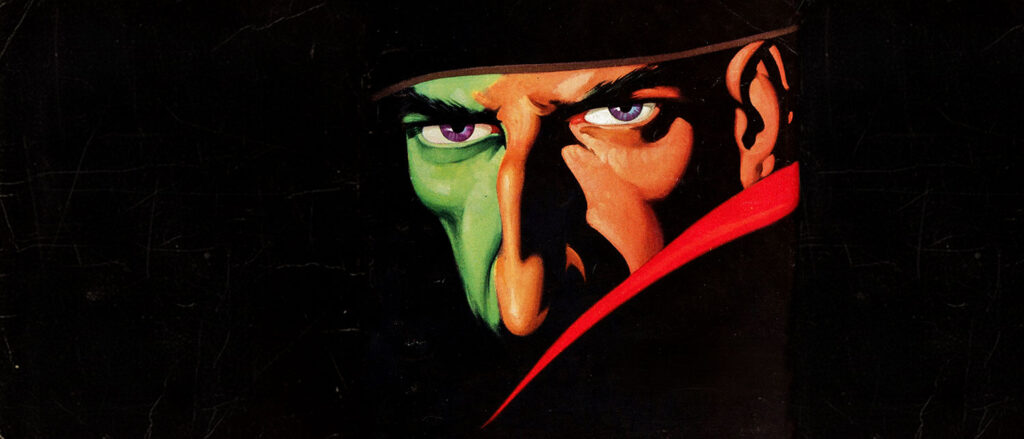
From the spring of 1931 until the summer of 1949, a slim figure cloaked in black fought mobsters, evil scientists, and crazed masterminds with two blazing automatics and a laugh that chilled the blood. The Shadow mattered not only because he sold magazines, but because he crystallized the working machinery of the hero pulp: the secret identity, the loyal network, the theatrical menace, and the promise of a new battle every month.
In July 1930, The Shadow was just a voice on the radio. Street & Smith Publications launched the Detective Story Magazine Hour on CBS, a radio program designed simply to promote its pulp Detective Story Magazine. A young scriptwriter named Harry Engman Charlot suggested the show needed a mysterious narrator and proposed the name “The Shadow.” Listeners latched onto the character and began asking for “The Shadow magazine,” which didn’t exist. Street & Smith took notice. By April 1931, The Shadow Magazine was on newsstands.
Walter B. Gibson, a newspaper reporter, professional magician, and prolific ghostwriter for Harry Houdini, was tapped to write the adventures of the Dark Avenger under the house name Maxwell Grant. Gibson set a pace that staggers the imagination: Most novels were delivered within a matter of days. In the pulp’s first decade, he hammered out a million words of fiction a year on his Smith Corona. He wrote 282 of the magazine’s 325 numbers. The remaining novels came from Theodore Tinsley, Bruce Elliott, and Lester Dent, all under the same Maxwell Grant byline.
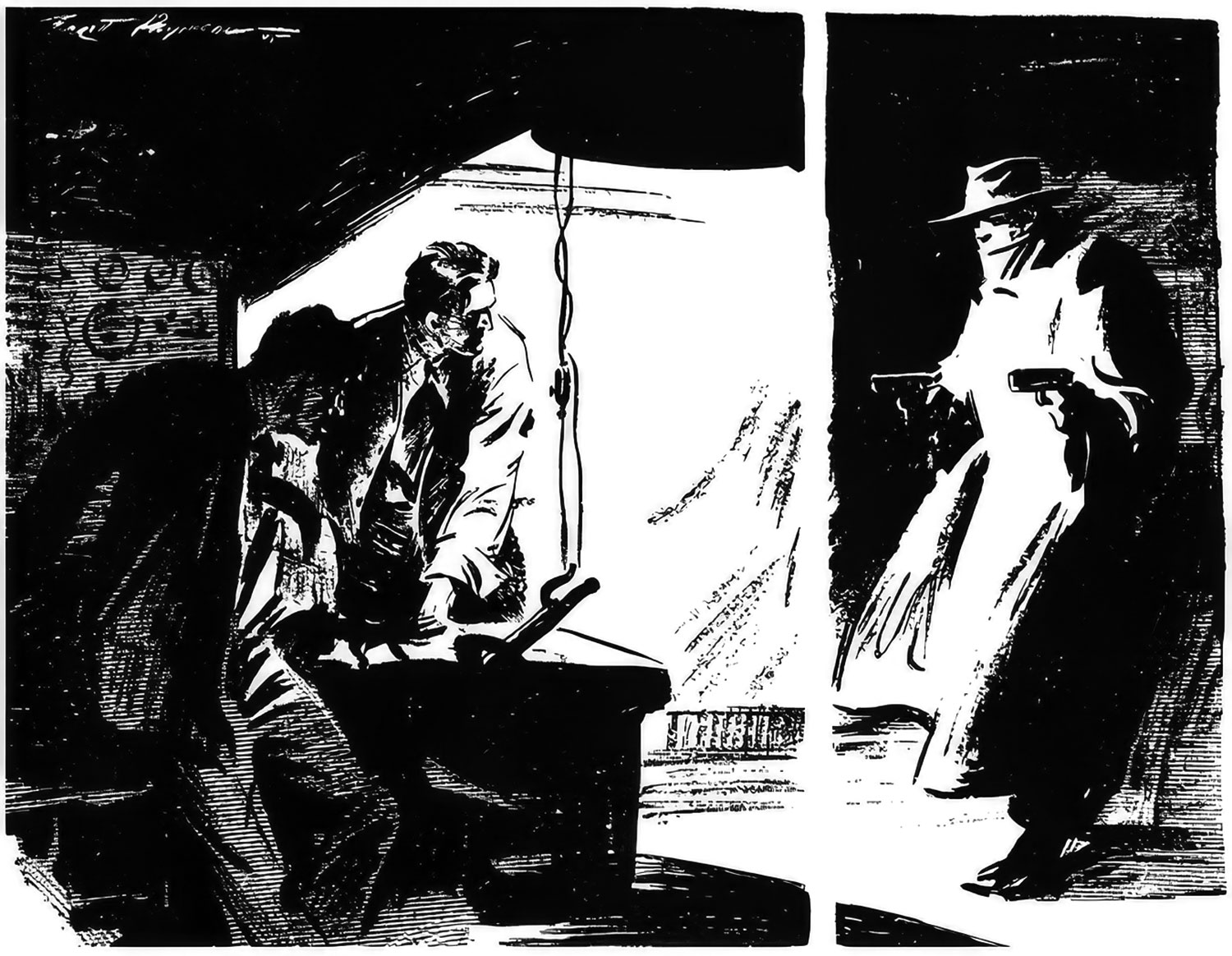 The Shadow of the pulps was not The Shadow of radio. That distinction matters because, even today, the radio character is what most people think of when someone mentions The Shadow. When Orson Welles stepped into the role in 1937 and began clouding men’s minds — a power the character never had in print — the program created an entirely separate mythology.
The pulp Shadow was Kent Allard, a World War I aviator and adventurer who drew on a magician’s arsenal — disguises, sleight of hand, escape work, and misdirection — as well as a network of loyal agents to wage war on crime. His most convincing disguise was as Lamont Cranston, a wealthy socialite, which gave him access to New York’s police commissioner and the city’s wealthy and powerful. The magazine didn’t reveal Allard as The Shadow’s true identity until “The Shadow Unmasks” (Aug. 1, 1937).
The success of The Shadow didn’t go unnoticed. Thrilling Publications introduced The Phantom Detective in February 1933. Street & Smith followed with two more single-character pulps, Doc Savage Magazine and Nick Carter Magazine, the next month. Other publishers rushed their own hero pulps to newsstands: The Spider, G-8 and His Battle Aces, Operator #5, among them. Beginning with The Shadow, pulp publishers were no longer just selling stories; they were selling recurring characters, costumes, methods, and mythologies.
The influence didn’t stop at the pulps. When Bob Kane and Bill Finger developed Batman, they patterned the character after the pulp mystery men, in particular, The Shadow. Finger later acknowledged that “my first Batman script was a takeoff on a Shadow story.” That first Batman story, “The Case of the Chemical Syndicate,” was closely modeled on “Partners of Peril” (Nov. 1, 1936), a novel written by Tinsley.
The Shadow published its final number in the summer of 1949, a casualty of the same forces that ended the pulp era: television, the paperback book, and changing tastes.
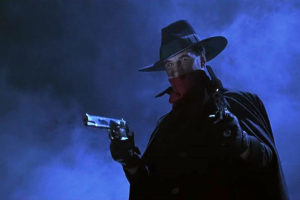
But The Shadow didn’t disappear after his magazine ceased publication in 1949. He had already moved to his own radio drama in 1937, which ran until 1954. He appeared on the silver screen in six two-reel shorts, seven feature films, and a movie serial in the 1930s and ’40s; a TV pilot in 1954; and a big-budget theatrical film, The Shadow, in 1994. The Shadow also appeared in a newspaper comic strip from 1940 to 1942 and in a variety of comic-book series since then.
By the late 1960s, the radio show found new audiences when a wave of nostalgia led to it being rebroadcast and episodes being sold on vinyl.
The Shadow’s adventures have repeatedly returned to print: New novels from Belmont Books in the 1960s were followed by various paperback and hardcover reprint editions, and more recently, Sanctum Books reprinted the complete run in authorized double-novel editions.
In 2026 — the 95th anniversary of the magazine’s debut — The Shadow remains one of the defining figures of American pulp fiction and one of the ancestors of the modern superhero.
Learn more about The Shadow
- The Shadow links
- ThePulp.Net’s curated collection of links covering The Shadow, organized by topic: the pulp originals, radio and film, collectors and deep dives, and the fan community.
- Who is The Shadow?
- Despite what the radio program suggested, The Shadow was not Lamont Cranston — he was Kent Allard, a pilot and adventurer whose true identity wasn’t revealed until the 1937 novel “The Shadow Unmasks.”
- The Shadow’s first cover
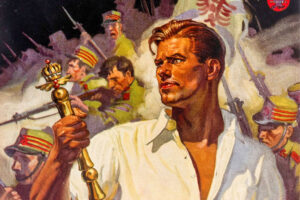
- The cover of the first issue of The Shadow (April 1931) was recycled from a 1919 issue of The Thrill Book — and the Chinese setting it depicted shaped the character’s early adventures in ways no one anticipated.
- The man behind the magic
- Walter B. Gibson — ghostwriter for Houdini, professional conjurer, and creator of Norgil the Magician — brought a decade of experience in magic and illusion to his work writing The Shadow.
- The Shadow’s magic
- Unlike his radio counterpart, the pulp Shadow didn’t cloud men’s minds — he used real magician’s tricks, from exploding powders to Houdini-style escapes, all drawn from Walter Gibson’s deep knowledge of stage illusion.
- The Shadow on film
- A history of The Shadow’s screen career, from the six two-reel Universal shorts of 1931 and a Columbia serial through seven feature films, a 1954 TV pilot, and Alec Baldwin’s 1994 theatrical film.
- The Shadow stills
- A gallery of images from the films featuring The Shadow.