A literary agent examines the ‘peculiar requirements of this first-class market for unusual adventure, detective, and Western stories’
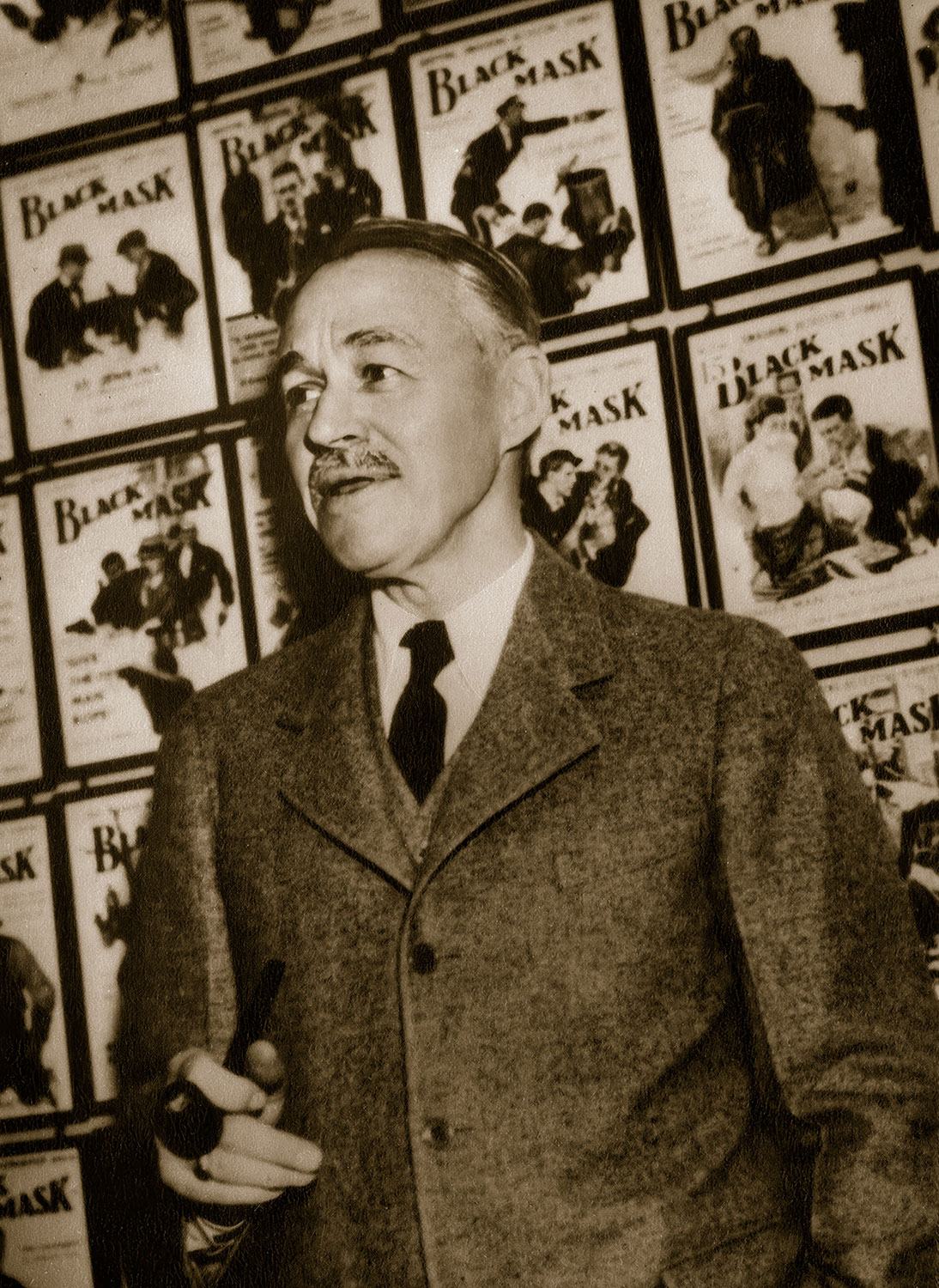
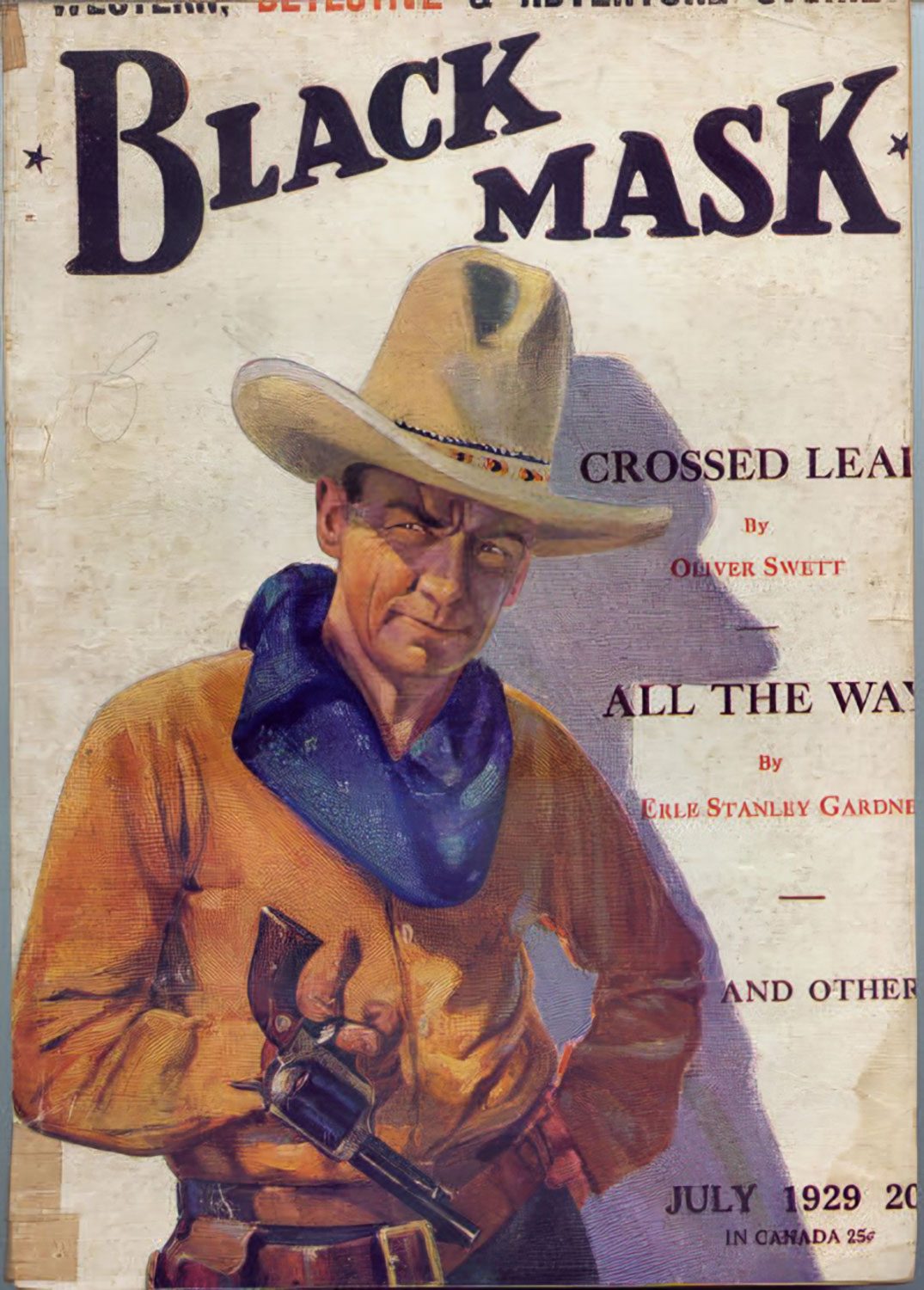
“It is difficult to put into words our peculiar policy,” Mr. Joseph T. Shaw, editor of Black Mask, answered when I asked him for a message to readers of Writer’s Digest. He significantly glanced around the walls of his office. They were literally plastered with covers of his magazine; cowboys with blazing six-guns, scarlet-coated North-West Mounted Policemen, Chinese Mandarins with ugly-looking knives, and underworld characters in evening dress formed a bizarre patchwork. In every picture there was action. I found part of the answer right there.
“Perhaps I can give you a better picture of what we want by telling you what we don’t want,” Mr. Shaw finally smiled. “Writers seem to make the mistake of considering us a formula magazine. I get so many of the crime-solution variety of detective story that is nothing more than a crossword puzzle. They usually begin with a murder, and the whole interest lies in finding the criminal. But there’s no real character interest, no convincing, real-life story! The dramatic events leading up to, and the actual commission of the crime, lose their effect because they are brought out piecemeal.”
“Then, you wish a story to proceed in chronological order as the events occur? To show the criminal laying plans for a murder, how he carries them out, and, finally, his apprehension?”
“Well, the majority of stories we use are not primarily concerned with a murder,” Mr. Shaw explained. “There is usually something else involved, and a killing accidental, or merely incidental to the plot. What I want first and last is a real story.”
While Black Mask, 578 Madison Ave., New York City, offers almost limitless versatility in subject matter within its theme, there is a keynote of ever-present action throughout its fiction. It is unmistakably different from the usual detective-mystery magazine. Perhaps its slant can best be crystallized as “unusual detective, adventure, and Western stories.” As Mr. Shaw suggests. The usual formula of the detective story found in most mystery magazines is avoided, and the individuality of the writer is given full sway.
A continual series of surprises
Editor’s note
This article originally appeared in Writer’s Digest (October 1929).
The July 1929 issue starts off with a first-person novelette by Erle Stanley Gardner titled “All the Way.” Bob Larkin of the Border Patrol goes into Mexico incognito to break up a gang of dope-smugglers. Armed with a cane made from the solid wood of half a billiard cue, Rob gets himself out of a tight corner in a Mexican barroom. He is “befriended” by one, Jacinto Alvaro, and meets this oily-tongued Mexican with equal hypocrisies in the hope of discovering the head of the smugglers. Alvaro is forever assuring his friendship, but awaits a favorable opportunity to use his knife. Larkin is aware of the Mexican’s intentions and pretends a desire to smuggle a shipment himself. Alvaro pretends to fall in with the scheme. Larkin recognizes Vera Rayon, a secret service operative disguised as a man. She manages to get a word with him; she intends to discover the channels of distribution and follow the dope “all the way.”
There is never a moment in this story where there is not something happening. There is constant action; a continual series of surprises, and it holds its suspense through the threatening death to both Vera Rayon and Larkin. But the real story, as Mr. Shaw would probably put it, is in the characterization and courage of Vera Rayon. Contrary to most other magazine stories of similar general type, there is not the slightest suggestion of love interest between Vera and Larkin; it follows more closely the probable everyday comradeship between these workers in a single cause. The subject of “dope” is considered unpleasant by many magazines and is often taboo. Here, however, the unpleasant features are barely suggested, and are overshadowed by Vera Rayon’s heroism.
A free-for-all
“Regards to the Chief,” by Earl and Marion Scott, is a short story of an ex-crook, Cameo Kirby, whose trail Matt Crawley, detective, has been hounding for years. Kirby is in a theatre, where he sees an old pal, Lucian Cary, in the leading villain’s role of the play. He leaves his nephew to chat a few minutes with Cary behind the scenes during an intermission. In the last act of the play. Cary is supposed to take a bullet in his heart to save the heroine. Only, this time the bullet proves real. Kirby has been watching the last act from behind the scenes. It seems a bit too realistic to him; yet he does not suspect the truth. He leaves the theatre and finds his nephew has left a note in their car that he will be home later. Probably a girl, Kirby smiles to himself.
Matt Crawley arrives and accuses Kirby. The leading lady’s diamonds were stolen also; he finds Kirby “with the goods” in the form of Cary’s ring on the tray in his hands. Just as he demands to know where Kirby has hidden the “ice,” Crawley is mysteriously shot. Realizing that he will be accused of both crimes, Kirby gets out just as the police enter.
Meanwhile, Dane Kirby, “Cameo” Kirby’s nephew, has been with Mary Arliss, an usher in the theatre. She tells him what happened; she is terribly frightened. Runs away from him when he questions her. Dane goes home and finds the police in the house. He knows his uncle is suspected; and Mary Arliss knew something she was afraid to tell. He sets out to find her.
The scene switches to Nick Childers, Snow Sinton, and Juice Jarvis, in discussion over their clever frame-up of Kirby. Suddenly, they find Kirby in their midst. He disarms them, forces Sinton to open the safe, and hand over the stolen diamonds. He forces Jarvis, handcuffed, to get into a waiting cab. and brings him to Denny Creighton’s roadhouse.
Dane Kirby runs across Mary Arliss; when he tries to force his questions, she again runs away. He follows her into a house, where he is trapped by Nick Childers. But Cameo has had Props, his pal, follow his nephew. Props runs into the trap also, but Childers’ gang lets him go with the ultimatum to Cameo that they’ll trade Dane for Jarvis and the “ice.” But while Mary Arliss has led Dane into the trap, with a woman’s inconsistency, she double-crosses Childers to save him.
Cameo at once goes to Frazier’s roadhouse, dances with the girl, and obtains a key to the room in which Dane is imprisoned. Cameo finds Snow Sinton in a huddle on the floor of that room with a brass candlestick beside him. Dane is gone. But of all people, Cameo is confronted with Matt Crawley, whom he thought had been mortally wounded. Cameo manages to knock him out. The girl explains that Sinton attacked her for double-crossing, and >he used the candlestick. She tells Kirby she saw Juice Jarvis shift the guns in the theatre, causing Cary’s death. She leads Cameo to Nick Childers’ door. Tie at first refuses to open, but she begs, “Please — Daddy!” Cameo holds a gun on Childers. Mary faints. Dane is in the room. Cameo forces one of Childers’ gang to untie him.
A free-for-all ensues. It is interrupted by Matt Crawley and the police. The detective explains that he knows Childers was the real murderer and Jarvis the tool. Also, that Childers has already “fixed” it, so he’ll never come to trial. Mary Arliss, he further explains, won’t have to testify against her father; she has been dead set against his doings. and wouldn’t live in his house. She has been making her own way. Crawley tells Cameo he’s laying off him on this deal.
Crawley subtly suggests that Cameo might avenge his friend Cary. But two things trouble Cameo: Dane’s too evident interest in Mary, and the consequent fact that Nick Childers was going unpunished.
The realism of the ending
There are certain significant features of this story that the writer, hoping to sell Black Mask, should carefully note. The realism of the ending; it gets away from the stereotyped “nabbing” of the criminal. The background romance, which, while essential to the story, is never more than suggested.
The swift, and at times almost irrelevant march of events makes for a far greater convincingness and realism. There is a wholesome departure here from the stereotyped “crossword-puzzle detective story.”
“The Carnival Kill,” by Raoul Whitfield, is the story of a “framed” stunt pilot. Gary Greer’s father had been murdered by a gang in league with the corrupt Center City police. Gary had avenged his father on two of the five murderers. A man is killed at the circus that afternoon; everything is planned so that the evidence will point to Gary. They are thorough so far as to even cut the ripcord of his parachute and file an elevator wire on his plane. But Gary finds out in time to take another parachute and manages to get down uninjured.
Back of him, black smoke from the wreckage of the ship curled up into the sky. On the far side of the hill, the ship had landed. Gary Greer didn’t look back. He had somewhere to go, something to do. As he moved, his eyes were narrowed, staring straight ahead. Only his tight-pressed lips seemed to be laughing. And theirs was not a pleasant laughter — it was the cold laughter of death. Death to gangster killers who had killed with laughter on their own lips.
“Crossed Lead” by Oliver Swett is a Western novelette, which in its action follows conventional lines but has several unusual situations. Dallas Pete Hanley, ranch owner, returns home to find his foreman and friend, Bud Gorman, seriously wounded and $20,000 stolen by a red-haired, blue-eyed bandit with a scar on the left temple. Dallas sets out on his trail and meets a man answering the description in the saloon. Certain tough characters attack a youngster; the red-haired suspect takes the boy’s park. When things begin to look too bad, Dallas joins the man he has been trailing in a common cause. They go through considerable fighting to save the boy’s interests and those of his uncle and cousin. All the time, Dallas is almost certain that “Sandy” is the man who robbed him and, for all he knows, murdered Bud. It later is very logically explained that the fiery thatch and the newly acquired scar are merely coincidental, and the real culprit has been “done in” by Sandy’s own hand and the money recovered.
While this story depends for its solution upon coincidence, which in all ordinary cases the writer should avoid, for it leads almost inevitably into the morass of unconvincingness, the real story lies in Dallas fighting side by side with Sandy.
Crooks can be human, too
“The Whitest Man That Ever Lived” by Heydorn Schleh, probably sold itself to Mr. Shaw by its intensely human and powerful theme. It’s rather a bit “off-trail” in Black Mask, but it happens to be one of those stories that sell themselves despite restrictions, and for which occasionally a magazine’s policy is stretched.
A girl comes into the district attorney’s office, says that she’s Ann Brennan, whom Jimmy Malone has confessed to having murdered. She forces the district attorney to listen to her story. How she was given a home by Jimmy’s mother when her parents died; how he got into bad company and was sent up for a “stretch,” which killed his mother; and how the police hounded him when he was released. He managed to educate Ann, and she finally got a job. But a slump came, and when she’s starving, Jimmy breaks his determination to go “straight.” Ann, unknown to Jimmy, begins to steal, too. She feels it’s unfair for him to take all the risk. She pulls a big job and tells Jimmy. He begins to cry, takes the money she gives him, and walks out. He returns with a suitcase and a ticket for Pittsburgh. He forces her to go. “For God’s sake—for my sake. Ann — be a good girl!” are his parting words.
“The Water Rats,” by Tom Curry, is of somewhat similar nature to “All The Way” in plot. In “The Water Rats,” a New York detective gets himself into the employ of rival river gangs and finally manages to get them just where he wants them.
“The Silver Horseshoe,” by Katherine Brocklebank, concerns a border service operative in the disguise of a jockey unraveling a Tia Juan race-track murder. As in all Black Mask stories, the reader is kept in suspense throughout the story: he isn’t quite sure what it’s all about until he finishes the last line.
From this survey of Black Mask can be gathered some very definite tendencies. It emphasizes the adventurous and romantic sides of the underworld and permits even its crooks to be human, and in some instances, very appealing characters. It does not insist on “retribution by the law,” but nevertheless avoids the glorification of crime. It permits the mention of the fact that the “law” itself is at times a bit — shall I say “twisted?” Character interest seems a primary consideration; all its stories are built ’round their characters, who are so real you can almost imagine yourself meeting them. Its detectives do not “deduce” clever theories; they act.
Locale for stories is preferably North America. A foreign setting should at least have American characters. Lengths for short stories are from 5,000 to 8,000 words; novelettes from 10,000 to 15,000. Serials are not used. Good rates are paid on acceptance.
About the author
August Lenniger ran the Lenniger Literary Agency, with Edith Margolis, handling the work of E. Hoffman Price, Gardner Fox, and other pulp fictioneers.