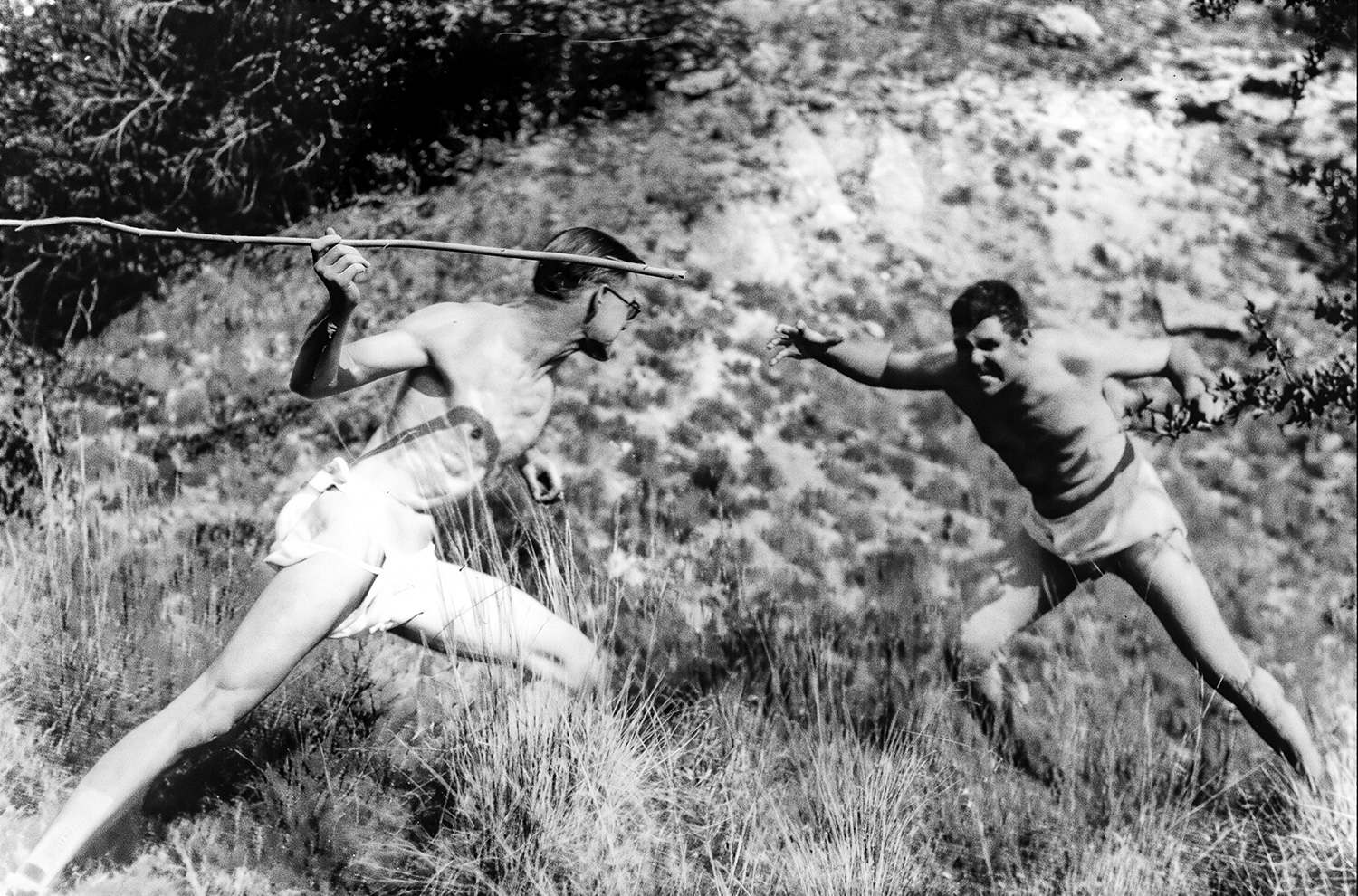
Robert E. Howard’s ‘Spear and Fang’ was a triumph for both writer and fantastic fiction
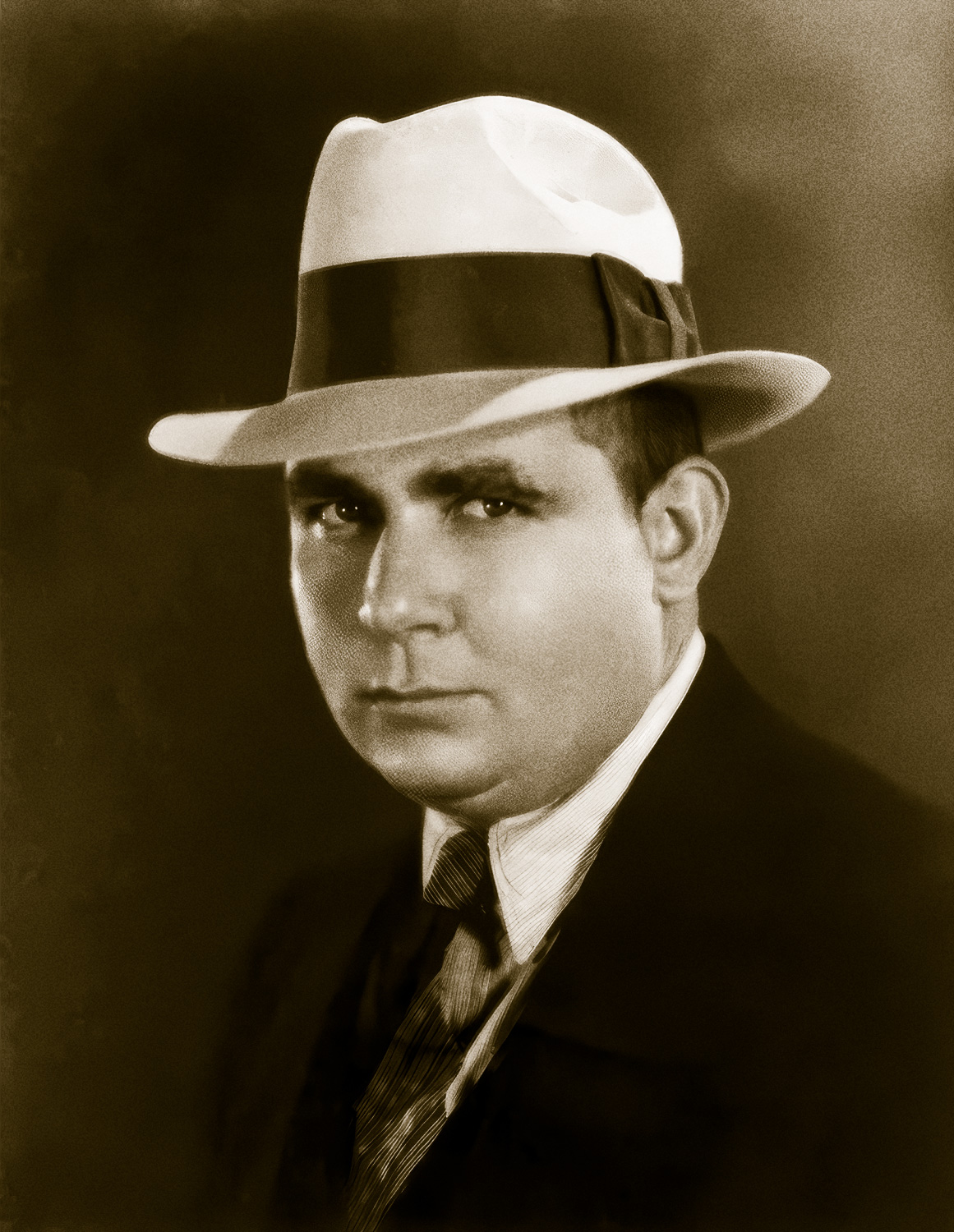
One hundred years ago, the July 1925 number of Weird Tales included the first professional work by an 18-year-old from a rural Texas town. The short story, “Spear and Fang,” featured a Cro-Magnon protagonist facing off against a Neanderthal “beast-man.”
For aspiring writer Robert E. Howard, it was a major personal triumph, but for the world of fantastic fiction, it would prove to be a monumental event.
Howard would go on to become one of the most significant contributors to the pulp magazines and a pioneer in heroic fantasy with his iconic characters Solomon Kane, Kull of Atlantis, and of course, Conan the Cimmerian.
But that first caveman story was more than just the genesis of a short but magnificent literary career — it also laid the foundation for what would become Howard’s shared universe for his characters, as well as the template for the genre that he is credited with creating: sword and sorcery.
Fanzine flashback
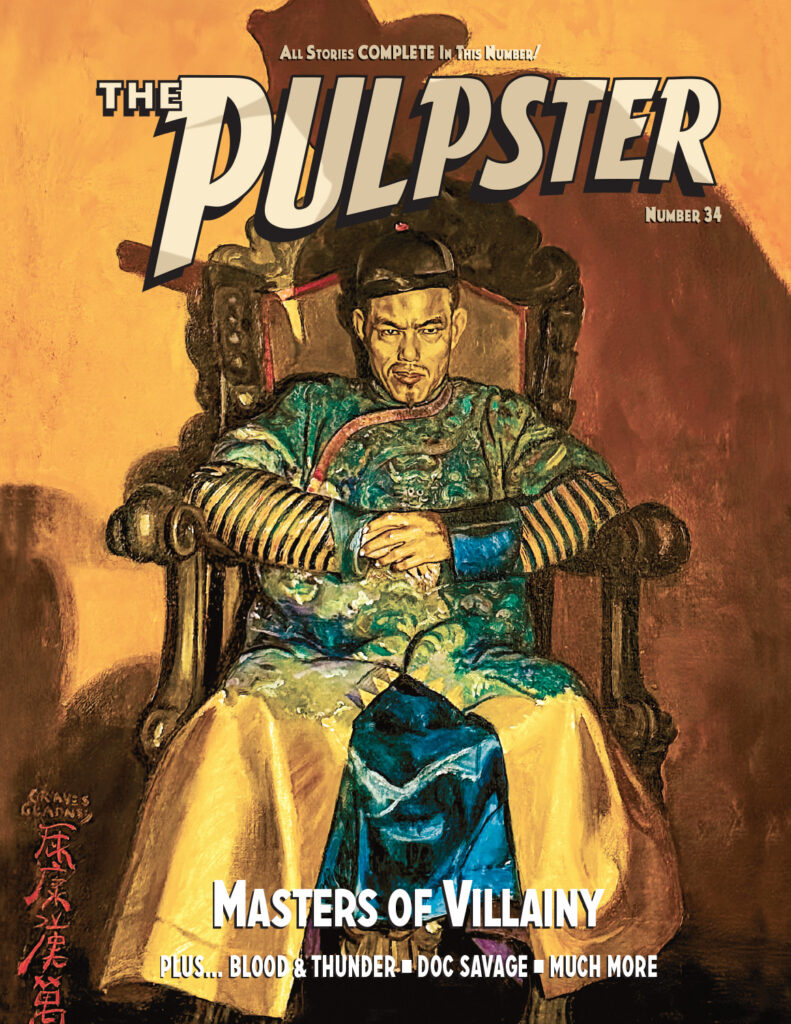 This article originally appeared in The Pulpster (#34) for PulpFest 2025. Reprinted with permission.
The dawn of Howard’s career
The “caveman” genre is not a particularly popular one today (Jean Auel’s Clan of the Cave Bear and its sequels are perhaps the most recent successful examples, and they are four decades old), but in the early part of the 20th-century, prehistoric fiction was ubiquitous.
Some popular examples that Howard likely would have read as a teenager include Before Adam (1907) by Jack London, The Lost World (1912) by Arthur Conan Doyle, The Land That Time Forgot (1924) by Edgar Rice Burroughs, and Heu-Heu (1924) by H. Rider Haggard. Howard was also reading the numerous prehistoric tales appearing in the general-fiction pulps, most notably, the Ta-an stories of Paul L. Anderson that were being published in Argosy.
Howard began seriously writing and submitting stories to the pulps in 1921, when he was only 15 — and not just any pulps, but the higher-end magazines like Argosy and Adventure, according to Mark Finn in Blood and Thunder: The Life and Art of Robert E. Howard. Not surprisingly, he met with rejection after rejection, but he persisted. It would be several years before he would get his big break, when a strange new title appeared on newsstands: Weird Tales.
We don’t know exactly when Howard first picked up a copy of “The Unique Magazine,” but we do know that he began submitting stories sometime in summer 1923. Those first rejected stories no longer survive, but it was the December number the following year that would be the turning point for a young Howard, writes Patrice Louinet in his essay, “Atlantean Genesis,” in Kull: Exile of Atlantis. In the letter column, The Eyrie, Weird Tales editor Farnsworth Wright put out a call for a particular type of story that he wanted to see:
Why has not someone written of a fight between a Cro-Magnon caveman and a Neandertal [sic] man? … Neandertalers and Cro-Magnons existed side by side, and waged relentless and savage warfare against each other. … How would you like a tale of the warfare between a Cro-Magnon (say one of the artists who painted the pictures of reindeer and mammoths which still amaze the tourist) and one of those brutish ogres, perhaps over a girl who has taken the fancy of the Neandertaler; and the Cro-Magnon artist follows the Neandertal man to his den, and—. But we have no room to tell the story in The Eyrie. We wish one of our author friends would write it for us.
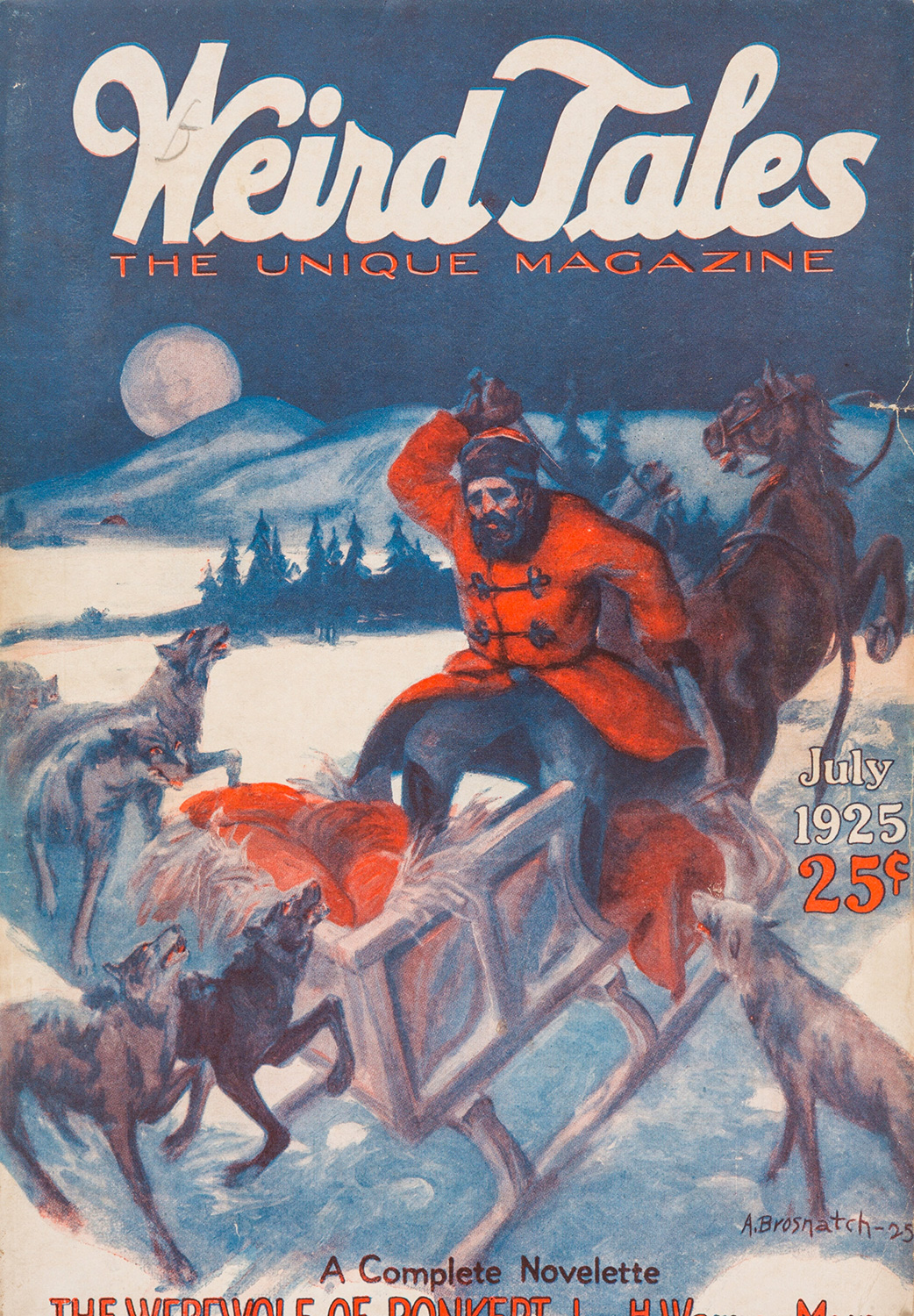
Howard was quick to take up the challenge and begin work on the story that would become “Spear and Fang.” It was submitted within days, and Wright immediately accepted it for publication, according to Louinet in “The Wright Hook (or, the Origin of ‘Spear and Fang’),” from Weird Beginnings. It would appear six months later in the July 1925 number.
As Patrice Louinet has noted, the plot of the story follows Wright’s request almost exactly. The protagonist is a young Cro-Magnon artist and warrior named Ga-nor. His female admirer, the beautiful A-aea, is kidnapped by a rival warrior, Ka-nanu, and taken into the forest. Before Ka-nanu is able to have his way with A-aea, he is suddenly attacked by a “gur-na,” one of the fearsome beastmen of the forest — a Neanderthal. Ka-nanu is killed quickly by the fearsome Neanderthal, and the man-ape snatches up A-aea and takes her back to his den.
Ga-nor, having learned of A-aea’s abduction by Ka-nanu, follows the two into the woods. He comes upon the scene of Ka-nanu’s grisly death and, realizing what happened, tracks the gur-na back to its lair. In a thrilling and violent combat scene — presaging Howard’s later works — Ga-nor emerges battered but triumphant, having killed the Neanderthal and saving the beautiful and grateful A-aea.
Where the monster came from
It is not just the basic plot structure that follows Wright’s story prompt, but also specific elements. Wright notes that “when a Cro-Magnon child strayed alone from its cave, and a cannibalistic Neandertaler stalked it, that was the end of the child.” At the beginning of “Spear and Fang,” we learn that a child from the tribe has gone missing and that a gur-na is the suspected culprit. This is confirmed later in the Neanderthal’s den when the monster offers the arm of a human child to A-aea to eat.
Wright also claims that “the anthropologists tell us that the legend of ogres dates from cavemen times,” referring to the Neanderthal, and that “the memory of those brutish and half-human people remains in our legends of ogres.” In “Spear and Fang,” Howard repeats this idea: “Of mighty power and little mind, savage, bestial and cannibalistic, they inspired the tribesmen with loathing and horror — a horror transmitted through the ages in tales of ogres and goblins, of werewolves and beast-men.”
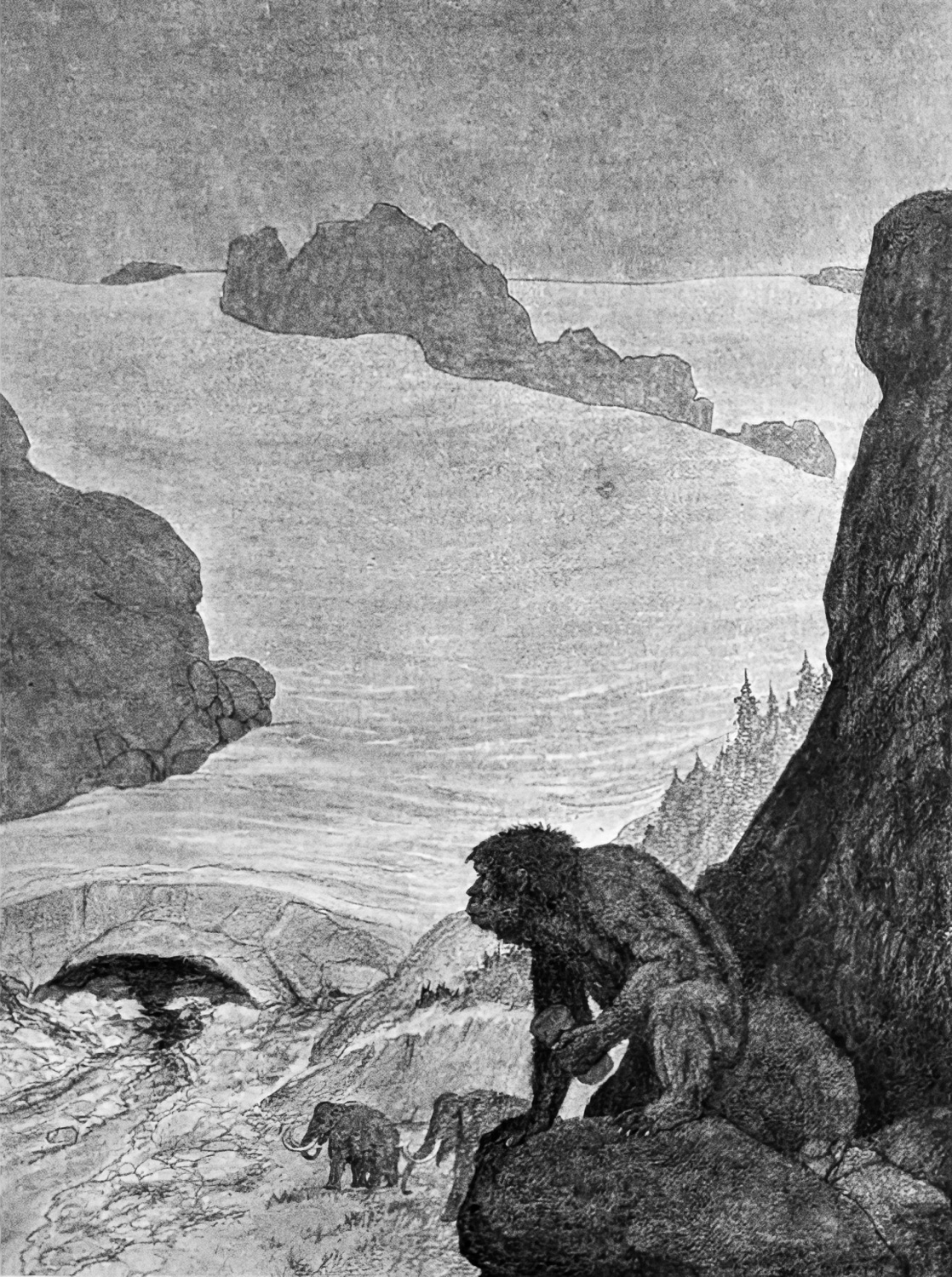
The idea that Neanderthal man was a cannibalistic horror whose memory persisted throughout the centuries as tales of ogres and other monsters of folklore seems to have originated with famed British explorer Sir Harry Hamilton Johnston, who wrote in Views and Reviews from the Outlook of an Anthropologist (1812):
The dim racial remembrance of such gorilla-like monsters, with cunning brains, shambling gait, hairy bodies, strong teeth, and possibly cannibalistic tendencies, may be the germ of the ogre in folklore…
But the idea was popularized in the early 1920s by none other than speculative fiction pioneer H.G. Wells.
Wells, for whom Johnston was a major source, promulgated this idea in his popular multi-volume 1920 nonfiction work, The Outline of History. He also introduced the theme of a prehistoric race war between Cro-Magnon man and the monstrous Neanderthals in a short story, “The Grisly Folk and Their War With Men,” published in a March 1921 issue of The Saturday Evening Post.
By the early 1920s, this bestial vision of Neanderthal man was already at odds with contemporary archaeological and anthropological evidence, but Wells’s concept persisted in popular culture. The Outline of History went through many printings and was available through mail-order advertisements in a number of popular periodicals. Charles DePaolo writes in “Wells, Golding, and Auel: Representing the Neanderthal” (Science Fiction Studies, 27:3) that it was almost certainly where Wright got the idea, and it would go on to influence generations of future authors, including William Golding and Jean Auel.
Howard was likely already familiar with this Neanderthal-as-ogre concept even before reading Wright’s editorial, as he owned a 1922 edition of The Outline of History. In one passage describing Ga-nor’s fledgling artistic abilities, Howard writes that a mammoth he was trying to depict “lacked a leg and had no tail.” This is likely echoing Wells’s description of Cro-Magnon art as “often primitive like the drawing of clever children; quadrupeds are usually drawn with one hindleg and one foreleg, as children draw them to this day.”
While Wright’s call for a caveman story was certainly the impetus for Howard, the reason he was able to respond with a submission so quickly was because he was already well familiar with exactly what the Weird Tales editor was asking for.
In fact, Howard had already been dabbling in the caveman genre well before “Spear and Fang.” He had written a series of poems and stories featuring a Cro-Magnon named Am-ra of the Ta-an, likely in 1922 or 1923, writes Louinet in “Atlantean Genesis.” Though these texts only survive as a few fragments, they show that Howard was already interested in prehistoric fiction. Howard scholar Rusty Burke discovered that the Am-ra fragments borrowed heavily from the Paul L. Anderson Ta-an stories published in Argosy beginning in 1920. Written as a teenager, the Am-ra fragments are little more than juvenile fan fiction, but they prepared a young Howard for when the Weird Tales opportunity presented itself.
From Cro-Magnon to Kull
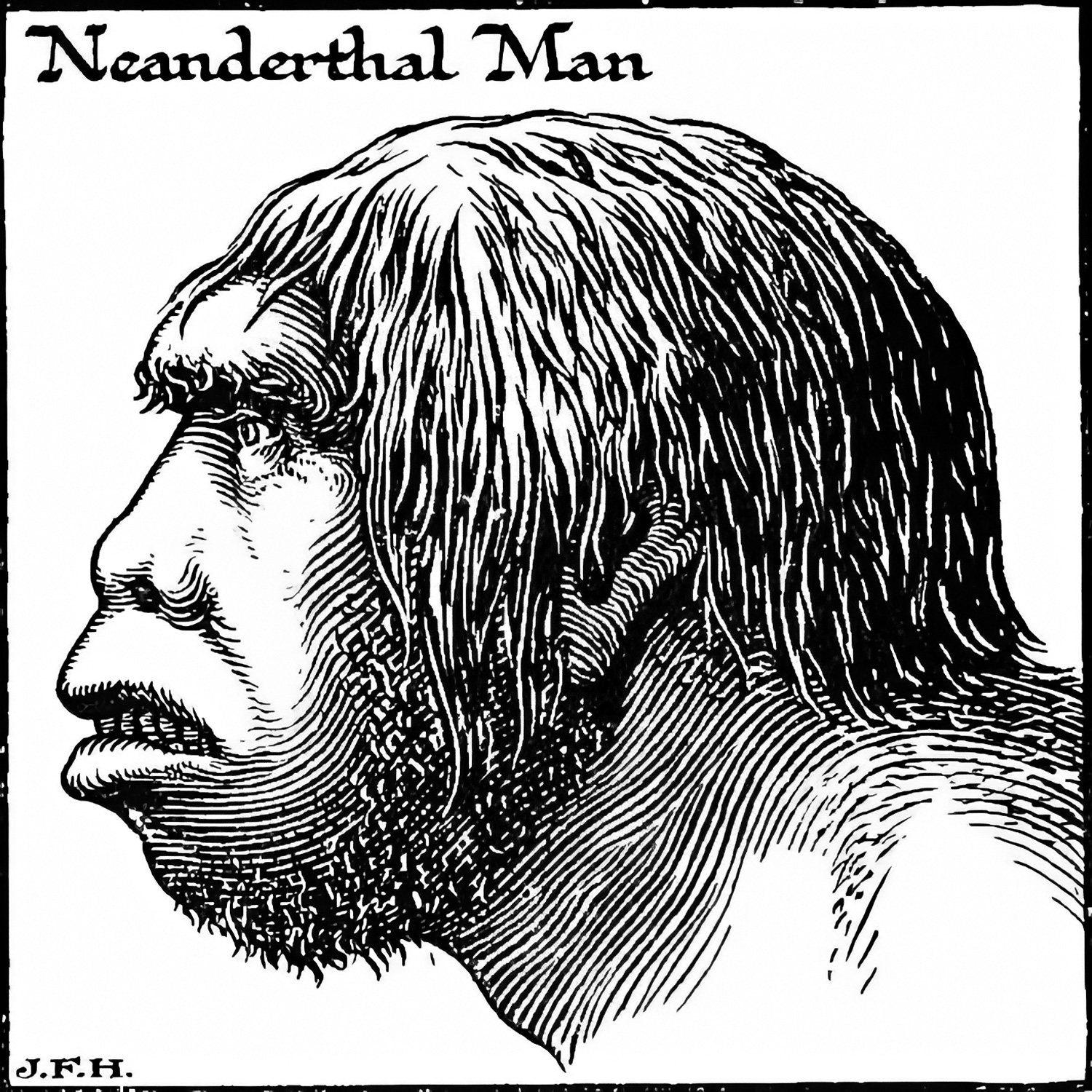
With “Spear and Fang,” Howard took his prehistoric fiction to a new level. Making the Neanderthal a true monster, rather than just a near-human cousin, provided a “weird” element to the story in what would have otherwise been simply another caveman tale. The basic plot, a heroic warrior slaying the threatening monster and rescuing the girl, would become the ur-formula for Howard’s later sword-and-sorcery fiction.
In fact, in the 1934 Conan story, “Rogues in the House,” the Cimmerian’s brutal hand-to-hand fight with the ape-man Thak echoes nearly blow-for-blow Ga-nor’s battle with the Neanderthal. I have argued elsewhere that Thak, though often depicted by artists as a giant gorilla, was likely meant to be a relic Neanderthal.
An even more direct connection between Howard’s caveman stories and the early development of his sword-and-sorcery fiction exists, and the first clue is a line in “Spear and Fang.” The narrator says the protagonist is from “the great Cro-Magnon race which came from no man knows where.” The idea that no one knows where Cro-Magnon man came from does not come from Wells, but possibly from a book that had just been published earlier in 1924: The Problem of Atlantis by Scottish folklorist Lewis Spence.
Spence argued that Plato’s story of Atlantis had a basis in reality; however, it was not the highly-advanced, lost civilization that the Theosophists were promoting, but rather a stone-age culture, Cro-Magnon man, that had fled to mainland Europe when their Atlantic continent sank.
Howard would borrow this idea in his later Kull stories by making the Atlanteans prehistoric “barbarians.” But the equation of Cro-Magnon man and Atlantis began for Howard not long after “Spear and Fang” was published. It would become the basis for the fictional, secondary world that Howard would spend the next decade building, and that would become the primary setting for most of his fantastic fiction.
In 1925, Howard wrote “The Lost Race,” which would become his first published tale of the Picts, a quasi-fictional race that Howard would use throughout his career. In this story, we learn the ultimate demise of the Cro-Magnon people, as their descendants are driven by the Picts to the hinterlands of Great Britain during the Neolithic Age. Thus, we see themes that Howard would return to time and time again: stone-age genocide and race war. The Cro-Magnon people wipe out the Neanderthals, and then the Picts wipe out the Cro-Magnons.
In late 1925 or early 1926, Howard developed these elements into a fictional prehistory of the world that included stone age versions of Atlantis and Lemuria (the lost continent of the Pacific). A series of global cataclysms causes great geological changes, and the various “races” — the Lemurians, the Picts, and the Atlanteans — are forced to migrate and displace each other.
Borrowing heavily from Spence, Howard has the Atlanteans (explicitly identified as Cro-Magnons) evacuate their sinking continent to the mainland, displacing the Neanderthals (referred to as beastmen). The Picts then follow and displace the Cro-Magnon Atlanteans. This rudimentary world-building essay was then inserted into the Bran Mak Morn story “Men of the Shadows,” which was rejected by Weird Tales in 1926.
Undaunted, Howard immediately began work on a new story set in his prehistoric Atlantis. For the main protagonist, Howard brought back Am-ra, now an Atlantean. But as the story progresses, an interesting secondary character seems to take over the narrative — another Atlantean named Kull.
Howard abandoned this story and began a new one, this time with Kull of Atlantis as the primary character. Howard would work on this new story, “The Shadow Kingdom,” off and on for the next two years before it was finally completed and accepted by Weird Tales, according to Louinet in “Atlantean Genesis.” Published in 1929, “The Shadow Kingdom” is considered by many to be the first true sword-and-sorcery story, at least in the sense that we use the term today.
Conan the Cro-Magnon
A few years later, in early 1932, Howard had the idea for a new series set in a fantastic, forgotten age with a barbarian protagonist — Conan the Cimmerian. After completing three Conan stories and successfully selling one of them, he began work on a detailed world-building essay to provide a backstory for this new series.
Titled “The Hyborian Age,” Howard took the basic framework he had created years before for “Men of the Shadows” (and used for the Kull stories) and developed it further. He created a fantastic era of lost civilizations, set after the sinking of Atlantis and the great cataclysm that destroyed the world of Kull. In this essay, we learn that the Atlanteans and Picts who survived the cataclysm and made it to the mainland devolved into stone age savages. In Howard’s world, those surviving Atlantean cavemen would be Cro-Magnons. Eventually, new cultures and civilizations rose up from the ashes of destruction. Those descendants of the Atlanteans became the Cimmerians, of which Conan was one. This lost Hyborian Age lasted for several thousand years, before it too was wiped away in another cataclysm, leading into the Neolithic Age and the rise of the Picts that was chronicled in the Bran Mak Morn stories.
“The Hyborian Age” was not intended for publication but rather for Howard’s own use in maintaining continuity for his series (though it would ultimately be published in Donald Wolheim’s fanzine The Phantagraph a few years later). Paraphrased sections of it, however, were inserted into the next Conan story, “The Tower of the Elephant,” including a mention of the destruction of the pre-cataclysmic age of Kull. In doing so, Howard was retroactively creating what we would today call a shared universe for his characters — a shared universe that had its origin in his early caveman stories.
The legacy of ‘Spear and Fang’
As “Spear and Fang” celebrated its 100th anniversary in 2025, it is important to recognize that this first, often overlooked, story set the stage for many of the great things to come from Howard. In it we see the rudimentary formula for many of his Conan stories: hero kills monster and gets the girl. In addition to Thak, there are many other ape-men and other evolutionary horrors that appear as antagonists throughout the series.
It was also the foundation upon which Howard built the fictional universe that would serve as the setting for all of his major characters. In fact, in Howard’s universe, Ga-nor the Cro-Magnon would be a descendant of the Atlanteans of Kull and an ancestor of the Cimmerians of Conan.
Editor’s note
In June 2026, it was announced that Genndy Tartakovsky would be making Conan the Barbarian, an animated series for Amazon Prime Video on conjunction with Cartoon Network.
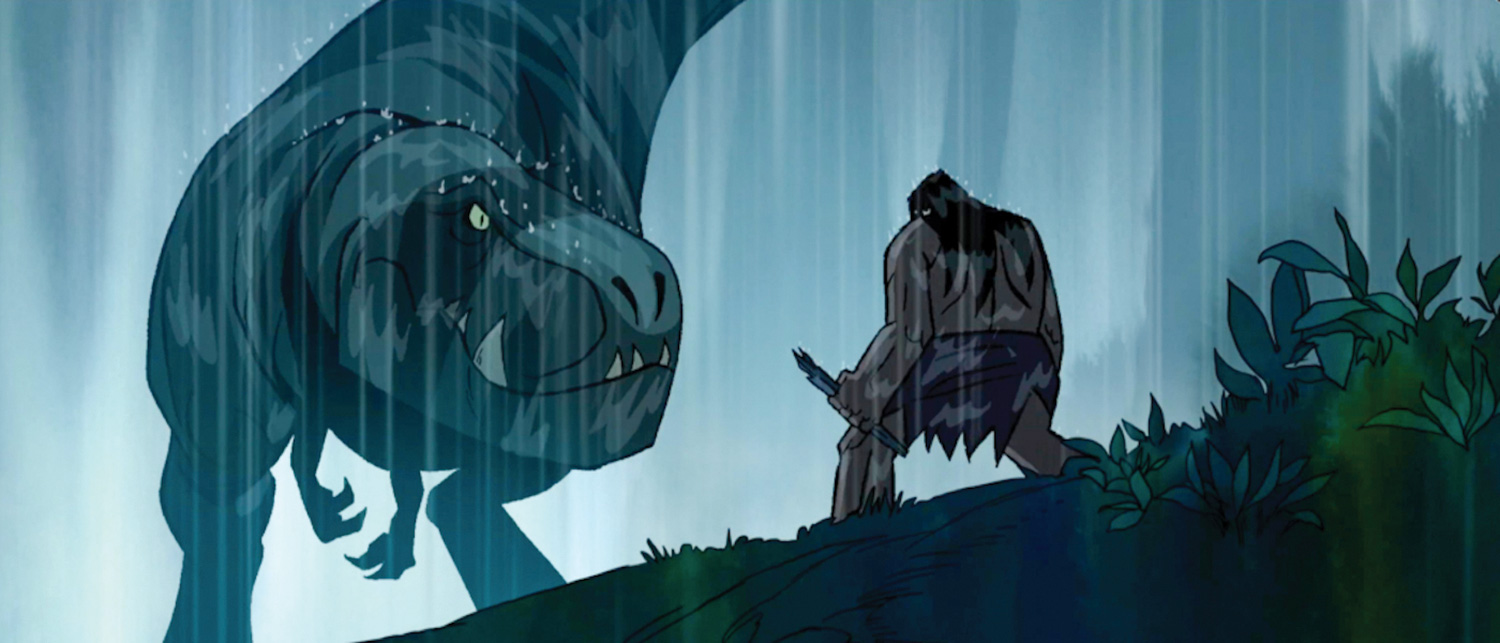
Today, the caveman story is largely a forgotten genre, though one current, incredibly well-executed example is worth mentioning here. In 2019, renowned animator Genndy Tartakovsky, best known for Samurai Jack and Star Wars: Clone Wars, launched a series titled Primal.
Set in a very pulp-like prehistoric world, Primal has now had three seasons.
Bloody, savage, and violent, it feels very much like a Robert E. Howard story — and that is not a coincidence, as Tartakovsky has said he is a big fan. And in fact, there is perhaps no better homage to where it all began than the names of his caveman protagonist and his dinosaur companion: Spear and Fang.
About the author
Jeffrey Shanks is an archaeologist and pop-culture historian. He co-edited the essay collection The Unique Legacy of Weird Tales, which was nominated for a 2015 Bram Stoker Award. He is on the board of the Robert E. Howard Foundation and writes essays on Howard for Titan Comics’ Conan the Barbarian. You can learn more about Robert E. Howard on Shank’s YouTube channel, An Age Undreamed Of.