The artist examines six of the 62 covers he did for the popular pulp magazine.
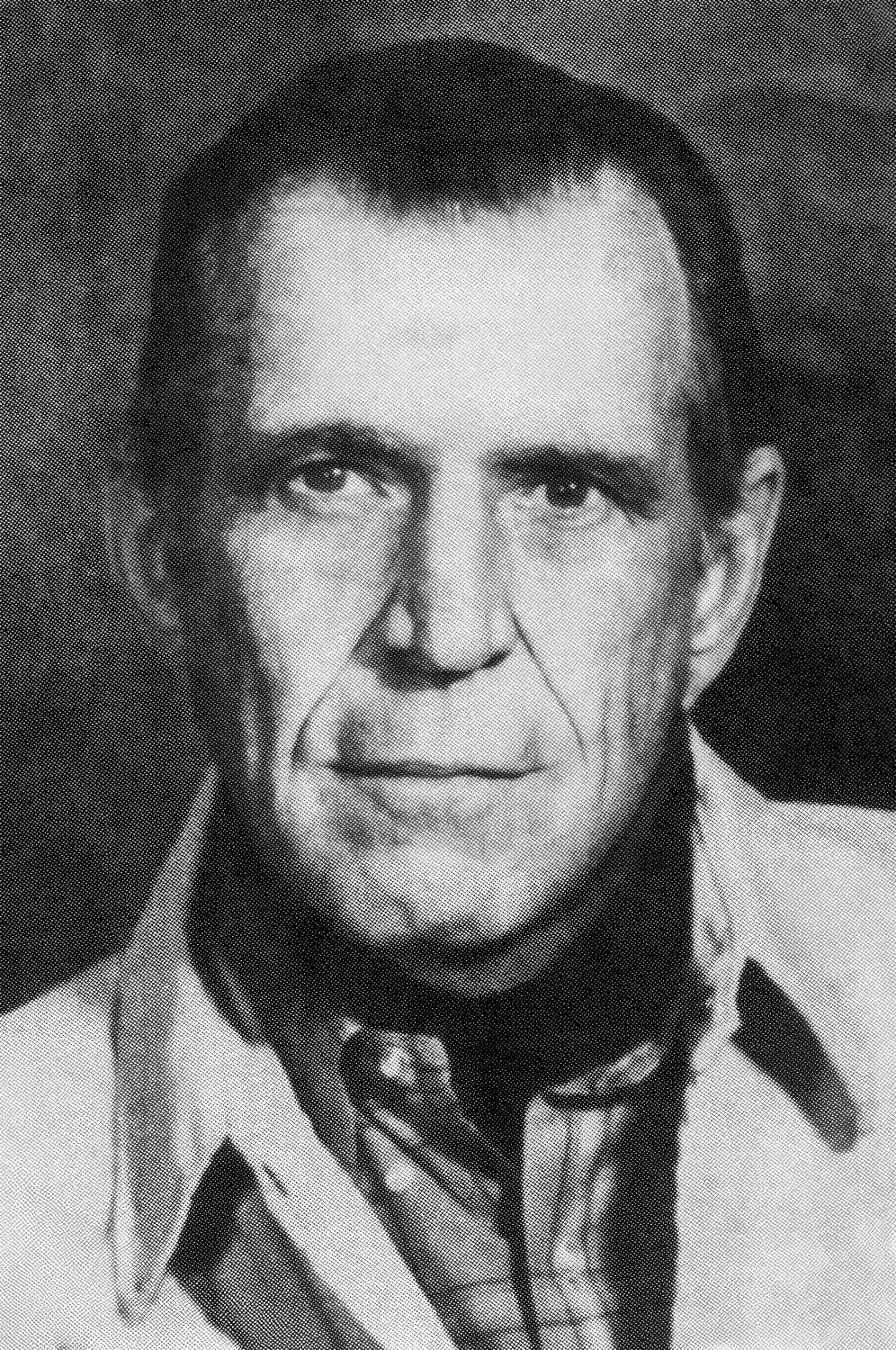
In the mid-1970s, artist Graves Gladney sat down with pulp fans Terry Klasek and Kenn Thomas at his home in Clayton, Mo., just west of St. Louis, for a wide-ranging interview. [Read the complete interview.]
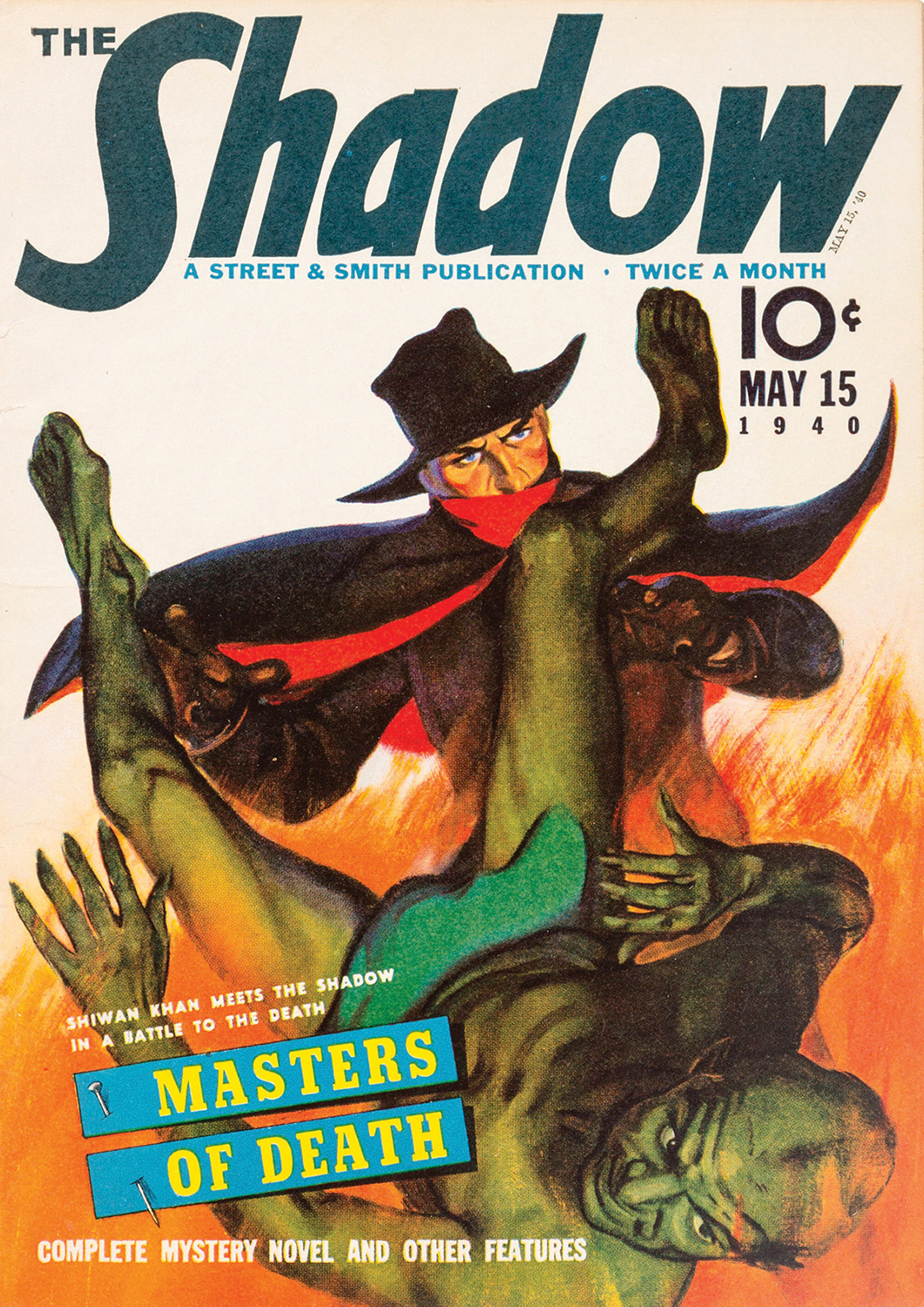
During the interview, Gladney was asked to discuss some of The Shadow covers specifically. Here are his comments.
“Masters of Death” (May 15, 1940)
Q: How many were there in the Shiwan Khan series, four?
Gladney: Four, yes. There was one called “The Golden Master,” which, incidentally, was one of the best covers I ever did. This is because I hired a Chinese [actor] who was at that time in the cast of Anything Goes playing on Broadway at that time. He had a genuine Mandarin costume, and I, through Goodwill or some similar organization, bought a great big ornate chair. He posed for me a full day, and left the robe with me to finish it. Even then, he charged me $25 a day, which was a lot of money, but I produced a cover I liked very well. It was the Sept. 15, 1939, issue. Here to the left is the true Chinese writing he told me how to do. That’s “Shiwan Khan” in Chinese.
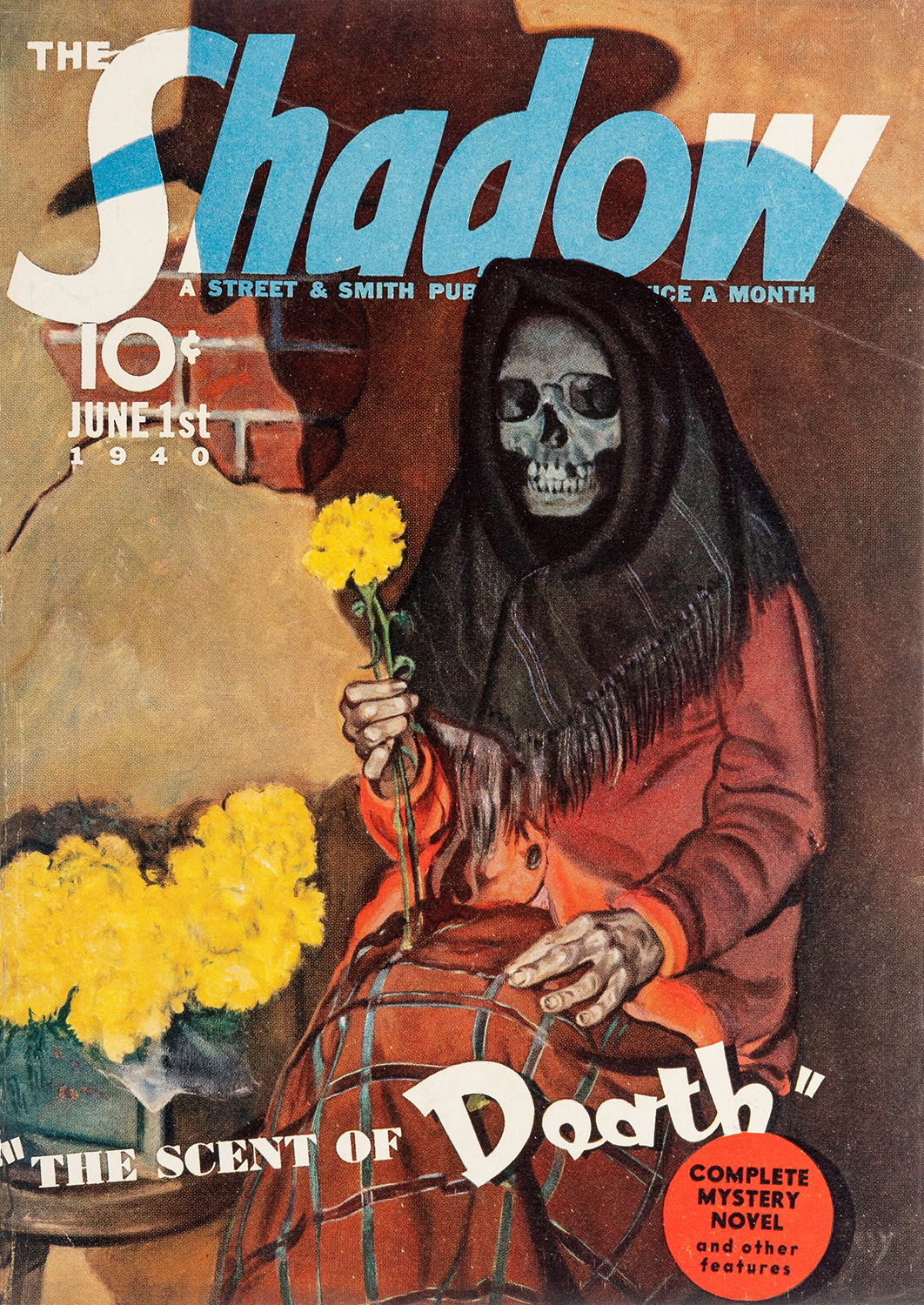
“Scent of Death” (June 1, 1940)
Fanzine flashback
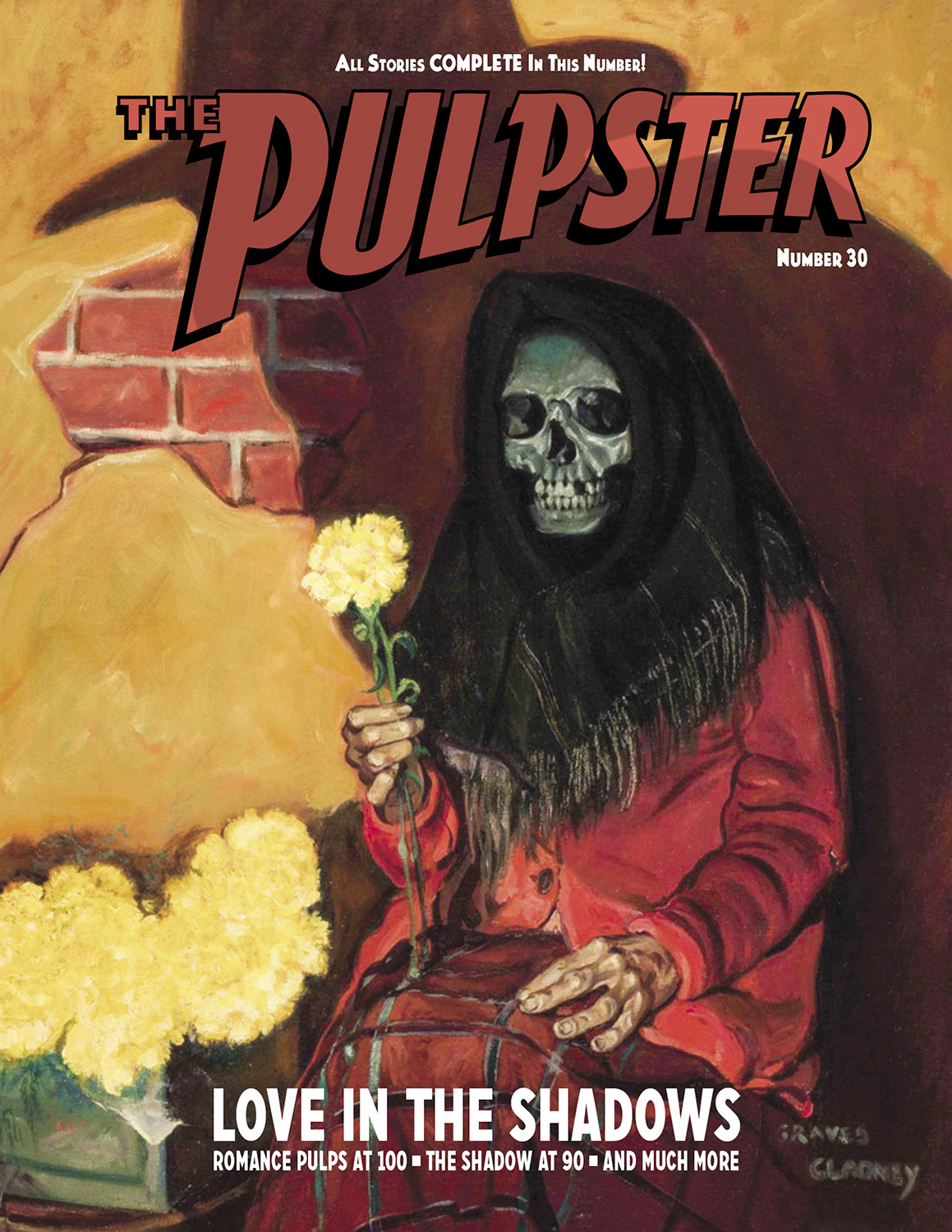
This article appeared in The Pulpster (No. 30; August 2021). It was originally published in the fanzine Whizzard (No. 5, January 1975) and has been edited and corrected.
Gladney: Through powers in New York, I hired a sometime model, a woman who was about 83 years old, very feeble, but I liked the bony feeling of age in her hands, which I painted very carefully. For the rest of it, I had her wear an old shawl and a sweater, turned a light on her, and it didn’t make any difference whether I painted a face in the aperture or not, so I left it black and later painted a skull in the opening. I then covered the whole thing with a cast shadow of The Shadow to give an eerie feeling. The flowers were the highest values in the picture and were the things you saw first. The flowers were poisoned.
Q: Didn’t you find some of the subject material for your covers a bit morbid?
Any time you tried to get humorous with a cover, you met the violent objection of the editors who thought you were painting down to them. But once in a while, I’d try to get humorous. Popular Publication’s [Henry] Steeger, a Princetonian, who was really quite cynical, had a strong liking for figures in hoods. He said, “Let’s have more one more of these.” So, I got tired of it and told him, “Why don’t we for Terror Tales have a big goal post with all these hooded figures huddled around and a tied-up nude girl over the goal post.” I thought it was funny. They didn’t. They got absolutely furious and said they didn’t want any more of that joking because this was a sacred subject.
Another time, I tried to joke, and they took it quite seriously. I said, “Let’s have this bound girl who has a hangman’s noose around her neck that’s tied to a beam with about 10 inches of slack. A dwarf would have a blow torch fixed on the cake of ice she is standing on. When the ice melted, away she would be hanged.” I thought the stuff would hit the fan then, that they would get mad. But they said it wasn’t a bad idea; do it. I told them to get somebody else to do it, and they did.
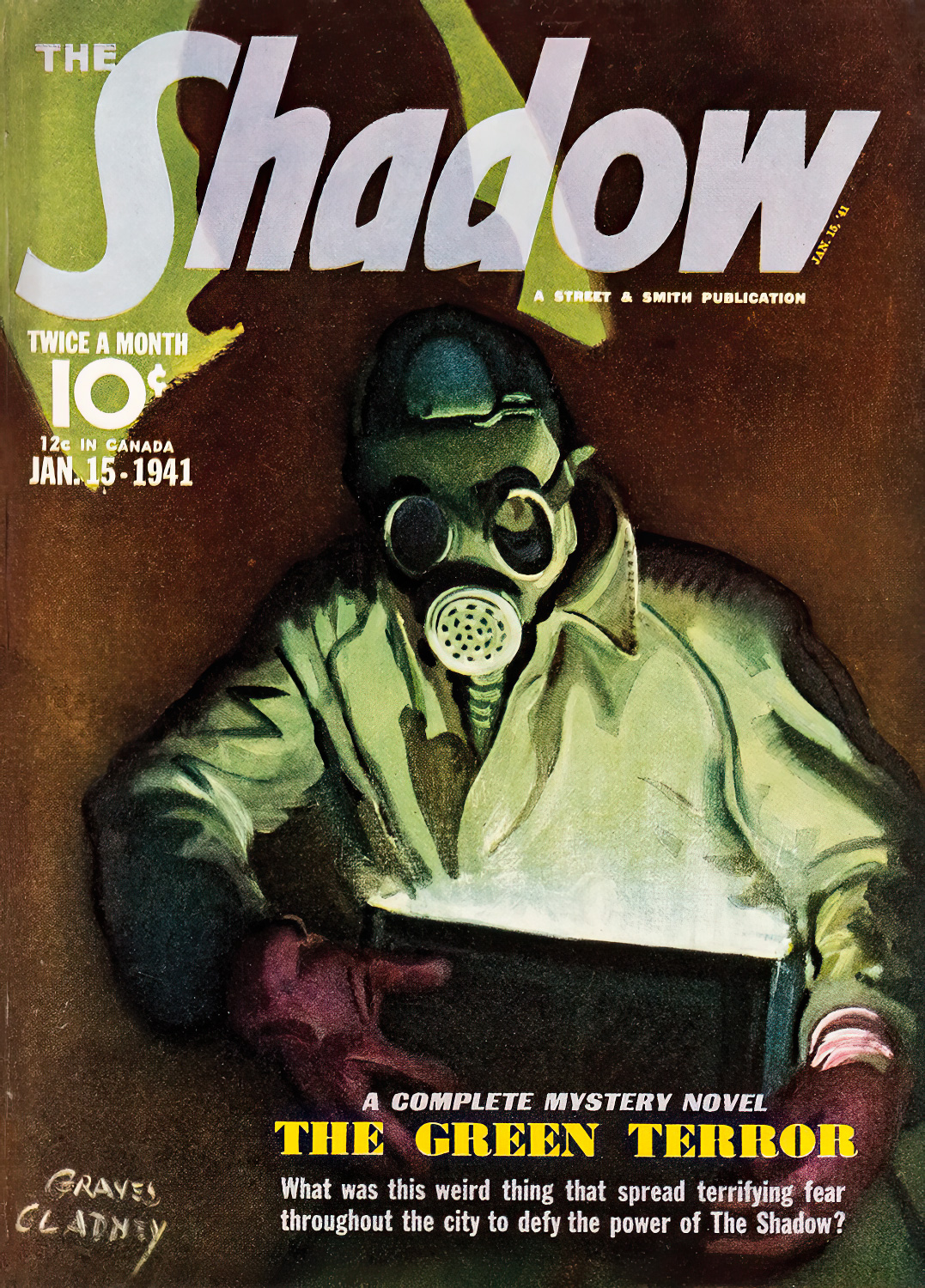
“The Green Terror” (Jan. 15, 1941)
Gladney: Oh, yes. Now, that one concerned a man who is carrying a great big box of radium around. Of course, radium is extremely heavy, and so I simply hired a local man named Charlie Wagner to put on an ordinary raincoat and wear a gas mask that we got from a local gas company, and he had a box in his hands in which I simply inserted a strong photo flash so that the light came upward onto his face. Since it was such a simple cover — he would pose, say, 15 minutes at a time and rest five minutes — I did the whole cover in less than three hours. They liked it; I liked it, and I thought it was very successful.
“The Wasp Returns” (Feb. 1, 1941)
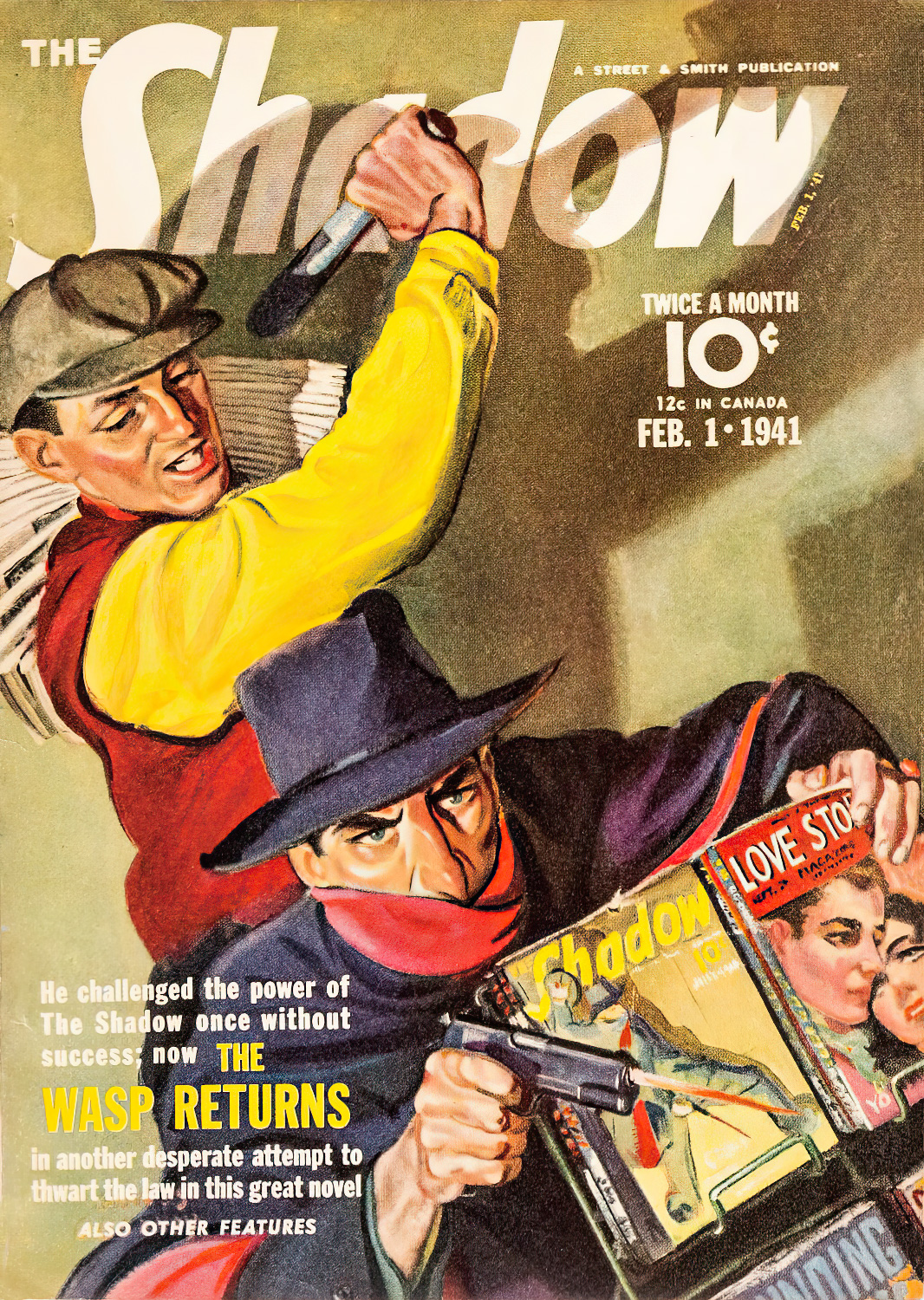
That’s one of the advantages of being a fictional character — you never die.
As you can see, the magazines he is hiding behind are Street & Smith publications: The Shadow, one of my own; Love Story; Astounding; and a bit of Doc Savage.
Incidentally, my own Shadow cover brings up another point. The editors insisted that, from time to time, that I show The Shadow’s specialized equipment. He had a flashlight, a ring, etc. This time [“Gems of Doom,” July 15, 1940], they told me to show The Shadow using those big suction cups he uses to walk up and down the sides of buildings. So, I put these great big things on his hands and feet to walk up walls. How, I don’t know, but nevertheless it is there.
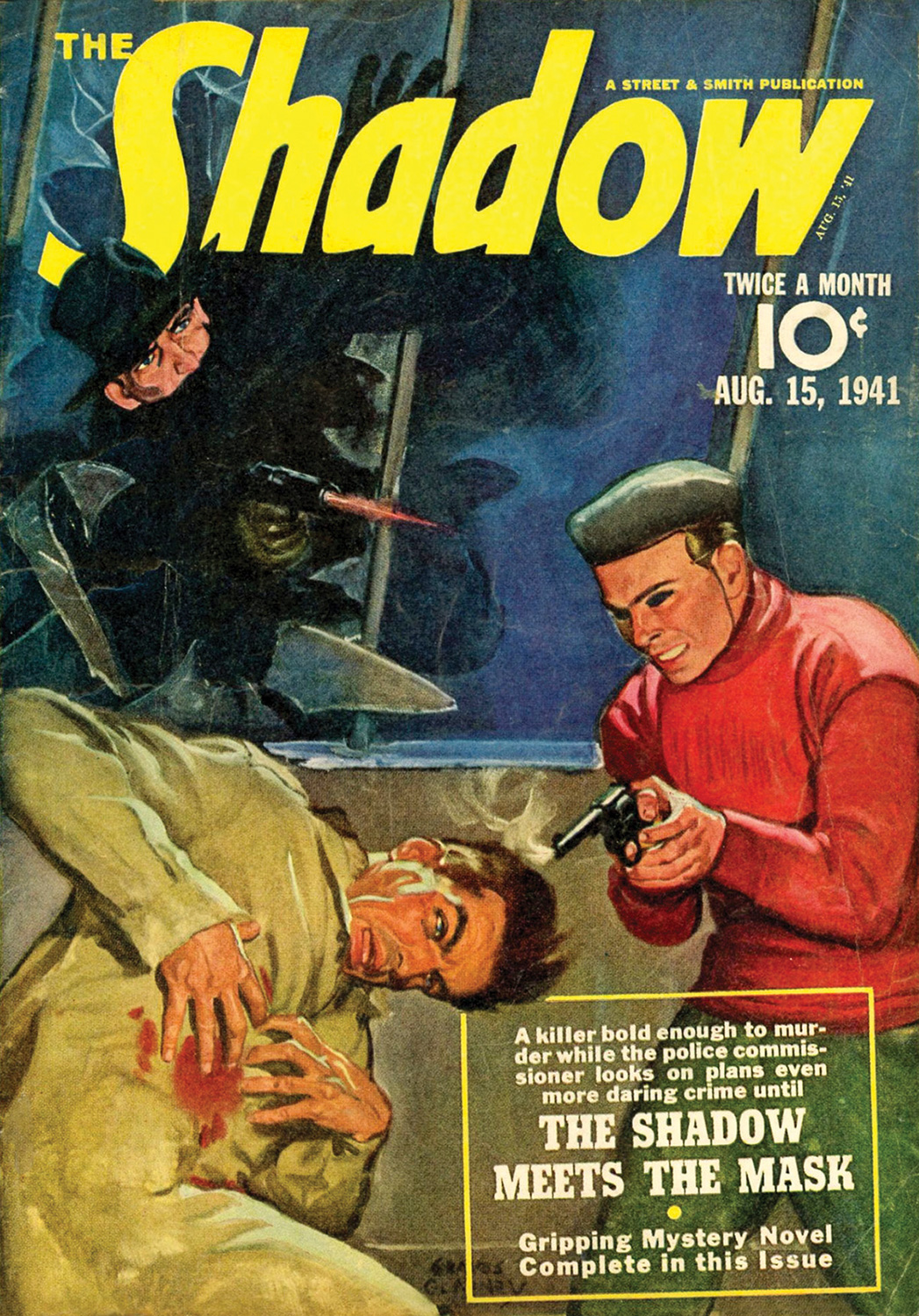
“The Shadow Meets The Mask” (Aug. 15, 1941)
Gladney: This is a Shadow cover and the reason I kept it because this man being shot is a self-portrait. With overwhelming difficulty using the mirror and putting the canvas at an angle, I got a pretty accurate portrait. The Shadow comes plunging through a skylight of the studio, despite the fact that such a fall would cut the Shadow to hell. This figure wearing the mask is a local boy named Al Dunn. All I did was paint a portrait of him and drew a line along his temporal and zygomatic [cheekbone] to make it look as though he was wearing a mask.
“Gems of Jeopardy” (Sept. 1, 1941)
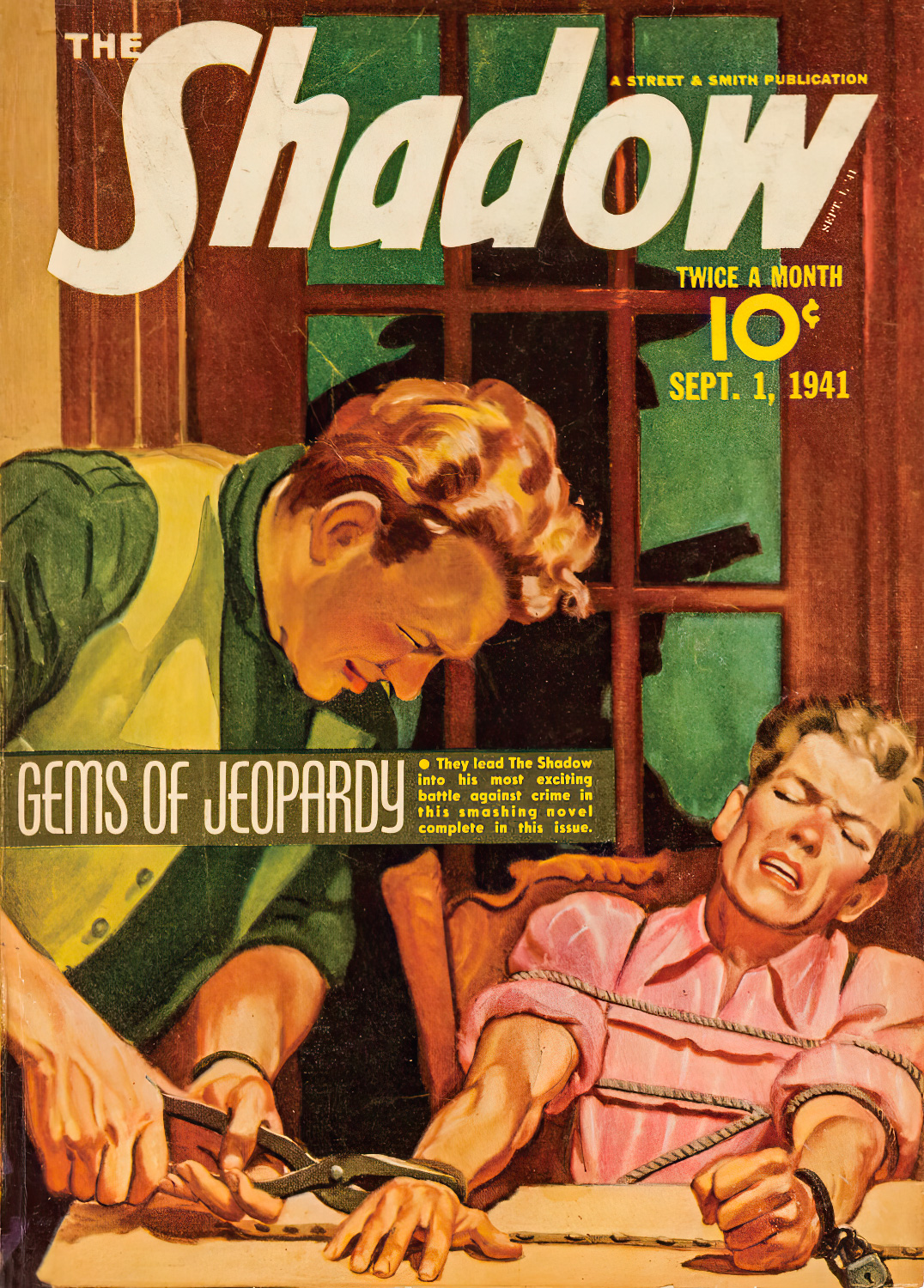
It’s interesting because the model of the man being tortured was one of the first listed casualties in the war [World War II]. Shortly after he posed for this, he enlisted in the Navy, and he was on one of the first of our naval vessels that was sunk. Most of the hands were lost, and among them, this man.
Then there is The Shadow getting ready to come in this odd door behind the torturer. And all the guy had to do was look up and see The Shadow with that gun stuck up his nose. But this didn’t bother the readers. Technically, I was only interested in the strong effect of light bearing down on the two. The hair on the one, even now, I see is quite well done. The hands are good, too. I want to tell you, to do hands this detailed is a full day’s work.
About the authors
Terry Klasek and Kenn Thomas were longtime pulp fans. Klasek died May 14, 2011, at age 64; and Thomas died Sept. 22, 2023, at age 65.