The artist candidly reflects on his craft and his work in the pulps.
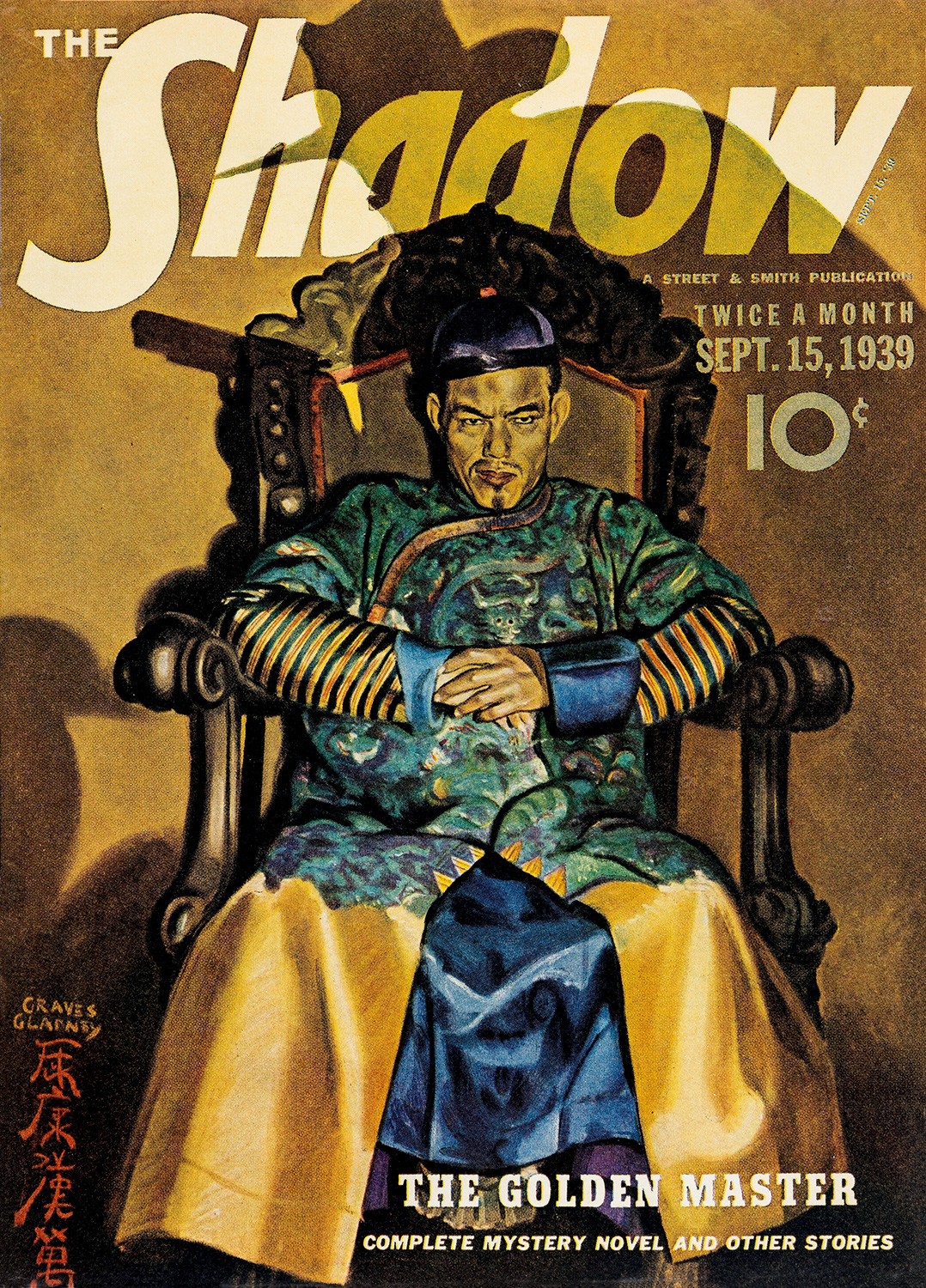
Graves Gladney painted some of the most iconic covers for The Shadow. He produced 62 covers between March 1939 and Sept. 15, 1941.
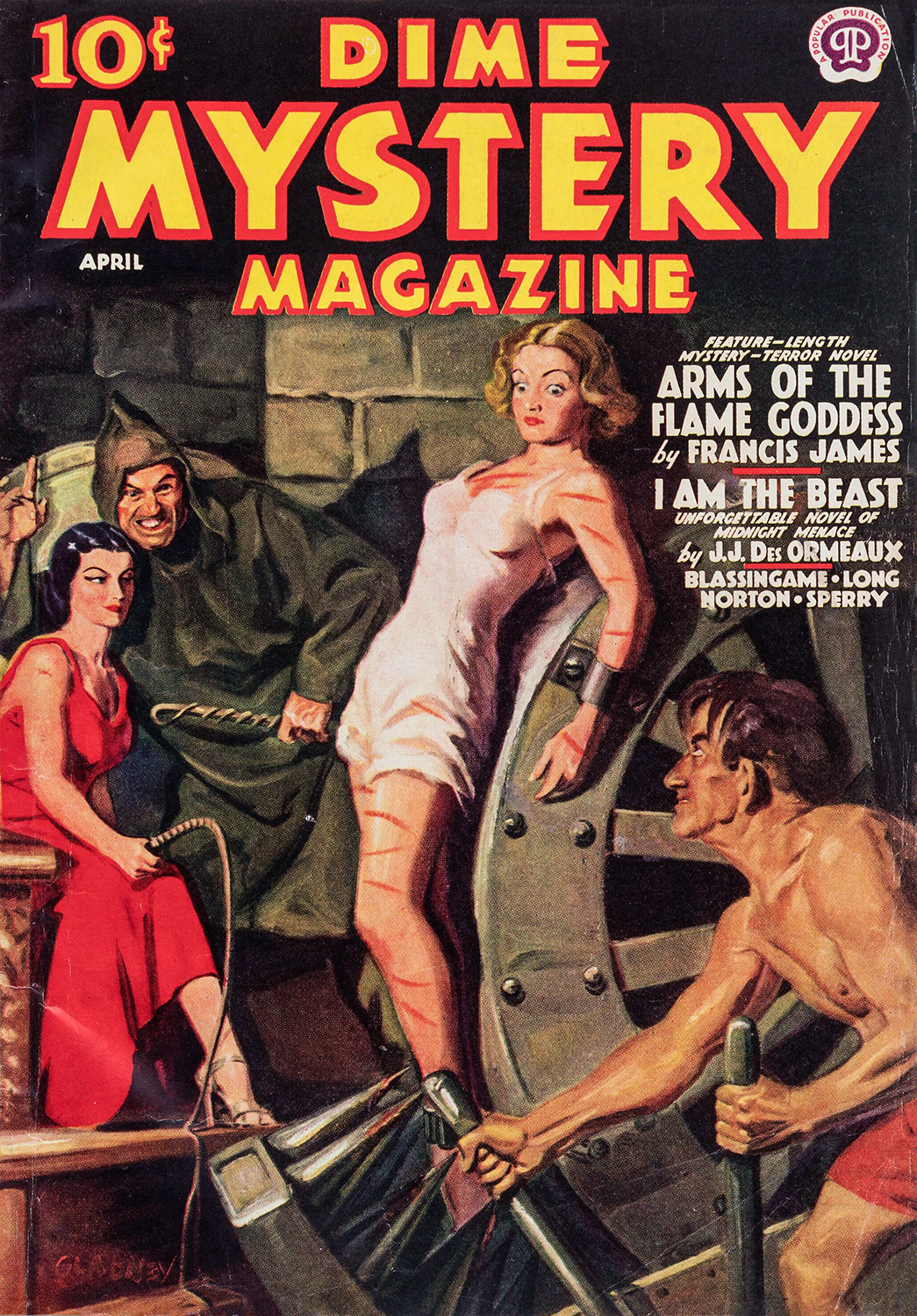
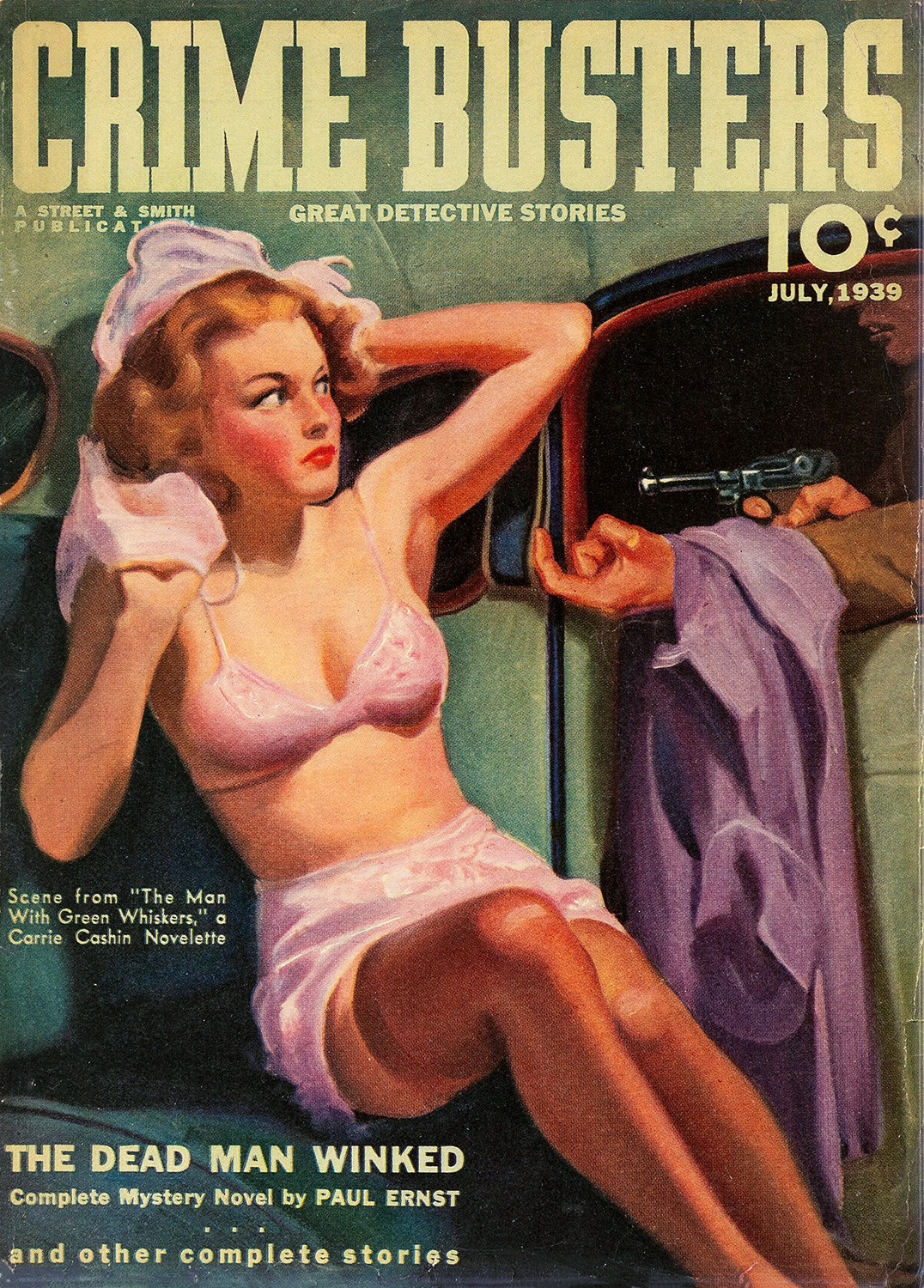
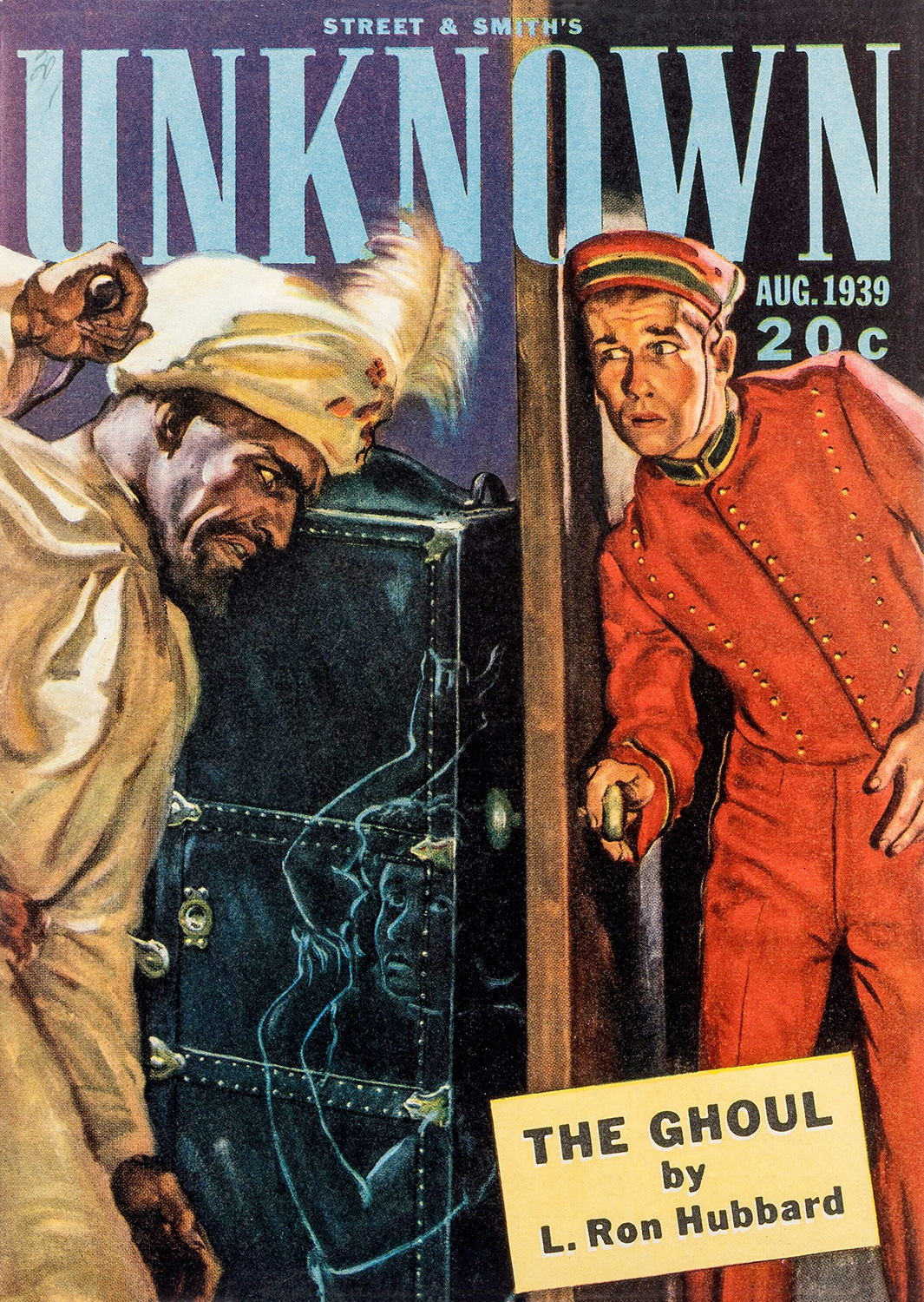
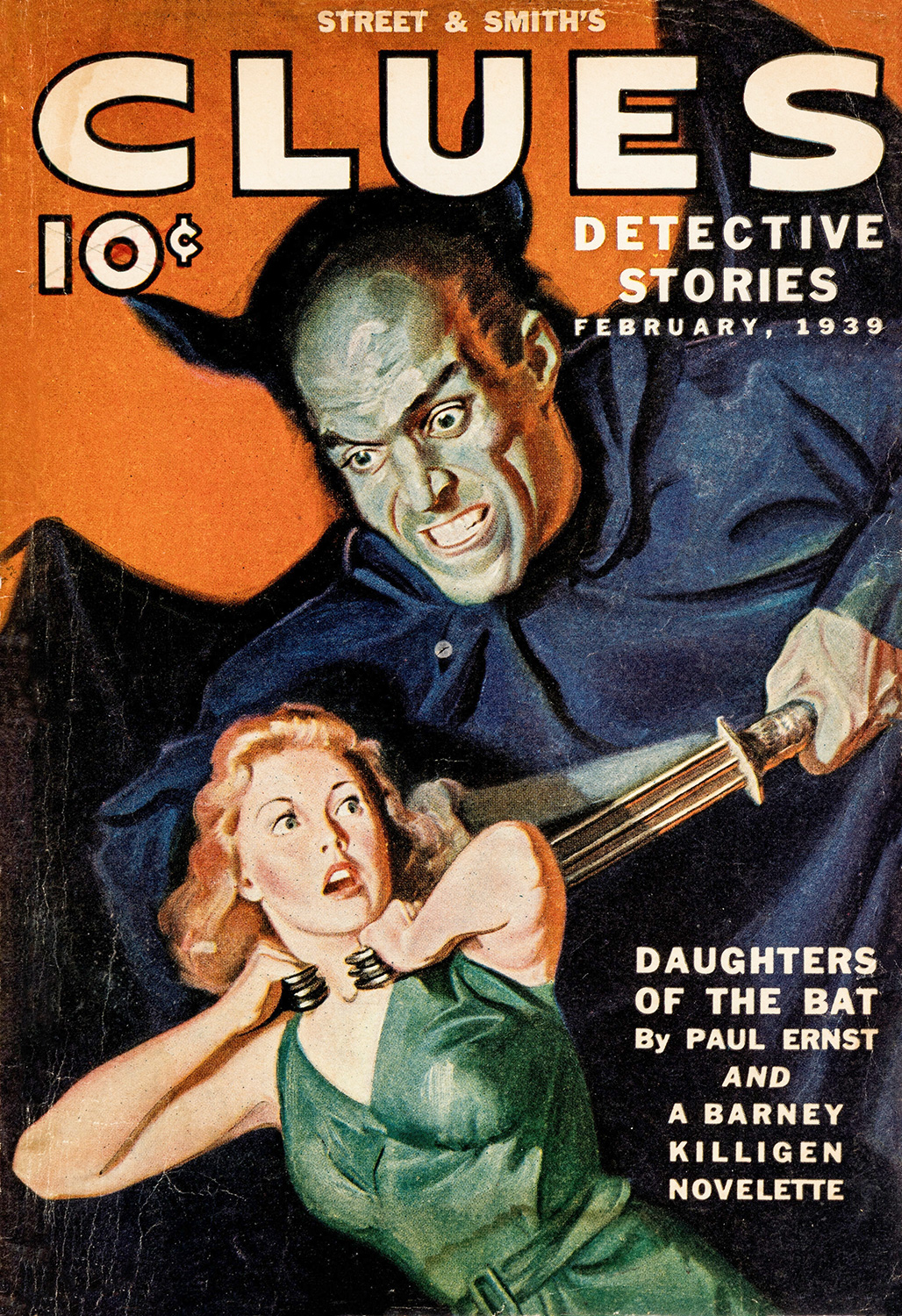
During his relatively brief career in the pulps, Graves Gladney also created covers for Lariat Story Magazine, for Fiction House; Adventure and Dime Mystery Magazine, for Popular Publications; and Astounding Science-Fiction, The Avenger, Clues Detective Stories, Crime Busters, Street & Smith’s Mystery Magazine, Street & Smith’s Sport Story Magazine, and Unknown, for Street & Smith Publications.
A few years before his death at age 68 in early 1976, two pulp fans — Terry Klasek and Kenn Thomas — visited Gladney at his home in Clayton, Mo., just west of St. Louis.
As Klasek and Thomas tell it, the silver-haired artist had just returned from an African safari and took pride in showing them photographs of the beasts he had subdued on his trip. A token of a previous trip, the stuffed head of a water buffalo, stared at them throughout the conversation.
After the photograph display and a tour of his gun collection, Gladney brought forth his pulp collection (all were ones with his covers) and some oil paintings, the original covers for several issues of The Shadow.
Q: Did you personally know any of the other pulp illustrators or writers, such as Walter B. Gibson?
Graves Gladney: I met both Gibson and [Theodore] Tinsley briefly, but aside from knowing … or … reading their manuscripts, I knew them very slightly, just by sight and to say this is Gibson and this is Tinsley.
Fanzine flashback
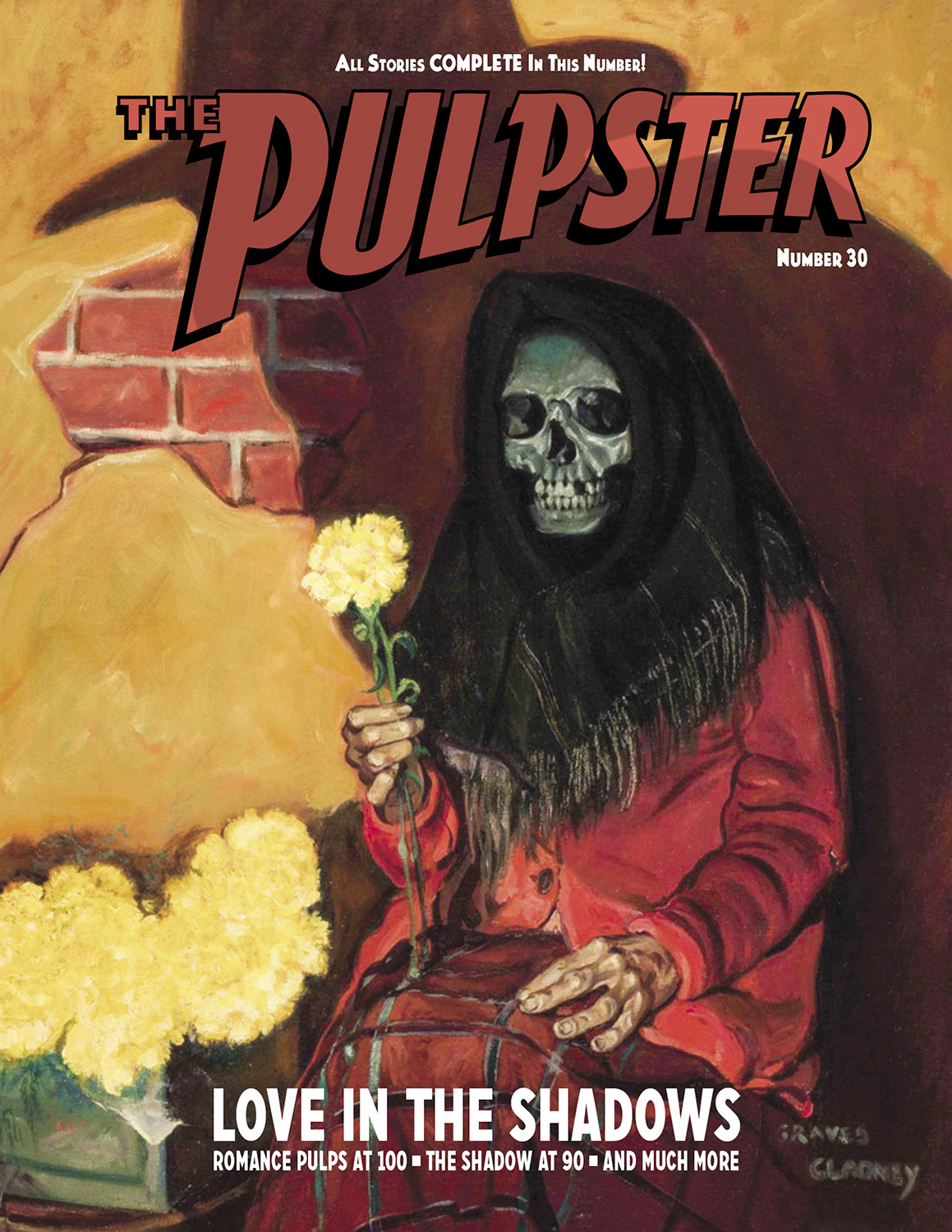
This interview appeared in The Pulpster (No. 30; August 2021). It originally appeared in two parts in the fanzine Whizzard (No. 4, Summer 1974; and No. 5, January 1975). It has been combined, edited, and corrected.
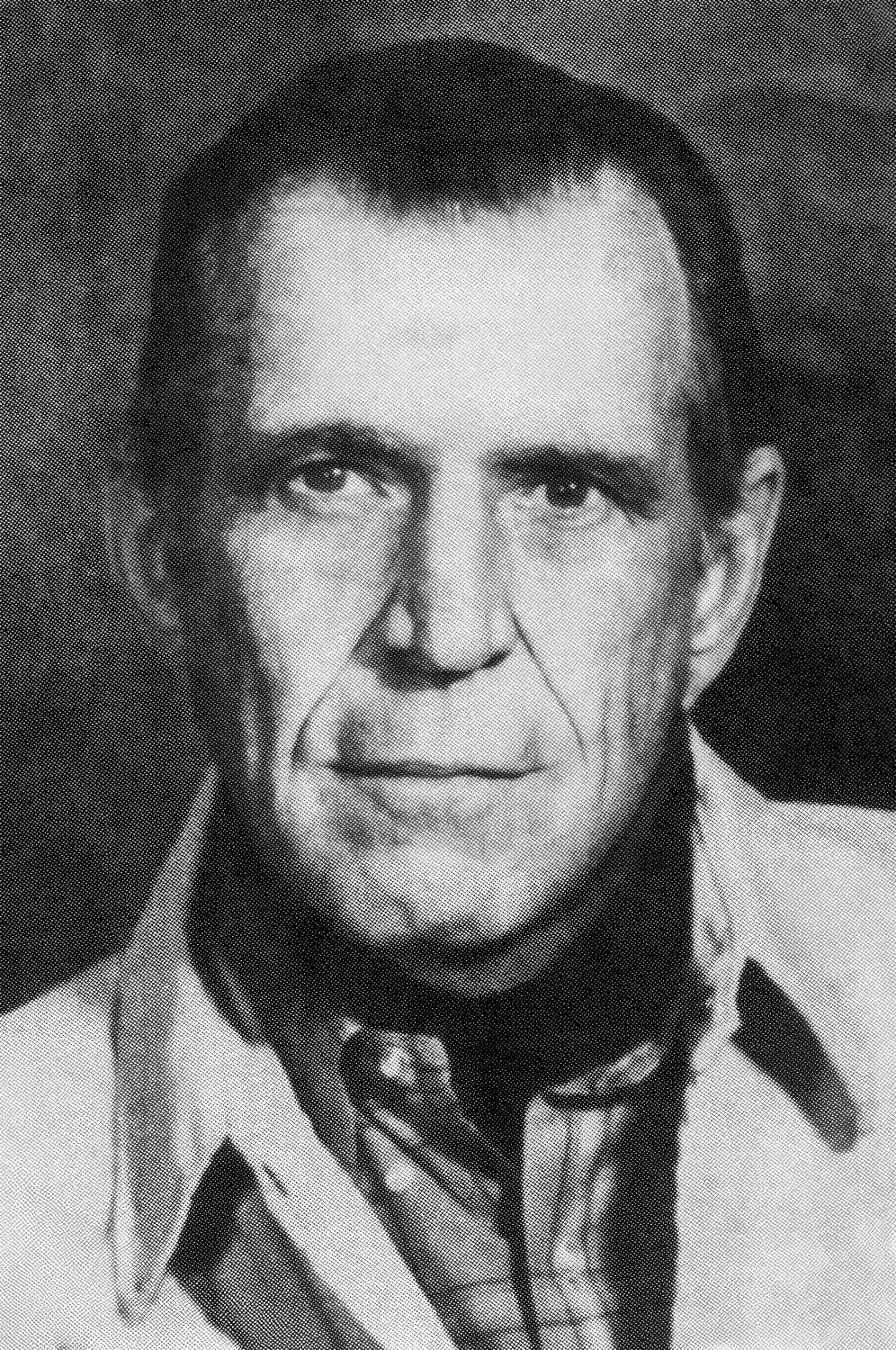
Gladney: Oh, Emery Clarke, I know intimately well. We even shared a studio after the war. I saw him almost every day for almost 10 years.
Q: Did you do any work on Shadow Comics of the period?
Gladney: No, I did none of that at all. Actually, the best black-and-white man for the inside of The Shadow Magazine was a famous illustrator and painter named Thomas Lovell. He was the last really talented man to do any black-and-whites; all of the rest I’ve seen were just pure nickel-and-dime hacks.
Q: How did you obtain an idea for the cover illustrations? Were you provided with a copy of the manuscript?
Gladney: Yes, a copy of the manuscript. Usually, the routine was that I was to take in a finished cover on, say, Monday, and once that cover had been okayed and finished and accepted without change, then I was provided with a copy of the manuscript for the next Shadow. Of course, The Shadow came out twice a month so theoretically I would have two weeks to do one, but since I was one of the staff artists, frequently they had a cover of some of the other magazines for me to do as well,
Q: Were you always a pulp illustrator, and how did you get started in the field?
Gladney: No, I’ve always considered myself a painter of traditional ability, good or bad. When I finished art schools I attended in Europe, I came back to the United States and was faced with the necessity of making a living. Times were very bad, and I had a few false starts. I tried to get on as a draughtsman on The New Yorker magazine, for example, with absolutely no success. Finally, I met a number of painters who were successful at making a living at painting in one of the most prolific, fertile fields for painting, that was the so-called pulps. They urged me to have a go at it. They explained the field consisted of four or five publishing houses dealing exclusively in pulps, and suggested I get started by doing a cover for one of them.
Q: What was the average pay per cover illustration?
Gladney: It varied, but of course, the pay compared to present-day standards was poor, but the money would buy a great deal more. The first covers I painted and were accepted paid me $75, and as I got better and more in-demand this was raised to $90, and then $100, and then, after Pearl Harbor, $125, with the exception of Popular’s Adventure magazine — which occasionally I painted a cover for — paid $150 to $200, which was regarded as indeed high, good pay.
Q: Which magazines did you illustrate, specifically?
Gladney: Well, a great variety. First of all, you must understand that in the ’30s, to my knowledge, there were at least five houses publishing successful and continually a variety of pulp magazines. There was Popular Publications, run by a man named [Henry] Steeger and a number of sub-editors. There was Fiction House, a smaller but thriving publisher. Thrilling Publications was run by Ned Pines. And, of course, there was Street & Smith. Now, I worked for all of these, and I got started, actually, with Fiction House, which was more liberal; they bought covers on speculation and rarely ever commissioned a cover. Sometimes they did, but most of the time, they waited for young, aspiring, and hopeful painters to bring them a cover in the hopes they would use it.
Q: What magazine did you enjoy doing the most? Did you have a favorite illustration?
Gladney: Of course, The Shadow was the most lucrative, because it guaranteed that if I did nothing else but The Shadow, I would make $3,000 to $4,000 a year, which in 1937-38 was very big money indeed. So therefore, I enjoyed that probably the most.
But the thing I wanted to make clear is that no matter what house I painted for, I regarded my work as the best I could do, never mind the subject matter. Most people tend to patronize painters of pulp covers, but I can assure you that the best of the pulp painters were very good painters indeed — Walter Baumhofer, Emery Clarke, Tom Lovell, etc. They didn’t just consider themselves as just painters of drama, but very skilled men who adapted their skills to a particular client.
I think The Shadow I enjoyed the most. And the ones I enjoyed least would be the western magazines, because I regard all of these western pulps as being basically phony. The stories they told had no relationship to reality.
Q: Well, the covers were good, and many people enjoyed the stories. What, then, in your view, caused the decline and eventual fall of the pulp magazine?
Gladney: First of all, the war, which brought exciting reality so close that it made the false excitement, such as the fiction in the pulps, dull and tame. And, of course, after the war, in 1946-47, television began, and once the television programs became popular, it simply wasn’t popular to interest adolescents in written sensational happenings when he [sic] could sit with far less effort and see far more violence, more sensation on television. I think that did as much as anything.
Q: Most editors at that time preferred realistic covers. Do you think this cramped your style in any way? Perhaps you wished to be more abstract in your drawings?
Gladney: Oh, by all means, no. I despise so-called “abstract” art. I think it’s simply a creation of promoters, snobbish dealers, and wealthy clients who seek some kind of notoriety through odd tastes. No. I think in general, the editors of pulp magazines had one good virtue: They knew what they wanted, and they could recognize it.
Now, it wasn’t always what I considered good in my case. Matter of fact, some of the worst covers I ever did, in my opinion, turned out to be the ones most liked by my employers. But this is inevitable; it is this difference of opinion that makes horse races. But at the same time, I never felt cramped by the demands of reality because I, within my own definition, consider myself an extremely realistic painter.
Q: Have you ever given any thought to returning to the field, and, say, do a cover for a digest magazine, the descendants of pulps, just for old times’ sake?
Gladney: Never even once. Because the only reason I ever painted pulp pictures was to learn my craft and to get better, which was impossible in an art school, or by painting that wasn’t driven.
By that I mean that the average so-called painter does not make his craft support him. He is either subsidized, which means he is teaching, or he is subsidized by outside help, father, family, or something. Whereas in my case, I wanted to get better and better. I still want to, and the only way I could see would be to be forced to paint every day along the lines that I consider valid, and at the same time, be paid for it. Now you have a choice that way, of either getting an agency job, which I despised, or tackling the open market and simply hoping that you were skillful enough and hopeful enough to knock off the low man of the totem pole and start your own ascent.
Q: Did you do any interior artwork?
Gladney: I’ve done a number of black-and-whites, but never for Street & Smith. [Before] I began to work for Street & Smith exclusively — which I had to agree to do when I took The Shadow contract — I quite frequently did a number of black-and-whites, to my sorrow, for Popular Publications, for Mr. Steeger, whom I despised and still despise, and you can quote me. Under pressure, I did a number of black-and-whites for G-8 and His Battle Aces.
Usually, what would happen would be that the original black-and-white man who had been commissioned to do the inside illustrations would be drunk or disorderly, so Steeger or one of his editors would offer me a huge bonus if I could do it and get it to them in the remaining time, as they could send it to the printers. Well, each time I fell for this bait and would kill myself to get it to them on time, within the deadline, and find out that they, through a variety of reasons or excuses, would pay me of only half of what they had promised. I cannot convey enough against the unscrupulous practices of some of the pulp editors.
Q: Before this interview, you mentioned that the editors were thinking of keeping a harlequin Great Dane that you disliked drawing as a regular feature for The Shadow. You promptly suggested that this idea did not strike you as pleasant, and the editors decided that you were right. Did you really have that much power as to deciding what went into the pulps?
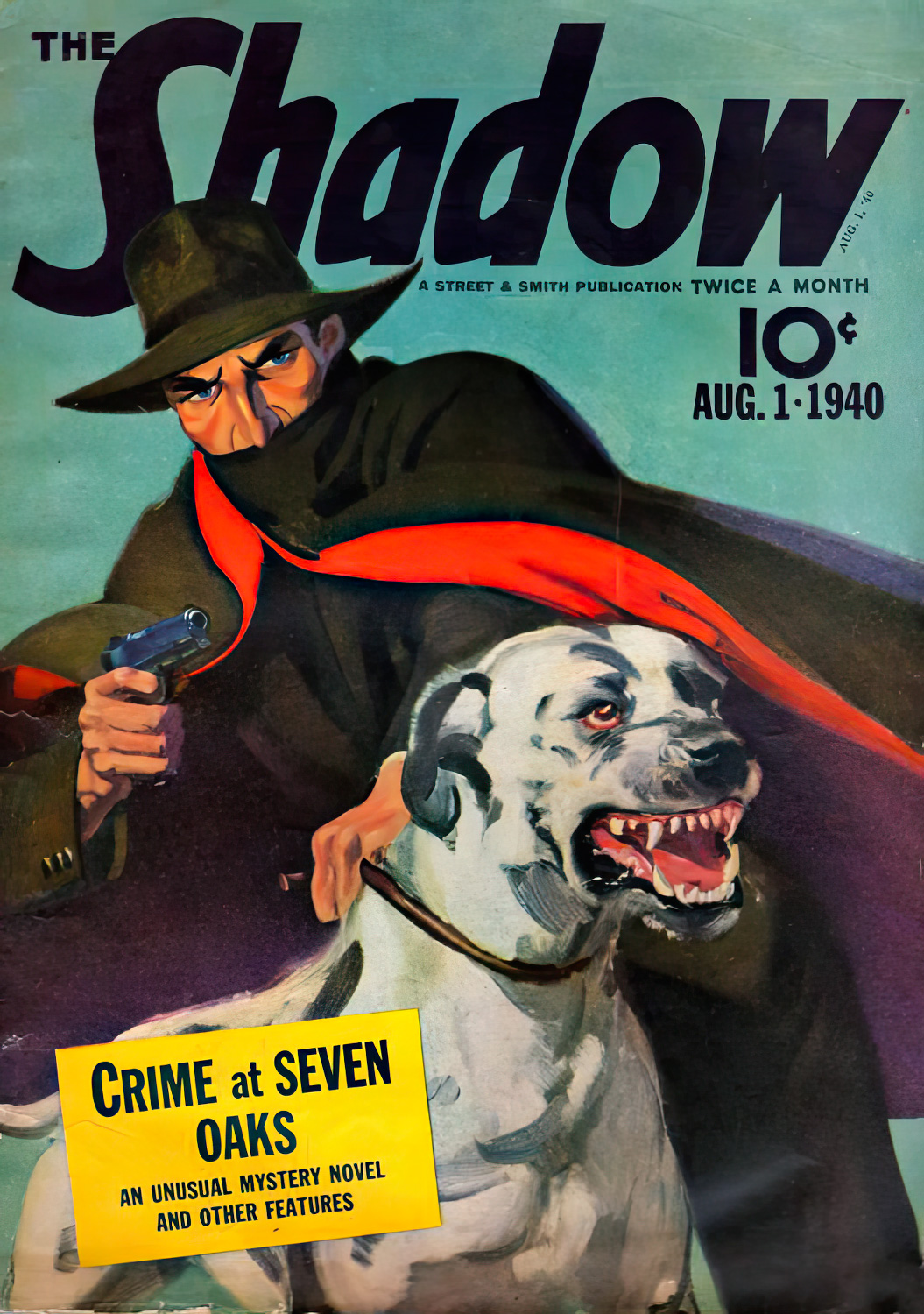
Gladney: The trick word there is “power.” I think that probably I never had any power. I think that I had a tongue and could explain the unworkable ideas that they had. For some reason, this idea of the dog seemed to appeal to many of the readers. There was a so-called Shadow Club, and every month, there would be a number of letters coming to the editor in reaction to a given Shadow cover. Not only the cover, but the entire magazine. This particular cover showing The Shadow with a great, big harlequin Dane on a leash seemed to appeal to an unusually large number of readers. The editor at that time was a man called [John L.] Nanovic, who was constantly “keeping his finger on the pulse of the nation,” and he thought it would be a good idea to have this dog as a periodic but regular character.
Q: Did the art editors decide what the cover was to be like, and did they make decisions as to, say, what color the cover backgrounds would be?
Gladney: Yes. For example, many of the magazines that were open, that is that the covers were bought on speculation, such as Rangeland Romances, put out by Popular. It had one requirement — the background had to be a kind of middle blue, and it always had that cover, that was fixed. Star Western, also by Popular, had a flaming red background. As for The Shadow, all of the art editors that were successful — [Sidney Walter] Dean, [William Maurice] Flynn, and [Alex D.] Sniffen — said that the cover did not have to have the same color background. As a rule, there was a great deal more liberty there [Street & Smith] than there was at other magazines.
Q: How would you compare the stories that you illustrated with those of more traditional fame, the classics?
Gladney: Now, you must remember that my own tastes are probably not indicative of the average pulp painter.
First of all, my own life has never been so limited that I thought of nothing else but painting. I read voraciously, you might say, but never did any of my reading include anything like the average pulp writing.
No, I read the manuscripts. At first, because I had to, but later on, when I became more established, more educated as to ways and means, I hired various art students who were always applying for some kind of job in the ’30s. I’d tell them to read the manuscript and pick three or four situations, and give me a quote from the actual lines indicating the situation. And to the best of their ability, they were to give me a sketch, no matter how crude. I’d pay them for it, and look at their quotations and sketches, and then I would formulate some kind of an idea from these and paint a full-color sketch of the same size and take two or three of them to the art editor, and he’d say, “Make me this” or “Make me that.” I would take this sketch back, enlarge it on the canvas, which was three times the size of the actual cover, and carry as far as I could from that sketch, and get the models and complete it.
Q: Is there any one particular cover that you point to as your best work?
Gladney: There were two or three of them that I personally liked very much, and they were as good as I could do, and I have no excuses or apologies for.
Some of the worst ones that I did were those that were most directed by the art director. And, oddly enough, the more I disliked them, apparently, they were more cherished by my employers.
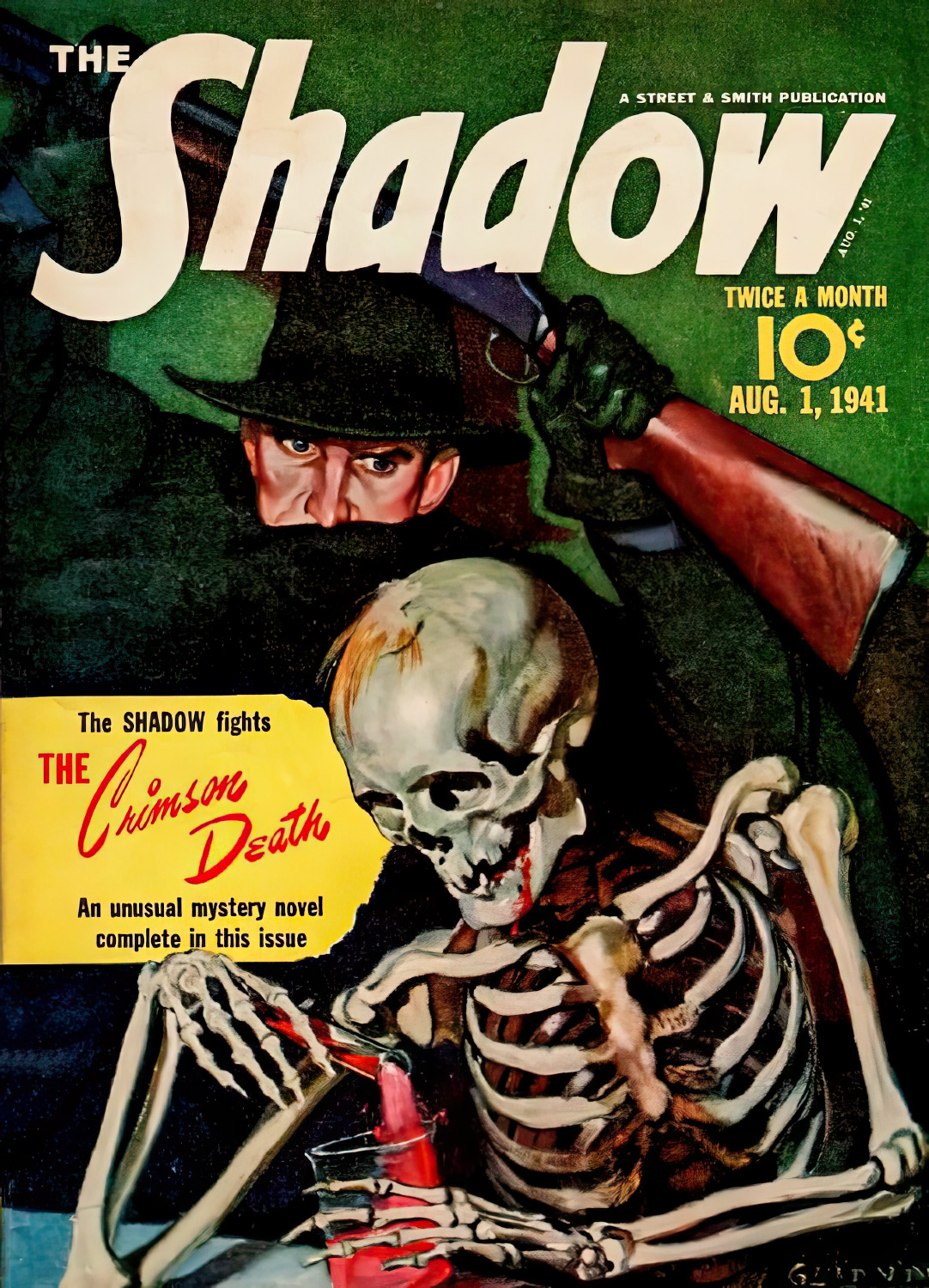
Yes, the cover I did with The Shadow about to strike a skeleton from behind with a Model 97 Winchester, I liked very much because I articulated the skeleton so that it was apparently — absurd of course with its bony appendages — pouring out a poisonous potion. I liked it because I remembered Walter Baumhofer, who was the king of pulps, had done several covers with skeletons that were so absurdly articulated that I really had to laugh.
So when it came to my turn, I really sat up a skeleton, and made the damn thing right and made it work. Of course, as anyone knows, when the human body is reduced to its bony parts, the tendons, which connect them, having been gone, it would be just a pile of bones, so it must be re-articulated, so the whole concept was totally absurd. Nevertheless, you can, by a system of wires — it’s done all of the time — pose a skeleton so that it is apparently performing the same functions of a normal body, and this also seems to be very eerie and frightening to the public. That was a good cover.
Another one that I did was called “The Scent of Death,” with an old woman selling flowers on a street corner, and in her shadowed head was a skull. They liked that, too. That latter cover was hung in the editorial offices of Street & Smith for years as an example of what they considered as good pulp painting and as an indication to aspiring newcomers of their own tastes.
Q: Aside from these two covers, as a rule, were you very conscious of detail or anatomical features, or did you attempt to allude to certain subjects?
Gladney: I’ve always been an advocate of reality. First of all, I would like to say that I would define art as nature filtered through a temperament. In other words, in my opinion, the finest art is produced by a very competent painter who is trying to portray visual impressions that which he sees as faithfully as possible. My ambition always was to tell, as truly as possible, the sum total of what I saw. I do not believe in abstract art because nature is so much more varied than any imagination.
Gladney: My father, whom I always adored, knew when I was young that I wanted to be a painter, and he insisted that an artist could never be any better than he is as a man, and that his ability at the arts, ultimately, would be the sum total of what he knew. There was a certain amount of truth in that.
Following this premise, he insisted that I go to college, that had nothing to do with the technique of painting. And I went to Amherst. I graduated after four years with a Bachelor of Science degree. I studied mainly languages and mathematics — and English, I suppose.
Anyhow, that being done, I then went to take my formal education in Europe, and I lived for four years in Europe. I went to two of the really excellent schools, the likes of which have disappeared.
When I returned to the United States, I really thought I was a painter, and my father quite rightly said that if I was a painter then my craft must support me — otherwise take up something else, because he was not going to let me sit around and call myself a painter if he was going to support me, which was reasonable enough.
So, I took off for New York. At that time, I had a foreign wife who spoke very little English and had very little liking for this country, but, nevertheless, I went to New York, and through many trials and tribulations, “by long and weary dances,” I began to make a living at the pulps.
Q: After you stopped doing pulp covers, what did you do?
Gladney: After I got out of the Army, I reopened my studio in New Rochelle, N.Y., and did a number of things, mainly for lithographing houses, calendar art, and posters. I also worked on comic strips with Emery Clarke and, very briefly, with Buck Briggs, who at that time was doing “Flash Gordon.” I wasn’t by any means successful at it because I was gradually becoming disillusioned with the notion of studio painting, simply because, perhaps, after a number of years in the Army and in the combat infantry, I had lost the ability to deal in completely false violence, having had enough of the real thing. Whatever it was, I gradually became disillusioned with it, and in 1949, when I was offered a job teaching at Washington University, I changed my residence to St. Louis.
I taught for 11 years at Washington University until I couldn’t stand it anymore for reasons best known to myself. I resigned and haven’t had a need for money in a number of years. I’ve tried to stay as far away from art and artists as possible.
Q: You mentioned that you worked on the “Flash Gordon” comic strip. Any others?
Gladney: Yes, on the ideas and the continuity, I helped Emery Clarke, who at that time was doing the “Invisible Scarlet O’Neil.” I say “helped.” You must understand that I assisted in the continuity of the strip. Although he was handling the strip quite well, I taught him that to write a mystery story, he must start at the end and work backward to the start. That way, you do not paint yourself in a corner, so to speak, and you always know what is going to happen.
To that extent, I helped him quite a lot over seven or eight months, and the strip prospered. Not necessarily because of my help, but as a matter of fact.
I also helped him on the names of quite a few of the characters of the strip, mainly because I liked him, and I liked using what little mental ability I have. I liked adapting my tools to the demands of the situation.
Their interview with Gladney continues in “Graves Gladney speaks his mind, part 2.”
About the authors
Terry Klasek and Kenn Thomas were longtime pulp fans. Klasek died May 14, 2011, at age 64; and Thomas died Sept. 22, 2023, at age 65.