A field guide to the penny-a-word trade, where action was God and plausibility his only prophet
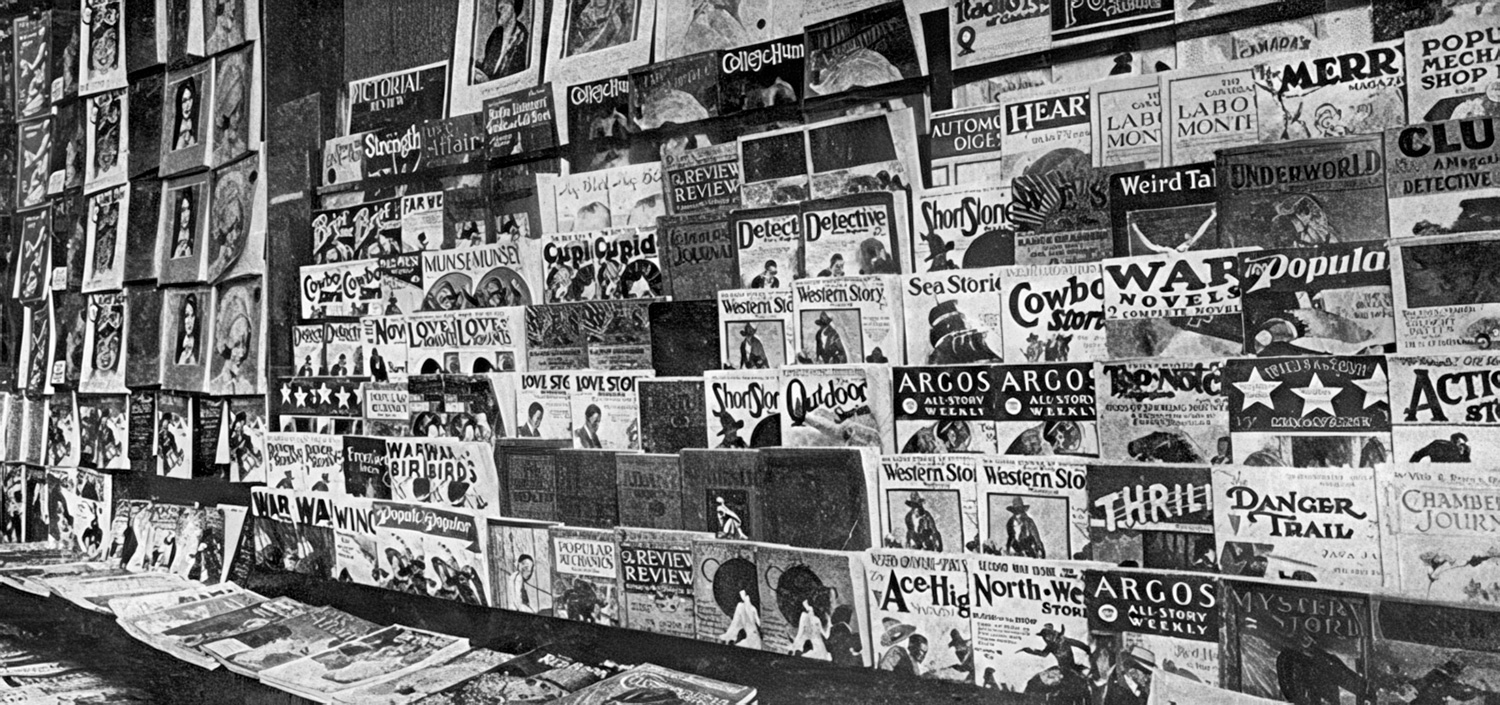
Wood-pulp literature is bought by the bale and sold by the long ton. It is printed on paper made (apparently) from gray oatmeal, pressed between illustrated covers seven times too vivid to be called garish, and shipped in carload lots to all points of the English-speaking compass.
“For sale at all newsstands,” it is avidly bought up by 20-million readers a week, and read in the best poolrooms, banking houses, subway trains, and university halls in the United States.
Wood-pulp is the great unrecorded fact of American literature, the successor to the dime novel as the standard literary diet of a thrill-hungry populace. It is the reading dividend of a democracy; the weekly fiction light that dare not fail. It has no subscription list, carries little or no advertising, yet has more readers than all other types of magazines combined. Stylistically, it’s awful; structurally, it’s carved out of unreality by the flat side of a venal typewriter; you may not like it, and may even despise people who do. But take it or leave it, approve, condemn, or patronize — Wood-Pulp, there she stands!
Editor’s note
This article originally appeared in The Bookman (August 1928).
You all know the wood-pulp weekly. Under its various names — Detective Fiction, Adventure, Black Mask, Flynn’s, Horror Tales, Sea Stories — it has at one time or another come under your reading eye.
Perhaps you bought a copy one day, just to see what it was all about. Probably you’ve been buying them ever since. Why? Because wood-pulp is as big a dime’s worth of vicarious satisfaction as one can buy in this palely inhibited age. They’re nine parts action and 17 parts romantic improbability, done to a sizzling turn by writers whose credo runs “Action is the true God, and plausibility is His only prophet.”
Wood-pulp, next to laudanum, is the most habit-forming drug on the market. Ultimately, it gets you. If you miss a week, or if the issue happens to be poor, or if your favorite author doesn’t write his usual story about Ss-s-imp-k-kins the S-stut-tering Detective — why, the week is ruined, and you’re bad news around the house.
But possibly, being one of the superciliary hairs on the Proust-Gide eyebrow, you have never heard of wood-pulp. Or haply you read only the Book-of-the-Era when it’s left at your door by the postman. Well, if you go in for that sort of thing, communication is going to be difficult; probably, this writer will have no idiom delicate enough to touch you. He intends to speak of things that will make you sorry you ever heard the horrible syllables “wood-pulp”; he is going to lay bare the hideous conditions under which pulp writers exist, crawl about, and perform their dreary stint.
Your ideas of literary production will be blasted; your concept of the artist as a young man or as any other kind of a human being will have to be revised. And if you are yourself a practitioner of belles lettres, who have been painfully undergoing the parthenogenesis of 500 words a day, and sniffing essence of verbena for the exact nuance of adjectival color and adverbial overtone — we ask you to lift your skirts please and step down into the smelly sub-literary pits where the wood-pulp boys twist their verbiage into linked injpossibilities long-drawn out.

Few mature intelligences want to write for the wood-pulp magazines. Few can. The physical battle of hurling 6,000 words a day onto paper, the brain-pulverizing business of devising enough hair-trigger action to stretch over the plotted area of your tale, and the ghoulish necessity (when invention fails) of coming back again to feed off the dead flesh of last year’s yarns — these are some of the reasons that make wood-pulp literature the last miry trench of men who write against despair. Actually, they are a special race of feuilletonists, stemming from the same huge trunk that bore Dumas, De Foe, yes — and the greatest quantity-fictioneer of all time, one Walter Scott, Bart.
Their talent — and it is considerable — is narrative; their genius — and it is magnificent — is stretching that narrative out into 40,000 or 50,000 words without loosening their hold on the lapel of the reader’s interest. For in Woodpulpia, the only unforgivable sin is dullness, and the forfeit of dullness is soon paid.
The magazine is barely on the stands when the editor begins to receive great batches of “fan letters,” blasting that last puny tale, “The Waffle Iron Mystery” by Nicodemus Dent.
Now “The Waffle Iron” may have been (from any reasonable standard) a closely reasoned, well-written yam that the editor tried to slip over on his million readers with some notion of raising their standards. But alas! it hung fire a trifle just between the second murder and the fourth poisoned dart. So, of course, it was doomed; Nicodemus Dent’s stock on the fiction curb drops about seven and three-eighths degrees, and the editor trembles as he hears the reading proletariat thunder “Action, action, we want action.”
And they get action. They get it in their serials, which are so arranged that a new one starts every week; they get it in the short stories, of which there are five or six in each issue. And they get it in their complete novelette, that peculiar literary form devised and fostered by the wood-pulp press.
The “complete novelette” shows the wood-pulp artist at his worst and best. No man who isn’t capable of turning out one of these novelettes in a week can ever hope to qualify as a union pulp writer.
They vary in length from 15,000 to 30,000 words, and are as hectic in theme and execution as the human brain can devise or the moving finger write. The dominant colors are red and black; character is delicately painted in with a calsomine brush. Plot circles within plot, action leap-frogs action, knives slither, pistols spit, fiends flee, and strong men pursue. There is a sizzle in every sentence, which consists of a terribly masculine subject, an actively smiting verb, and a rapidly smitten object.
Your wood-pulp stylist never goes in for psychic probings or contingent metaphysics. If a page of James (Henry, not Jesse) were discovered in a wood-pulp magazine, what a scene would ensue, my countrymen! The skillful pulp artisan also knows that there must be a complete episode and a copper-riveted climax every 500 words. Murder makes a nice climax, but if this cannot be conveniently arranged, a hold-up, or a mysterious disappearance will do nearly as well.
In fact, anything will do, just so long as the writer can keep it dizzily zigzagging across the reader’s vision. Otherwise, the tale grows somewhat limp, and again the fan letters descend in an avalanche, complaining that the stories are getting too high-brow, hence soporific. Briefly, the wood-pulp audience is always clamoring for a knockout. And they always get it.
Along towards the 15th round, just when the villain has the hero hanging on the ropes, all softened up for a kayo, Roderick Manley, the fair-haired boy, lets fly the equivalent of a terrific left hook, whereupon Virtue triumphs, Sin is confounded, the treasure is recovered, the mortgage lifted, the murder solved, the lovers reunited, and the bulls walk on merely to manacle the cringing culprit. Oh, boy, and also hot dog! Dear Editor: That Nicodemus Dent sure can write a wow of a tale!
II – The writers
In the tradition of beautiful letters, especially in that part of the tradition most painfully concerned with the mot juste, it seems impossible, not to say sacrilegious, that one man should be guilty of 60,000 words a week. But to any successful practitioner of wood-pulpery, this feat is not unusual. Most of them have had 60,000-word weeks, and a million words a year is not an improbable output for the wood-pulp worker with a family to support. The chief marathoner of all time was, of course, Col. Prentiss Ingraham, who wrote and published a thousand books, averaging 60,000 words apiece.

But even with the old, bungling, fountain pen system, he amassed a lifetime total of some 70-million words. His income averaged about $10,000 a year. And this is about as high as a wood-pulp writer can go. Suppose that the most active of the present-day group — Garret Smith, Ben Conlon, Judson Philips, and a dozen others whose names stand AA1 in the wood-pulp register — turn out half a million words a year, and get 2 cents a word for everything they write. That means they are making their 10,000 a year, and work like triple-compounding donkey-engines to do it.
What manner of men are these who grind the wood-pulp grist?
First off, they are all writin’ fools who were born with the storytelling pipe between their teeth and endowed with deep brain-creases in the plot-manufacturing area of the occiput. Moreover, they know how to toss a sentence into the air and make it land on its feet the first time. None of this rewrite stuff in Woodpulpia.
If the boys began to revise their stuff, they would all starve to death. So it’s one long machine-gun rattle from first to last, with all repairs made in mid-flight, and never a backward glance if the participles are dangling or whether the paragraphs start with a topical sentence.
As one might expect, many of the best pulp artists have been recruited from newspaper ranks. While there are a few steady pluggers in the business, the wood-pulp writer as a rule is an improvident descendant of the Grub Street hack, usually hating his job, and lashed into feverish activity once a week by the necessity of getting the Thursday check. (The good ghost walks on Thursdays in Woodpulpia.)
There is a lure about writing for Dizzy Stories, and the lure is this: you get your cash on the nail. Whatever befalls, your check comes in on Thursday, and then you’re all set for another nice period of loafing.
Suppose you are broke, wretched, and in no mood to trifle with the niceties of language. Very well. You call up the editor of Dizzy Fiction (he is an old friend by this time) and this colloquy ensues:
“Good morning, Horace Greeley. How about an idol’s eye story?”
“Good stuff. Haven’t had one for two weeks. Where’ll you lay it?”
“Chinatown, eh?”
“Nope, I’ve got six Chinatown stories on hand. Make it Fifth Avenue.”
“O.K. How many words?”
“Keep it under 5,000.”
“Right. Have it in tomorrow.”
So you sit down, write the idol’s eye story (which mustn’t differ one preposition’s worth from all other idol’s eye stories), and when you come to the 4,850th word, you begin tapering off for the end. This must always be done in not more than 100 words. Long explanations aren’t permissible, and if you can tie the whole works up in a paragraph, so much the better.
After seven or eight hours at the crank, your tale is all wound up, you take it down to Dizzy Fiction Inc., and the next day you get your $99.86.
If you’ve done your best and have really turned out a standard idol’s eye story (which begins by Roderick Van Fleet being accosted by a beautifully gowned woman on Fifth Avenue, who presses a carbuncle of fabulous worth into his hand and disappears), the editor is enraptured. He knows that the fan letters will come pouring in from all points of the zodiac, clamoring for another idol’s eye story by Nicodemus Dent.
And if enough fan letters come in, and if you get other editors interested in your stories, why, perhaps your rate will go up to 3 cents sometime. But higher than that, it cannot climb — unless you get to be an Edgar Rice Burroughs and invent another Tarzan.
III – The editors
What now of the wood-pulp editors, those lower-cave troglodytes of literature who in their eyeless dark paw over the thick-scummed manuscripts of crime? Do they like to read incessantly of arson, kidnappery, counterfeiting, and knife-throwing? Alas, they do not. Generally, they are meek and modest men with a thwarted lyric urge or a pale flair for playwriting.
I speak now not of the Bob Davises, the Matthew Whites, the Arthur Hoffmanns — that older generation of editors who raised wood-pulp to the condition of folk-literature, and kept it there for nearly half a century.
Rather, I have in mind the newer accretions clustering about the core of wood-pulp. Most of this younger school are sad-eyed chaps who have harangued freshman English classes from the infallible side of the desk but found the freshmen too obstreperous for them at last.
So they went down from academia and made the rounds of the newspaper offices, and were terribly brow-beaten by the rude people in those offices. Then they tried freelancing for a time, and ended up wearing blue shirts to save laundry bills.
Finally, they heard that Street & Smith was starting another paper and that an editorial clerkship was being created for Triple Action Magazine. If they are young enough and docile enough to listen to what the General Overseer lays down as the new Triple Action policy, they get the job. They are given a cubby hole in the corner of a coat room, or perhaps only desk space in a vast skating rink of an editorial room crowded with similar desks.
It is their function for the first six months to utilize the off-scourings of the older magazines in the same office; to buy at a cent a word all that is not quite good enough for Burglar Stories or Ghost Mysteries. At the end of this period, the editor begins to marshal his own camp of writers, raises his rate to a cent and a half, and if he’s any good at all, shows a circulation of 250,000 before the end of the year.

Wood-pulp magazines fall into three big classes, and naturally, there is a hierarchy of quality adventure stories (Wild West, Sea Stories, etc.), detective stories, and all-fiction — which means a wood-pulp goulash composed of every kind of story.
Naturally, there is a hierarchy of quality; some of the magazines are infinitely superior to the others. Frank A. Munsey’s Argosy is the oldest and perhaps the best of the wood-pulp leaders.
This magazine has been brought out for 45 years by the same editor, Matthew White, who stands today a unique figure in the magazine world. Once a week, he brings out 150 pages of clean, wholesome fiction. There’s no denying that it’s wood-pulp, but it’s always good going and, for the most part, sound, cleverly written stuff.
Frank E. Blackwell, editor of the Street & Smith Detective Story, is a wiry, tough-minded veteran who would have gone insane long ago if he were not a humorist who could take the daily beating with a wise-cracking jape at life and literature, which he affects to despise. Actually, however, he is devoted to Shelley and Thackeray, and cannot be induced to pore over detective manuscripts more than 11 hours a day.
And Arthur Sullivant Hoffman took Adventure so seriously for a decade that he made a great magazine of it, but later descended in the scale of things by taking up the editorship of a glossier, more effeminate sheet for a short time.
In the course of the last quarter-century, to go back no farther, this triumvirate of editors has seen platoons of wood-pulp writers pen their names in water, take their $100 checks, and pass on. Only a few have broken through the sub-literary crust and emerged into the upper world of light and letters. But even among these successful writers who served a wood-pulp apprenticeship, there are no really great names. One thinks, perhaps, of Sax Rohmer, J.L. Fletcher, Frank L. Packard, Mary Roberts Rinehart, Edgar Rice Burroughs, Leonard Nason, and a few others.
But, however long the list is extended, it will be a pitifully short one in comparison with the number of wood-pulp hacks who never could break away from the thraldom of Dizzy Diction.
A gray wrack of pathos clings about their names. Their 2 cents a word is spent long before their story appears, and in less than a month after the issue is on the stands not even the shrewdest of their own supersleuths could trace a single copy of the number carrying their yarn. No library files copies of wood-pulp.
Of the millions of words the wood-pulp writer grinds out, of the hundreds of plots he concocts, nothing remains but ephemera, shadows — dead wood-pulp with an old date on the cover.
About the author
Henry Morton Robinson (1898–1961) was an American novelist, editor, and teacher, born in Boston and educated at Columbia College after serving in the U.S. Navy during World War I. He taught English at Columbia University, worked as a senior editor at Reader’s Digest, and is best remembered for The Cardinal (1950), a bestselling novel later adapted into an Academy Award–nominated film, and for A Skeleton Key to Finnegans Wake (1944), written with Joseph Campbell. He also wrote over 300 stories for Adventure, Short Stories, Top-Notch Magazine, West, and other pulps.