

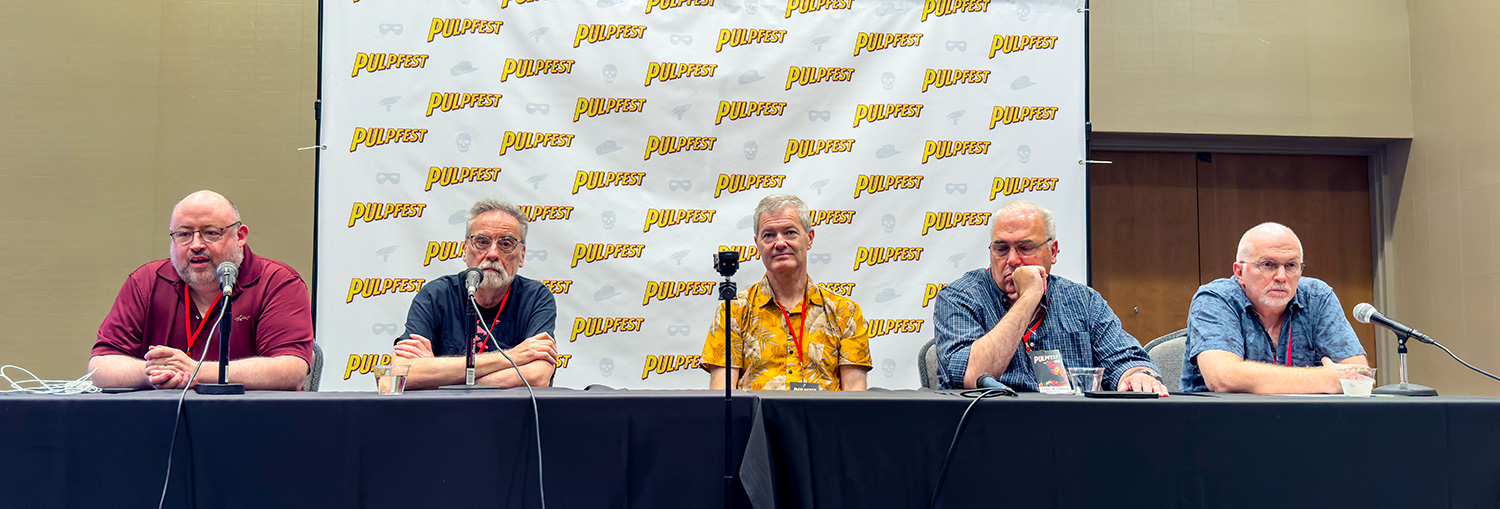
Author William Patrick Maynard moderates a discussion of how pulp-era fictioneers — Raymond Chandler, Robert E. Howard, William Lindsay Gresham, and Lester Dent — drew on their anxieties, experiences, and weaknesses to fuel and add to their work. The panel features author John Bruening, co-publisher at Flinch! Books, pulp fan Morgan Holmes, author and PulpFest committee member Craig McDonald, and author and pulp historian Will Murray. This Pulp Tales was recorded at PulpFest 2025 in Pittsburgh on Friday, Aug. 8.
Click to expand the transcript.
Pulp Tales Announcer: Welcome to Pulp Tales, fascinating stories of the pulp magazines and the creative minds that brought them to life. The fictioneers, the artists, the editors, and others. Brought to you by ThePulp.Net. Learn more about the pulp magazines through articles, blogs, bibliographies, links, over 100 episodes of this podcast, and much more at ThePulp.Net. Your link to the pulp magazines for almost 30 years online at thepulp.net.
Will Murray: So his loneliness, the fact that he was forced to use his imagination, the fact that he probably didn’t have a lot of books to read, and we know that he got a copy of Tarzan and the Jewels of Opar when he was like 15 for his birthday. That molded him and that gave him that power of imagination, but also that thirst for life to meet people, to travel, he traveled to Europe, of course, and he went to Central America, and he had his boat in Florida, and what molded him was loneliness.
Pulp Tales Announcer: In this episode of Pulp Tales, author William Patrick Maynard moderates a discussion of how pulp-era fictioneers Raymond Chandler, Robert E. Howard, William Lindsey Gresham, and Lester Dent drew on their anxieties, experiences, and weaknesses to fuel and add to their work. The panel features author John Bruening, co-publisher at Flinch Books, pulp fan Morgan Holmes, author and PulpFest committee member Craig McDonald, and author and pulp historian Will Murray. This Pulp Tales was recorded on Friday, August 8th, at PulpFest 2025 in Pittsburgh. Bill Maynard begins.
William Patrick Maynard: We’re talking today about personal demons in the creative mind. And while the gentleman, and we will have had a lady with us as well, but unfortunately, Laurie moved to the West Coast and was unable to make it work within her budget to join us here. Which, you know, at least we have John at the end for Glamour.
And that said, what prompted this was in looking at the fact that escapism is what much of Pulp Fiction is about. Escapism, for me, and probably for many of you and many of the people on this panel, is the portal out of an unpleasant real world into a much better, much more interesting world. And on a personal note, you know, I grew up in the inner city, but I had a home and a house and everything.
And my parents grew up in housing projects. And so to me, I didn’t really think about people that were more fortunate when I was growing up. I thought about those who were less fortunate.
Very much in the sense that books were the necessary escape from a world that seemed fraught with abuses and addictions. There was a lot of alcoholism and drug addiction in my neighborhood growing up. Most homes had varying degrees of abuse, you know, verbal, physical, worse.
And there was a lot of tragedies, which is often what happens. in lower income situations. I lost my mom when I was nine.
I’m sorry, I was ten. She was just four weeks before her 40th birthday. Obviously, I’m very nervous doing this part.
Sorry, it was actually four days before her 40th birthday. Which has stayed with me. Just the memory of having gifts for your mom and you don’t get to give them to her.
And books became such a necessary portal of escape. And it took me out of a world that seemed gloomy, cruel, horrible in a lot of ways. And I got to read a world, I never liked kid books.
I loved a world that was Edgar Rice Burroughs and Robert E. Howard and later Saks Romer that gave me places that seemed filled with danger, but of an exciting type of danger and adventure, and in which people were always in control of their lives, even if they were thrown into very difficult situations. No one was helpless in these stories. They were always capable.
And, you know, it goes beyond fiction. it was the same thing that drew me to comedies because comedy does the same type of thing. It puts people in situations, sometimes painful situations.
Daryl Schweitzer, who’s not with us right now, is walking around with a Three Stooges shirt and I was thinking about that. So much of that sort of humor is taking pain until it’s the point where you laugh at it. And that sort of escapism became so important to me And I realized the more I learned about writers or artists and even editors, so many of them were, their work was colored by the personal demons they struggled with either from childhood or throughout their life.
Or it actually was cathartic, the work they did where they were able to grapple with issues even if they didn’t directly think they were doing so. And I realized when Craig and I did our talk on Hemingway and Hammett and the parallels in their lives, some of those parallels were also the way they struggled with their personal demons. And that certainly colored their work, but it also served as a muse to their work as well, where it was part of what they were grappling with life issues and using their fiction to do so to express feelings that they probably couldn’t have had in conversation with anyone else and that’s why I brought no preparation but the gentleman you see here to to be able to speak since they’re all very articulate speakers and very distinguished writers scholars collectively on their chosen authors who they can look at their lives and be able to share with you a sense of the environment the authors came from or the environment that was their own background as adults how it reflected in their work whether their work was an escape from it or whether those those issues were what inspired their work so without further ado I will turn to the man that has been such an influence and such a friend to so many of us and who I will always have the memory of my sister.
I have two older sisters telling me the only good thing I wrote was this piece she pointed to and I said that’s Will Murray, that’s not me.
Will Murray: My favorite pulp author of all time was Lester Dent who lived an outsized life as a writer a treasure hunt aficionado or private pilot. But he grew up in Missouri, Oklahoma, and Nebraska as well as Wyoming. He hated Wyoming and the reason he hated Wyoming was they lived in such a desolate area. His father was a rancher farmer.
They moved a fair amount and they were poor and he was an only child and Lester you know credited in later years to his powerful imagination with the fact that he had to use his imagination to entertain himself. One of his stories was that you know he had imaginary playmates and they were vivid and he tells a story of he was so lonely that he adopted a pet squirrel. His father said okay, the squirrel can sleep with you, but you’ve got to sleep in the same bed as me for protection.
Well, the father, who was a giant of a man like Lester grew up to be, rolled over in the middle of the night and suffocated the squirrel, and that was the end of Lester’s pet squirrel, and the end of his companionship for a long, many years. And he was kind of awkward when he finally got to high school in Missouri. I believe they moved back to Missouri at some point.
and one of his classmates said he smelled like cows. Well, he worked on a farm, so of course he smelled like cows. And, you know, he talked about the tremendous loneliness of Wyoming, and he was much happier in Oklahoma and Missouri eventually.
Missouri, I think, he grew into later life because he once said, I felt I was an Oklahoman more than anything else. And in fact, a little known fact of Les Perdentes, his Oklahoma accent was so thick, even though he was born in Missouri, when he finally relocated to Missouri, people had trouble understanding him because of that thick accent. So he moved in, and actually they moved on by a covered wagon at different points, through Nebraska and back down to Oklahoma.
So his loneliness, the fact that he’s forced to use his imagination, the fact that he probably didn’t have a lot of books to read. And we know that he got a copy of Tarzan and the Jewels of Opar when he was like 15 for his birthday. And so he was a Tarzan fan.
And that molded him and that gave him that power of imagination, but also that thirst for life, to meet people, to travel. He traveled to Europe, of course, and he went to Central America. And he had his boat in Florida.
And in Missouri as an adult writer and retired to Missouri to be a gentleman farmer. And what molded him was loneliness and isolation and the fact that he didn’t have playmates growing up. And his father was busy ranching.
His mother was also busy with household chores. He had to rely on his own imagination to survive his childhood from the psychological standpoint. And that’s what made him.
That was his demons, were loneliness, the lack of experience, and the fact that he had to catch up on associating kids his own age when he finally got to high school.
William Patrick Maynard: Okay, thank you very much, Will. And it gives me, with more than a little amusement to say to the left of Will Murray, is Dr. Morgan Holmes, who is certainly one of the most erudite and articulate scholars for pulp fiction and any literature that I’ve had the pleasure of knowing. So, Morgan.
Morgan Holmes: Hi, thank you. It’s interesting what Will talking about there with Lester Dent, I didn’t know that, kind of reminds me a lot of Jack Williamson, very similar situation out in New Mexico, traveling in a covered wagon, out there in the middle of nowhere. You know, definitely he was just desperate for something different. But I think with a lot of these writers, they’re just wired different you know, it just you know, it just you know, Lovecraft.
Robert E. Howard to lesser degree Clark Ashton Smith, they were just who they were. Howard, his dad was a doctor, had a mother, I think he was a dead infant, you uh that you know whether that had an effect or not a dead sibling you know when he was an inventor beforehand but uh you know these people are just uh they are what they are and there’s just like this inner thing to get get it out and um i always remember reading about um a few of you may have heard about uh a post-punk band joy division you know in the late 70s and you know a reviewer said they were there because they had to be there they weren’t there just for the fame or the whatever they had something to get out of them and you know and you get somebody like uh you know just that spark of creativity versus just kind of a workmanlike uh aspect you know like in music you know you got sid barrett versus maybe paul mccartney you know who just has this you know work ethic where you know sid went nuts and uh enhanced by lsd and uh the uh but i think a lot of it is just personality wise. You know, I know with Robert E. Howard, you know, he’d written about periods of just, he couldn’t write anything.
There may have been some depression going on, you know, especially very commonly, there’s the winter depression. People get low in vitamin D, you know, they get cranky or, you know, just kind of go in a low mode. And, you know, Lovecraft was just a different guy.
I talk to people that knew Donald Wondry. He was an eccentric. He was always pretty cool to me in letters, though he had a reputation of being cranky with some if they rubbed him the wrong way.
Jack Williamson I did meet one time, and that’s an interesting case in that he seemed to have some personal demons and may have gone the suicide route, but in the late 30s he underwent psychotherapy and kind of got that stuff out of him, and he made it through. Not everybody does. and, you know, the, you know, just, like I said, there’s the inner stuff.
Sometimes I just, I think they’re just born that way. Other times, yeah, there’s the childhood trauma that has an effect that has an effect, you know, turns them in a certain way. And on the other hand, there’s a lot of writers that are just very, very boring.
I remember in 2006, I was talking in Cross Plains with Roy Thomas. Who did I talk about with him? Gardner Fox.
I happen to be a Gardner Fox fan. And he, and Royce said to me, he said, you know, he said probably the most exciting part of Gardner’s Day every day was going out to get his mail. Yeah.
Yeah, he just, he was at a typewriter. And the same thing was in Kinsman, Ohio, I was talking to the guy who used to mow the lawn for Lee Brackett and Ed Hamilton. And he said, you know, Ed was just at a typewriter all the time.
And he said that, or Lee was out there doing some gardening, And Ed would be on the front porch smoking a cigarette and drinking whiskey. And, but he said, you know, then like Thursday, well, it’s going to be a payday. His comic book money was coming in like every week.
And so, you know, a lot of people live very, very boring lives because they’re, you know, they got to make a living, you know, at the typewriter. So, yeah, you got this extreme. And then Will knows a little bit about Norville Page.
He might be one of these examples or just one of these guys that is kind of manic.
Will Murray: The story, yeah. I’m sure he was manic or manic-depressive. We unfortunately don’t have a lot of information about him, but one of the things that shows how crazy Page was in his creative way is the story in the family is that he was supposed to go to, I think it was William and Mary College, but he eloped with his girlfriend instead.
and he went off to some other state to be a newspaper correspondent. But before he went off to there, he spent some time writing post-dated letters to his family about how well he was doing in college. So he would mail them periodically.
And he did them all in advance. He may have done some while he was newscapering, but he went off to have a newspaper career. when his parents thought he was off in college.
And he was happily married, and they didn’t know it. His wife, I guess, was Native American, a part Native American. I really don’t know.
But he was enough to say, to essentially pre-plan his scheme, his scam, to write all the letters in advance and mail them out. And we think he’s had a few nervous breakdowns. And if you read the spider, there’s certainly a lot of manic depressiveness in Richard Wentworth, as well as some bipolar and messiah complex stuff.
And we know he said to a fan’s spider in a letter that there was a time where I couldn’t bear to write another spider, but now I feel definitely about it. So, yeah, it would be wonderful if we had access to more about him because there’s quite a story there.
Morgan Holmes: Something I’ll just add at the end is what did the effect of World War II have? There’s writers that just quit. The main one I can think of is Donald Wandry.
He went off and he saw combat in Germany with the 69th Division, and they had some hard fighting with the Waffen-SS. He pretty much did some poetry afterward, but his fiction writing career, maybe one or two stories, but that was it. What effect did World War II have?
you see certain things.
Will Murray: The pulp market basically collapsed in 1943 to core titles and never really recovered. So there wasn’t market. A lot of writers went to the like Chinsley and Page went to the Office of War Information because pretty much most of the titles and editors they worked for were gone.
Morgan Holmes: And World War II killed off the adventure. A lot of these guys were seeing adventure in hell holes like New Guinea and the adventure market was gone after World War II.
William Patrick Maynard: I’ll turn it over to Craig. So Craig McDonald, everyone down there, left of Dr. Morgan Holmes, is not only a very good friend, but a great author, and certainly probably the only Edgar-nominated author I’ll ever be able to call a friend. Craig has a specific author he’s going to focus on, and I think whose life really lends itself to what we’re discussing today.
Craig McDonald: Yeah, as Bill mentioned, this was kind of sort of, here’s the title, and where do you go with this? So, I was gonna go all in, and the author I picked is William Lindsey Gresham, who has, we did a Hemingway panel, and we talked a lot about Hemingway, and the fact that he was born at a time where it was fashionable to dress boys as girls. and look what that produced, the guy who wanted to be the most macho man on earth and put himself through all kinds of jeopardy.
William Lindsey Gresham was born in Baltimore, but he had a mother who also did similar things. He describes having kind of a pageboy haircut and Buster Brown collar and this lovecraft. Spent a lot of time trying to compensate for that through life.
His great escape came when he went to Coney Island and just fell in love with the carnival. And Bill was talking about escape and why we picked the topics we do. And William Lindsay Gresham was probably the most noir novelist who ever lived in many respects.
Because the carnival was his great escape, but his greatest novel, and it was his only really successful novel, was about the carnival, and it paints the most nightmarish picture of it you can envision. It was called Nightmare Alley. It was adapted for film with Tyrone Power, who picked it up, optioned it, trying to save his career.
Didn’t get a good response at the time. As often happens, retrospectively, it’s now regarded as one of the great film noirs. It was remade recently by Guillermo del Toro.
He could go further, obviously, times being what they are now as opposed to the 1930s and 40s, or early 50s when I think the first one was made. Wayne Lince Gresham was someone who was always looking for escape. He kind of followed the Hemingway model in that they both participated in the Spanish Civil War.
He got tuberculosis there, kind of like a Dashiell Hammett thing that dogged him through life. He got back to the States and he was almost like a folk artist. If you’ve seen the Bob Dylan biopic came out recently, Pete Seeger’s prominently featured.
He’s kind of falling out of cultural knowledge for generations until that movie came out. A lot of Pete Seeger’s recordings are Spanish Civil War songs that were taught to him by William Lindsay Gresham. This is man who touched a lot of different lives.
He was a philanderer. He was a profound alcoholic through most of his life. He didn’t live long. He only lived into his 50s. He really was someone who just struggled to really put anything together in a kind of a professional way as a writer.
He was published in the pulps, he had short stories in Doc Savage and various others. He married a woman, his second wife was named Joy Davidman and she was a poet. There was a movie that was made about her fleeing from William Lindsay Gresham. It was an Oscar winning movie at the time, Anthony Hopkins is in it.
Basically William Lindsay Gresham eventually ended up with her cousin and gets into AA and kind of recovers for a while and lives a sober life. But he never really can match the power of his first novel. The second one is called Limbo Tower.
It’s set in a tuberculosis clinic. Somebody described it as a pulp version of Tomas Mann and he really thought it was a serious novel. Got zero attention.
He kind of bookended his career with, he started with Nightmare Alley, which was a set in carnivals about mentalism and magic. And William L. Gresham learned sword swallowing and fire eating and this sort of thing. So his last successful book was called Monster Midway, and that was kind of a non-fiction treatment and deep dive into the carnival.
and his fascination with Carnival was really kind of gritty and with the Carnies, it’s a very dark kind of vision. And then his life kind of just falls apart again. He starts writing for men’s magazines and just kind of lame articles here and there.
He does a Houdini biography and then the last published work he had, purely for cash obviously, was a book about bodybuilding. And if you’ve seen photos of this guy, he was never going to be a bodybuilder. So, I mean, it was purely for the cash.
He had tried to commit suicide unsuccessfully by hanging sometime before he published his first novel. And then he was diagnosed with throat cancer. And so he goes back to a hotel.
I believe it was in Baltimore where he was born. But checks in under the name Asa Kimball, which is always fascinating to me because I’ve never figured out what that connection would be in his life. And he basically overdosed on pills.
So there’s your inner demons in the creative mind.
Will Murray: A little-known fact about Nightmare Alley is he got some of the idea from Walter Gibson, who had worked in Carnival’s. I think Gibson had said something to the effect that the character, and from the shadow novel, The Freak Show Murders. That makes sense. So I don’t remember how well they knew each other, and if they knew each other, was he into magic, stage magic?
Very much, yeah. Okay, they would have that association. But Nightmare Alley derives in part from The Freak Show Murders, a 1944 shadow novel, and from Gresham’s communications or conversations with Walter Gibson.
So it’s a very interesting insight into a significant story that was influenced by The Shadow.
William Patrick Maynard: Thank you. To the left of Craig McDonald is Mr. John Brennan. John’s a good friend that I love bantering with at these shows, but the truth is John is someone I have a great deal of respect for because John is such a nice guy and such an everyman that it belies the fact that this guy is a great writer and anyone who’s read his Midnight Guardians knows he’s a very good writer.
He is a man of great integrity in his personal life, which I like that about him. But I love the fact that John not only knows so much, is passionate about so much, but also refuses to let others desire to label him and put him in boxes ever confining. He has great character, and he’s a man of great inner strength who doesn’t seem resentful when these things happen.
He just simply proves his detractors wrong. So I picked John to talk specifically about a favorite author that both of us share because when I had the pleasure of doing the panel with Craig, I knew at some point I wanted to do a panel and have John talk about Raymond Chandler.
John Bruening: First of all, thanks for the introduction. I can’t wait to meet this guy. As Bill mentioned, I’m the eye candy for the afternoon.
But yeah, when he asked me to be part of this discussion, the first person that came to mind was Raymond Chandler. It seems like a lot of what we’re talking about today is about the trauma and the adverse circumstances that people are born into and grow up with and how it has a profound adverse effect on their lives, their personal lives as well as their professional lives. And certainly Chandler was a good example of that.
Before he even started writing professionally for the pulps, his life was already a mess. I won’t do a long biography here, but he was born in 1888 in Chicago. He was the only child, and his father abandoned the family when he was, I think, three or four years old.
He was very young. And his mother decided that he would get the best education possible by taking him to England. I believe she was originally Irish.
She may have actually been a native violin. I’m not sure about that. Somebody might know.
So she took him to England and he grew up there. He went to schools in England. He became a naturalized citizen of the British Empire in 1907 when he was, what, that would be 19 years old.
He passed a civil service exam, took a job with the civil service, but he quit that within a year, started working as a journalist for a couple of London newspapers, but that didn’t go well either, and he bailed on that career track pretty quickly. One of the things he wrote about that period of his life, I don’t know when he wrote this, but he wrote it about his young adult life, I thought was interesting. It’s not too long. I think it’s worth noting here. He said, I was distinctly not a clever young man, nor was I at all a happy young man. I had very little money, although there was a great deal of it in my family.
I had grown up in England, and all my relatives were either English or colonial, and yet I was not English. I had no feeling of identity with the United States, and yet I resented the kind of ignorant and snobbish criticism of Americans that was current at the time. During my time in Paris, I had run across a good many Americans, and most of them seemed to have a lot of bounce and liveliness, and to be thoroughly enjoying themselves in situations where the average Englishman in the same class would be stuffy or completely bored.
But I wasn’t one of them. I didn’t even speak their language. I was, in effect, a man without a country.
And I think this was something that plagued Chandler for most of his life. Like his father, he did a good deal of drinking of his own. By his late 20s, he had moved back to the United States and enlisted in the Canadian Expeditionary Force.
He saw combat in France during World War I. He was a trainee for the RAF when the war ended. After the war, he came home and got romantically involved with a woman named Pearl Eugenie Sissy. Her nickname was Sissy Pascal.
She was 18 years older than him, although there’s some evidence to suggest that he didn’t even know that because the date of birth that she put on her marriage certificate was dramatically different from the date of birth on her birth certificate. So for all he knew, he was marrying a woman eight years older than him when she was in fact almost 20 years older than him, which suggests that maybe there might have been a gullible aspect to his personality. I don’t know.
By the time he was in his mid-30s, he looked like he was getting a sense of direction with his life. He became a bookkeeper for an oil syndicate in California, and he did well for about 10 years. He worked his way up the corporate ladder and became a vice president, but he was fired within a year of achieving that level of, that rank within the company.
He was fired for a series of episodes involving alcoholism. He would take, he would disappear for days at a time, oftentimes with a secretary or some female member of the office. and there were also he was known for numerous threats of committing suicide I don’t know that he ever actually followed through but I know he talked about suicide intermittently throughout his life so it was only then that he sort of started steering towards writing for the pulps by the time he started writing for Black Mask in the early 30s it seemed like he had already demonstrated and inability to hold the threads of his life together.
And I think that comes through in his work. It seems like his Philip Marlowe, he’s a methodical and thorough detective, but also is somebody who sort of holds himself apart from the rest of the world, which I think is very emblematic of Chandler himself. I don’t know that he was ever able to repair the broken aspects of his personality.
even after he achieved success as a writer and achieved success as a writer in Hollywood. His wife died in 1954, and in the years following his death, he slipped further into alcoholism and depression. I believe the story goes that he never really had her, she was cremated, and he never really had her ashes properly interred because he just couldn’t, He couldn’t get it together to just do that last final act with her remains.
On his gravestone, they were eventually buried together after he died in 1959. His gravestone reads, dead men are heavier than broken hearts, which is, you know, cemeteries are depressing places to begin with, but to read that on some of his gravestones is even more so, I think. And there’s a famous, I won’t read the whole quote because it’s a little bit long, but I think the first few sentences speak a lot about, it’s from an essay he wrote called The Simple Art of Murder, and it speaks a lot about, I think, who his characters, what his characters were about and what he was about.
Down these mean streets a man must go who is not himself a mean, who is neither tarnished nor afraid. He is the hero, he is everything. He must be a complete man and a common man.
and yet an unusual man. He must be, to use a rather weathered phrase, a man of honor, by instinct, by inevitability, without thought of it, and certainly without saying it. He must be the best man in his world, and a good enough man for any other world.
I think, again, that’s… There’s something in that about… There’s something in that that speaks to a sense of, like, loneliness in his characters, especially Philip Marlowe. Again, he was a good detective, a thorough detective.
He always got the job done, but there was something about him that was always kind of sad and alone and sort of held the world at a distance like Chandler himself. So that’s sort of – his life was sort of a parade of wrong turns in alcohol, which is unfortunate because his work, in my opinion, is so good, but clearly there’s a price to be paid for doing that kind of work, I guess.
Will Murray: well done I want to mention something that’s always puzzled me when he was first writing for Black Mass for the first two or three or four years before he got a dime detective which probably paid him a little bit better and let him do longer stories how did he survive? did he have savings? because he didn’t write much and the pay wasn’t that so great you could live off a story
John Bruening: well like he mentioned and I don’t know exactly what his financial circumstances were the financial circumstances of his family but he suggests that there was some money in his family. I don’t remember what his father did for a living, but… Good question.
I don’t know. But I think there was some money in his family that he was probably living off of. I know that he did well financially once he started writing for Hollywood, but that was a number of years after he started writing for Black Mask.
I can tell you that some of the places where he and his wife lived were kind of sketchy parts of suburban Los Angeles. So I suspect he wasn’t spending a whole lot of money on rent.
Craig McDonald: Wasn’t he famously, under doctor’s supervision, re-embracing alcohol to write the script for double indemnity? I’ve heard that said many times. I think so. I’ve heard that as well. The only way he could produce the pages was juice.
John Bruening: I’ve heard that as well. I’m going to say that’s probably the case. I mean, I think it’s safe to say that plotting wasn’t his strong suit.
I think he was very much about atmosphere and about character and dialogue, but as far as creating tight plots, either in his stories, his novels, or even his scripts, he wasn’t famous for that. I mean, there’s the famous story about the dead chauffeur. But yeah, I would suspect that he probably needed a lot of guidance and supervision, either from a medical perspective or from friends or from co-workers, to get from the beginning of a project to the end.
William Patrick Maynard: It’s purely pedantic, but it’s not double indemnity, it’s Lou Dalio. That’s- Yeah. Where it’s- Alan Ladd.
Yeah. Yeah. And he needed the alcohol to get him through completing the story, even though whether he did so successfully is open to judgment.
One of the things I really enjoyed you and Craig both brought out with yours, when you discuss their lives, the train wreck of their lives. You showed how the personal demons both drove the creative highs of their work, but also took them to their personal lows with the way their lives ended. And I wanted to look at it, although it may not be as extreme in Lester Dent’s case, I would ask Will and then Morgan to speak about specifically how you touched on how the loneliness informed Lester Dent’s work.
If you could talk about where you think that led him in his personal life up to the end of his life, that would be interesting.
Will Murray: Well, as a starting point, you did mention in an interview that growing up in various ranches and whatever, there were tons of pulp magazines, the bunkhouse were the cowboys, and the ranchers would read them. So that’s where he got his exposure to that type of fiction. and that’s how when he understood you could make really serious money running for the pulps, that’s where he chanted his energy and it was the perfect place for him.
I, you know, he seemed from people I talked to who knew him to have become pretty well realized as an adult. I’ve often thought that, you know, I mean, his wife said that, someone said that, you know, someone said that marrying Norma Dent, which he did when he was in the early 20s, you know, probably saved her from jail, but she never got into the details. But probably he was rambunctious and maybe not as socialized as he might have been.
But he might have been just a typical Midwestern or Westerner in that sense, in that time frame. I mean, he spent a lot of time in the Oklahoma oil fields as a telegrapher. The thing about him is when he got married and he buckled down, he was very industrious, very focused.
And he joked once about, he wrote Pulp Fiction for the money. He was greedy. And Stan Lee once told me the same thing.
What motivates you? And he said, greed. So, you know, I think that’s a reasonable motivation if it empowers you to do your best and excel, I suppose.
But he was also a strong storyteller. I think whatever demons drove him, they were largely abolished through marriage and climbing the ladder, because when he became a pulp writer, he was working a high-tech job as a maintenance man on a telegraphy operation. I think, not operation, but a system.
He would have been the equivalent in our day of a computer engineer or a programmer. But when he started turning out tons of Pulp Fiction, he had a kind of breakdown that he saw some of his characters that he was writing about in the room. And he went on, I think, Demerol or something.
And so he was very concerned about, you know, what he called the jitters, you know, nervous breakdown. But he had constant deadlines with Doc Savage and tried and largely failed to write outside of Doc Savage at different points because he wanted to keep his own. name in there so his demons at that point where I think more you know I’m a top-selling pulp writer but I hardly ever get to see my name he used to send his wife the newsstands to pick through the magazines to buy the magazines with his name on it because he didn’t have time to go do that so his demons at that point I think were in demons of ambition you wanted to rise rise rise into the slicks and into whatever and you know he succeeded in a couple slick sales late in life did some hardcovers but they didn’t take off went to Hollywood once but didn’t like it and so he thought of himself as a kind of failure because he wrote for disposable pulp magazines and so that was sort of a demon you know in the sense that he thought he was he could do better than he did what he didn’t understand is he was doing much better than he imagined in terms of his posterity his influence on not only popular culture but you know prototyping superheroes and writers of all types so his demons changed I don’t think he was a lonely guy didn’t have kids he his wife had a miscarriage and that was the end of that so that was probably an an unfortunate thing for him too, obviously, ’cause they put it off too long.
But he was pretty well adjusted, I think.
William Patrick Maynard: Morgan, I wanted you to touch on Robert Holmes on a personal level. Robert Holmes, Robert E. Howard, Morgan Holmes. Robert E. Howard’s posthumous treatment of his work and his life has always been a controversial area for those who love him and love his work.
You know, whether it was edits and rewrites and renamings of characters that happened during the paperback boom, or whether it was the controversy of things like Dark Valley Destiny or even the whole wide world. It’s a prickly area. Anyone brave enough to tackle Robert E. Howard’s personal life with their own view of it stepping into an area that some people may welcome your take on it and others will be very unhappy.
So I would love to hear yours. Yeah,
Morgan Holmes: Will mentioned something interesting about Lester Dent, kind of, you know, he got married, you know, became a writer and Howard kind of did the same thing, you know, he, you know, he’s writing for Fiction House, you know, broke into Street and Smith, he wanted to get into popular publications. So he kind of, and I think the big train wreck that happened, he kind of worked through, maybe there was depression issues going on. I remember talking to Jack Scott and he said that Howard had a short fuse, but that’s not an uncommon thing.
But he was working his way up, kind of like Ehop and Price, working his way out of Weird Tales to other. And then, you know, his mom’s health fails. You know, the cancer or the tuberculosis.
You know, and the other thing is he just wasn’t good with dealing with women. And, you know, he just, you know, it was just very, very awkward. You know, he had that relationship with Novelin Price that went south.
And unfortunately, it all kind of came together very close together. And there was an article I read, Michael Moorcock made a good point about creative exhaustion. Yeah, he was working himself very hard to get money to pay for his mom’s bills and medical treatments and the like.
And, you know, so he was doing a lot of the caretaking. And I’ve seen people in the medical field, I’m a podiatrist, and I’ve seen cases where, you know, you get this elderly patient dies and they might have a daughter or somebody takes care of them, and they have a really tough time. It’s almost like a breakdown, you know, because their whole existence is around that.
and I think with Howard, unfortunately, it was just a combination. He didn’t have a wife to kind of anchor him, you know, and I don’t think he dealt with grief well, and I think it was just one of these things, you know, some say, oh, you know, one that I don’t agree with is, you know, he was fascinated by death and he was planning on suicide. Well, you know, he had a lot of productive years producing for the pulps there, so, you know, you can take a pistol to your head at any time, And I think it was just a, you know, just one of those things.
And he was short on sleep. You know, insomnia, short on sleep, I mean, they found in studies, like, your blood sugar goes up, your cortisol levels go up. You know, mentally things can happen.
And, you know, I don’t think, you know, he’s living on coffee those last few weeks, getting no sleep, dealing with the stress of his mother dying. It’s hell. You know, my mom died last year with cancer, and it’s not fun waiting for somebody to die.
And, you know, so I think it was just, unfortunately, just the things came together. You know, unfortunately, Ellsberg DeCamp, S.T. Joshi just destroys DeCamp in his Lovecraft biography.
You know, he calls DeCamp’s half-baked psychoanalysis. You know, DeCamp did not have a background in psychiatry. And he was very opinionated, you know, you get married, you’re a productive citizen.
And, you know, Lovecraft, or DeCamp, just did not have, I think, an understanding of the creative mind, the eccentric creative mind, like a Lovecraft or a Robert E. Howard. It was just totally wrong. You know, I think you’re getting, everybody has an opinion.
You know, it’s like everybody has an anal sphincter, you know, as an opinion. And I had my own where I think it was just a case of a combination of stress, grief, just his family. He wasn’t real close to his dad.
Just a confluence of things where maybe things have been a little bit different. And things might have turned out different. But on that, like I said, Howard was wired differently to begin with.
And he wasn’t in the most, yeah, he had written in a letter to somebody, I forget who it was, but he said something like, yeah, the thought of remaining in Texas is only slightly worse than the thought of leaving it. You know, the, you know, which I agree. I lived, I worked in Texas for two years and it was a general Sherman, you can go to hell, you can go to Texas, go to hell and rent out Texas.
And I had a talk with a friend of mine and Howard lived in a different state. It might have been a different outcome. You know, it’s, there’s one particular biography by a native Texan that’s, oh, Texas, Texas, Texas.
And it’s just like, you know, Texas isn’t that. And I intend on writing a rebuttal to that at some point.
William Patrick Maynard: Thank you. I have enjoyed this. I know this was somewhat difficult at the outset for looking at how this panel may or may not turn out because dealing with personal demons is, especially when you’ve got an author who commits suicide or drinks themselves to death, those are not easy topics to talk about.
And I started out with the sort of personal confessional, not that my life is the worst life ever, but you go through things in life that shape you. And for me, books in particular, but then also film or music, became the necessary escapes and I really think of, whenever I hear escapism, I think how books were a portal. And the first time I think I saw in a Doctor Strange where he would go through the portal and step into someplace else.
In my head as a kid, I thought, that’s what I do when I’m reading. You know, not necessarily a comic, but certainly Edgar Rice Burroughs, Howard, and then when I discovered Romer around the time I was 12, books took me out of the situation I was in. And one of the things I’ve seen when I write, even though it’s purely subconscious, when I reread things, I realize, especially if you have a third book that’s been through numerous drafts, I realize there’s a lot there that’s personal, that a reader wouldn’t know is personal, that you’re writing things that were going on in your life, or had gone on in your life.
And you recognize that and recognize how the things that can scar you will also inspire you with stories. They’re not necessarily autobiographical, but you’ll read a phrase an author has, and it might resonate for me. And sure, I agree with Morgan.
I don’t necessarily go down with the simple pop psychology explanations of how life is far too random to ever put people in a box, as we talked about earlier with John. But I’ll read something like the early, one of the early call stories that were published posthumously. And there’s the example of mercy killing or Tower of the Elephant, and there’s mercy killing.
And in a way, I think that even though he wouldn’t have used that particular phrase, in Howard’s mind, there was always a sense that, and especially when you think of Tower of the Elephant being likely inspired by John Merrick to some degree, there was a thought that life can be so cruel and so hard, sometimes it’s merciful to end it. And I think that ultimately becomes, along with the other factors Morgan brought up, something that was in the back of his head always. And, you know, he wrote violent, visceral fiction, so it made sense that it’s not an obsession with death, it’s an obsession with life and death being part of that.
So we wrote about battles, and those personal demons were a battle as well. And I think to an extent, someone like Hammett and Chandler, you know, writing from the standpoint of detective fiction or Grisham, they’re looking at life on the skids. And so regardless of what they may be struggling with themselves, part of what they’re doing when they write is grappling with the fact that this world is a difficult one.
And part of why readers respond so well to that fiction is because it seems real. It doesn’t seem artificial. Raymond Chandler may have never been a private detective the way Hammett could say he was, but Chandler was writing about things he actually recognized and it resonates that this is his view, even if it’s an idealized version, his Knight Aaron.
And that’s, I love the fact that these four gentlemen did such a great job taking the creators’ lives in ways that is both respectful to their creation as authors, but also speaks to their understanding of it. And I thank you for sharing it with the panel. You’re welcome.
I think we’re right on time. There is, I think, a little bit of a gap before the Flinch Fest one. Does anyone have any questions they wanna ask these gentlemen?
Yes, sir.
Morgan Holmes: Question from Morgan. You mentioned Jack Williamson who saw psychotherapy. Do we know what it was that specifically caused him to seek out that kind of dog?
He talks about it in his autobiography, "Wonder’s Child," and it looks like the impression is he was a very depressed individual that had 1935, he’d taken a pistol to his head. It wouldn’t have been a shock. Yeah, I think he just, I know when I met Jack, It was 1988.
He was kind of very quiet, but I could see where he was kind of like a depressed type guy. I think he realized there was a problem, and he underwent the psychotherapy, and he made his way through. I was going to say another writer, I think, who worked his way through was Lovecraft.
He had a depression or a breakdown in the teens where he just kind of total recluse, and he kind of worked his way out of it, gotten involved with the appas and letter writing. Did he write the letters to Argosy before the breakdown or not? Because he was like a letter hack.
Will Murray: I think it was after. Okay. That’s my impression, that it was after.
Because his breakdown was high school. Oh, yeah. Okay.
Okay. And I wonder if some of it might not have been night terrors. Because his mother had issues.
Of course, his father certainly did. And two of his father’s brothers also committed suicide or had issues that…
Morgan Holmes: There’s a guy I went to high school with, and I meet up with him at our reunions. He’s a pediatric psychiatrist. And we were talking about doing medical charting.
And I said, you know, my big thing is the objective part. He said, my biggest part is family history. We try to go back multiple generations with mental illness if possible.
But yeah, Lovecraft, he kind of like methodically worked his way out and married briefly and even tried to meet Farnsworth Wright. There was dashed back in his face in the 30s to become a Paul Packer. And so I mean, there’s a case there of a guy with demons and he worked his way through it.
But yeah, Jack Williamson, yeah, if you want to read, it’s a great, great autobiography by him. Yeah, he lays it all up front. It’s very different from Robert Bloch’s autobiography, which is, I think, kind of superficial.
William Patrick Maynard: Any other questions? Yes, sir.
Audience 1: Well, you mentioned how he, and I never thought about him, how Dent was disappointed because he never got any recognition under his own name of the whole thing. And I don’t remember when he died, was he still around when they were starting to reprint?
Will Murray: No, that came about five years later. So he missed the fact that he became one of the best-selling paperback novelists of the 1960s and ’70s.
Audience 1: Yeah, that’s too bad, ’cause I was thinking that might have.
Will Murray: Well, he would have gone through the roof because Streets had promised him dark savages would never be reprinted in book form and of course that was verbal but you know he was very insistent on getting paid for everything and anything and so if those books had come out and he had he had he might even sue but he wouldn’t have grounds to sue I don’t think the streets were bought all rights but I think he might have been eventually proud but he would have been furious that all that money has been made you got nothing and I’m part of the problem of the proudest things I do as a agent for the Leicester Dent estate and prior when I was first the agent is getting his widow money for books she was living on Social Security had been since 59 and I came to the picture in 79 so anytime I sent her a check it was a cause for rejoicing and the only other time she got money that I’m aware of is the Doc Savage movie. She did get a piece of that. So I’m very proud that I helped keep his widow, not only in some money, it wasn’t huge amounts obviously, but I also helped keep his name alive. Not that it wasn’t happening anyway, but I’m doing it by getting some of his Lester Dent stories back into print, which we got tons back into print. And a lot of unpublished stuff, too.
William Patrick Maynard: Thank you so much for this turnoff. This has been great. I hope a lot of you can stay for Flinch Fest. Jim and John are great guys.
Pulp Tales Announcer: You’ve been listening to Pulp Tales, fascinating stories of the pulp magazines and the creative minds that brought them to life. Brought to you by ThePulp.Net. Learn more about The Pulp Magazines through articles, blogs, bibliographies, links, over 100 episodes of this podcast, and much more at ThePulp.Net.
Your link to The Pulp Magazines for almost 30 years. Online at thepulp.net. Subscribe to Pulp Tales on your favorite podcast platform or listen to us on the web at ThePulp.Net.
If you enjoy our content, please like us or leave us a review. And tell your fellow Pulp fans about Pulp Tales. Thank you for listening, and keep reading the Pulps.
Pulp Tales is copyright 2025 by William P. Lampkin.
This transcript was generated automatically, so it may include typos and other errors.


