

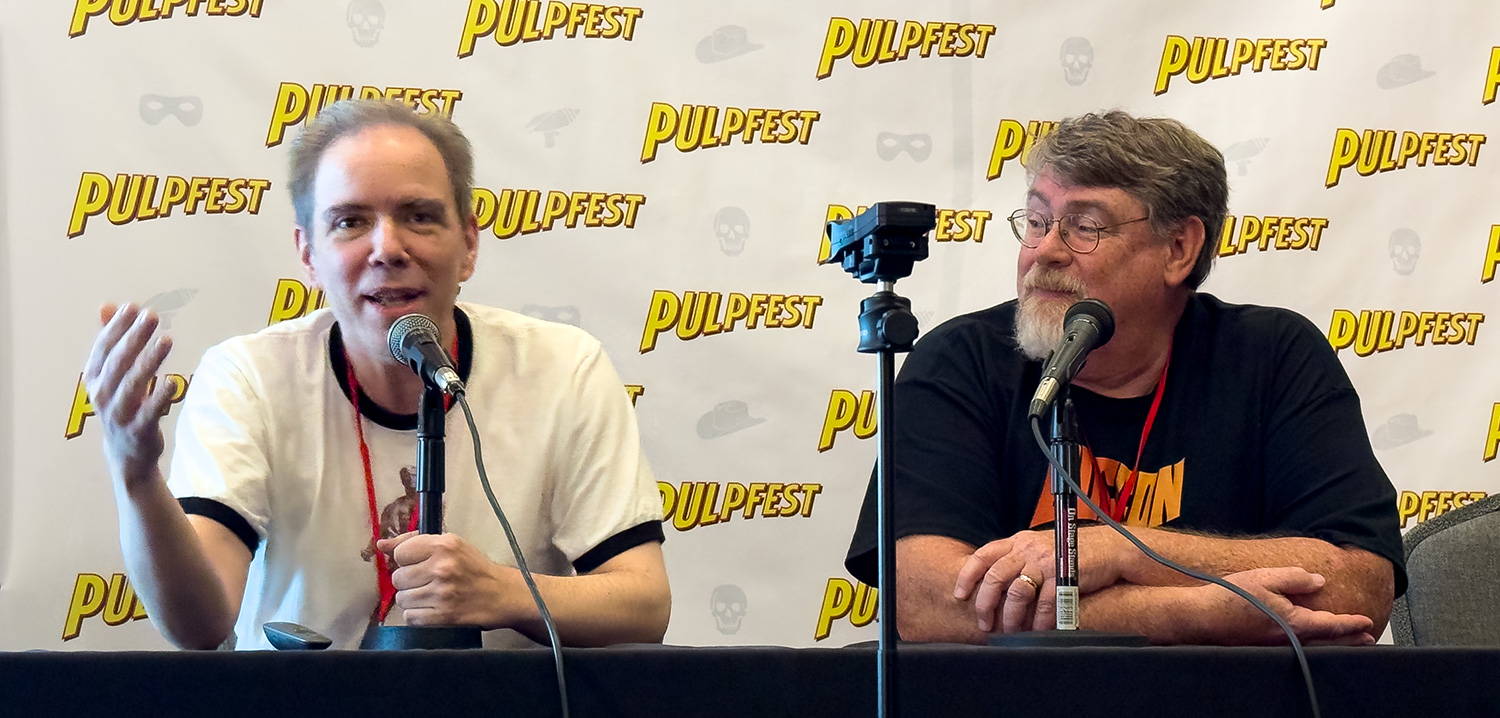
Pulp collector Chris Kalb, co-publisher at Age of Aces Books, and artist and filmmaker Ron Hill, reflect on Doc Savage: The Man of Bronze on the movie’s 50th anniversary. Produced by George Pal and directed by Michael Anderson, the film was released in 1975. This presentation was part of Doc Con, held in conjunction with PulpFest 2025. This Pulp Tales was recorded in Pittsburgh on Saturday, Aug. 9, 2025.
Click to expand the transcript.
Pulp Tales Announcer: Welcome to Pulp Tales, fascinating stories of the pulp magazines and the creative minds that brought them to life. The fictioneers, the artists, the editors, and others. Brought to you by ThePulp.Net. Learn more about the pulp magazines through articles, blogs, bibliographies, links, over 100 episodes of this podcast, and much more at ThePulp.Net. Your link to the pulp magazines for almost 30 years online at thepulp.net.
Chris Kalb: Yeah, so let’s start at the beginning. Obviously, George Pal, he wasn’t like a fan of Doc Savage. He, like the rest of us, he saw the books at the bookstores, and he thought the covers were amazing.
He’s, you know, a visual special effects guy. He thought they were really cool, and he noticed when he would come back to the bookstore that they were sold out. And he’s like, oh, this could be something.
And so he had opted in 71. He bought on the writer Joe Morhaim. And when he’s describing the project, he says there’ll be pure escapism, a little camp, and a bit nostalgic.
We want to appeal to children and adults who love action, adventure, good entertainment. So from the very beginning, he had been using the word camp.
Pulp Tales Announcer: In this episode of Pulp Tales, pulp collector Chris Kalb, co-publisher at Age of Aces Books, and artist and filmmaker Ron Hill reflect on Doc Savage, The Man of Bronze, on the movie’s 50th anniversary. Produced by George Pal and directed by Michael Anderson, the film was released in 1975. This presentation was part of Doc Con, held in conjunction with PulpFest 2025. This Pulp Tales was recorded in Pittsburgh on Saturday, Aug. 9.
Ron Hill: Who stayed up to watch the movie last night? Stay to the end of the movie.
Chris Kalb: All right. This presentation is for you. because we’re going to go really deep on Doc Savage, the Man of Bronze.
Deep dive into Doc. Because we found some great material thanks to Jen DiGiacomo. Yeah, she had a cache of material from the production.
I had a cache of material from the production. Also a shout out to Justin Humphreys, who wrote a great book about George Pal. He was a really good source of information.
But let’s start with our personal stories, because it’s actually very similar. We both watched Doc Savage, The Man of Bronze on television. You caught the first broadcast airing.
Ron Hill: The first broadcast airing, it was, from what I understand, Thanksgiving. There it is, Thanksgiving weekend. Oh, you’ve got the list?
Yes. It’s listed there. I was 13.
No, I just turned 14. I told my parents, I’m going to stay up and watch this. I said, it’s a school night.
I said, but I have to watch it. I’ve been waiting all summer. And what did you think?
Oh, let’s not go there.
Chris Kalb: I mean…
Ron Hill: Okay,
Chris Kalb: we’ll go to…
Chris Kalb: We can go to my story. So I saw the first primetime TV airing, which was after it aired late at night, on January 28th, 1978. And I didn’t know what day.
I had to look this up, which was really interesting. It’s Opposite the Love Boat. came on after Bionic Woman and actually I didn’t know to watch it my my dad said hey hey Chris because I didn’t know who Doc Savage was my dad was like hey you should watch this Chris it’s like Batman and I was like I was 10 so I was like yeah Batman’s awesome and serious I will watch this and it was to me it was it was like Batman it was amazing and what’s interesting having done the research is like we just said it was a late night movie that ended up in prime time that was actually almost accidental.
It had replaced what was going to be airing was Stranger in the House, which is the TV title for Black Christmas. And it got pulled because some sorority girls had actually been murdered two weeks previously. So they pulled it from the lineup and they were like, well, what else do we got?
Doc Savage. So I found out that it’s actually, like, I almost didn’t become me, right? I wouldn’t have discovered Doc Savage.
I wouldn’t have discovered Pulps. I wouldn’t be giving this presentation, except for this tragic news.
Ron Hill: Doc Savage saves the Nielsen ratings. So, yep.
Chris Kalb: Yeah, so let’s start at the beginning. Obviously, George Pal, he wasn’t like a fan of Doc Savage. He, like the rest of us, he saw the books at the bookstores, and he thought the covers were amazing.
He’s a visual special effects guy. He thought they were really cool, and he noticed when he would come back to the bookstore that they were sold out. And he’s like, oh, this could be something.
And so he had opted in 71. He bought the writer Joe Morhaim. And from the very beginning, this is the first article I could find.
It’s from Cinefantastique, spring of 1972. And when he’s describing the project, he says, there’ll be pure escapism, a little camp, and a bit nostalgic. We want to appeal to children and adults who love action, adventure, good entertainment.
So from the very beginning, he had been using the word camp. I don’t know if he knew exactly what that meant. I think he thought it was, oh, it’s going to be fun and tongue-in-cheek.
But I’ve heard stories that like, oh, they edited it. They added this campy stuff at the end, in the edit, with the music. I think he’s the one that started the camp and the humor.
yes, it may not have turned out exactly as he intended, but he’s I think, and Justin Humphreys would agree, it was his idea to make us a lighter
Ron Hill: G-film. I have not read Humphreys book about Pal, but did Pal he must have been aware of the Batman TV show. Yeah,
Chris Kalb: exactly. And I think he sort of maybe felt the way I did, which was he didn’t get it or whatever. He thought it was just a lot of fun.
Not that we’re looking down on this, we’re making fun of this. There’s a fine line when you’re doing something camp or doing something tongue-in-cheek. But essentially from the very beginning, he was talking about it as camp.
And in fact, Joe Morhaim, who wrote the original treatment, I haven’t read it, but Justin, I was talking to him again on Facebook, said it was much more straight And then George had added a lot of this stuff to his script. And he did that because there was a writer’s strike. There was actually a writer’s strike in 1973.
I remember that. Battle of the Network Stars, all that. And the writer’s strike, there was 16 weeks.
And in that period, George did a rewrite. Now, he asked Joe to write it, but Joe was on strike. He wasn’t going to break the strike to do edits on Doc Savage.
And so George kind of got in there and added a lot of apparently goofier parts. And ironically, he was able to do that because he wasn’t a member, but he had to become a Writers Guild member later to get his name on the film. George had to join the Writers Union after he had sort of, he belatedly broke the strike.
I don’t know how you’d call it. Anyway, the original director on October 18th, 1970, the Nazi director is Gordon Douglas. What do you think of that?
In like Flint. Yeah.
Ron Hill: That had more of a Doc Savage tone, didn’t it? Yeah.
Chris Kalb: See, he also did The Detective, which is like super gritty. And Them, which is hard to describe. But so like he’s done a lot of different things. What do you think his film would have been like?
Ron Hill: Well, like I say, maybe if it would have been in like Flint, it would have had more of that Bond kind of thing. Kind of colorful. Which had the camp.
So George would have been having. Exactly. That’s what I’m thinking.
Chris Kalb: But then just two weeks later, Michael Anderson replaced him. And he was known at the time for "The World in 80 Days" and then later, just the following year, for "Logan’s Run."
Ron Hill: For "Logan’s Run," which always amazed me. I did not know until recent years that the same guy who did Doc Savage directed "Logan’s Run." Very different.
Chris Kalb: Yeah, very different. And just a year apart, actually. So the script was then finalized on November 16th, although there would be, you know, there’s always revised pages throughout.
And on December 21st, they got this letter from the MPAA, ’cause remember, they’re looking for a G rating. And we all watched it last night, and I quipped that it was a hard G. Like, just like there’s a hard R, and this was like a hard G. Like, they really went after it. And so there’s four items here.
It’s really the depictions of violence, right? So it’s like, oh, you know, when we see the sniper’s body laying there, don’t make it too bloody. when you see the green deaths, don’t make it too bloody.
And the fight on the yacht, there were stabbing people with a cane, don’t make that too crazy. But what’s really interesting is they picked on the fight with Captain Seas and they thought, don’t let it get too intense. Do we think that maybe this letter led to that crazy fight at the end, which kind of stops and starts and has a jokier tone?
That’s an interesting thought,
Ron Hill: yeah. Ceremonial area.
Chris Kalb: Yeah. Okay. Because it does say in the script that the fist fight between Doc and C’s takes on a spectacular judo, karate, and kung fu dimension, but it doesn’t say in that order with subtitles, you know what I mean, which is what ended up happening in the film, if you see.
Ron Hill: Yeah, maybe when the people with the ratings saw that, they thought, you know, Bruce Lee, We don’t want to turn into that kind of a thing. Exactly.
Chris Kalb: How can we tone this down for kids? Anyway, it’s interesting. So they did their…
The movie’s going to film in January. They started their search in December. And they put these posters on the right in movie theaters.
And it kind of doubles as promotion of like, hey, we’re making Doc Savage. But they really were kind of casting a white net. And then that ad was in Variety.
on December 13th, I think. And thousands of people applied. Anybody famous?
Well, I learned 20 people were kind of in the running. And this guy was among them. If you know William Smith, who played a lot of bikers, and he was in Any Good Way But Loose.
And he’s a big, looks like a big hulking guy. He was in Rich Man, Poor Man. And he’s done a lot of different things.
you’d know you it’s one of those actors where you’re like oh that guy but what so that’s interesting yeah that’s the only that’s the only factoid that I could I could pull that was from Justin’s book but we do have from the production materials what they gave the actor to test with okay so there are five scenes the first one was really just they wanted to just film the actor talking with the director and they would do a close up, like just screen test. They did the scene where Doc learns that his father is dead. That’s a good one.
They did, he had to do the code, like if you could sell the code, right? You’re ready to sell the code. Yeah.
And then also just an improv fight, like fighting towards the camera just to get like how they move. And then the last one, and this is like three pages, the scene with Mona that ends with, Mona, you’re a brick. And a kiss, actually.
The original one, they kiss after, Mona, you’re a brick. Oh, the kiss.
Ron Hill: You asked her way at the beginning, what did I think of the kiss.
Chris Kalb: That’s not Doc. That’s not Doc. So if I press play, this is what George Pal says about Ron Ely.
George Pal: When we tested him, it was just no contest. All the others fell out because he was so magnificent, so good, and so believable. Because this picture has so many levels.
We made a nationwide search. And actually, Ron Ely is just Doc Savage. Nice.
Chris Kalb: And then the Fabulous Five, they did the scene after Johnny comes into the apartment. And they all have those lines about, like, we promise if we ever got out of the war, or we would serve each other in whatever it is. Anyway, so the five plus five, they’d probably do group auditions and did those lines. So these are the guys we ended up with. What did you think?
Ron Hill: I thought Renny was pretty good. I thought Johnny was good. I thought Long Tom was okay, but I always thought Paul Gleason and Eldon Quick should have switched roles. Really?
Chris Kalb: Because Paul Gleason’s taller than Eldon Quick. Right, just baseline. Yeah, I mean, Eldon Quick looks sickly.
Like he could have been a long time. They apparently had other choices, but part of the deal was Warner Brothers wanted to only accept actors that would do multiple pictures for the same price. Michael Anderson remembered that they had a better monk, no surprise, but he wouldn’t do multiple pictures so they replaced him and so the monk we got is kind of a second choice.
Ron Hill: And we don’t know who the better monk was.
Chris Kalb: No, Michael Anderson couldn’t remember any of this. Justin did his interviews too late to remember. What?
Chris Kalb: They were looking for Buddy Hackett.
Ron Hill: I had heard that as, that’s a real rumor.
Chris Kalb: What was the real rumor? Buddy Hackett. Buddy Hackett, I wouldn’t be surprised.
Okay, so here, yeah, again, I don’t think Monk would be that different, because looking at this, when Cinefantastique came out with an article, I took that picture of the concept art of Monk and I unskewed it. Jopal’s impression of Monk was always going to be that he’s like fat and like a buddy hacketype, frankly, with a little habeas corpus in the pocket and whatever. I don’t think he was ever going to be that different from, he might have more charisma, but he wouldn’t be the Monk we know, which we think of as like stocky and like muscled and a tough guy, yeah, with a voice like this.
And so speaking of production art, we’ve all seen this picture, and we’ve never found any of this amazing art on the walls, although I’ll be showing some other storyboards later. But I just needed to point out that they’ve got the Steranko artwork from the comic scene from ’72 there on the wall, which was definitely an influence on Ronnie and his costume. And in fact, Steranko claims that himself in the later Doc Savage issue when the movie came out.
or before the movie came out. But some really cool stuff. So this is the sort of Eagle’s Nest concept art.
I took this from the making of movie, the making of, because they do like a pan or a push. I took basically different frames from the 60mm and kind of piece that together. And then also this fortress concept with the polar bear.
I mean, if the movie had opened with this, I mean, that would have been cool. like do it at night and have a polar bear and pan over.
Ron Hill: When I first saw the movie that night, way back in ’75, and I saw them pan away and show the whole "Fortress of Solitude," I thought, "I’ve built igloos that big in my backyard."
Chris Kalb: Yeah. So, you know. Yeah.
Yeah, that was supposed to be a matte painting, and it looked actually became a model that Fred Hartman built with like salt around it to be the thing. Like, the matte painting could have been more spectacular, but maybe they didn’t have the budget. And there’s a lot of budgetary problems here.
So I had to put this in here, because Robyn Hilton was on January 17th. We’re getting close to filming now. She was on Johnny Carson talking about her next project, which is Blazing Saddles.
But the next one was Doc Savage. What are you doing now? You finished the movie.
Robyn Hilton: Yes, I just did another movie, and then I’m doing the series Doc Savage. It’s coming up February. sometime in February.
Johnny Carson: Yeah. Well, it’s nice to have you here tonight.
Robyn Hilton: Thank you.
Johnny Carson: Are you all calmed down now? You said you were a little nervous between the break. Wasn’t this easy?
Robyn Hilton: It was very easy.
Johnny Carson: Was it fun?
Robyn Hilton: It was fun. Excitement. All right.
Chris Kalb: Anyway, I always thought that was an interesting tidbit. And here’s what they were paid. This is how much each of the actors were paid.
Obviously, Ron Ely got the most at $20,000. It’s only $20,000. The highest paid of the Fabulous Five, Ham and Rennie.
and then Monk was next and then actually Long Tom and Johnny got $8,000 is that about right? It wouldn’t be right for me
Ron Hill: that was 1974 and they got no royalties or anything well maybe after that strike
Chris Kalb: yeah I don’t know yeah they were just contracted per week and then they got guarantees on the amount of weeks and some of them were paid out over time like Long Tom and Monk. So let’s get into the filming. They started on January 23rd and 24th in Grand Junction, Colorado.
They filmed the scenes where the fortress is and then they also filmed a lot of long shots with Ron Ely and a group of doubles over sand dunes and snow in Colorado. I have some cool behind the scenes pictures here. There’s Ron looking for snow in his boot These are from the collection of Jim Gould, again, like getting changed and people helping him get into some warm clothes.
And they stayed at the Holiday Inn, that’s George Pal and Ron Ely, and they had the snowmobile at the Holiday Inn, which is very cool. This is a postcard from that era of that Holiday Inn, but they even put on the sign, "Welcome Doc Savage and his pal George. Because I guess the whole crew was there.
We don’t know who that woman is. But that picture’s in Justin Humphreys’ book. Pretty cool.
Okay, so now the first thing they formally, that was a pre-production group, the first thing that they really shot is all of the business at the Columbia Building, which is frankly, I think, the best sequence of the film. That early. I would agree.
Yeah? Yeah. So here’s the shot from February 1st, which is they’re celebrating Pal’s birthday with the native guy, I guess you’d call him, I don’t know, and that’s Dar Robinson and Tony Epper, who was doubling Ron, and they became good friends because they were sort of a similar type.
But those guys are actually kind of legendary stunt performers. And in fact, think about this scene when you watch it again because I know you’re all staying for the airing of the fan cut after this. Not only is there an 11 story drop off of the building, there’s a gap between the wall of the building and where he’s running and there’s a 12 story foot drop on that side with pipes.
You’d land on infrastructure and pipes and he’s just running across and it’s not even even, right? It goes up and down. The only thing they did, he has no wires or anything, the only thing they did is they put sandpaper on the tops of the surfaces.
So he wouldn’t slip. Right, so there’s a little bit of grip for scenes like this, but now when I watch that, after reading this in Justin’s book, when I watch that sequence, I’m like, that’s nuts. And Dar Robinson actually, fun fact, he set a record for the highest feet first free fall.
Even today? Still stands? I don’t know if it’s still standing.
I didn’t have time to, but at the time it was. And essentially that came from an interview with Eldon Quick that’s in the book. Very interesting.
So now, thanks to Jen, we have the storyboards from this scene. And I’ve matched up the storyboards with the footage. I’ve cut out all of the business, most of the business, with the Fabulous Five because it wasn’t storyboarded.
Hold your applause. But let’s watch the, let’s just watch, this is going to take four minutes, but I think it’s really interesting because it’s the first time I think I’ve ever seen storyboards from the Man of Bronze and we can see how they match up with the movie. You know the movie, so it’s going to be small.
And I should mention that the cinematographer of this movie, Fred Koenekamp, is an Academy Award winner. You can see the shots that they didn’t get and some of the shots that they added. They had clearly been to the building when they drew these storyboards.
And I think the storyboard is actually by Fred Hartman because they compare well with the legendary work he did on The Boston Strangler, which was storyboarded within an inch of his life because it has all of those multi-panel scenes. As you can imagine, that tower is like in a parking lot somewhere. They never composited it with the rest of the building.
See he throws the gun instead of the knife. And he’s actually trying to scale down when he falls. He doesn’t just like get scared.
So that’s it. Pretty cool.
Ron Hill: What did you think? I thought that was amazing. You know, they were obviously on location. They knew where they were going to be, the grates and the iron work and everything.
Chris Kalb: Yeah, some of it really tracks like that. We’re going to do a long, this is like in the binder, it’s like a fold-out page, we’re going to do a long tracking shot. And if you look, it’s like they really drew the girders and the columns the way that they looked. And then other places they definitely had to fill in. And there’s even a note in the script like, remember to get some shots of Rennie pulling up the ladder, you know, because it wasn’t in the storyboard.
Ron Hill: And that’s how they use the storyboard, is they show it to everybody involved at production, that here’s what we want to try to achieve. Does anyone know? Did they do the whole movie? I mean, yeah.
Chris Kalb: Yeah, there’s a picture that we saw earlier where it’s Eli, sorry, and Anderson and Pal, and there’s a lot of little pictures from storyboards. Probably a lot of the set pieces. There are some set pieces, we’ll talk about deleted scenes later, that didn’t survive.
So those would be the ones that would be fun to see. So on the tail end of this, this quick scene of them coming down in the elevator and getting in the car, and you can see Doc’s other vehicles there too, was filmed right near that eastern building, just down the street, basically, at a place called All Right Auto Parks. And now it’s Joe’s Auto Parks.
So I just thought that was interesting. I’m sorry, I said this was going to be a deep dive.
Ron Hill: Do they have placards there, and do people line up to take pictures?
Chris Kalb: We should. I did find a picture on Google. I didn’t include it.
Ron Hill: Maybe a Doc Con location.
Chris Kalb: Sometime. But when they actually get out of there, this scene is not near the building at all, it’s on Columbia Ranch, which is a big studio, and they have this New York street, and they did the alley there. And so this whole scene, Doc comes out, all that stuff.
So I have, I got off of eBay at some point, a bunch of contact sheets from a studio photographer. And so these are tiny pictures, but I have a powerful scanner. I’ve blown up all of the pictures so we can take a look at some behind the scenes.
I’m just gonna let it run. Behind the scenes on that day of shooting when Doc comes out the doors. From when he’s putting out his boots to when he actually gets outside.
But behind the scenes stuff that I don’t think anyone’s seen. I like these moody shots. I think the photographer had aspirations to be a movie maker.
There we go. recognize that they’re doing sort of a rehearsal by those doors. I think that’s it.
But anyway,
Ron Hill: a unique look. The thing about seeing those, and I think back to when George Pal says he is Doc Savage, and when you see Ely with the other production people and how he towers over them, and how how he seems, even in just those still photos, he seems to be very much a part of the team, not a boss, not on airs, not stuck up or anything.
Chris Kalb: No, like working with everybody, like what do you think?
Chris Kalb: He was pointing at something on his wrist, like very collaborative it looks like. And I think he’s like the best thing in the movie. Oh, hands down.
Yeah, to me, you can always watch him and it’s a good movie. And so then just a couple February 7th and 8th, they filmed at the Santa Monica Airport. They filmed outside on one day and inside on the other day. Let’s take a look at some of these pictures.
This, I had to cut a bunch of photos. I just had too many from those tiny little, it measures like 36 pictures on a contact sheet. But they’re playing, they’re like playing games on the side, which I love.
And this is a mix of slides and the contact sheet.
Ron Hill: I like how he still has the protection from the makeup.
Chris Kalb: That’s I can’t sleep that. I think you can see that was Michael Anderson. And so they’re seeing that the cases are too low in the scene so they’re going to put them down on boxes so that when they do the shot they don’t go out of frame. And I love this where they’re playing backgammon. And they’re actually sitting in other people’s chairs like that says Eldon Quick as if like two other guys were playing backgammon and then they sat down to play backgammon. by all accounts everyone had a great time on filming this from what i put what justin says because he did interviews with several people and um you know michael anderson was really nice the criticism was he was like too nice like he would like if somebody had an idea yeah let’s do it like he was he was kind of an english gentleman that was like didn’t want to say no to anybody and and so um and maybe it wasn’t controlled as much so this is not the not the movie that i wanted to put here
Ron Hill: but it looks like it’s from a contact sheet so they must have had a bunch of paperbacks around for
Chris Kalb: for reference well this this is from the making of this is the TBS jungle which comes later because I didn’t get the movies in the right order but we don’t need to watch it we don’t watch it so let’s so on February 8th like while they were filming that stuff at the Santa Monica Airport then they decided to change the names of Monja to Mona and Kukulkan to Kukulkan. And that’s the very last minute. So if you get that final script, I think Phantom Press publishes a copy of the script, it still has the old names in it because this is like February 8th now that they decided to change the names.
Ron Hill: Because Monja was the name from the books, the stories.
Chris Kalb: Yes. I don’t know why they changed it, but it does mean none in Spanish. And maybe they thought no one’s gonna buy Princess Ardala as a nun.
Pamela Hensley, sorry. Then they went to Kimora Crest. I think a lot of these location shoots are, you know, they look great, right? It’s really, it’s the studio and lots of stuff that slows them down.
So I have a bunch of these call sheets for every day of filming and if they’re going to a location they include a map. And this map goes from the studio to the location but neither of them were actually on the map, they had to draw them into the map. And the road may be icy.
That’s right, road may be icy. I love all, just all the little details of some of this material, which I’ve had for years, and I just want to thank you guys for forcing me to like actually look through it and kind of like think about this whole production. And then they started on the stages, stage 25, where they did the penthouse scenes, and don’t know where this picture is from but it’s been said that this is like outside the stage they had this giant banner see those are people down there giant banner of Ron Ely for the to kind of announce like this is where we’re filming guys and just to be cool I guess but that’s shot of Ely is from the jungle which hasn’t been filmed yet so I don’t know when this banner was put up but here’s a a production art by Fred Hartman.
He also worked on the design for In Like Flint, which is, I guess, a coincidence, but it looks exactly like his artwork. And it’s very cool. This is exactly the layout of the apartment, the penthouse when you see it, which is very cool.
From there, they went to Palmdale and they did the town, the small town, and they did the dry riverbed with the the bones and it’s even like that’s a prop they brought right like it had to be listed in the thing and but there was a two-day stay so again sorry I got another postcard this is the postcard from the time of the Vagabond Inn in Palmdale California which I thought was kind of cool
Ron Hill: oh I love this guy okay because everyone was like oh is he a villain is he yeah this this actor Michael Berryman was discovered by George Pal?
Chris Kalb: Yeah, this is his first film. He was working at a flower shop near where George Pal’s son David ran an antique store. And so he was just going from the antique store by the flower shop and he saw this guy and he’s like, hey, do you want to be a pictures?
He thought he’d be perfect for this random role. But it was actually discovered by George Pal. Of course, we all know him from The Hills Have Eyes and other horror stuff.
But this was his first role. I thought he seems, if you’ve seen the movie, right? Heavily looped?
If we’ve seen the movie. I’m sure everyone here has seen the movie. But I always thought his lines were dubbed over.
But I don’t know if that’s because it’s his first role. And it was a little squirrely or what. But I just thought that was interesting.
I have no other facts about the Harold Lloyd estate. But it’s cool that they filmed on the Harold Lloyd estate. For all of the Hidalgo offices.
The president’s office. and where they have the lunch and then the pool. Then they were in the Warner Brothers Studio Stage 28 for a long time doing all that yacht stuff.
And then on March 12th, they went to Burbank Studios, which has its own New York Street and also has the Mexican Street for the exteriors in Hidalgo and the infamous final scene. This is a great picture. If we had a trivia question, If my topic of one of the favorite questions, my question would have been, what’s the name of the actor who played Habeas Corpus?
It’s R. Hogg, R is his first initial, I don’t know what that stands for, R. Hogg.
Ron Hill: What other acting credits does he have?
Chris Kalb: I don’t think he has any, because actually there were like six pigs, and they all squealed and ruined every shot, and everybody hated them. So I don’t think he worked again, he grew up and he became food i don’t know but that’s a great question because like they obviously this is like a setup picture that’s funny because if you look at the actual shooting schedule it’s just under livestock pig like he’s not like you know a celebrity yeah well this would have been
Ron Hill: you know what was the big there’s another trivia question though what was the pig’s name on Green Acres? Oh, Arnold. So maybe this is Arnold’s progeny in the film.
Chris Kalb: I would believe that the trainer is the same. I don’t know the guy’s name, but he’s listed in the credits as a pig trainer or whatever. Again, this is from Jim Gould’s collection. And then on that final scene, the old lady that crosses the street, I thought this was interesting, is the wife of Walter Lantz, Grace Stafford. Because he was great friends with George Pal. they were animators from Walter Lantz and George Pal and so she makes this cameo and the doll that she drops that the scout picks up is an Andy Panda doll like I never noticed that
Ron Hill: and there it is the Andy Panda doll who played the boy scout that helps her cross the street
Chris Kalb: yeah who played the scout I don’t know that’s a great trivia question next year we’re going to do all of the cameos but that’s pretty cool then we get to the jungle set and I think this is it. There we go. So let’s watch this.
Narrator: Now Doc Savage steps from legend onto the screen in a new film being produced by George Pal, himself a legendary figure with his epic films Destination Moon and War of the Worlds. Pal chose two of the best in the industry to work with him. Michael Anderson, who directed Around the World in 80 Days, and Academy Award winning cinematographer Fred Koenekamp.
Doc Savage, the man of bronze, recounts a part of the amazing saga of the Golden Giants’ war against the forces of injustice. The dangers and thrills in the filming never stop. Michael Anderson keeps the action going by staging an unusual event near the prodigious pool of gold.
Sometimes the tradition backfires. everything author kenneth robeson’s character did was the greatest doc savage was an invincible adversary with incredible strength ron ely is also a physical phenomenon and an expert in hand-to-hand
Chris Kalb: combat yeah i want to talk about that guy uh he’s actually very well established his name is Takayuki Kubota, he only died last year. He was the technical advisor on the fight. He was already Ron Ely’s karate instructor.
And so he had appeared in The Mechanic in 1972 with Charles Bronson and they became good friends. And then became kind of like a karate instructor to the stars. And so when Ron Ely wanted to get into karate, his agent said, hey, you should get into karate.
This is all covered in that Fighting Stars magazine. You’ve seen it on eBay. Read the article.
So he was probably brought in by Ron Ely, although he had worked in films in Kung Fu, the TV show and stuff before, but he was a technical advisor. Also, really good friends with James Caan, as he was his karate instructor, and that’s why he ends up as an extra character in Bottle Rocket. Wes Anderson.
What? Wes Anderson’s first film. Yeah, so it’s just like fun trivia.
All of those little scenes were all filmed in one day on the stage, from the beginning. A couple of them were on the next day at the Burbank Studios lot. And then the last thing they filmed was inside the Fortress of Solitude.
And there’s the beautiful illustration. I just have to point out that obviously the construction of the fireplace in the center is different. But the Fortress of Solitude is actually written or debossed on the cone.
It’s not a sign over the door. It looks more like Doc Savage lettering that’s been pressed out of the metal, which would have been cool and more subtle, let’s be honest. Yeah, so that’s it for sort of the filming of the movie.
Ron Hill: Those are so cool. Man, we sure did make you do a lot of work for that.
Chris Kalb: Happy to do it. Let’s talk about some deleted scenes really quickly. So this scene is in the trailer.
It’s not in the movie. Because at the end you just see him drive off, but here in the trailer there’s like a close-up of Ron Ely driving. I thought that was interesting.
Okay, so this promo that I’m going to play is from, if you’ve seen it, it’s on a, I’m just showing part of it, it’s on a Fantastic Worlds of George Pal DVD as an extra. What’s interesting about it is it has an alternate scene with the snowmobile? in the Arctic, and you’ll see that it’s a little bit longer before they do the push-in and things like that.
But I secretly want to play it because it has different music and a different narrator than what we got in the movie, and it makes all the difference. The music is the theme from the FBI story, the Jimmy Stewart movie, by Max Steiner, but it’s still a march. And the narration, I’m 99% sure, is Ted Cassidy, who we think of as Lurch, but also did the opening narration for The Incredible Hulk, where he’s like David Banner, scientist.
Like it’s in that mode, so let’s take a look.
Ted Cassidy: This is Doc Savage, the Man of Bronze.
George Pal: No glint, no glint.
Ted Cassidy: This is Doc’s fortress of solitude in the Arctic Circle, where he retreats ever so often from the grueling pressure of routine to concentrate and further develop his wide knowledge. to study astronomy, the planets, the stars, the universe, or work to invent something that one day might be useful to mankind.
Chris Kalb: So that, I thought, was really… It just shows you how different the movie could be, and it’s kind of a trailer for the fact that we have a fan cut following this talk, where people have done similar things. Different music, different narration.
Ron Hill: Definitely the voiceover sounds better.
Chris Kalb: Yeah.
Ron Hill: I always thought the voiceover sounded like the guy who did Fractured Fairy Tales.
Chris Kalb: Paul Frees? It probably was.
Chris Kalb: The VHS, I discovered, has more footage on the top and bottom, just like the, it’s actually just a different framing, so don’t throw out that VHS. Okay, now we get to some of the cut scenes. Doc was actually exercising while he’s waiting for the fish to come up, and then actually gets the fish.
So this sequence, you’ll see it’s number 15, we’re also going to see 16 and 17. It’s he gets the fish, then he eats the fish, and of course washes it down with milk. And so this is a shot from there, again, this is thanks to Jim Gould.
And then he’s listening to music while he’s eating the fish. He gets up, plays some piano, and then does this conducting thing because he’s so moved by the music. If they’d kept that in the film, would it have improved it?
Ron Hill: I think it would slow it down. Although we all know Doc was a violinist, right?
Chris Kalb: Right, and he rearranged all of the songs on Cigarso Ogre. Remember, they were stuck, and they needed to entertain. So he did rearrangements of the songs to keep people entertained. there’s a scene later before when Doc’s looking at the slides and he gets attacked by the green snakes before that there’s a long scene with Monk, it really just kind of explains what he’s doing, we can kind of guess what he’s doing but we do have this one studio still that was released that captured it
Ron Hill: see that, a scene with Monk like involving the aides
Chris Kalb: more, yeah like doing chemistry yeah that’s what I’m thinking it really kind of beefs it up But it’s funny, just as an aside, remember in the alley he turns and he says, "Hey Johnny, you gonna be okay?" That’s not in the script. So I think they were consciously adding moments like that too, though, that would make them feel like a team.
Which is why Ron Ely is Doc. He’s concerned about everyone at all times. Absolutely.
Totally. Now we don’t have any stills from this, but this is a scene that follows on from Ham and Monk eating enchiladas. You were telling me about this.
Yeah, so it’s basically, he says, you’re going to get fat if you eat that. And then he eats it, and it’s like super spicy. And they actually, you can see the special effects, they rig it so this hat flies off.
That’s how hot it is. And Rennie, who at the beginning of the scene had gone to get water for the steaming radiator, is coming back, and Ham grabs the water and pours it over his head to cool down. And the fact that there’s a line drawn through the script, that means that they filmed it.
So this is George Pal’s script, and they would mark off the things that they had filmed. So my impression is that this is a deleted scene, like somewhere in the Warner trash pit, I gotta know, maybe somewhere. If we ever got something that was more than just an archive release, but like a real 50th anniversary release, maybe people would be moved to kind of find some of this material.
So that’s cool. This one I really love, ’cause you can see a vestige of it in the movie. When Doc comes in the apartment, Rennie is putting down a photo album.
So right before that, we were gonna see the photo album. It was gonna sort of cover Doc’s life with his father. And they had scripted in the script.
They had several scenes like he’s on safari, he’s seven year old doing science, he’s 15 years old climbing the Alps. They’re in parkas at the dome. And then an adult Ron Ely in a sleek racing plane, my first solo flight.
So, and they had, you know, they planned this out. We’re gonna do these pictures and we need these props and we need a welfare worker for the kid actor. And they were gonna shoot all this, but they never did.
They definitely put it on the last, like towards the end of filming. And then they were just, you know. And you don’t need it.
I mean, I admit that.
Ron Hill: Like you get. – Doc is a boy. That might have helped explain about the father and everything.
Well, it’s cool. I always wondered who did the painting of the father. Yeah.
Chris Kalb: I was looking at, because they had matte paintings. I know who did the matte paintings, but I don’t know who did the painting that was hanging on the wall there. Okay, the biggest thing that’s in the script that they didn’t film, although, again, there’s vestiges of it, is that that yacht was going to transform into a three-masted schooner.
and this was going to be the big George Pal special effects stop motion thing in the movie and they did it to disguise the yacht so it looked like an old sailing vessel and they were going to throw tarps over the side to make it look like wood and then they were going to do stop motion on the mass coming up and this whole thing what’s left they didn’t obviously who has the money for that uh they didn’t do it but there but you if you read if you can read lips he is saying the line when Doc Savage gets away, modify ship, instead of what was looped as move out the ship. Modify ship. Yeah, so they had budgeted this at one point for $25,000, but they got it down to four using a miniature, or maybe shrinking the miniature, and again, they put it as a second unit thing towards the end.
You’ll see on that shooting schedule, they never added a day date. They just kept not scheduling it and then it went out of the movie. But this is why, it’s interesting, and again you see why they don’t need it, this is why Ramirez says we can’t find that boat anywhere.
It’s because it had just transformed into, no boat matches that description or whatever is the line, I put it there. But you don’t need that. We know Ramirez is dirty, like he’s obviously going to lie to Doc Savage anyway.
Ron Hill: So it said $25,000 for that effect is what they budgeted.
Chris Kalb: Well, initially, but when they lowered it, it was probably going to get cut, and they were like, we can do it for four, and they kept it. How much did the actors get? I know! That’s more than Ron Ely.
You can get a second Ron Ely in this film for that amount. There was also a scene, and this was scripted before they cast Ron Ely, where Doc is going to swing through the trees like Tarzan. After they spot the pool of gold and he separates from the group that gets captured, he was going to swing away like Tarzan.
And again, they kept putting this off, and they eventually, I think, never filmed it. Because my last call sheet is like, the call sheets kept moving. I have multiple that say, oh no, today’s Thursday, today’s Thursday.
I think they just never shot it. Here are some early abandoned concepts. I’m just going to run through this really quickly.
Because they did a big script rewrite in August, I think for budget reasons. My favorite line is, the river of gold is to be eliminated. We shall have pool only.
So they were going to have that. The last scene with Captain Seas was going to be a parade, a daytime parade, and they were going to be marching with the Salvation Army band. And all of the aides were going to be there.
It was going to be a big, obviously high budget scene to end the picture, Christmas time parade and all that, but obviously they shrunk it down. I could not imagine ending on that.
Ron Hill: I think the way they ended it, if they insisted on ending on the crime college angle,
Chris Kalb: was the best way. Yeah. There was going to be a scene in Hidalgo Airport, they cut that, and then the river sequence.
There was going to be a big river chase between seas in cars and docket is meant on a boat in the river. And this is like, it says page 89 through 97. That’s like eight pages of like River Chase that they cut.
But that would have been like, I think a big, you know, like action sequence in the middle of the picture. Which they kind of needed. They needed, right?
Yeah. I was talking about this with my brother. The, you know, like, yeah, there’s that long part in the middle where they’re just going The fight scene on the boat and then not much happens.
They’re just going somewhere.
Ron Hill: You know, they’re in the Valley of the Vanish.
Chris Kalb: So that’s the kind of set piece I think that they needed. Also in the early special effects budgets it says animated gold flecks superimposed in Doc’s eyes. Everything that ended up becoming a glint three times, anything that ended up becoming a glint in his eye was actually going to be the swirling gold pools in his eyes. Which I think was really cool and we almost had it guys.
Ron Hill: And that was only it cost 350 to turn Ely’s eyes, just lewd to gold.
Chris Kalb: I think we’re right.
Ron Hill: We hit our mark.
Chris Kalb: I obviously have 60 more slides, but come by my table and I can show you all the stuff about the release, Ron Ely, going on these different going all around the Carolinas, etc. All the posters that came out. Anyway, thanks everybody for coming to this talk. I hope we have a little bit different view of the movie.
you know, they were really, these guys were trying to make something. They didn’t have the budget necessarily to pull it off. But, you know, a lot of people worked on this and had a good time.
Ron Hill: I think it all happened post-production, whatever, you know, did not improve the movie. But yes, thank you. Thank you.
Pulp Tales Announcer: You’ve been listening to Pulp Tales, fascinating stories of the pulp magazines and the creative minds that brought them to life. Brought to you by ThePulp.Net. Learn more about The Pulp Magazines through articles, blogs, bibliographies, links, over 100 episodes of this podcast, and much more at ThePulp.Net.
Your link to The Pulp Magazines for almost 30 years. Online at thepulp.net. Subscribe to Pulp Tales on your favorite podcast platform, or listen to us on the web at ThePulp.Net.
If you enjoy our content, please like us or leave us a review. And tell your fellow Pulp fans about Pulp Tales. Thank you for listening, and keep reading the Pulps.
Pulp Tales is copyright 2025 by William P. Lampkin.
This transcript was generated automatically and may contain transcription errors, typos, or other inaccuracies.


