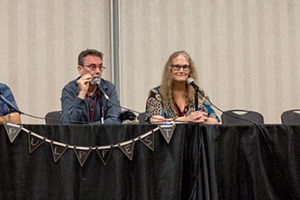
Ed Hulse, publisher at Murainia Press, and pulp collectors Tom Krabacher and Kurt Shoemaker discuss the masters who made the long-running magazine Adventure into a leading light of the pulp rack. This Pulp Tales was recorded at PulpFest 2025 in Pittsburgh on Thursday, Aug. 7.
Click to expand the transcript.
Pulp Tales Announcer: Welcome to Pulp Tales, fascinating stories of the pulp magazines and the creative minds that brought them to life. The fictioneers, the artists, the editors, and others. Brought to you by ThePulp.Net. Learn more about the pulp magazines through articles, blogs, bibliographies, links, over 100 episodes of this podcast, and much more at ThePulp.Net. Your link to the pulp magazines for almost 30 years online at thepulp.net.
Tom Krabacher: And I think central to Hoffman’s thinking in philosophy, and he had stated this on several occasions in his editorials, was that good adventure fiction and literary quality were not mutually exclusive. It was pointed out, for example, that Sinclair Lewis, who was a Pulitzer and Nobel Prize-winning American novelist, actually worked with Hoffman as an editor or in an editorial capacity at Adventure for a couple of years.
Pulp Tales Announcer: In this episode of Pulp Tales, Ed Hulse, publisher at Marania Press, and pulp collectors Tom Krabacher and Kurt Shoemaker discuss the masters who made the long-running magazine Adventure into the leading light of the pulp rack. This Pulp Tales was recorded on Thursday, August 7th at PulpFest 2025 in Pittsburgh. Kurt begins.
Kurt Shoemaker: I don’t know what these guys are going to talk about mostly, but I’m going to focus on the Adventure of the 20s, the best years, in my opinion. And it’s largely due to Arthur Sullivan Toffman’s personality that the magazine was the success it was. For one thing, and my main theme is, he made the magazine feel like a community.
The people belonged to it. They all, it was very common for readers to get a new issue and open up a magazine and just like I do and maybe many of you turn to the campfire right away to read the letters to see what people are talking about. New authors would stand up, figuratively, at the campfire and introduce themselves and tell about themselves.
And Talbot Mundy even wrote a long essay criticizing Julius Caesar. Poems would occur, all sorts of them. Bill Adams was a frequent person there.
Just an idea of Adventure according to Arthur Sullivan Hoffman was that it could happen anywhere. Far away is exotic of course and I’m not making a New Jersey joke in that he said even this is I’m paraphrasing Hoffman on this even in it in New Jersey you can have adventures and when I was a kid growing up reading the Lancer books, Lancer Conans, I thought Texas would at all look like Monument Valley, dry and deserty. I live there now in the hill country of Texas and we have trees all over the place.
I’m mowing frequently and as you know from the news, unfortunately, we had a lot of rain lately but it certainly wasn’t, it was more exotic when I was in 10th grade than it is now because I can go to Cracker Barrel now in Texas. So the campfire is the heart of the community and there are other departments like Ask Adventure, Lost Trails, Songs men have sung, all sorts of things that just give the magazine personality, as well as issues that in 1925, just to pick a year of the 20s, when their circulation was probably around 300,000 then, shortly years later. By 31, according to Time Magazine, it was down to 100,000.
That’s after Hoffman had left. Yeah, Hoffman, and he’s from Ohio, Phi Beta Kappa, friend of Hugh Pendexter and Mundy, too. They used to go camping in Maine, where Pendexter lives, who unfortunately is fairly forgotten in Norway, Maine, where he’s from.
I’ve actually been there, stopped at the library, and one librarian knew who he was and went and got someone’s master’s thesis from the back room. That was a biography of Hugh Pen Dexter, but everyone else never heard of him, where they could do some capitalizing. Not that he’s Robert E. Howard, you can’t always choose who you’re famous for anyway.
But here’s some trivia just about the magazine in general. Robert E. Howard made an appearance in there, as you may know. He was in the Ask Adventure column.
And he asked that his name not be used. It’s just REH from a place called Cross Plains, Texas, which I think was a pretty good clue who we’re talking about. And he’s asking questions of their Slavic expert about what’s it like, how is whipping women treated in Central Europe, which I thought was decidedly strange.
He would have been, it was early 20s when this was Edgar Young, just as a not really an interesting trivia like Robert E. Howard, but he had one story published in an issue about a treasure seeking party in South America and they all die at the end of the short story. And then in the next issue or a couple issues later, there’s another lone adventurer appears out of the jungle and finds the treasure and lives and gets away. So it’s a two-part story separated.
And if you hadn’t been like me, just reading them by coincidence, one after another, you might not have noticed it. Writer Talbot Mundy, what I find very interesting, was a good friend of Rose Wilder Lane. They lived in Danbury, Connecticut near each other.
She’s the daughter of Laura Ingalls Wilder. Rose was an early thinker for the libertarian movement. She was very much against income tax and stopped writing for a while.
In fact, when we were at, my wife and I were at, Laura Ingalls Wilder’s house many years ago, Laura had an interesting, actually it was probably Rose who did it, because Rose built a house for her parents and then lived in her parents’ house. But she had her library set up with a five-foot wall around it, which for them, they were very short, like Laura was four-foot something, as was her husband, I think, maybe five-foot two. But she had a wall where she could go into the library.
There was no ceiling on it. And there was a chair and table in there. And she would read.
I’m listening to the tour guide. I glanced over and there’s a bunch, there’s a stack of Adventure Magazine. You know, it’s one of these unexpected things that just happens sometimes.
And they were all from the teens. The big fat issues are unseen these days, pretty much. So that’s when I learned about the friendship with Talbot Mundy that she had.
The main thing for me is the sense of community again, and I can prove that too, because the community even has its own preacher in Bill Adams with his slants of life features, how I look at it. He’s non-denominational, just common sense, good old, there is a being, and we all should get along and be good to each other sort of thing. And then the mayor of the town, to use the community theme to a ridiculous extreme, is Hoffman.
And he has his own opinions on things that are, we’ve outgrown all this, I’m sure. And that tone was a signal that irony is coming up. That he would talk about the future of democracy, gun rights, immigration, issues that, of course, we still have with us, to abandon the irony.
me. So I’m just dropping off some things, some trivia, some things I’ve learned. In fact, another piece of trivia is one that only my family knows.
My daughter and son, when we would bathe them when they were children, I would use a line, or my wife got it from me also, a line from W.C. Tuttle stories that she would use and I used too. And it occurred in several stories so I would every time I wanted the kids to raise their arms so I could scrub their torsos I would say show me where the rain comes from.
And so that adventure culture community legacy entered our family and recently I was visiting my daughter we were visiting our daughter and she was bathing our grandsons and I heard from the other room show me where the rain comes from and so it’s going down through the generations of the community now just that bit and there’s a lot still undiscovered I think in Adventure certainly it’s my favorite magazine and learned a lot from it anyway I’ll pass it on now to Dr. Mr.
Tom Krabacher: Kraybacher What I want to do is start with Kurt’s discussion of community and Adventure and then go down specifically talk to about the authors that formed a key part of that community. Hoffman, in every discussion of adventures in the magazine centered around Hoffman, was editor of the magazine for about 17 years from around 19, roughly to get the dates, from about 1912 to 1927. That’s not 17 years, that’s 15 years.
And during that time, he played a role that other legendary pulp editors like Joseph Shaw at Black Mask and John W. Campbell at Astounding Dead, was to leave their personal signature marks on the character of the magazine itself. And I think central to Hoffman’s thinking in philosophy, and he had stated this on several occasions in his editorials, was that good adventure fiction and literary quality were not mutually exclusive. And it was pointed out, for example, that Sinclair Lewis, who was a Pulitzer and Nobel Prize winning American novelist, actually worked with Hoffman as an editor or in an editorial capacity at Adventure for a couple of years.
And Hoffman also brought the notion of a sense of community. He wanted the magazine to be, just to use his word, a meeting place for readers, writers, and adventurers, where every adventurer is welcome and we all have a place to gather. And central to that was the letter column, the campfire that Kurt had been mentioning in discussion, where you had, for one thing, Hoffman being an active participant in the discussions, but also was central to trying to incorporate writers into that discussion as well.
So there was this sense of community there. He would bring writers on board, sometimes people you would never hear of before that never hear of much afterwards like early on Captain Fritz Duquesne who was a salesman, a traveler in elephants and in several of the letter columns they were discussing the troubles he was getting into with his elephant business in places like Cuba. And he also, to build the sense of community, introduced things like the idea of Adventure clubs that people could form.
They sort of joined on their own and he picked up to encourage it elsewhere. The Adventure IDs, which readers could get to the magazines. And a little later on as we got into the second, well later in the second decade of the 20th century, the idea that Adventure IDs should be metal so that they couldn’t be damaged or destroyed.
It had contact information on it. So if someone was injured or found with an ID and the person found the card or the metal plaque, they could use it to contact the important relatives or contacts involved. The purpose of this was to build up among the readers a sense of real community, that there were Adventure clubs forming elsewhere and that people were all part of the same broad Adventure family.
Other things they did eventually were introducing ideas of the Adventure pin or the campfire pin, which people could write to the magazine and get for 25 cents. A metal pin and an enamel pin, which was described as being smaller than a dime, 3/8 of an inch, which looked like this, which is three colors on it, one for land, sea, and air, and then the number 71, which is, if you give letters, they’re a numerical value placed on where they’re located in the alphabet. The words campfire add up to a total of 71.
And this is a legendary pin because Although there are lots of pulp collectibles out there, as far as I know, no one, although a lot of people have looked over the years, has ever found one of these. Although there are reports that at the time people were seeing people with those pins in 1919 or 1920. So you have this sense of community and a sense of loyalty.
And Hoffman worked hard to bring the writers into that community. One thing he did was to introduce the idea of, or the custom, of new authors on their first appearance and Adventure. Write a brief introduction about themselves.
That appeared in the letter column. And it starts out with usually the same phrase, "In our longstanding campfire custom, new authors are invited to introduce themselves and X, whoever that new author is at issue, would do so." So there’s a sense of connectivity there.
And what it led to is a kind of loyalty among authors that they appear, authors tended to appear again and again in Adventure over the years. Now partly this was due to the fact that Adventure paid much more generous word rates than any other magazine around. Some authors were reportedly getting 8 to 10 cents a word, which just outstripped almost anything else they could get.
But the other thing was that there was this interchange that takes place back and forth. So I got a count of the top 20 authors that appeared in the magazine most frequently, And just the top five are Hugh Pendexter, the writer from Maine, Kurt mentioned, was in the magazine in 247 issues that included pseudonyms. W.C.
Tuttle, who Kurt also mentioned, 189 issues. Bill Adams, who was a mariner, a sailor, who had small pieces almost from the get-go when the magazine was founded, was, and you’d write poetry and articles and slants on life at sea, 163 issues, Talbot Mundy, 159, Gordon Young, 155. And if you looked at when these authors were there, many of them started within the first couple of years of the magazine itself early on and stuck with it for decades into the 1940s. I just realized, jumping around, we didn’t mention that Adventure ultimately was published for 42 years depending on when you want to figure the starting date is.
And over 700 issues. It’s either 733 or 753. So there are a lot of them.
And you end up with this sense of writer’s community, a sense of identity, and push for quality in the material. I’m trying to keep track of the amount of time I’m allocated before I have to turn it over to Ed. But what I’d like to do is give examples of two authors that were popular in a magazine could really be considered in the 1920s in particular, starting the teens and on into the 20s and early 30s, Masters of Adventure, the title of what this session is about.
The first of these is Arthur Gilchrist Brodeur, who in many ways could be considered the American equivalent of J.R.R. Tolkien. And I mean that because Brodeur, like Tolkien, was a scholar of, he was a philologist, a study of language at Berkeley.
He was a scholar of Old Norse, of German, of English. Like Tolkien, he wrote a key work about Beowulf. Tolkien’s article Beowulf and the Monster and the Critics, which was a argued to reinterpret Beowulf, was considered by many the key literary work on critical work on Beowulf in the 20th century.
And Brodeur wrote a book called The Art of Beowulf, which came out in 1960, which was the work by an American author as well. But what he did with his writing partner, Farnham Bishop, they both met at college, is in the late teens and early 20s, turned out a number of stories with historical settings that were very popular with the readership. Their first appearance was a novel called In the Grip of the Minotaur, which linked basically figures from Carthage mythology, not of Carthage, of the Trojan War, with the mythology of Menaean creed, and tying it in with the vaguely understood at the time presence of a group called the Sea People, which transformed the Middle East.
And to explain this, the letter column had a mini-essay by them, talking about the historical background of their works. The Lady Fulvia story, which were set in 12th century Sicily, featuring the daughter of a Sicilian nobleman in the politics of the Mediterranean at the time, particularly war with the Ottoman Empire, also was very popular. or there are six of them, these have been reprinted.
And they had great explanations in terms of the historical background as well. They were well written, but they played to the notion of authenticity. The other writer I wanna mention is Gordon Young, who was born in Missouri, lived on a farm, worked on a ranch, joined the Marines, served in the Pacific, and was stationed in the Philippines at the time of the Moro rebellion, 1908 to 1910.
Returned to the states, ended up literary editor for the Los Angeles Times, and started writing. and has written what I think are some of the best novels to ever appear in Adventure. His most famous character is probably a sea captain named Hurricane Williams, who is really hard-boiled and about as unsentimental as you can get.
Ed and the Marania Press have reprinted one of the best books in the series, the first one, just called Savages. My favorite is one about a mutiny that follows a couple years later called what appears under the title just Hurricane Williams, but the magazine title was called Storm Rovers. He also wrote Westerns, Right and Left, drawing on his experience working on ranches.
And he’s the author of his longest running series, the Don Everhart series, which John Woley and I argue is really a precursor to the hard-boiled fiction that appeared in Black Mask a few years later. I’m going to end this here just so we’re trying to stay in time. The point I’m trying to make is that there was a clear group of writers that probably would identify themselves as Adventure writers.
And it was probably, not probably, you can draw a line, but in my mind started to really take shape around 1918 to 1920. And they formed a key to this kind of literary fiction that appeared in Adventure Magazine and sort of followed in that tradition Hoffman identified. Ed, to you.
Ed Hulse: Well, I’d like to back up and give you a very quick view of the magazine from 30,000 feet. So like we said, it started in 1910. November 1910, I think, is the first issue.
And it was published for the early part of its tenure by a company whose core business was printing dress patterns to be sold to women. And how they decided to get involved in the pulp, I mean, I know the story is there, and I know I’ve heard it, but I don’t remember the details. Anyway, the magazine was printed, and we didn’t mention that Trumbull White, who was the first editor for the first couple years, his son, Ken White, edited the magazine in the 40s. And to the best of my knowledge, it’s the only example of both a father and son editing the same magazine.
So I think that’s kind of cool. Anyway, Butterick got the thing going. The first issue, by the way, is not printed on pulp paper, which doesn’t really mean anything if you’re not a collector.
But it was printed on a better stock of paper, which means that surviving copies are in much better condition as a general rule. They’re not brown or crumbly or flaky. So if you see an issue number one, you’ll know that that’s something to be pretty excited about.
As Tom said, there’s good stuff in the first four, five, six years of the magazine. I think it starts hitting its core, just as he does, around 1918, 1919. You’ve got most of the group that would become the core writers.
Hoffman, the editor, Arthur Hoffman referred to him as his writer’s brigade. Most of them have published their first story in the magazine by 1918 or 1919. Others came along, other characters were invented.
I think what Hoffman was looking for, he took a very expansive view of the word adventure and what it meant. So to him, there were a whole lot of stories that might have conceivably appeared in other magazines. Every once in a great while, he would print what he called an off-trail story, and it might be something like The Green Splotches by T.S.
Stribling, which is a 1920 pulp story about aliens, extraterrestrials who come down to Earth and muck around down here. Well, it was a strange story for Adventure to run, but Hugo Gernsback loved it, and he wound up printing it three times in various issues of Amazing Stories and Amazing Stories quarterly. Stripling, by the way, I should mention, This is an example of the kind of loyalty that Adventure engendered among its writers.
You could get people, and again, the word rape may have something to do with this. There were people who wouldn’t be caught dead writing for pulps, or who you would think had outgrown the pulps, that would return to Adventure. They might not submit anything after they got famous to the other pulps that they had written for in their salad days, but they would go back to Adventure.
And Stribling was a perfect example. He had come to the fore in the mid-20s with a series of adventurous detective stories, which were later collected in hardcover called Clues of the Caribees. And the sleuth was a professor who was on sabbatical named Professor Poggioli, and he solves various crimes while he’s touring the Caribbean, and he’s in Haiti one month, and he’s somewhere else.
He’s in Benares in one story. Later, about five or six years after he wrote those stories, he won a Pulitzer Prize for one of his novels. Now, once you won a Pulitzer Prize, in those days you were considered pretty hot stuff.
And yet, he came back to Adventure a couple of times after that, And most importantly, in a 1935 issue, with really a groundbreaking story, and dare I say a daring story for a pulp magazine, called Judge Lynch, which is just what the title implies. It takes place in the South, it’s got a racial background, it involves a lynching. Very few magazines would have touched, pulp magazines would have touched something like that.
But the idea that Stribling at this point was already a world-renowned author and that he would come back, and Adventure was past its best days at that point. I mean, it was still a solid magazine. And Howard Bloomfield, who edited it, started in 1934, 1935, after the magazine had been sold by its original company, the Butterick Company, and it went to popular publications, which is the company that published Dime Detective and the Spider and Operator 5, things like that.
Harry Steger was a good author, but he was even a better businessman, and he determined that if he couldn’t compete with a magazine, he might as well buy it. So he wound up buying Argosy and the other Muncie Pulps. He wound up buying Black Mask when it was losing money, and he bought Adventure and its companions.
There were two companion magazines to Adventure. One was called Everybody’s Magazine, which was a pulp for part of its existence and a slick for part of its existence, but it printed a lot of fiction that could easily have been an Adventure. For example, in 1916, Everybody’s is the magazine that serialized what is considered Talbot Mundy’s most famous novel, King of the Kyber Rifles, which was very important to his career.
But like I say, it could just as easily have been an Adventure as in Everybody’s. And then there was a second short-lived magazine called Romance, which despite its title was not a love story magazine. It was just a lot of it had to do with costume dramas and things like that. But Hoffman, in his wisdom, cast the widest possible net.
So a lot of the authors that we think of as the core members of the Writers’ Brigade had distinct specialties backed up by real-world experiences. For example, there was Arthur O. Friel. Now, you know, a name not spoken on this earth for 5,000 years.
That’s a line I got in a mummy movie. But Friel wrote of adventures in South America in the Amazon country. His first series for adventure, which was a very novel idea, the protagonists were two native guides, one named Pedro and the other Lorenco.
And each story sets up a different situation, and it has Pedro addressing the reader as if he was conversing with him. So he says, Senor, you will remember that the last time we spoke we had just come back from the Amazonian rainforest, that kind of thing. And they did fabulous stories.
Well, after that series had run for a couple of years, Frill started another series, which was kind of an Adventure, really an American Adventure thing. Three guys named McKay, Knowlton, and Ryan. And they first appeared with Pedro and Lorenco in a serialized novel called The Pathless Trail, which was serialized in 1921.
Frill went on to use those characters again, and he even revived that Pathless Trail universe in a 1927 or 28 story, a science fiction story, that deals with the descendants of these original explorers. So it was the kind of thing that Adventure was willing to push the boundaries of. But again, Friel’s own experiences in South America informed his fiction.
So a lot of the things that he was describing, as they’re trekking, they’re hacking their way through the rain, he had done all this stuff. another guy was the aforementioned W.C. Tuttle who’s one of my personal favorites he was a western writer who wrote like Walt Coburn from experience Tuttle’s father was a sheriff in Montana in the 1880s which is the legitimate wild west era and Tuttle knew all kinds of ranchers and townspeople and other people his father introduced him to, and he ultimately created his first stories for Adventure, his first major series was called the Pipe Rock series, and that’s comedic western stories.
And they were fine, a lot of people liked them. My personal favorites, he created a fusion of detective stories and western stories, and the protagonists were a sometimes ranged detective called Hashknife Hartley and his sidekick was Sleepy Stevens. So what these often did was they took murder mystery tropes, the kind of plots and character types and situations that you could read in an urban based mystery, but he transferred them all to the west.
So instead of the crooked city cop that’s trying to railroad somebody, it might be a corrupt small town sheriff. And the small town sheriff had a wisecracking deputy and so on down the line. So Tuttle, again, wrote from experience and he had seemingly limitless variations on the theme.
Some of the hash knife stories are better than others, but at their best, it’s a terrific series. Then you got a guy like Harold Lamb, who was one of the guys who didn’t write about his real world experiences because most of his fiction took place in the Middle Ages or slightly later. He was famous for creating a running character called Khalid, who was a Mongol warrior and warlord, and that became an entire saga.
Lamb, being a historian, filled his stories with real-life people who interacted with his fictional creations. But he occasionally wrote novels about real-life people, Well, one of my favorites is called The Three Paladins, which was printed in the magazine in 1923. And the protagonist is a young warrior named Temujin who became Genghis Khan.
And that’s a really fascinating story. It’s like a trio of guys, and you can tell with all the warlike Adventures they get into, they’re going to conquer the world or something close to it. So Lamb also, by the way, wrote stories about the Crusades, and the movie producer Cecil B. DeMille, who some of you may have heard of, the kind of stereotypical, tyrannical movie director, he made a movie called The Crusades based on Lamb’s works.
So you have Tuttle and him, and who else? Who else might think? Talbot Mundy, who we’ve talked about before, to me he’s synonymous with Adventure, although he wrote for other magazines, including Argosy and short stories and several other major pulps.
But Mundy was kind of a humbug, but he had a lot of real-world experience in Africa and in the Middle East. So consequently, when he went to Adventure, all his stories were set in the Orient. I say all. There are a couple of outliers.
Most of his stories were set in the Orient, either in East India or the Middle East or Eurasia, and a lot of Indian stuff. And his probably most well-known character is called Jim Grimm, which is James Schuyler Grimm, who was an American intelligence officer during World War I who worked with the British government in Palestine when they were carving that whole area up after World War I. So the original Jim Grimm stories are pretty much contemporary Adventures set in the Middle East and using real people and real political situations as working them into the plots. But Mundy became a very spiritual type of person and he got hooked up with theosophy and he developed all kinds of what were then considered outre beliefs.
And that mysticism wound up in his fiction. So the Jim Grimm stories, probably beginning with one called The Nine Unknown and going through The Devil’s Guard and my personal favorite, King of the World, which is also printed in book form as Jim Grimm, You start to get crazier connections and a lot of mystical asides that you wouldn’t have gotten in his early fiction. It was also Monday, I should point out, who wrote what was probably the single best remembered short story in Adventure, which was called The Soul of a Regiment, which appeared in 1912.
It was so popular that just about every five years or so, as the magazine hit its 15th anniversary, its 25th anniversary, they would reprint Soul of a Regiment. And I’ll close with a little description of the 25th anniversary issue, which came out in November 1935. By that time, Popular Publications was publishing the magazine.
In the early 30s, it had gone through a very rough period. That was when William Rudd and A.A. Proctor were editing it.
Magazine, you know, it was hit very hard by the Depression. The quality of the fiction slipped because they weren’t paying as much money for the stories. There were a lot of reasons.
When Popular bought it, Howard Bloomfield, who was brought over from Muncie, where he was editing Detective Fiction Weekly, Bloomfield made, of all the editors who followed Hoffman, he was the most conscientious about trying to restore the magazine to its glory days of the 20s. And to that end, he assiduously courted some of the guys who had moved on as the magazine started to fail, and they were looking for other markets. he coached them back into the magazine. So they decided to do something special for the 25th anniversary issue, and the strategy they decided on was to get the best writers, the dozen or so best writers, and half of the stories would be reprints from earlier issues, and the other half would be newly written stories, but by those old-time favorite writers.
So if you read the 1935 issues of Adventure, and you look at the letters column, what Bloomfield did was, all you long-time readers, and he knew the magazine had incredibly loyal readers. I mean, Adventure readers read the magazine for 20 years at a time. They said, all you readers, write in and tell us what stories impressed you the most and that you would like to see reprinted.
Well, a lot of people, in terms of the longer stories, chose a novel called Barehanded Castaways by a writer named J. Allen Dunn. And this was one of Adventure’s major coups during its peak period. Hoffman and his sub-editors got in and said, you know what, we haven’t done a desert island tale in a long time.
But let’s do one that without any of the cliches or any of the easy outs that these characters get. So they posited a situation where these eight or nine men are shipwrecked, totally naked, no tools, no matches, no pocket knife, no nothing. And they’re on a raw, stark island and they have to survive.
And they have no idea if they’re ever going to get off that island. But they have to figure out how to feed themselves, close themselves, survive, fight wild animals. That was a huge favorite, and while it was published in book form in England, curiously, it was never published in book form in America until I published it a number of years ago.
There was a sequel called The Island, which picked up that same storyline with some of the people who would, eventually some of the guys create a ship that will hopefully take them to civilization. Other guys stay behind in the island. So the island naturally picks that up.
So, Hoffman was in a spot, everybody wanted that reprinted, but by this time, Adventure had shrunken, and even though they added some extra pages for the anniversary issue, they couldn’t do a full book-length novel. They did do Soul of a Regiment again, they did one of the Pedro and Lorenco stories, and then they had newer fiction by Gordon Young and Harold Lamb and some other people. But I would urge you, if you’re interested in Adventure at all, and by the way, on the occasion of its 25th anniversary, Both Time and Newsweek, you know, major mainstream news periodicals.
Tom Krabacher: And Publishers Weekly.
Ed Hulse: And Publishers Weekly all did stories on Adventure’s 25th anniversary, which is an honor that pulp magazines did not get. And one of those outlets referred to it as the Dean of the Pulps. And the pulp collecting cognoscenti has, I think, feels mostly the way I feel.
There’s Adventure and there’s everything else. I mean, it’s the key pulp magazine, I think. Now, historically, you can argue that Argosy or All Story is more important.
Amazing Stories is important. Black Mask is important. But in terms of quality and entertainment value, there’s Adventure and there’s everything else.
A couple of steps behind. So if you’re interested, I’m willing to bet, I know for a fact that at least one of the dealers in that room has a copy of that 25th anniversary issue, which by the way is pretty common and not all that expensive. And there have been conventions where there have been two or three or four copies of that issue in the dealers room.
So if you’re interested enough in this tremendous magazine, that’s a good one to sample. I’ll let it go there. Maybe take a few questions or do we have time?
Walker Martin: Yeah. Adventure probably has one of the most famous men of any pulp reading it. Harry Truman has a collection of letters to his wife where he talks about Adventure about a dozen times as an index. And he mentions starting in the 20s, going through the 30s, I think there’s a letter in the 40s, where he’s talking about picking up the latest issue of Adventure. So he read it for like 20 years or even more, longer than that.
Ed Hulse: Adventure had a very distinguished readership. not just the stereotypical pulp reader, we’re told is a not very well-educated, maybe blue-collar worker, small-town type minds. Adventure attracted a very diverse group of people, which included college professors and prominent businessmen, which is what makes the campfire, the letter column we were talking about, so interesting.
When Talbot Mundy in 1925 wrote his scathing appraisal of Caesar, Julius Caesar, that started a debate that lasted for more than a year. Because you had history professors, you had other writers for the magazine, all writing to argue, and there were some that took Mundy’s side and a lot more that took the other side, because Mundy claimed not to be a fan of Julius Caesar, and it was, like I said, it was a very lively debate. And just as I’m thinking about it now, since those issues are in the public domain, I just might reprint all of that debate in a future example.
Tom Krabacher: Just to add to that, one thing we didn’t mention, there’s a lot of things to mention, was the frequency of Adventures publication. Started off as a monthly, went to twice a month, and then three times a month. At 192 pages.
So at this period of time during the Julius Caesar debate, exchanges could take place very quickly. You didn’t have to wait two issues and two months down the road to see what the illiterate, ignorant opponent of your position had to say. You could keep the energy of the debate going, walk or dead.
Walker Martin: One thing that I wish we had time to talk about was Hoffman’s opinion about women. The magazine started off having to use pretty faces on the cover and having a lot of girls like in the Chinese desert all of a sudden appearing with treasure hunters, stuff like that. And then after a while I guess he realized it’s just so unrealistic. So he just about banned women characters from the stores as a major character and he stopped having women on the covers, I think for decades Adventure there was a period of Adventure did not have a single woman on the cover because he considered a men’s magazine it was an Adventure magazine and the areas where these guys
Tom Krabacher: would go and pretty women did not show up well he justified that by citing sales figures apparently interviews with newsstand dealers, not subscriptions, showed according to his numbers that only 4% of the readers of Adventure, or at least the purchasers, were women.
Kurt Shoemaker: And he did say that if a woman was necessary for the plot, he would have a woman in a story, but apparently not many women were necessary for the plot. John, you had a question.
Audience 1: I want to do a commercial for those. There’s two or three best-of Adventure anthologies and those wonderful books reprinting the campfire stuff. That stuff is out there.
Ed Hulse: Yeah, Matt Mooring has reprinted a big… Steger Books has reprinted a lot of the early campfires and he’s promising to do another one.
Tom Krabacher: And didn’t Black Dog do two best…
Ed Hulse: Black Dog did two best of Adventures, but from the early years. So I want to make one last point before we drop. Again, I should have mentioned this before because it comes, and this is in the context of Hoffman knew that you could find Adventure everywhere.
One of the regular contributors was a guy who was bylined F. St. Mars. Now his specialty, instead of writing about the Amazon or Africa or India or whatever, he wrote about animals, wild animals. And you’re not going to believe me when I tell you, but one of the most thrilling, suspenseful pulp stories I’ve ever read is an F. St. Mar’s story about warring ant colonies.
And describing the strategy of the queen and the age. And then there was a wave of soldiers that swept over the hill, that kind of thing. Only Adventure would have printed something like that.
Only, you know. So that’s about it. I wish we had three hours, really.
Pulp Tales Announcer: You’ve been listening to Pulp Tales, fascinating stories of the pulp magazines and the creative minds that brought them to life. Brought to you by ThePulp.Net. Learn more about The Pulp Magazines through articles, blogs, bibliographies, links, over 100 episodes of this podcast, and much more at ThePulp.Net.
Your link to The Pulp Magazines for almost 30 years. Online at thepulp.net. Subscribe to Pulp Tales on your favorite podcast platform or listen to us on the web at ThePulp.Net.
If you enjoy our content, please like us or leave us a review. And tell your fellow Pulp fans about Pulp Tales. Thank you for listening, and keep reading the Pulps.
Pulp Tales is copyright 2025 by William P. Lampkin.
This transcript was generated automatically, so it may include typos and other errors.