

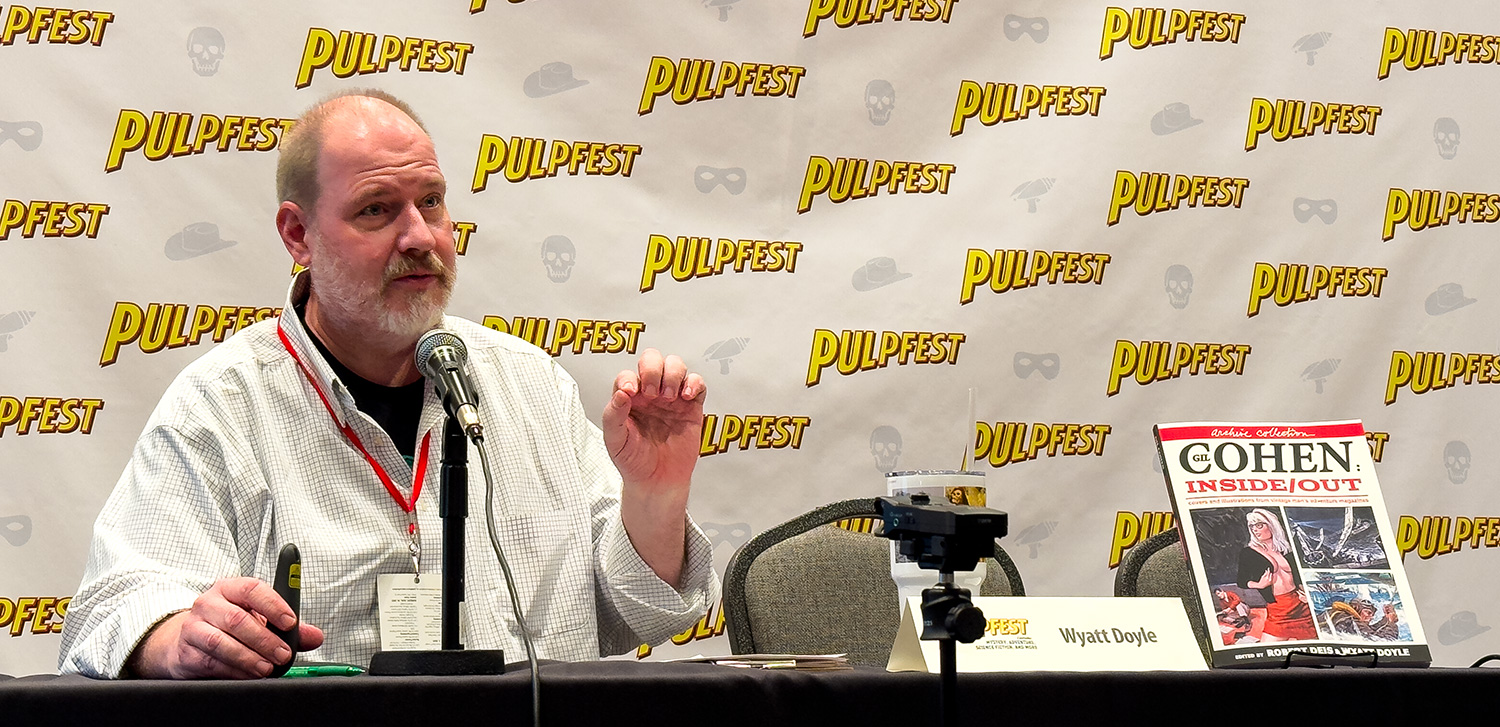
Wyatt Doyle, co-editor of the Men’s Adventure Library series, discusses the “masters” who put together the men’s magazines for the American war veterans. This Pulp Tales was recorded at PulpFest 2025 in Pittsburgh on Friday, Aug. 8.
Click to expand the transcript.
Pulp Tales Announcer: Welcome to Pulp Tales, fascinating stories of the pulp magazines and the creative minds that brought them to life. The fictioneers, the artists, the editors, and others. Brought to you by ThePulp.Net.
Learn more about the pulp magazines through articles, blogs, bibliographies, links, over 100 episodes of this podcast, and much more at ThePulp.Net. Your link to the pulp magazines for almost 30 years. Online at thepulp.net.
Wyatt Doyle: To quote Block, in addition to the stories I wrote of my own initiative, sometimes an editor would call the office with an assignment. He needed 2,500 words to fill a hole in an issue that was about to go to press, say, or he had a terrific idea and he needed someone to write it up. A shipwreck or a disaster or a, in caps, very bad man. Something I was prepared to rise. Thus did Lawrence Block, at around 20 years old, become a writer for MAMS.
Pulp Tales Announcer: In this episode of Pulp Tales, Wyatt Doyle, co-editor of the Men’s Adventure Library series, discusses the masters who put together the men’s magazines for the American war veterans. This Pulp Tales was recorded on Friday, Aug. 8, at PulpFest 2025 in Pittsburgh.
Wyatt Doyle: My name is Wyatt Doyle, together with Bob Deis, who, as Mike said, is sadly not here. we work on the Men’s Adventure Library series. And, I mean, a major challenge to our efforts to document Men’s Adventure magazine history is the fact that it went largely unrecorded at the time.
Most working in the industry, they viewed the magazines as disposable entertainment, and very few expected any of the work that they contributed to MAMS to endure much beyond each issue’s shelf life on the newsstands. So as a result, in so many cases, MAM men’s adventure magazines, in case that’s not clear, MAM veterans didn’t themselves retain copies of stories they wrote or illustrated or modeled for, copies of magazines they appeared in, or even original artwork. I mean, it’s odd to think that anyone involved in the arts wouldn’t keep copies of their work, but MAMs were a job, and that’s how contributors tended to see those years and that work.
Tonight, I’d like to briefly profile some of the leading lights of the MAM era and share some of the reasons we consider them to be important. We’ve been fortunate enough to help some MAM veterans to tell their stories in our Men’s Adventure Library series and get to know them a little bit. And I hope tonight will enhance your appreciation of both their memorable work as well as who they were as people and artists.
We have several important figures I’d like to discuss, so you’ll have to forgive my brevity. My goal is that the talk be something of an appetizer platter of ma’am greats. And please stop by my table if you want to explore any of our subject’s work in greater detail or if you have questions.
First up, George Gross. This is our book collecting the cream of George Gross’ work on men’s magazine covers. Soft covers on the right, hard covers on the left.
Illustration artist George Gross’ career and influence are broad, spanning multiple formats of men’s adventure literature. Gross’ career stretches back to the pulps and early paperbacks, illustrating just about every genre from sports pulps to crime. It’s worth remembering, too, that pulp artists like George Gross were not only illustrating pulp fiction, they were establishing visual templates for the emerging genre.
And in George Gross’s case, we can point to a very specific example of George Gross establishing the template for Pulp Fiction. The movie Pulp Fiction. Gross came from a family of artists. His father had a commercial arts studio.
And George studied at Pratt, where among his classmates were Frank Volk and Howard Sherman, who would go on to join him in the pulps. Gross did prolific work covering the pulps, sometimes serving as his own model. Now this reference photo of Gross was not actually shot for the bullseye detective cover, but it’s a close enough match to make the point.
His ascent in Pulps benefited from his wartime availability. Impaired vision in his right eye disqualified him from military service. So in the 40s, he was available to paint dozens of covers for Fiction House magazines.
After the war, he added paperback covers to his repertoire, And Gross made another significant contribution to adventure illustration when he took a fledgling young illustrator named Mort Kunstler under his wing. This is a Gross paperback cover featuring Mort Kunstler as Gross’ model. And unless I miss my guess, the lady is Deborah Kunstler, Mort’s wife, and frequent model.
George was older than Mort, but their fathers were friends, and Mort’s first real drawing instruction occurred as a kid joining his father for regular weekend bull sessions at the Gross Arts Studio. And as Mort matured, it was George Gross who welcomed young Mort to the studio where Mort did odd jobs and occasionally earned a workspace set up next to his Uncle George. Working side by side, it was inevitable.
They would end up pressing one another into service as reference models, and Mort and Gross are both easily recognizable in each other’s work during that period. Now here we see the final use of that reference photo of Gross in an illustration by Mort. As the pulps died off, Mams emerged, steadily climbing in popularity.
Gross and Kunstler would become prolific contributors to the emerging genre, and here we see Mort featured on two Gross covers. Gross nurtured Mort’s talent and recommended publishers and venues where the young artist might find work. He educated him both in artistic technique as well as practical considerations.
He helped Mort learn the business of being a commercial artist in an occasionally unpredictable industry. And I’m going to quote Mort Kunstler himself here. He said, he used to give me very practical lessons.
I got the best lesson in my life very early on. I remember one time I said, I was just at publisher Dodd Mead and they promised me a painting commission. I’ll have one next week.
I was so excited. I hadn’t gotten an assignment from anyone yet. George said to me, let me tell you something, Mutz.
My nickname was Mutz. Still is. It’s not a job when someone likes your work.
It’s not a job when they say they’re going to give you work. It’s not a job when they give you the work. It’s not a job when you deliver the payment.
It’s not a job when it’s approved. Not even when the boss approves it. It’s a job when you get the check.
And the check doesn’t bounce. Now that’s Depression-era talk. It’s a job when the check doesn’t bounce.
In Depression days, I’m sure checks did bounce, you know. That was his first business lesson for me. Right from the start, he always kept me level-headed.
He was just about the best influence that anyone could have had. He was my mentor. Gross’ career continued on the men’s adventure path, and as mams began to fade from the newsstands, Gross returned to paperback covers.
Most notably, mass-market paperback reprints of classic pulp characters, such as The Avenger in the 1970s. And as you can see, George was not above occasionally cribbing from his man work and applying it to his later paperback work, when appropriate. Also, Nick Carter in the 80s. Perhaps no other artist can really be said to have contributed so significantly to the full range of men’s adventure fiction in all its 20th century iterations. Gross retired in 1984, and he passed away in 2003.
His work and influence on So Much That We Treasure should really not be forgotten. And that’s Mort Kunstler again by Gross. Same 1955 illustration with slight variations for a repurposing in 58.
Or sorry, 56. I don’t think anyone who ever met Mort Kunstler forgot him. He had the kind of personality that stayed with you.
He was an artist who never lost sight of the bottom line. He was sharp. He knew how to look after himself and his interests, which is a rarity among visual artists.
Mort was respected as both an artist and as a businessman. Mort sought out cover assignments, which tended to pay better, but also came under greater scrutiny by art directors and savvy publishers like Martin Goodman of Magazine Management Company. Mort told us many times of Goodman’s attraction to scenes that were densely packed with action and activity.
Mort could be a master at depicting such scenes, and he took great pride in occasions when Goodman made his approval known. Mort became such a popular and reliable artist for magazine management, he was granted a unique dispensation that allowed him to follow his dream of moving his family to Mexico for a time. Mort and his family lived well, American dollar was strong, and for Mort, work continued as usual.
He would take illustration assignments from magazine management, regularly creating and shipping paintings over the border to their offices in New York City. Now here’s Mort serving as his own model for a 1954 saga interior illustration, and we’re pretty sure that’s Deborah, Mrs. Kunstler, as well. As I said, she served as a model frequently in her husband’s career.
Now Mort’s keen sense of his own worth helped him navigate his career from peak to peak. When he ultimately left Mam Illustration, it wasn’t because he’d grown to dislike the work or its subjects. He just realized that advertising was a more lucrative path, and at the time was considered a higher tier work in general.
Advertising art was a field well known for its excellence, attracting the best of the best and paying them accordingly. And Mort, a lifelong athlete who arguably was prouder of his athletic career than of his artistic career, love to compete. Mort went on to specialize in historical subjects and his work and fine art prints in that area are perhaps the proudest area of his legacy but for MAM fans it’s Mort’s trailblazing work as a men’s adventure illustrator that we really love best.
We lost Mort not long ago but he was a hell of a guy and his work continues to reward deeper investigation. Now unlike most of the others on this honor roll, Robert Silverberg was ultimately a tourist in the field. He was already well established as a writer of science fiction by 1958, when during an unexpected dip in science fiction publishing, Silverberg found himself plying his trade in other arenas.
Crime digests like Trapped, Guilty, Manhunt, as well as Mams like Male, For Men Only, Stag, True Men’s Stories, and others. But perhaps his most intriguing detour was his becoming an essential part of a low-rent, short-lived MAM called Exotic Adventures, where he ended up supplying copy for much of the magazine’s six-issue run, in some cases writing every piece, or nearly every piece, in an issue all under different pseudonyms. I mean, there’s simply nothing else documented in MAM history to compare to it.
Now, Exotic Adventures’ artwork, so often key to a men’s adventure magazine’s quality and interest, is a mixed bag, and that’s being generous. It’s easy to see how contemporary collectors might overlook it, but Silverberg was already a pro, and his writing really elevates exotic adventures. Here he watched the secret sex rights of Uganda.
Not many can claim the same. So despite his skill at working in a variety of man themes, he would more or less settle into pseudonymous sexology reports for MAMS. One area he didn’t really explore in exotic adventures, writing under his L.T.
Woodward pen name, he’d write book-length, quote-unquote non-fiction studies of sexuality that served as a slightly more respectable strain of erotica than, say, sex novels. But he wrote them too. Now, while not sexology, Silverberg did contribute nonfiction to exotic adventures, such as an expose of Border Town Vice and this consumer guide to liquor shopping overseas.
If that seems out of character for a men’s adventure magazine, the thing to keep in mind is that they were created to appeal to male readers in any way possible. And it didn’t matter if that was via something sexy, something thrilling, something like a drinking guide. I mean, it was, everything was open game there.
Now, as science fiction publishing rebounded, Silverberg was happy to step away from the various avenues of exploitation publishing and rededicate his talents to the genre he truly loved. So MAM’s loss was unquestionably science fiction’s gain. Lawrence Block, a friend and colleague of Silverberg’s from those years, who could also be called a notable tourist in MAMs.
Now Lawrence Block would enjoy his greatest success and acclaim under his own name in the years following his MAM contributions. Another born writer, Block cut his teeth working as an editorial associate for the Scott Meredith Literary Agency. His job was, and I quote, reading the stories of wannabe writers who paid Scott to read their work.
Amateur writers hoping for a break. So casting a critical eye across the flood of stories was, as Block insisted, the best possible job for anyone interested in publishing or writing for print. To quote Block, "In addition to the stories I wrote of my own initiative, sometimes an editor would call the office with an assignment.
He needed 2,500 words to fill a hole in an issue that was about to go to press, say, or he had a terrific idea and he needed someone to write it up. A shipwreck, or a disaster, or a, in caps, very bad man. Something that would never occur to me to write, but more often than not, an occasion to which I was prepared to rise.
Thus did Lawrence Block, at around 20 years old, become a writer for MAMS. Now, shipwrecks, disasters, and very bad men actually aptly sums up most of the work Block created for MAMS. All were standard MAM templates for non-fiction articles, and Block took to the MAM tone with ease.
Not everyone could. All of the writers that we’ve interviewed and all of the artists that we’ve spoken with have hammered home the idea that it’s not as easy as it looks, and there was very specific tone that needed to be met, and not every writer was capable of it, and not every artist was capable of delivering it either. His hard-nosed sex-pose about prostitution, written as Sheldon Lord, She Doesn’t Want You, we see its first printing here, saw print no fewer than four times in four different magazines.
You can read that story in Both Weasels Ripped My Flesh, our collection, and our Block collection, Naked and the Deadly. Now, later appearances in men’s adventure magazines would be what we call book bonuses, excerpted from lengthier works. And ultimately, Block followed a similar course to his friend and colleague Silverberg, shifting into sexology paperbacks, mostly under his pseudonym, Dr. Benjamin Morse, and then later as John Warren Wells.
Now, the last two spreads that you saw, just to give you another sense of man efficiency, the artwork is completely taken from other places and was not created for this at all. Samson Pollen. There’s a lot of people who worked in men’s adventure magazines who did great work but remain unsung.
Probably none more so than artists who did not accept many cover assignments. So understand, when the internet discovered MAMs and images started appearing to wet new appetites for these long-lost magazines, it was predominantly MAM covers that flooded online spaces, and still do, but what wasn’t copied and shared nearly as much were the interiors. And Samson Pollen was an artist who much preferred interior work, rarely painting covers.
As they say, location, location, location. The fact is, Pollen had little interest in covers. We’ve only identified a single Pollen cover that was created as a cover.
There are other instances where Pollen’s work, his interior illustrations were used on covers, but they were not cover paintings by design. Now, he was versatile enough to paint just about any kind of scene, but the work for which he’s most fondly remembered can be broadly broken down into two main categories. Women and action.
Naturally, we’ve devoted collections of Pollen’s work to each. These collect Pollen’s original artwork sourced from his personal archives. Now, when it came to depictions of women, Pollen’s women were tough, fierce, strong, and always sexy.
Curiously, almost no Pollen illustrations depict women in terror or women being menaced, though women being menaced are a staple of man fiction and illustration. It was something that Sam hadn’t even considered himself when I asked him about it. It was no statement he was making.
Rather, we suspect it was simply the magazine’s art directors recognizing various artists’ strengths and assigning illustrations accordingly. When it came to depictions of action, Pollen’s emphasis was on motion, and it was a challenge he relished. It was an ongoing study for him how to most effectively depict action and movement.
He recognized that sometimes this meant slightly exaggerating the human figure. Working closely with magazine’s art directors, he recognized that he had to take chances with his concepts and compositions if he wanted to depict action most effectively. He never wanted his characters to look posed.
That was something he sometimes saw and was critical of in the works of his contemporaries. When he painted scenes, he imagined himself in the scene and tried to communicate with a brush what he was seeing, feeling, and experiencing. He most definitely considered himself a storyteller.
And sometimes he literally appeared in his work. Sam is recognizable in a few illustrations, and this one’s a favorite. And on a few occasions, art directors used photographs of him in articles claiming Pollen was the protagonist of the story.
Here Sam is Tad Blaine, who single-handedly defeated a biker gang known as the South’s Rockfest Marauders. And here Sam is treasure hunter and adventurer Mike Schaefer. Sam, of course, had no idea that his photos were being used for this.
He was just in the office. He said, Sam, let me get your picture. and then a month later he’s Tad Blaine or Mike Schaefer.
Now following the Twilight of the Mams, Pollen transitions seamlessly into paperbacks. All kinds of paperbacks. From popular action series, to romances, to books targeting younger readers.
I particularly enjoy how go for broke Sam went on these covers for kids novels. I mean, his MAM experience really shines through on these. perhaps even more than on his adult action paperback covers.
I mean, these protagonists may be middle schoolers, but they’re very much in a Pollen painting. Sadly, we lost Sam in 2018. He had been retired for some years.
Our book with Eva Lynd is called Eva, Men’s Adventure Supermodel, and is one of the most popular women in MAMs with dozens of appearances as both a pin-up and as an illustration model. She has certainly earned the title. Really, no other woman in MAMs comes close.
Only ubiquitous male model Steve Holland can be considered in the same league when it comes to MAM appearances. Now, Eva was born Swedish royalty, and she moved to the U.S. as a young girl, where she fell in love with acting, which led to roles and modeling work.
Sometimes it was pin-up modeling, sometimes figure modeling for artists and illustrators. Now, her good looks certainly helped her find employment, but what made illustrators call her back again and again able to bring her acting skills to bear on her work as a model. Now that combination, she insists, is what makes a good illustration model in the first place.
A model needed to know how to pose and favor the camera, sure, but not every model knew how to sell a scene, nor did they have the imagination to effectively react to non-existent weapons and hardware, as well as other sometimes imaginary characters in the scene, all of which were more likely to be absent from the photo shoot to be added to the composition later. Now when I hear contemporary actors talk about the difficulties and challenges of green screen acting, where backgrounds, props, and sometimes characters are all added in post-production, with actors performing against neutral backgrounds, pretending to be part of an epic scenario, it reminds me how decades earlier models like Eva and Steve managed to perform effectively under similar, if far more low-tech, settings. When Eva modeled for MAM artists such as Al Rossi, who employed her frequently, or Norm Eastman, who also thought of Eva as a favorite, she brought good looks and a strong sense of performance to her work.
Sometimes Eva played victims, sometimes she played fighters, but it’s unlikely that most MAM readers realize that the pinup they were mooning over in one section of the magazine was the same freedom fighter mowing down Nazis on the cover. This is Walter Kaylin. This is our book celebrating our favorite Walter Kaylin fiction from MAMs.
Catchy title, huh? Kaylin’s work also appears in this book. and one of my very favorite Walter Kaylin stories appears in this book.
Can you tell we like his writing? I mean, his career for MAMS didn’t line up precisely with the years that those mags were on the newsstands, but it came close. And it seems appropriate for someone that we and many others think of as the definitive men’s adventure magazine writer that he was there almost from the mag start to the finish.
There’s no genre that Kaylin specialized in. His work is defined less by subject matter and more by his approach to subject matter. And that approach could best be described as fast, furious, and larger than life.
It may well be it’s the breathless urgency that he brought to his storytelling that prevents the reader from pausing to challenge a story’s veracity or realism. He just moves too fast for questions. He wrote Hard-Boiled Crime.
Westerns, historical fiction, generally on the darker side, exotic adventure, tales of revolutionary uprisings as here, alarmist nonfiction, death trap sagas, which were extremely popular, reality-based survival stories, various approaches to international espionage and intrigue, biography, both bogus and factual but embellished, Gangsters, humorous tall tales, which I’ve often compared men’s adventure fiction to tall tales in the way that it speaks to us and the way we respond to it. And of course, animal attack stories. And that is a Samson Pollen illustration there on a Kaylin story.
Walter, Kaylin’s daughters, Jennifer and Lucy, they shared this thumbnail sketch of their father, which I find very romantic myself as a writer. To quote them, A Jewish guy from the Bronx, he was the second son of a school teacher and homemaker whose signature dish was pineapple upside down cake. After graduating from William and Mary College and serving as a member of the Signal Corps in World War II, he began his career as a conventional writer, producing ad copy for J. Walter Thompson, and working briefly at Woman’s Day, where he wrote as a woman and was the only male in the office.
But his heart was always in fiction. The more muscular and hairy chested, the better. When he landed in the world of men’s adventure magazines, he knew he’d found the fraternity of writers he wanted to join.
As part of a stable that included Mario Puzo and Joseph Heller, presided over by Bruce J. Friedman, he pumped out stories about the sexual conquests and derring-do of He-Men with Take No Prisoners Relish. That’s actually… Walter’s daughter, Jennifer, is a very big wheel in publishing, And I believe she’s still editor-in-chief of O, The Oprah Magazine, so clearly it runs in the family.
Now, it’s Mario Puzo and Bruce J. Friedman who really seeded the idea of Kaylin as a ma’am writer’s ma’am writer. In their early 1980s interviews with Josh Alan Friedman, both of the magazine management veterans spoke of Kaylin in reverent tones, bordering on the mystical. Kaylin could write anything.
Kaylin was fearless in his excesses on the page. There was no one that could touch him. But his doings and whereabouts post-magazine management were uncertain then.
They weren’t even certain he was still alive. Daydreaming about the life of a mam writer, it’s easy and even irresistible to imagine Kaylin just feverishly pounding a typewriter, swept up in flights of his enviable imagination. Even the trials of the struggling writer in the mam era seem romantic.
Jennifer and Lucy Kaylin again. "To hear our father tell it, those years were as lean as they were fun. By day, he lived so close to the bone, he would ritually pawn his typewriter for quick cash, then retrieve it just in time to save it from being sold.
He was a regular blood donor back in the day when you got paid for it. He and his buddies made a science of figuring out which midtown hotels were hosting events, the kind that had open bars and ample buffets." Kaylin’s writing style is immersive, and combined with complicated, everything-plus-the-kitchen-sink plotting, readers tend to share the anxious states of mind comparable to Kaylin’s overpowered protagonists.
Even at their most extreme, the stories afford no time for skepticism. He was an intensely physical writer. He had rich descriptive gifts and a sense of momentum that just does not quit.
I mean, to the point where his endings sometimes feel like afterthoughts. Some stories halt more than they conclude. But with Kaylin, the journey can count more than the destination.
I mean, that’s not to say he didn’t know and appreciate the values of killer endings or silence or slow burns, particularly when he presented his counterpoints to some unspeakable savagery. Some Kaylin stories begin with a playfulness that encourages the reader to drop their guard just ahead of some nightmarish turns that’ll follow. That’s the one that I said is one of my favorites.
It’s in I Watched Them Eat Me Alive. Snakes don’t even particularly skeeve me, but this story will skeeve you. Basically, a plane crash lands in a swamp that’s completely filled with deadly snakes and have to get out.
I don’t know that even such swamps exist. They exist in the world of Walter Kaylin. Similar to what I’d said about Lawrence Block and Robert Silverberg, Kaylin had like an almost innate understanding of these highly specific needs of man fiction.
And his work in the field across decades would help define the genre. But that once in a career symbiosis came at a real price. For decades, it was only in those musty obscure magazines, most now well over a half century old, and copies hard to come by.
They’ve been the sole portal to the majority of Kaylin’s prodigious output. Robert F. Dorr, another really wonderful person. So from childhood he told us, I’ve had two main interests, the Air Force and writing.
And as if to prove it, he shared this photo with us for inclusion in the Handful of Hell collection. Bob was born in 1939, so he just missed out on being able to read aviation pulps as they hit the stands. but he was drawn to early men’s adventure magazines and their stories of pilots and war heroes, especially stories by Glenn Infield.
His first paid magazine piece was published in Air Force Magazine when he was only 16. It was around then that he discovered he had been born with a hearing impairment, thus ending his dream of becoming a great fighter pilot. But while it kept him from becoming a pilot, it couldn’t keep him out of the Air Force, and he enlisted the day after he graduated high school in June 1957.
He was out of the Air Force by 1960, just before his 21st birthday. His plan, as he put it, was to be a writer and adventurer, and he dreamed of writing a great American novel. He continued to write pieces for men’s adventure magazines.
I’m going to quote Bob himself a bit here because he wrote so eloquently about his man years. He says, As there was a period of several years when I was going to college part-time, I also worked some part-time jobs. But most of the time, I was supporting myself with income from the men’s adventure magazines.
I wrote a lot for magazine management, which published Stag, Male, for Men Only, Men, and others, and for Pyramid Publishing, which published Man’s Magazine and some other men’s adventure magazines. They usually paid me $350 per article, and $350 was pretty good. Not only was it pretty good then, he told us, it hasn’t gotten much better.
There are plenty of fine, high-quality magazines that pay less than that today. For most of that period, I was moving around a lot. So I had a post office box in San Francisco.
I had a couple of buddies there that I hung around with, guys I’d been in the Air Force with. I remember when we’d get together, they’d say, let’s go down to the post office today and see if you’ve got a check for men’s magazine. And every once in a while, there would be that wonderful moment where there’d be a check for $350 at the post office, and we’d be rich.
He says, magazine management had sort of two tiers of men’s adventure magazines. Magazines like Stag and Male were the better ones, if that’s the right word, but they had many others, and I was published in almost all of them. Another company I wrote for published Man to Man magazine and Escape to Adventure, which was another pulp adventure mag.
They also produced Sir magazine, that’s Sir with an exclamation point, which was more like a girly magazine. I can’t remember the editors anymore, but I was published in all of those. He said, I had virtually no real communication with the editors.
I knew their names, but I didn’t talk to them. My 15 years of communication with Noah Sarlat, who edited Stag and other magazines for magazine management, consisted of little notes that contained three or four words. I did eventually have some telephone communications and one personal meeting with Pyramid’s Phil Hirsch, editor of Man’s Magazine.
Basically, I typed up a story, I sent it into one of the editors, and either they used it or they didn’t. If they used it, they sent me a check. If they didn’t, they sent me a rejection note. Then I’d send it to another editor.
Since I had almost no communication with the editors, I had no idea if they knew that many of my stories they were publishing were fake. They didn’t ask whether they were true or not. With one exception involving one article out of hundreds, no editor ever suggested a topic to me.
I simply looked at what the magazines were publishing and tried to write similar stories. Now the protagonist of this story, Bob Dorr’s story, is portrayed by Dorr himself. That’s Bob in the corner.
He was a bit of an adventurer, and that is a photo of him from a parachuting expedition in Madagascar circa 1965, but it’s presented here as Bud Prather, Borneo adventurer. This is Bob again. One of the closest comparisons to the men’s magazines that I can think of is the women’s confession magazines, which I also wrote for during those years.
For them, I wrote articles like, I was brokenhearted when he left me for my sister’s husband, and things like that. In the first person, as if it really happened, from a female viewpoint, even though I really know nothing about women. I’ve spent over 70 years trying to figure them out and still know nothing.
But I wrote the articles anyway. I used different bylines for each because the name was the name of the woman in the article. They paid less than the ma’ams, so I only did a handful of those.
I learned a lot about writing later in other ways, but the MAMs were a good training ground and you could see some practical results from your efforts. Writing for the men’s adventure magazines was a learning process in a lot of ways. I think the guys who put those magazines out deserve a lot of credit for helping to teach a whole generation of writers how to write.
Gil Cohen is known to many as the definitive cover artist for the Mack Bolan Executioner Novels by Don Pendleton. These cover paintings with the subject of our first Gil Cohen collection, titled One Man Army. He’s known to others for his late career aviation art, which is rightly celebrated.
But before any of that, he was one of the most versatile illustrators working in MAMS, where he honed and refined his skills as an illustrator the old-fashioned way. One commission at a time. It’s a quote from Gil: "My first foray into action-adventure was the men’s adventure magazines that used to be popular in the ’50s and ’60s. I did a lot of work that helped me mortgage a home and bring up two kids.
I worked for Magazine Management Company, i.e. Marvel Comics Group. Marvel Comics Group was the comic book division. They published Male, Stag, For Men Only, and a bunch of others.
An illustrator named Mort Kunstler, who has gone on to his own kind of historical illustration, did work for them. Jim Bama, who is now a prominent Western painter, did work for them. And the editors.
Listen to the editors. Bruce J. Friedman, who did the screenplay for Splash and a bunch of other things. The art director was Larry Graber.
One of the editors was Mario Puzo. I don’t need to tell you what he’s done since. It was an incredible stable of people out there.
Now, that’s a Cohen spread for a Mario Puzo story there. You’ll note the author is not Mario Puzo. Most of Puzo’s work for MAMS was done under the name Mario Cleri.
Cohen again. I did a lot of covers for these magazines and a lot of inside illustrations. I did hundreds of illustrations in that period of time, in my 20s and 30s. That was a period when I would do illustrations in like a day, two days, three days.
I mean, I worked like a fiend during those illustrations. Frankly, some of them looked it. They weren’t as well thought out or painted as they later got to be.
And you learn how to draw. In 1969, Gil illustrated a scene from a new action novel excerpted in a popular man from Magazine Management Company. The book was by Don Pendleton, the first in what would become the Executioner series, and the for men only illustration marked the first time Cohen would render the iconic character Mack Bolan.
Quoting Gil, I hope I don’t disappoint any of the Mack Bolan fans, but when I got that assignment in 1969, I didn’t know anything about Mack Bolan at all. To me, he was not a special character. He was one illustration assignment I had out of hundreds that I’d done.
It was just another assignment. And so when I painted the character on a rooftop, shooting a sniper’s rifle down at presumably the mob, I didn’t think of the Mack Bolan character I painted later at all. Now, because Gil had been in the Army, one thing that was very important to him was the way that characters in illustration handled weapons and the way weapons were displayed and presented.
So he immediately dove into that. The weapons are right. I made sure of that.
It’s not only the two years that I had in the military, but my lifetime of interest in that stuff. Even in that first illustration with his gun case opened up, I know the guns that are in there. I see a Mauser semi-automatic pistol, the first pistol of its type.
It’s from earlier in the 20th century, but people were still using them in the 50s. And I always thought it was a cool-looking thing. It really is. Then you see a Luger, and you see all the accessories.
Silencers, scopes, magazine clips, things like that. I never even became cognizant that this story was attached to Mack Bolan in any way until Bob Deis brought it to my attention not long ago. If I’d been reminded of it before then, I think I would have remembered because the executioner and Mack Bolan has had a lot to do with my career.
I certainly remember the art, though. I don’t have it anymore. It was probably sold a very long time ago.
Now, this is Gil’s interpretation of an excerpt from Wilbur Smith’s Dark of the Sun. Now, Gil insisted that he had no idea how to paint women when he started. And some of his earliest work bears that out to a degree.
But Gil learned quickly, and as you can see in this 1967 piece for Man’s World, gorgeous women were soon helping to define his man work. Now, I can share some big news today. Some of you have stopped by the table. We’ve talked about this.
After celebrating his action paperbacks with the one-man army collection, The Men’s Adventure Library will present the definitive look at the MAM art of Gil Cohen. We’re working very closely with Gil on a big three-volume collection that assembles three decades of his explosive illustration art. It’ll be from his earliest work in the 50s through the twilight of Men’s Adventure magazines in the 70s. We are planning a special limited edition hardcover to whet your appetite ahead of the three-volume set.
But in even more limited quantities, we have an advanced softcover edition that’s only going to be available here at PulpFest. For you and only you. We really do only have a few of these.
They’re not going to make it through tomorrow. But our goal is, and this is a good point to bring up about the absent Bob Deis. I’ve been putting these books together, and it started off we were going to do a Gil Cohen book.
Bob kept sending imagery. I said, Bob, we’re into two volumes. now.
He’s like, all right, let’s keep going. Then I said, Bob, I think we’re pushing three volumes now. He said, let’s keep going.
The last conversation I had with Bob, he said, I knew there was more stuff back in the ’50s. So I went through my magazines, and I’ve got about a dozen pieces that we’re going to add to the book. So if I can get Bob out of the ’50s, we’re going to get volume one out as soon as possible, but in the meantime, as I say, we do have a handful of copies of what we’re calling the archive collection, which is not a best of, because there’s no way I would want to be tasked with creating a best of Gil Cohen, but what we have here is a nice overview of what you can expect from the three-volume series that’ll be coming later this year. Gil is still with us.
Somebody who, I forget now who pointed this out to me, yesterday said, so is Gil the last man standing of Men’s Adventure illustration?" And I was like, "No, no." And I was like, "Yeah, I think Gil might be." I mean, sad to say, but sadly we lost so many of the people that we worked with on these books in the Men’s Adventure Library.
As you’re hearing me say, "Oh, then we lost him." So Gil is in his 90s, you’d never know it, and he’s very excited about this, and we’re doing a lot, we’re doing the book with his full cooperation and enthusiasm. So, quick, quick questions. Yes.
I’m sorry, which publishing arm?
Audience 1: Marvel.
Wyatt Doyle: Well, they didn’t come out as Marvel. Basically, Marvel was part of the corporation, and the Men’s Adventure magazines were coming through Men’s Magazine Management Company. Yes?
Michelle Nolan: In my book, Baseball and Football and Compult Magazine, that I did five years ago, Robert Silverberg, I wrote a chapter on him and several other writers who began their career writing sports, and nobody knows, nobody’s ever done that. And I wondered, you know, Silverberg wrote seven very excellent sports stories, short stories, before he ever wrote anything but one science fiction story. Is that right?
Yeah, he was into baseball, heavily into baseball. One football and six baseball. I’ve got them all, and they’re all good.
That’s fantastic.
Wyatt Doyle: He could write anything, Silverberg.
Michelle Nolan: actually much better writing baseball than he was writing sex.
Wyatt Doyle: You wrote a lot more sex.
Michelle Nolan: Yeah, I know. Anyways,
Wyatt Doyle: I didn’t know if you knew it
Michelle Nolan: or not.
Wyatt Doyle: I didn’t know it. Thank you for letting me know. Thank you all. I’m sorry I didn’t have time for more questions, but I hope I’ve whetted your interest.
Pulp Tales Announcer: You’ve been listening to Pulp Tales, fascinating stories of the pulp magazines and the creative minds that brought them to life. Brought to you by ThePulp.Net. Learn more about The Pulp Magazines through articles, blogs, bibliographies, links, over 100 episodes of this podcast, and much more at ThePulp.Net.
Your link to The Pulp Magazines for almost 30 years. Online at thepulp.net. Subscribe to Pulp Tales on your favorite podcast platform or listen to us on the web at ThePulp.Net.
If you enjoy our content, please like us or leave us a review. And tell your fellow Pulp fans about Pulp Tales. Thank you for listening, and keep reading the Pulps.
Pulp Tales is copyright 2025 by William P. Lampkin.
This transcript was generated automatically and may contain transcription errors, typos, or other inaccuracies.


