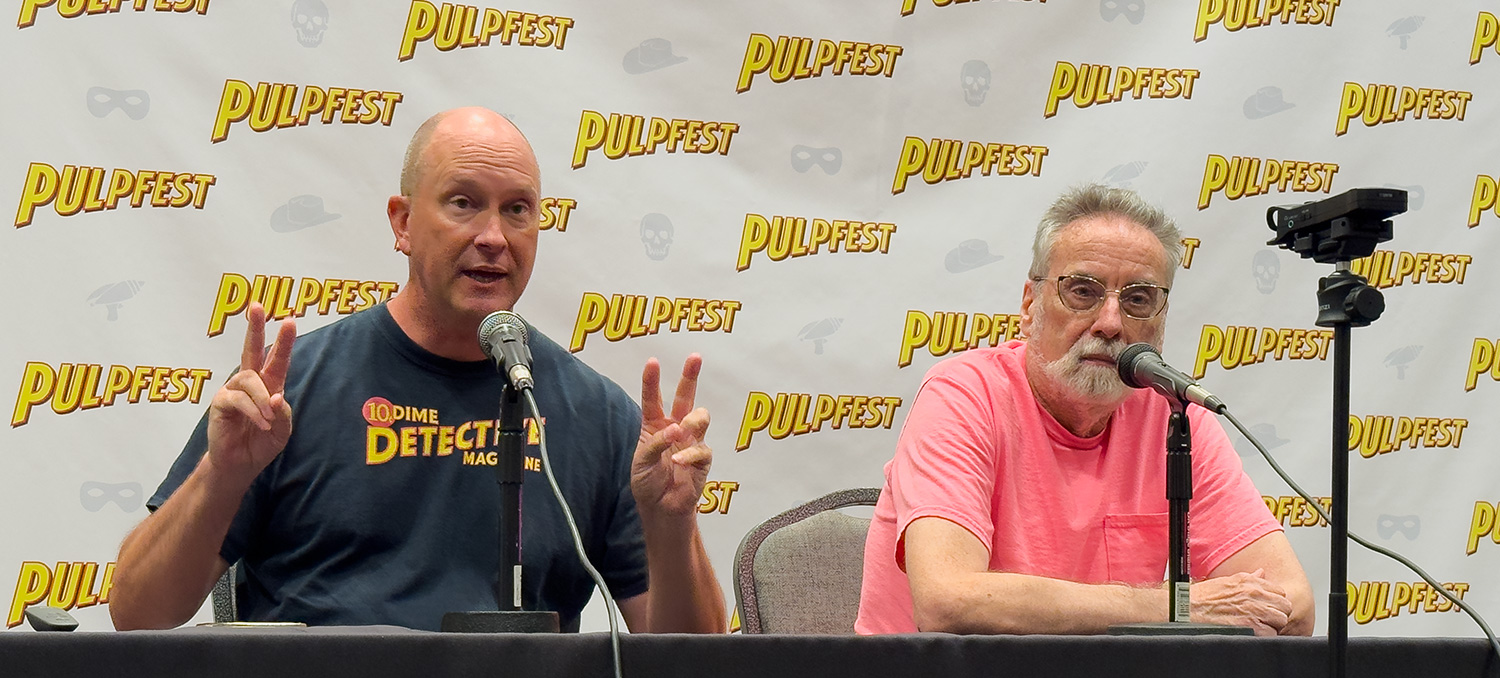
Pulp collector and former intelligence consultant Tim King and author and pulp historian Will Murray explore the masters of villainy, a celebration of the 90th anniversary of the villain pulps. This Pulp Tales was recorded at PulpFest 2025 in Pittsburgh on Thursday, Aug. 7.
Click to expand the transcript.
Pulp Tales Announcer: Welcome to Pulp Tales, fascinating stories of the pulp magazines and the creative minds that brought them to life. The fictioneers, the artists, the editors, and others. Brought to you by ThePulp.Net. Learn more about the pulp magazines through articles, blogs, bibliographies, links, over 100 episodes of this podcast, and much more at ThePulp.Net. Your link to the pulp magazines for almost 30 years online at thepulp.net.
Will Murray: Dr. Death felt that the world had gone to hell, that science was bad for humanity. We needed to be hurled back into the dark ages. We needed to go before machinery and get back closer to God by giving up all modern conveniences, including electricity and plumbing. His goal in life was to throw us backward into the dark ages, and he thought he was the only one who understood.
Pulp Tales Announcer: In this episode of Pulp Tales, pulp collector and former intelligence consultant Tim King and author and pulp historian Will Murray explore the masters of villainy, a celebration of the 90th anniversary of the villain pulps. This Pulp Tales was recorded on Thursday, August 7th at PulpFest 2025 in Pittsburgh.
Tim begins.
Tim King: Great. Thanks everybody for being here on the much-vaunted Thursday evening slot. This is where it all gets kicked off.
Ed Hulse agreed to warm us up for us, so we appreciate him doing that. Last year we did a talk, or I did a talk, with a theme where I was assembling a pulp strike team. And I grabbed various characters and put them together and explained how they would be done as a way of explaining about spycraft in the pulps.
And that was pretty well received, so I thought this year I would do something similar. where we do draft picks. So for those of you who are sports fans, whether it’s NFL or baseball, or really that’s about it, those are the only sports you should watch, football or baseball.
The first Ohio State game is August 30th. I know you’ll all be watching. I thought we’d do some sports draft picks.
So I contacted the Society of Evil, extra villainous in literature, And they agreed to let me be the emcee for the sports draft pick of Villainy. And I have a color commentator, special guest presenter, an up-and-coming writer named Will Murray, who’s much more knowledgeable about these characters than I am. And so he’s going to give you the background stats.
We’re going to do it in reverse order. So normally, if the NFL or the MLB was doing a draft, they would grab their most desired pick first with their first pick. But this is villainy.
So we’re going to go with sort of the also-rans first. And then we’re going to work our way up to the master of villainy. So, are you ready?
Yeah. So with our last draft pick, the Society of Evil would like to draft Dr. Death. Conveniently enough, you should know something about Dr. Death.
Will Murray: Well, I first read Dr. Death and the Corinth reprints back in the 70s, although they were 1960s reprints. And of all the pulp I was reading then, it was the wildest and craziest stuff because it went full blown into the occult and the supernatural. Dr. Death was originally Professor Rance Mandarin.
He was not Asian, but his last name was Mandarin. And he was a dean of psychology at Yale, and he got interested in the occult. And this led him to two things.
One is mastery over occult forces like elementals, which he could sum up. The ability to create zombies, he had to dig up corpses for that. I think he resurrected a mummy or two.
And some other strange things. And he was really, really, really insane. because his, you know, we talk about mad scientists and usually they’re just cracked, right?
Or they’re off on one wing somewhere with one little hobby horse. This guy felt he was the emissary of God Almighty in the world. At the same time, he was a devil worshiper and conducted black masses, but never mind that contradiction.
I think we can all relate to that. Dr. Death felt that the world had gone to hell. and that science was bad for humanity.
We needed to be hurled back into the dark ages. We needed to go before machinery and get closer to God by giving up all modern conveniences, including electricity and plumbing. And his goal in life was to throw us backward into the dark ages.
And he thought he was the only one who understood. "The Essential Problem" in the 20th century, early 20th century. And he was, I guess, because he was described as gaunt and frizzled hair, I imagine Albert Einstein was kind of a model for him because Einstein had that hair and was considered brilliant and Dr. Death was considered brilliant but bent.
So he was to me not the last person, draft pick, the first one. In the sense that he was so over the top and the stories were so over the top, it’s hard to believe they were published by Dell, which when I was growing up Dell comics were the good comics. No violence, no blood, no sex, no nothing.
And so, but the Dell of the 1930s was a different kettle of fish.
Tim King: Okay, very good. Well, he was, I think he was probably first, right? July 1934? Yeah, I think he was first.
Will Murray: Yeah, he was.
Tim King: Yeah. Will, do you have a, like, Dr. Death is making a comeback, though, right? You’ve got him?
Will Murray: Yeah, I won’t take up too much of the panel, but in the editing stages now is Secret Agent X versus Dr. Death. And the basic premise is Dr. Death picks up where he left off in the fifth novel, which was not published in the 30s, but relatively more recently. And Secret Agent X is assigned to deal with him and discovers that gas guns and gadgets and trick disguises aren’t so good against zombies and elementals and the type of craziness that Dr. Death could talk.
So he decides he needs to recruit a team. And I won’t tell you who the team members are, but there are a couple of them on there. You might recognize one.
You might think you recognize the other. But they’re characters from the same publisher as Dr. Death. And as I said, Dr. Death is the same publisher of Secret Agent X. So I sort of kept it in that family.
But Dr. Death is Dell. So it’s a crossover between two publishers. entities of that time.
And it works pretty well because Secret Indian X usually fought really over the top, semi-supernatural menaces, but they weren’t truly supernatural. So he’s challenged in new ways. I like it.
Sounds good.
Tim King: With our next draft pick, the Society of Evil picks, Dr. Satan. I’m going to need that book back. No, I’m just kidding. I think Dr. Satan was more like
Will Murray: eco-terrorist or he had a different no um he was a dabbler in black magic and he his motivation was just money greed and just money and greed but also i think he liked doing evil for evil’s sake so he was not you know in that sense he was probably not rational like dr death but he’s a little more rational well on the scale of rationality or irrationality and he would wear this you know costume and he had these two sidekicks. And his heroic antagonist was Ascot Keene, which is a name that probably is more 1920s or before the 1930s, but that’s what Paul Ernst came up with. And I read these stories so long ago, I don’t remember them very clearly, except Bob Weinberg reprinted them originally, but they’ve been reprinted in much more colorful and modern editions.
And I think he’s been revived because he’s in the public domain. People have done news stories with him. So when I came up with Dr. Death versus Secret Agent X, originally it was someone suggesting to me at a convention, how about the spider fighting Dr. Satan? And I thought, I didn’t think the spider licensor would go for that.
But when I thought about it, I gradually came to Secret Agent X vs. Dr. Death. Maybe I would pick Secret Agent X vs. Dr. Satan at some point, I don’t know. But I’d have to re-read those stories and see if he’s strong enough of character.
Tim King: There weren’t very many of them, were there? Five, I think. Five.
Five. All right. I did seven, I think.
What’s that? Seven. So you’re going to have to edit this out to make sure that I give the correct number.
Count your numbers from the world.
Will Murray: I think, yeah, you might be right, but… I think I have somewhere in there. It’s an odd number.
It’s about five or seven. It’s not an even number. But I wish I could remember.
Tim King: Are you the researcher Kenneth Grant who wrote the blurb? I don’t know if I were. Okay.
All right. All right. With our next draft pick, it really gets weird.
the octopus and the scorpion
Will Murray: well the octopus was and the scorpion were essentially the same magazine the octopus was a master villain of sort of unknown heritage you know he wore an octopus kind of outfit but there were hints that maybe he was kind of octopus like as a person they never explained it he wasn’t Cthulhu or a relative But he battled the skull killer who was also known as Dr. Skull, who was an inner city medico who helped the poor and the indigent. And something happened. And they rewrote the second octopus as a scorpion.
And the only possibility that I’ve ever come up with is the villain of the first spider serial was the octopus. And maybe Columbia, the studio, objected to the octopus magazine. because Columbia owned the octopus in the context of the spider cereal.
So they changed the scorpion and then they bailed on it. And there was a mystery as to, you know, the skull killer fought both the octopus and the scorpion and there was no resolution. So I got the right to bring them back for Scourge of the Scorpion, my third spider novel, and I tried to make sense of it all, which was kind of hard, but I did, sort of.
And those of you who read it know that I had to jump through a lot of hoops to make anything make sense. But I had a lot of fun with that because they were over the top, like Dr. Death and Dr. Satan. It’s just unfortunate that either one of those characters didn’t get developed to a degree where we have a few more adventures and we had some idea what the hell the writers were thinking.
Tim King: I’m receiving a communication from the Society of Evil draft pick headquarters in the center of evil in the world, New York City, Manhattan. And there’s been a very, normally we don’t do this, but we’re getting a communication in. Well, there’s a request for a verbal draft pick.
So I’ll go ahead and allow it this time. There’s a request in from someone named Dr. Clark Savage Jr. and he would like to draft John Sunlight. John Sunlight is a name I’m familiar with.
Will Murray: Well, John Sunlight was the only significant Doc Savage villain who appeared twice in the course of the Doc Savage magazine run. And he had escaped from a… He’s a Rasputin type of character in some senses. And he escaped from a Soviet gulag and found Doc’s Fortress of Solitude, got inside and got control of Doc’s superweapons.
And Doc dealt with him in Fortress of Solitude, which is the big reveal of this Fortress of Solitude that had been mentioned since the beginning. Spoiler alert, sorry. You know, beginning of the series, but never shown.
So we got to see what it looked like. And then a couple of issues later, since Sunlight seemed to have, might have survived being attacked by a polar bear, Sunlight starts organizing an army in Asia to conquer the world and Doc has to come in and deal with him. And he was a very charismatic villain.
But he, you know, and Dent wrote it so that the sequel originally was going to be Sunlight using the superweapons stolen from the Fortress of Solitude to start a European war. But Nenevik, the editor, John Nenevik, objected to issue continuity. So they put a book in between them and broke the continuity.
And Dent had to pick up the story from a different point. And years later, when I discovered the outlines of the two stories that Lester Dent had written, I wrote the middle story, where the weapons stolen from the Fortress of Solitude are in the hands of warring Balkan powers, and strange things are happening because they’re super weapons. People are disappearing.
So Dent wrote both of them, right? He created John Sumer. He created him. He was a very interesting villain in the sense that he was not physically strong, but charismatic and very evil.
But he managed to test Doc in ways that maybe some of the more physically formidable villains would never have been able to do.
Tim King: Okay. Sounds like a good possible pick for the Society of Extra-Villainists in Literature. We do have another request in, I apologize, this is out of regular order, but this is coming in from Society of Evil Headquarters. This one comes from a World War I aviator and spy, Kent Allard, so he says, for Dr. Radial Mokino, who I think goes by the Nom du Gare voodoo master.
Will Murray: Yeah. Well, you know, there are three voodoo master stories and they’re all excellent. And if I recall correctly, the shadow seemed to have killed him in the first one, but brought him back.
I don’t remember actually clearly, but he was definitely killed at the end of City of Doom, the second one, or burned alive. Yeah, burned alive. And then somehow Scarred managed to survive and showed up a few years later in Voodoo Death.
No, Voodoo… Voodoo Death? Trail, Voodoo Trail.
Right? I think so. Yeah, Voodoo Death was a digest with a version of the Voodoo Master, but under a different name.
And I think they’re superior shadow novels. They’re very different. But the voodoo master, he didn’t do real voodoo. He used hypnotic lights and other things to make someone mentally blank so that they could…
Tim King: All written by Gibson. All written by Gibson.
Will Murray: So he had to have the pseudoscience explanation. Yeah, yeah. He wasn’t really a voodoo master, sort of a voodoo faker.
Tim King: Well, we’ll consider that draft pick. That’s okay. So with those, we have a reveal for the number one draft pick for the Society of Evil.
But before I reveal who the number one draft pick for the Society of Evil is, I thought I would ask all of you and all the pulps you’ve read, who do you think holds the title? Fu Manchu? Is Maynard in here?
Is that you then? Awesome, great to meet you. Fu Manchu, eh?
So much for sending my slides ahead of time, no operational security. Dr. Fu Manchu, so I’m not authorized by the estate of Saks Romer, but I think Saks Romer would take exception to calling Fu Manchu a pulp villain because the original Fu Manchu stories were done in the slicks, right? A higher grade delivery system, colliers, etc. But Dr. Fu Manchu was in serials that became novels.
I think the original run was 15. Edit that out if I got it wrong. Kay Van Ash, I think, had two authorized.
And then when Patrick Maynard, I think, had two and maybe a third in the hopper, maybe one day. So that’s a lot. But then, as everyone has already pointed out, the most imitated character, let’s leave aside movies and comics and everything else, he was Dr. Yensen.
He was Wu Fang. He was Shiwon Khan. I asked, actually, in one of the online forums, did Doc Savage have a Fu Manchu clone? And someone suggested the Mystic Moa story was appropriate there.
And there was a version that appeared in the spider, etc, etc, etc. Several versions. Yeah, several versions. So I would have to say that if you were going to go for the overall number one draft pick for the Society of Extra Villainous and Literature, it would have to be Fu Manchu.
Now I have to tell you that I just got back from a family vacation, so I took the first appearance and the second, the first book and the second book, and of course you burn through them so quickly. It’s interesting to come back at this point in my life and reread them. I read them a long time ago, and there’s lots of conversations that can be had there.
But the key takeaway specific to this topic, which is villainy, is that he wasn’t very villainous and he wasn’t really present very much and I have to say that when I read them in my mind you know there’s for those of you that haven’t read them is there anyone that ever hasn’t read them there’s dr. Nalen Smith who’s kind of a John Watson version no he’s more like the Sherlock Holmes yeah sorry I got it wrong yeah Petrie was a true was lost and Nalen Smith the roving commissioner from Burma, he’s not very bright. He just falls into trap after trap after. What he has is dogged determination, so I almost think it’s more like Captain Ahab and Moby Dick because he just keeps charging headlong and doing dumb stuff.
But you know, he’s not very villainous. Fu Manchu is more villainous than the other novels. So you’ve written A version when you were writing Destroyer there was a
Will Murray: Yeah there was a version of Fu Manchu who was a wing Wing Moon. I don’t remember but the point is his name meant the nameless one. So I got to play with Fu Manchu and Bruce Lee in a Destroyer novel and I got to write Shi Won Khan who was logical as a shadow villain was logical to be a dark savage and shadow team up villain so I had fun with that.
Tim King: I am not a non-fiction writer, but as I read these, I thought, you know, you could bring Fu Manchu back and maybe kind of work around some of the more objectionable elements to it simply by showing them, as you have done in your more recent like spider work, where you combine characters and take these one-dimensional pulp characters and give them some flavor. But just to basically say that, you know, from his point of view, Dr. Fu Manchu is the hero. He’s trying to do the right thing.
He’s honorable. His methods are different, right? So it would be just like two different world views.
It’s almost like locking two people in a room that speak different languages and having them try to solve a problem, but they can’t easily because they speak different languages. Nalen Smith is just a knucklehead.
Will Murray: I would say a modern Fu Manchu in the books aren’t modern anymore, except relatively, but Dr. Noh and the James Bond novel, that was basically a modernized Fu Manchu. Clearly the number one. All the stereotypes are most of them anyway.
And I think Ian Fleming stated that Dr. Noh was his take on Fu Manchu. His idea came from that. So that’s a villain in that league.
Tim King: Well, definitely the first overall draft pick, extra villainous. And I think when I was walking around before we came in to give this talk, I saw that there’s a big poster out there. So I don’t know if someone is featuring Fu Manchu books.
Maybe. So that’s it. So that’s the Society of Evil.
Those are the Masters of Villainy. What do we do with them now? I don’t know.
Will Murray: That’s next year. Don’t ask me to team any villains up I think that’s a little bit overkill
Tim King: Well you’ve got that going already With Dr. Death You’ve got the B-list heroes Being led by the A-list heroes
Will Murray: Yeah but Dr. Death is the only villain In the book I’m talking about what if you teamed up Yen Sin and Wu Fang That would be kind of dumb Just like the same guy A different antagonist in a different tone You could do it. I have to do it. I could probably do it.
Hu Fang was more juvenile and Yen Sin was more an adult like the spider in terms of the intended audience. Or more adult like Fu Manchu. But keeping up villains, that’s kind of tough because they don’t always necessarily work together very easily.
They wouldn’t work together all that easily. But now they’re thinking of it, I’m thinking about it, right? You know, maybe there is a team up.
You’re welcome. Maybe there is a team up. I just have to think through it.
Tim King: Any comments about Masters of Villainy? Yes, sir?
Audience 1: I’m going from memory. If somebody can correct me if it’s not getting any better. Do you agree with Richard Blue Walk and the impression of the skull face of that paperback that Dr. Fu Manchu was, instead of all the Sherlock Holmes and the characters that were coming out, he was doing Moriarty, so he was pretty much, you know, he kind of like, the character, real individual, you know, the Lion House section of London, but he decided it was a financial reason that, okay, if everybody’s doing Sherlock Holmes, I’ll do the opposite, just go for Moriarty’s version of that.
Will Murray: Yeah, I don’t know. I always thought Skull Face was kind of like another take on Fu Manchu from a sort of ancient wisdom point of view.
Audience 1: Well, I’ll put it in there, so my question is, do you agree with him? He’s trying to, I want to get money from him, and I think the word argument would be a better way to break the literary ground.
Tim King: Maybe, I haven’t. So, have you guys read, ironically enough, the name, the title, Master of Villainy? by Kay Van Asch, it’s a sort of a biography of Sax Romer. Sax Romer was more of a, he was always a dreamer, he was a writer, he made money writing songs and ditties and so forth, and kind of got into writing almost by accident, is kind of my memory of it.
And he was an Egyptologist, and he was into the occult, because the occult sold. People were very interested at that time, so I think you’re on to something. He basically took the concept, because if you look at the characters, superficially they’re extremely similar right we’re already in the background pulling all the strings that’s Fu Manchu in the first novel he doesn’t really do a whole lot other than get described as the most you know evil fiend in all time and I’m reading it going he’s not doing anything very fiendish right now and of course Nalen Smith is sort of a Sherlock Holmes knockoff and Petrie I will say I find Petrie kind of annoying he’s that stereotypical English character of the time.
I look at her immediately, I fall in love forever. She keeps putting you into deaths and harm’s way. Why do you keep doing this?
So I think you’re on to something. And then it sort of developed over time. Yeah, absolutely.
Yep, just to get started. And I think once he got rolling, he was able to flesh out the character. You could be on to it.
But he’s still a first overall draft pick. He’s got enough doctorate to breathe. Yeah, that’s right.
That’s right.
Audience 2: I have a question. Yes, sir. I just started the Shawan Khan series.
And I was looking at the timing. He appears first in 36 and then again in 37. John Sunlight is in late 38.
Will Murray: I think Shawan Khan is a little later. I think he’s 39 and 40. Maybe 38, 39, and 40. But Shawan Khan is definitely more in the 39 and 40.
Audience 2: Okay, I thought I’d check the dates. But my basic question was, was there any transference of the notion of you need a named nemesis from Siobhan Khan? Well,
Will Murray: in the sense that in the later 30s, starting with The Voodoo Master and just tentatively, John Manavik, the editor, kind of loosened some of the restrictions that he had on The Shadow, and then again on Doc a little bit, against continuity. They didn’t like continuity they didn’t want the readers to feel like they had to buy every issue or they missed something if they didn’t buy every issue. With the shadow there was more continuity, with talk there was less.
I think they became aware to keep the interest up in readers, to keep the readers hooked. They had revealed who the shadow was, okay, so that mystery was solved. So they needed to move on to some other ways to keep the readers reading.
So Shiwon Khan, the voodoo Master were part of that I guess. And I think in Doc Savage it was just let’s give this a shot. You know it’s working with the shadow so let’s give it a shot. Because it was the same editor.
So he obviously was opening up to the idea of a recurring villain without it being too much. I think he once said something. He said you know if the villain came back it makes Doc or the shadow look weaker.
Now you and I wouldn’t agree with that because we used to Batman and the Joker and Superman and Luther and whoever. But you know, a recurring girl simply means a greater challenge for the hero and yeah maybe he doesn’t capture the guy at the end of the first story or kill him. So I think it’s more a test of the reader’s interest in reading the next issue and the next issue and the next issue, give them something they haven’t seen before because there were a lot of loyal readers to both magazines.
And this is before the comic books started to get into recurring films very much. So it didn’t come from there.
Tim King: And as Mike said in his intro, I mean, Ron Hill, do not rush the stage, okay? But the The shadow was more organically created, creating concepts and backstory and methods and things as the story started cranking out. Whereas Doc Savage, the written character, this is not Will’s opinion, this is my opinion, the creation of the character very much was like as the character’s biography was written.
In other words, he was designed and built to be the thing. He was like the first industrially processed, not AI, but you get the concept, right? Like, you know, chat GPT or Grok or whoever, make me a pulp superhero that can do everything.
And you get the bronze superhero, right? Who cares if they’re fighting muggers or diamond smugglers or whatever? You have to have some kind of over-the-top villain that’s going to challenge them and push them to their limits, within limits that the pulps would have, right?
Very rarely did they get injured. They never really failed ultimately within the course of the story. So you have to have somebody for them to fight against, whether they have a bunch of minions or they can do it all on their own or they use a gadget or they use pseudos, whatever.
You have to have a master villain. Otherwise, who cares? We’re not going to read it. It’s going to be boring.
The shadow saved a cat from the tree. You’re not going to get more than one issue out of that. Yes, sir?
Audience 3: This is a privileged question, I admit, but why do you suppose it is that in the Popes, Oriental villains are always detectable by their obsolete fashion sense? They dress like that two mandarins decades after that went out of fashion.
Will Murray: Well, you know, it’s one of the failings of the Pulps is they still had a lot of dime novel carryovers in how they present, because some of the same publishers. And they just, you know, for the purposes of covers, they needed to have colorful. I remember the Jack Kerouac novel, Dr. Sax, which was inspired by the shadow, and he made mention of tight-coated Chinese gunmen.
And I said, I would like to have seen a few tight-coated Chinese gunmen in the shadow. Yeah, they existed, but usually they were described as wearing robes or something traditional. And it was, I guess, partly not able to think modernly, but also just the need for colorfulness or exoticness taken to an extreme.
Tim King: First of all, I specialize in frivolous questions, so thank you for asking. It makes for a better cover. I think it’s also easier to just crank it out. We’re reading these, we’re visualizing as we go.
Audience 3: You probably could come up with a funny and superficially plausible explanation.
Tim King: There might be a Society of Evil subchapter that just cost it.
Audience 3: Vampire slayers spot vampires by their obsolete fashion.
Tim King: I’ll make a note of it. Thank you. Thank you.
Pulp Tales Announcer: You’ve been listening to Pulp Tales, fascinating stories of the pulp magazines and the creative minds that brought them to life. Brought to you by ThePulp.Net. Learn more about The Pulp Magazines through articles, blogs, bibliographies, links, over 100 episodes of this podcast, and much more at ThePulp.Net.
Your link to The Pulp Magazines for almost 30 years. Online at thepulp.net. Subscribe to Pulp Tales on your favorite podcast platform or listen to us on the web at ThePulp.Net.
If you enjoy our content, please like us or leave us a review. And tell your fellow Pulp fans about Pulp Tales. Thank you for listening, and keep reading the Pulps.
Pulp Tales is copyright 2025 by William P. Lampkin.
This transcript was generated automatically, so it may include typos and other errors.