

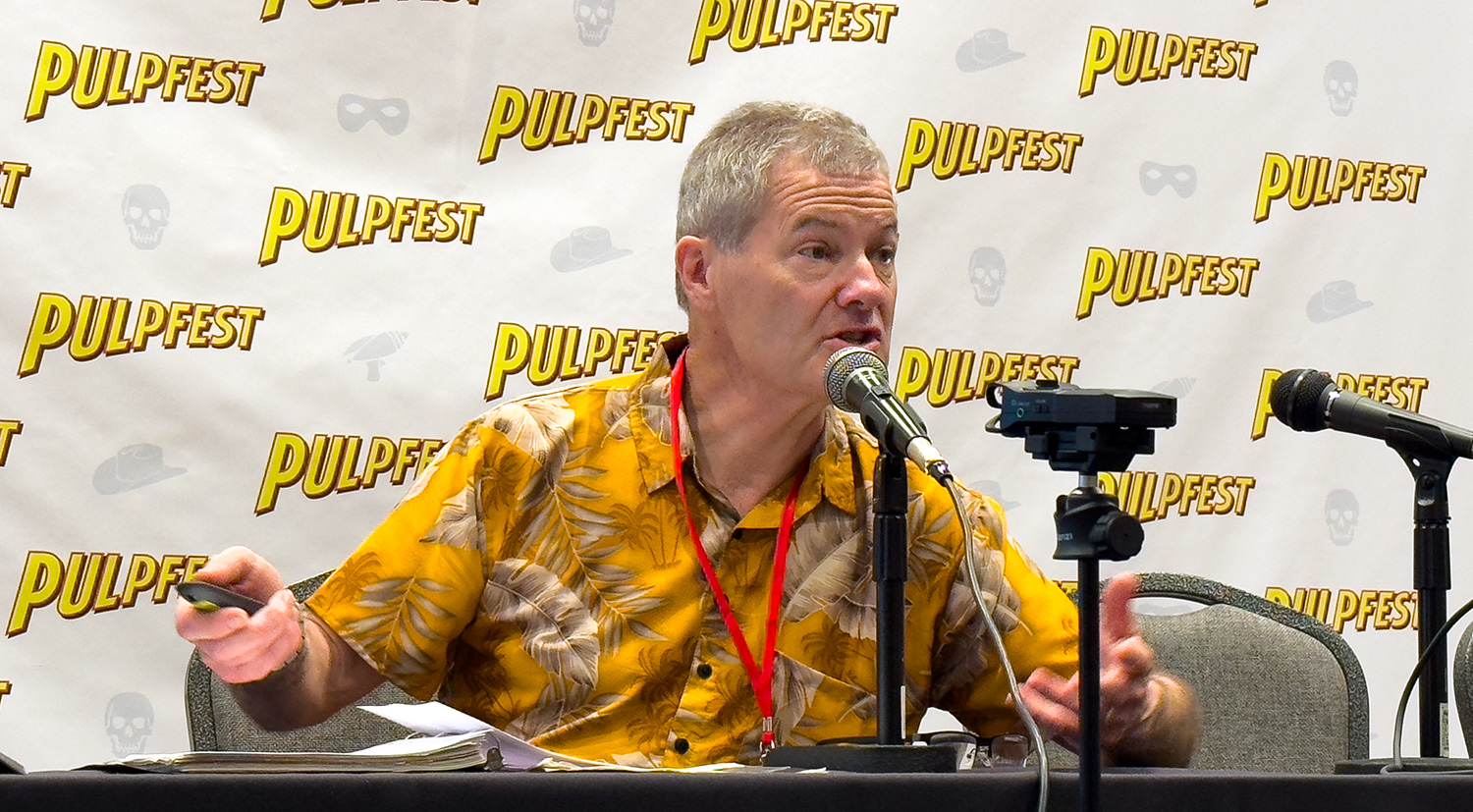
Pulp collector Morgan Holmes reflects on author Rafael Sabatini, one of the masters of blood and thunder, on the 150th anniversary of his birth. This Pulp Tales was recorded at PulpFest 2025 in Pittsburgh on Friday, Aug. 8.
Click to expand the transcript.
Pulp Tales Announcer: Welcome to Pulp Tales, fascinating stories of the pulp magazines and the creative minds that brought them to life. The fictioneers, the artists, the editors, and others. Brought to you by ThePulp.Net. Learn more about the pulp magazines through articles, blogs, bibliographies, links, over 100 episodes of this podcast, and much more at ThePulp.Net. Your link to the pulp magazines
Morgan Holmes: for almost 30 years online at thepulp.net and he had eight stories in adventure two of them were novels and one was captain blood which was kind of serialized as a series of stories and then the other one was the seahawk which had actually had been out years earlier but adventure ran but the book that really blew him wide open was scaramouche in 1921 that was the one that really became a big writer, at least in the U.S.
Pulp Tales Announcer: In this episode of Pulp Tales, pulp collector Morgan Holmes reflects on author Rafael Sabatini, one of the masters of blood and thunder, on the 150th anniversary of his birth. This Pulp Tales was recorded on Friday, Aug. 8, at PulpFest 2025 in Pittsburgh.
Morgan Holmes: Okay. So, Rafael Sabatini, And a writer that you probably know, you know, may not know him directly, but, you know, if you know Errol Flynn movies, and pretty much any swashbuckler movie owes to Rafael Sabatini. Though the pirate movies are really just one small part of what he did.
And I’ll tell you what, the raphaelsabatini.com website was a godsend with that. and a nice little logo there for that. He got the rapier, or épée, sword, which, you know, pretty much swordsmanship.
Born 1875, died 1950, just like Edgar Rice Burroughs. And Sabatini was born April 29, 1875, and I’m assuming it’s Jesi, J-E-S-I, Italy. His father was Italian, his mother was English.
They were opera singers. He may have been illegitimate when he was born. And he was sent as an infant to Liverpool to his mother’s parents.
Lived there for a little bit and then back to his parents at age seven, back to Italy. Then his parents moved to Portugal where they were teaching. And then as a teenager, he was sent to school in Switzerland.
And so he ended up speaking six languages. He was very, very much a polylingual. He graduated at age 17 from school, went to Liverpool in 1892 to work for pretty much like an international company.
Worked as a translator. His big thing was doing Portuguese translation for accounts in Brazil. And he began writing in 1895 or 1896.
And he felt that historical romances were more fun to write than to read. So maybe he read some bad stuff. There were some other swashbucklers in the 1890s. If any of you had that book, was it the big book of swashbucklers?
Or was it the mammoth book of swashbucklers? There’s some, like Stanley Weyman was a big in the 1890s. and then I’m unsure if, oh my God, the guy that did Gifford Aware went that far back. I believe this is N.C.
Wyeth, and in fact, I’m pretty sure it is. You know, pretty much, that’s from Captain Blood, though that was used for an edition of the Black Swan. And I mean, that’s Sabatini right there for that.
There he is with his wife. He, let’s see here, he married in 1905. Ruth Goad Dixon was his wife, and in 1909 they had a son, Rafael Angelo, who they called Binky.
And at that time they moved to London. He started selling stories in 1899, a lot of them, like Pearson’s, London Magazine, Royal Magazine. He wasn’t really much of a pulp writer.
You know, like Mike was saying, very much in England. And you had these more upscale fiction magazines like Pearson’s for that. And he quit his job in 1905 to write full time.
And he pretty much wrote about a novel per year at that time. And just tons of short stories. I mean, if you go to the Fiction Mag’s index and look at him, I mean, there’s just tons of Sabatini stories out there.
World War I, he became a British citizen. He got the notice, he was the report to the Italian army. And if you’ve ever read about the history of World War I, you didn’t want to be in the Italian army.
You know, there was like 12 battles at the Isonzo where they just hurled themselves against these fortified heights held by the Austrians. And, you know, the Austro-Hungarian army, you know, largely made up of minorities who hated the Austrians, but they had no problem shooting Italians. And so he actually worked for intelligence as a translator.
during World War I. His first novel was in 1901, The Lovers of Yvonne, published in 1902. And here’s an example of some of the, like Pearsons here, the storyteller, 1914, and he was really cranking along at that time. H. de Vere Stacpoole wrote The Blue Lagoon, and for that, Hugh Walpole, which I’ve never read.
But, you know, a lot of these British magazines. Here’s one of his earlier novels, Bellarion. And a lot of his stuff, you know, you always think of the swashbuckler, the puffy shirt with the rapier type fiction.
Well, he wrote a lot of stuff set in the Italian Renaissance. You know, late Middle Ages, Renaissance, you know, into the Enlightenment. And think about the stuff historical about the last is roughly the Napoleonic era.
for that. So you kind of, you know, Italian Renaissance, the 1600s, Age of, you know, the Enlightenment, and that’s pretty much his bailiwick for that. And here we are, Adventure, an early one.
And he had, let’s see, one, two, three, four, five, six, seven, eight, eight stories in Adventure. Two of them were novels. And one was Captain Blood, which was kind of serialized as a series of stories.
And then the other one was the Seahawk, which had actually had been out years earlier, but Adventure Ant, I think what it was technically, the Seahawk had been out in England, but never in the US. But the book that really blew him wide open was Scaramouche in 1921. That was the one that really, he became a big writer, at least in the US, as far as that, and then Captain Blood ended up being big, and then Hoffman at Adventure obviously saw, so he would’ve had, so he’s right alongside people like Harold Lamb, Arthur Gilchrist Broder, and a young Robert E. Howard would’ve been reading Rafael Sabatini.
Probably Howard’s pirate stories are to a large degree derived from Sabatini’s fiction that he read, probably an adventure. But that’s an early one. He was in Top Notch.
And why is it you can never find top notch issues here from the 1930s, but you got all these earlier ones? For that, but yeah, like you said, he was, and that’s from 1920. There weren’t that many, like I said, he wasn’t in the pulp a lot.
You know, there he is, Scaramouche, the novel that really got him big. And for that, and then here we are, Adventure at the time, the Captain Blood and the Seahawk was being run. Adventure was really running hot, three issues per month.
Great Dragon Ship cover there, but obviously not Sabatini. And there we go, kind of a pirate-themed cover there with the Sabatini in it. And then here we go, the hardback for Captain Blood.
And, you know, the very, very popular novel. You know, that’s been kept in print for quite a long time. I think Captain Blood is still in print from Penguin right now.
Yeah, but, you know, it’s a quintessential pirate novel. You got Dr. Peter Blood, Irishman, thrown in a prison ship, sent to Barbados. There’s an uprising against King James II.
And so he escapes with the other convicts, and they turn pirate. And eventually, things get better. The romance, an issue there.
And then, if I’m correct, wasn’t romance a sister mag to adventure? Yeah, so here he is in romance. And wasn’t romance technically a pulp?
Yes. Okay. I know it went through different incarnations, and it’s kind of, I’m never quite sure for that.
This is a British Argosy from 1926. Yeah, nice cover to that, for that. And then Boy’s Life.
And, you know, Boy’s Life is, you know, somebody once told me that Boy’s Life and Playboy paid the best for short fiction. This is like 30 or more years ago. And my son was in Boy Scouts, and Boy’s Life is not the magazine it once was.
And, yeah, it would have been cool to get issues like this for that. And, but the, yeah, and he was, I mean, he was just all over. If you look at the Fiction Mag’s index, you know, you’ll just see just all these different magazines, generally higher end, you know, like, you know, I don’t know if Adventure gave a good deal to get Captain Blood and the Seahawk or what, but, you know, it really just wasn’t a, Here’s an issue of Hutchinson’s, which was a pulp, and a very gothic-looking, medieval-type story there.
And Hutchinson’s, I mean, that was kind of like the adventure for the U.K. And here we are when he came back and wrote more Captain Blood stories for Pearsons. And, I mean, obviously Captain Blood was hugely popular.
And this is before the movie with Errol Flynn. And, I mean, kind of looks like Errol Flynn there a little bit, just with longer hair. And here’s another one from Pearson’s with another Captain Blood stories.
You know, there was the Captain Blood novel, and then in the 30s, he wrote two different batches of stories. There’s like The Return of Captain Blood and I think The Further Adventures of Captain Blood. And for that, just, you know, obviously, you know, it was his biggest character and just hugely popular with people and very much the, you know, even Captain Jack Sparrow has a little bit of literary DNA of Captain Blood in him.
And, you know, here’s an example issue of American, you know, a slick magazine from the 1930s. And, you know, so he took off and, you know, in the 1920s, beginning in 1924, there was the writings of Rafael Sabatini that went through 1937. There’s 34 volumes. And I know some of you may have come across, I have a couple volumes of the Sax Rohmer.
It’s like the Sax Rohmer library. It’s kind of like this. I’ll have to go back and take a look and see if my Rafael Sabatini hardbacks are part of this series.
And then I know I was told, Arthur Machen had a big reprint in the 1920s. And it’s kind of like, it’s interesting you have these different authors getting these series reprints in the 20s. into the ’30s for that. The, now in addition to the fiction, you know, the novels, all the short stories, he wrote a couple biographies. Did one on Cesare Borgia in 1912, and did one on Torquemada in 1913.
That’s one I haven’t looked at, and I don’t know if he makes a defense of Torquemada or not for that, but he did write, you know, kind of going into the Harold Lamb thing of going from fiction into biography, and he, April 1st, 1927, Binky gets killed in a car crash. His wife was driving in a roadster, and he saw it. So his son’s killed, and then he divorced in 1931.
He pretty much admitted he’d been in a bad marriage. They both pretty much agreed. And in 1931, he moved to Hay-on-Wye, which is on the Welsh-English border, in a place called Clock Mill.
And he remarried in 1935, It was actually his sister, it was actually his wife’s, brother-in-law’s wife, Christine Dixon, and she was a sculptor for that. And Sabatini, he came to the U.S. once, 1930, did a tour, speaking tour, and in the winter he would go to Switzerland to ski.
He loved fishing and he loved skiing. I think I got a picture here. There he is skiing.
And so, you know, he’s very, very athletic. And here’s an interesting thing. We don’t know if he ever practiced or took sword lessons.
There’s a lot of fencing and sword fights in his fiction. We just don’t know if he was in school, if he was taught fencing or not. It’s a mystery.
He certainly makes it look convincing for that. So he would go to Switzerland. His output declined in the 30s, but he was still producing.
And then he had another tragedy. His stepson joined the Royal Air Force in World War II. He flies over there, and his wife and him are watching a plane, and it crashes and kills his stepson.
So you’ve seen a son and a stepson both killed in front of him. I think that was 1941 when that happened. In the 1940s, he didn’t write too much.
Died February 13, 1950. From what I’ve been able to find, his health declined. No real cause of death.
He was 75 years old, which really isn’t that old by today’s standards. Here he is with his wife. Like I said, athletic guy.
Very strong face on him for that. And there’s his house on Hay-On-Why, Clock Mill. And that’s one of his last novels, The Sword of Islam.
And so he was still producing. There was obviously an appetite all the way through for his fiction. And now influence.
One thing I’ve been trying to figure out is H. Bedford Jones seemed to be like a poor man’s Rafael Sabatini. But the thing is, Jones started up pretty early, and Sabatini really hadn’t taken off in the United States yet when Jones got going. So I think it’s just a kind of a case of like a convergent evolution.
But yeah, I’ve always wondered about that. One person I think definitely was influenced by Sabatini was Frederick Faust, a.k.a. Max Brand.
Here he is writing as George Challis, who was the pseudonym used for his historicals there. And this has been the mid-30s. My favorite, Frederick Faust, Tizzo. It’s set in the Italian Renaissance.
And Tizzo is, these are just marvelous swashbucklers. And these have been reprinted by Steeger Press for that. But, I mean, I think Frederick Faust had read his share of Rafael Sabatini for that.
And then Sabatini, you know, in paperback, he was kept in print quite a bit. You know, it’s interesting, in the 70s, Ballantine Books reprinted some of his books. They used Darrell K. Sweet, who you associate with Del Rey Books.
But Darrell K. Sweet did these Rafael Sabatini covers. And, you know, you may run across them in a used bookstore. I have The Black Swan and one of the Captain Blood books with Darrell K. Sweet.
And, you know, kind of nice cover there, distinctive. You know, so it goes to the show. Here’s Captain Blood Returns with the Darrell K. Sweet, you know, eye-catching cover.
You know, and this is probably right about the time. You remember that movie Swashbuckler? Yeah, from the late 70s. Yeah, wonderful movie.
My dad loved it. You know, my dad liked Errol Flynn a lot. You had seen Errol Flynn back in the ’30s. And I remember one night, Swashbuckler was on.
We watched it. He said, "That was a really good movie." And I mean, again, you got the literary DNA of Rafael Sabatini going through Swashbuckler for that.
And these paperbacks are from right about that time. And there was another movie called Panache. It’s a little bit more of a, I’m trying to remember if that was one of Peter Sellers’ last movies.
That was kind of like a Swashbuckler. And then, of course, you had the Three Musketeers, Four Musketeers. So in the 70s, you had a little bit of a swashbuckling thing going on there.
And I just loved watching that. And I wish I’d gotten a Sabatini earlier, because I remember thinking about enjoying these swashbuckler movies and thinking, you know, I’d like to read some swashbuckler fiction. And I just, at the Walden Books in the late 70s, just looked outside of the science fiction and fantasy section to the general fiction.
I might have seen these. And I’m trying to think when I’d started reading Sabatini. It was probably in the 80s, you know, after I was reading a lot of sword and sorcery and just kind of branching out into historical fiction and the like.
And here’s from about 20 years ago. There were some reprints of Rafael Sabatini with interesting covers. And it goes to show there’s still some interest still 20 years ago in Sabatini with some additions with a unified cover.
I remember seeing these at Barnes & Noble for that. And he ended up writing 34 novels, six nonfiction books. And he had some interesting quotes, like in an interview when he toured the U.S.
He said, In my eyes, a teetotaler is quite as intemperate as a drunkard, and he is without a drunkard’s sense of decency. For whereas most drunkards are ashamed of their intemperance, most teetotalers glory in theirs, making a boast of it and ram it down the throats, literally in the form of ginger ale and such chemical abominations of their guests and other victims. A drunkard is usually content to be drunk himself.
He does not demand that the whole world shall be drunk with him. A teetotaler insists, and when possible enforces this insistence, that everybody else shall abstain as well. And he was asked about his best novel, and he said, my best novel is always, in my opinion, my last.
But that is chiefly because by the time I’ve revised the typescript and revised the proofs, the narrative is so stale to me that I cannot bear the sight of its printed page. Yet, if I have a favorite, it’s Scaramouche. And the twist of fate is present in many of his stories, especially the short stories we read as Sabatini.
You know, there’s often a sense of irony or a change where a guy, a lot of times, through no fault of his own, gets into big trouble and he’s about to be hung or something. And then there’s some, you know, hand of fate in there that saves him. And I remember one Doug Ellis reprinted in The Best of Adventure.
There’s a Sabatini story. And I’m trying to remember, is that the one that had Bonnie Prince Charlie in it? Yeah, yeah, that was a good story.
Yeah, a lot of the short ones are like that. There’s often an arc with the novels where you’ve got the character who, something bad happens to him, again, not often through his own fault, and the character gets really mean and bitter in the middle part, and then there’s some sort of redemption in the last part of it. So you see that a lot.
The thing is Sabatini, you have the hopelessness of human behavior, that no matter how much you try, your politicians try and make the new man, humans are humans, and they’re going to act as they are. There’s no change in them. The prose is very smooth.
English, not quite. My old buddy Steve Tompkins used to say about, there used to be a guy, Ben Zoom, used to write these awful pieces, and Steve said, yeah, it was English is a pseudo-second language, which I like that phrase a lot. In some ways, it’s like Sabatini’s English is a pseudo-second language, but it’s very, very rich.
It’s very dialogue-driven. I mean, there is swashbuckling, But, you know, I remember years ago talking with my buddy Howard Jones. We were talking about Sabatini and writers of adventure.
And I often tell people, it will come up to me and say, you know, I want to move out into some historical. I’ve been reading Sword and Sorcery. And I said, don’t expect a Sabatini nonstop action.
You know, there’s going to be several ways. Don’t go by the movies. I mean, you know, The Seahawk is a fun movie, though it has nothing to do with the book.
and Captain Blood is a wonderful swashbuckler. I mean, that’s like the template for swashbuckler movies, but there’s layers going on. One thing to pay attention to Sabatini is the dialogue.
There’s often witty things being said by certain characters and things, so don’t go in expecting an action novel because it’s not. There’s layers there, and just take your time for that. you know, Sabatini is, like I said, I think there’s a couple Penguin classics right now, but you know, just unfortunately, it’s like H. Rider Haggard and other writers, you know, he’s kind of fallen away, but you never know.
There might be an adaptation of one of his novels, maybe a new version of Captain Blood, and you might see some resurgence for that. But yeah, definitely. Not, like a lot of pulp writers, you know, the writing is different, maybe more dense as a description, but, you know, if you’re in the right mood, Sabatini is great for that.
So, but, yeah, definitely not a huge pulp writer, but Arthur Sullivant Hoffman certainly would run anything he could get his hands on in Adventure. And any questions? I’ll try and answer.
Audience 1: Yeah. Yeah, I’ve heard, I’ve heard, yeah,
Morgan Holmes: the Seahawk is actually Barbary Corsairs, and it’s an Englishman, he basically, his cousin sells him off, and he ends up becoming ahead of the Corsairs, and he comes back for payback. And it’s a really great novel. I think actually in certain ways, much better.
The movie is about the Spanish main. It’s basically Captain Blood with, you know, just Captain Blood 2 in cinema form with Errol Flynn. And the, but yeah, The Seahawks is a great novel.
Audience 1: Oh, my question is, he was fluent in six languages, you said, you were saying. Did he ever do foreign translations of English novels?
Morgan Holmes: You know, I really don’t know. As far as I know, everything’s in English. And I’d have to go back and do deep research on finding out.
You would think probably like in Italy, you know, the way he was cranking out stuff, you know, how would he find the time to do translations into French and Italian and Spanish? Yeah, Sean. How much of his stuff is in the public domain at this point?
What’s the copyright now, 28, 29?
Darrell Schweitzer: I think it’s at least at 26. is everything before 26 is in the public I think it might be 27 by now
Morgan Holmes: yeah a very good amount of it because he began slowing down about that time
Darrell Schweitzer: he’s been dead for 75 years without him doing I would guess by American rules everything public domain
Morgan Holmes: yeah I like the sword of Islam I mean that was like late 30s and I guess the other thing is
Darrell Schweitzer: he’s been dead long enough to put everything in the public domain
Morgan Holmes: Yeah, yeah, they, at least overseas. I guess the other thing is how, you know, the thing we’ve talked about earlier today, having an estate that bothers to enforce it and do deals, I mean, it’s just a huge issue of these orphan estates out there, orphan writers, for that.
Michelle Nolan: Yeah, Michelle. Have you read the story of Islam?
Morgan Holmes: No, that’s one I haven’t.
Michelle Nolan: The question I have is, does it involve the clash of civilizations that we have going on today?
Morgan Holmes: Oh, very much so, because he, I think it’s about Genoa versus, with Andrea Doria, the Italian, Genoese admiral versus, I think it was Barbara, was it Barbara? Who was the, the Barbary Corsair, who’s actually a Greek, an Ottoman, they were from one of the Greek islands, and they went rogue. I want to say Barbarossa, but I think it’s about Andrea Doria versus this Turkish, Greek turned Turk Corsair.
Michelle Nolan: What year did he write it?
Morgan Holmes: Oh, that was late ’30s is when that came out.
Michelle Nolan: I never heard of it. You’re the first person that I thought I knew a lot about the guy, but I never heard of that book.
Morgan Holmes: Yeah, yeah, it’s one of the later ones, and one you never really hear about. Maybe it’s politically incorrect. I mean, he’s very much, you know, the, you know, with Sabatini, the stuff that I’ve read, it’s not so much clash of civilizations, it’s just men being wronged. and you know demanding justice going on but you know there is some of that um i haven’t really read much of the way the italian renaissance stuff but that was generally the condottieri of the city-states going at it and pirate stories had nothing to do with clash of civilization no no that was just you know getting spanish gold yeah it was his riches yeah yeah exactly you know go out go free booter and get knighted by the by the king of the queen Like Henry Morgan.
Audience 2: Yeah. Is there a great sword fight scene in any of the stories or other really particularly dynamic scenes?
Morgan Holmes: Well, there’s the classic one with Captain Blood versus, I think it’s a Frenchman that he fights. I mean, that’s just like a classic. The one on the beach, right? Yeah, the one on the beach. Yeah, that’s the…
Michelle Nolan: The rat one was on the beach.
Morgan Holmes: The, uh, yeah, right there.
Michelle Nolan: That’s when they introduced Blood as a hero. That was basically the beginning of this heroism, that fight.
Morgan Holmes: Well, no, that’s about midway, because you had the first part where he’s sentenced.
Michelle Nolan: But that’s just the sentencing. I’m talking about the actual independent pirate fight.
Morgan Holmes: Yeah, yeah, because they take the Spanish ship, and then he’s falling out with the French corsair. And then, yeah, I mean, that’s like, you know, If there’s any one scene from Rafael Sabatini, that is it right there. But there’s other stories out there with fencing scenes I have not read.
Audience 3: Scott Osh has plenty because that’s his deal. He goes, the copy people who aren’t allowed to fight, get him to go fight the nobles in the Senate or part of their revenue.
Morgan Holmes: Yeah, it’s kind of like the quintessential puffy shirt story. scary emotion.
Michelle Nolan: Yeah, Michelle? Was Captain Blood, I know it was probably the first real major talking pirate movie, you know, since the other ones were silent. Yeah.
Do you think that director Curtiz, Michael Curtiz, did a good job of abiding by Sabatini’s basic ground rules? I think he did. Not to see Austin Captain.
Morgan Holmes: Yeah, Captain Blood is is fairly, you know, what you could do in the 1930s.
Michelle Nolan: That movie came out a year after the Hays office took effect.
Morgan Holmes: Yeah, that’s right.
Michelle Nolan: They couldn’t do certain things with women.
Morgan Holmes: Yeah.
Michelle Nolan: Yeah.
Morgan Holmes: Yeah, I think it’s a great novel. Or, I mean, great movie.
Michelle Nolan: It is a great movie.
Morgan Holmes: I mean, it made Errol Flynn a star.
Michelle Nolan: Oh, yeah, it was the first starring role.
Morgan Holmes: Yeah, yeah, he swashbuckling served him well.
Michelle Nolan: Yeah, he played a dead body in the previous one.
Morgan Holmes: Anybody else? What was your dress by the Barber? You know, I actually like the Seahawk quite a bit.
You know, because it’s a little bit different. It’s not a pirate. It’s a Barbary Corsair, so it’s a little bit off.
You know, I haven’t really explored the Italian Renaissance, which is a lot of his earlier stuff. You know, he has, like, a book with a fictionalized Cesare Borgia. You know, and, you know, those are, and like I said, I think Frederick Faust took, you know, directly from those to do the Tizzo stories in Argosy.
Michelle Nolan: You had Bellarion up there.
Morgan Holmes: Yeah. Yeah. Did you have that one?
Yeah, that’s one of them. There’s the lion’s skin. You know, there’s quite a few.
The, yeah, Bellarion. And that’s one of his, you know, before Scaramouche. And it looks like he just kind of slowly, steadily built an audience over the years.
And then Scaramouche was the one that blew him wide open. It’s interesting to see, if you look at Argosy Magazine, there was like an uptick in historical adventures in the late 30s. Pardon me, late 20s in there. You had like Arthur Gilchrist Broder had a novel.
F. Van Wyck Mason had some stuff in there. I remember he had like a three-part crusader thing. So it’s kind of like for a period, the historicals had died down, and now all of a sudden in the late 20s, even to the point where you had a couple of pulps, like Soldiers of Fortune, trying to do historical adventure.
And that seems to go through the 1930s, and then, of course, World War II happens and it dies down again. Anybody else? Thank you for having me.
Pulp Tales Announcer: You’ve been listening to Pulp Tales, fascinating stories of the pulp magazines and the creative minds that brought them to life. Brought to you by ThePulp.Net. Learn more about The Pulp Magazines through articles, blogs, bibliographies, links, over 100 episodes of this podcast, and much more at ThePulp.Net.
Your link to The Pulp Magazines for almost 30 years. Online at thepulp.net. Subscribe to Pulp Tales on your favorite podcast platform or listen to us on the web at ThePulp.Net.
If you enjoy our content, please like us or leave us a review. And tell your fellow Pulp fans about Pulp Tales. Thank you for listening, and keep reading the Pulps.
Pulp Tales is copyright 2025 by William P. Lampkin.
This transcript was generated automatically and may contain transcription errors, typos, or other inaccuracies.


