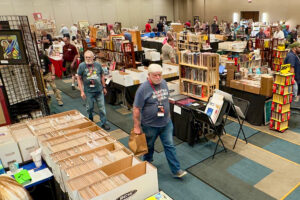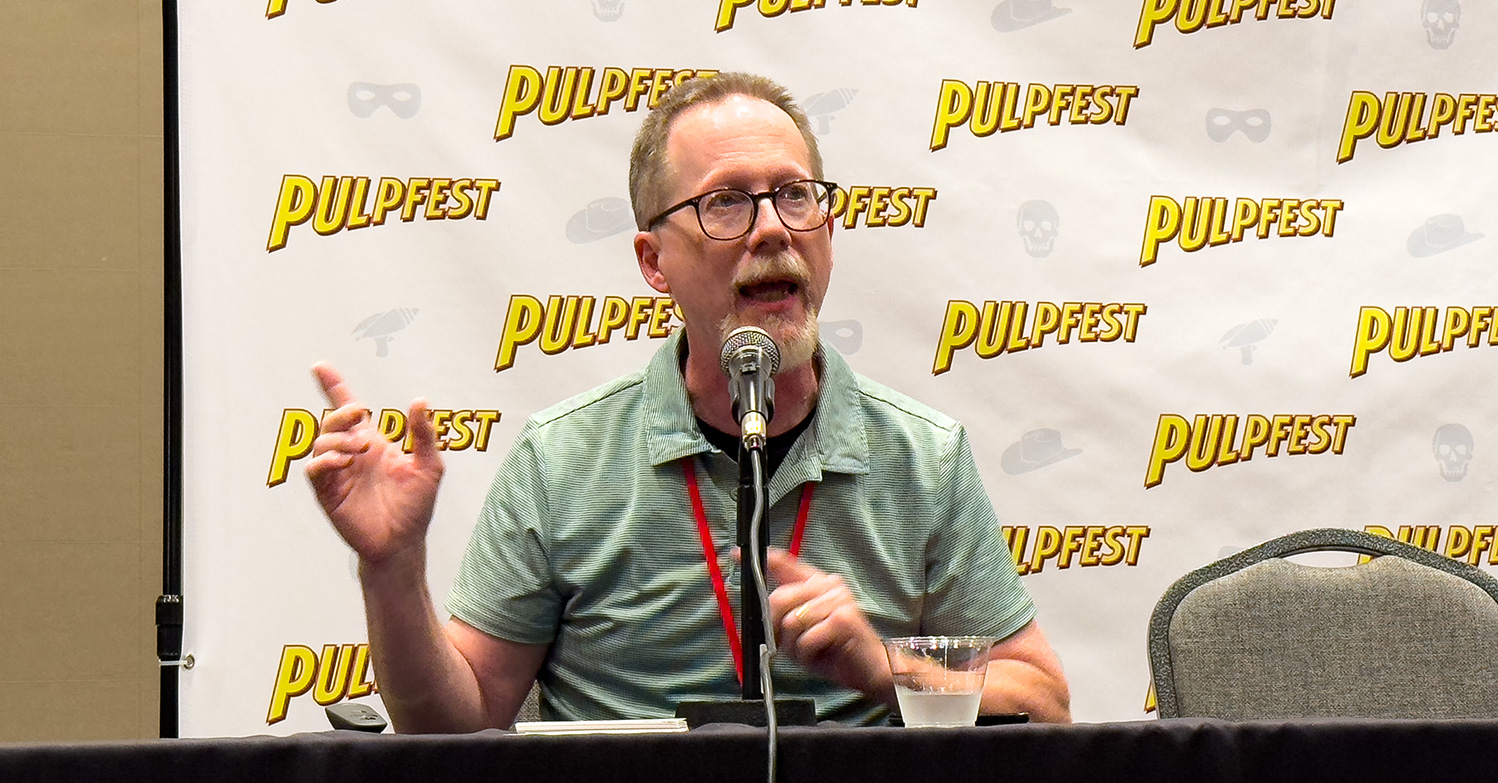
Author Jim Beard, publisher at Becky Books and co-publisher at Flinch! Books, takes a look at how Tarzan, Edgar Rice Burroughs’ enduring character, has been marketed for over a century. This presentation was part of ERBFest, held in conjunction with PulpFest 2025. This Pulp Tales was recorded in Pittsburgh on Thursday, Aug. 7.
Click to expand the transcript.
Pulp Tales Announcer: Welcome to Pulp Tales, fascinating stories of the pulp magazines and the creative minds that brought them to life. The fictioneers, the artists, the editors, and others. Brought to you by ThePulp.Net. Learn more about the pulp magazines through articles, blogs, bibliographies, links, over 100 episodes of this podcast, and much more at ThePulp.Net. Your link to the pulp magazines for almost 30 years, online at thepulp.net.
Jim Beard: I promise you, we’re going to mention the Disney Tarzan a few more times, but you’re not really going to see anything more, but I won’t put you through that. Because honestly, we would be here for days to go through everything that came from the Disney Tarzan film. Love it, hate it. I got to tell you something, you know, it was keeping the character and the property out there.
Pulp Tales Announcer: In this episode of Pulp Tales, author Jim Beard, publisher at Becky Books and co-publisher at Flinch Books, takes a look at how Edgar Rice Burroughs’ enduring character, Tarzan, has been marketed for over a century. This presentation was part of ERBFest, held in conjunction with PulpFest 2025. This Pulp Tales was recorded in Pittsburgh on Thursday, August 7, 2025.
Jim Beard: Welcome to the Dum Dum, and yes, I’m the Dum Dum who keeps agreeing to do these things. This is actually the third.
Mike Chomko: And you know, he came to me this afternoon and said, Mike, I have a good idea to talk about for next year.
Jim Beard: Yeah, but it won’t be one of these merchandising things. Don’t let him whine. So this is actually the third that we’ve done in this series.
I’ve done The Shadow, and I did Conan, and today we do Tarzan. But there’s way, way, way more Tarzan stuff through the years. So we’ve got a lot to go through.
But I just want to say right off the bat that this is kind of a warning. There is a lot of images of shirtless men in these slides. So if you feel faint, I want to make sure you know where the exits are.
There is water out there. But if you faint in here, could someone next to that person help them? I would agree with him.
Like I said, this may be quick. It’s more of an overview than anything. There is no possible way that we could, in 45 minutes or less, we could get through all of the Tarzan merchandise.
Let’s face facts. Tarzan was a merchandising slot. And we’re not going to cover the novels, because you know all that stuff.
So, Tarzan, Lord of the Merchandising Jungle. We are going to start with the 800 pound gorilla in the room, which is the films. But there’s so much to cover here, so we’re going to go through it quick.
So, 1918, Tarzan of the Apes, the silent movie with Elmo Lincoln. And this is really interesting. Supposedly, that’s supposed to be one of the most faithful adaptations, even to this day.
I thought that was really interesting. In 1918, there was a sequel that they called The Romance of Tarzan. And then in 1927, The Golden Lion.
And that has the really cool fact behind it that Boris Karloff, a young Boris Karloff, was kind of like a minor player in the movie. And in that movie, it was played by James Pierce. And I thought this was really interesting, too.
he turned out to later marry Edgar Rice Burroughs daughter. So he became Edgar Rice Burroughs’ son-in-law. So in 1929, there was the first sound production, and Tarzan was played by Frank Merrill.
It said that they didn’t like his voice, so it was partly dubbed, and that his voice was unsuitable. I thought that was really interesting. All right, you knew that we had to get to him, Johnny.
Weissmuller. 1932, Tarzan the Eight Man. Johnny made 12 films up through 1948, and we got a lot of what we know today, the big things that yell, a boy, his son, Cheetah, all of that came out of the Johnny Weissmuller film.
There were other films in that era, though, which is really interesting. was competing Tarzan films, one of them being Buster Crab. Okay, so in 1933, there was an actual serialized movie, Tarzan the Fearless, that was 12 chapters.
1935, The New Adventures of Tarzan with Herman Briggs, and that was 12 chapters. And that’s another one that was considered to be very authentic. And then we just get a plethora of Tarzans.
And we’re going to go through this quick because this era is just more and more Tarzans than you can shake a vine at. Lex Barker, so we’ll start down over there. Lex Barker made five Tarzan films from 1949 to 53.
Gordon Scott made six. He’s the guy in the middle there at the top. He made six Tarzan films, 55 to 60.
And then Jack Mahoney, two. He only did two, 1962, 63. Then down below here, Mike Henry, 1966 to 68, made three Tarzan films, and of course, Ron Ely.
Kind of a cheat. There were two Tarzan films, but they were actually, from what I understand, put together from the TV show. But they were released later.
They weren’t released before the TV show, but actually after it got going. And then we make a big, big jump. So Ron Ely’s were in 1970, and we don’t really get another Tarzan film until 1981.
And yes, of course, Miles O’Keefe. The less said, the better about that. But 1984, we get a little bit better.
Christopher Lambert, Greystoke, the legend of Tarzan, including some ideas from, and it’s very appropriate for this show, Philip Jose Farmer. More modern muscles. We make kind of a big jump again.
1998, Tarzan and the Lost City with Caspar Van Dien in the part. And then 2016, Legend of Tarzan with Alexander Skarsgård and Margot Robbie as Jane in that. So, and then we jumped to Sony’s version in 2022.
So yes, I did jump one. Yeah, we have to have it up there. I promise you, we’re going to mention the Disney Tarzan a few more times, but you’re not really going to see anything more of it. I won’t put you through that, Because honestly, we would be here for days to go through everything that came from the Disney Tarzan film.
Love it, hate it. I’ve got to tell you something. It was keeping the character and the property out there for whatever you might say about that.
The Disney Tarzan also had a few direct-to-video sequels. But we’re not going to touch upon those. And a TV series.
Well, it gets better. We go to Tarzan on stage. Hold on to that thought.
Boy, we start really early on with Tarzan on stage, 1921 with Ronald Adair. And then 1976, there was a thing called TZ, and that’s T period Z-E-E. And it was like a rock musical on stage. But it was Tarzan, but they had to call it TZ or whatever.
And then 1999, Disney had a stage production, basically the movie. Interestingly enough, the apes were played not really in costume. You saw the actor’s face.
I mean, the costume was more of the body, but they didn’t actually have them with ape faces, So you actually got more of the actor coming through the role. Okay, so let’s talk about radio. 1932, there was radio production of James H. Pierce.
That was 77 episodes. It aired three times a week, and they were 10 minutes long. 1951, 75 half-hour episodes.
ended in 1953, and that was Lamont Johnson who played the part. And then we jump to the TV shows. Oh, so at this point, the Tarzan movies that already existed were starting to show up on Saturday mornings, so that was, again, that was keeping Tarzan out there.
Of course, Ron Healy, 57 episodes, 1966 to 68. Then we jumped to the animated Saturday morning cartoon from Filmation, which though there was actually five different versions of that show, they kept kind of reinventing it, and it was called all different things like the Tarzan Hour or whatever. It’s funny, I was there and I don’t even remember.
But like we were talking earlier around the pizza table, if you saw one filmation show, you saw all the filmation shows. It was basically the same thing. Let’s see, then we jump down to the middle.
1989 here, there was a TV movie. And then 1996, there was a 22-episode TV series with Joe Lara in the part. And then in 2003, played by Travis Fimmel.
Yeah, Fimmel. Fimmel. Yeah, I wrote that.
And then Netflix had a short-lived series in 2017 and 2018, which you can see right there. Okay, so we made it through all of the filmed TV animation, all of that. So we’re going to jump now to a world that’s a little bit more in my line.
Before starting in on the comic books, I want to talk about the comic strips. So the first strip was in 1929 by Hal Foster. Started it off, and it actually began with the actual origin story of Tarzan.
very different looking strip than we think of today but 1929. In the 60s and 70s there was the strip drawn by the great Russ Manning of Magnus Robot Fighter fame or at least that’s how I think of him. In the 30s and 40s Bern Hogarth did a strip.
In 2001 to 2002 an artist named Eric Battle. That still actually, or the strip actually continues to this day, but if I’m not mistaken, it’s just reprints. Now, I don’t think it’s like a new one that I’m aware of.
So, literally, Lord of the Comic Book Jungle, because there have been a lot of Tarzan comic books over the years. Right down on the end is really kind of where it began. This was the illustrated Tarzan book number one, and I love it because it’s referred to as the story "picturized."
So in a way, it was kind of like a graphic novel thing. In the middle, "Four Color Number 134." Before Dell actually did their comic book series with Tarzan as the title, they had a long-running series called "Four Color," and like every issue of the comic book was a different theme, concept, character, whatever.
So they started off in 1947, Four Color number 134, Tarzan and the Devil Ogre, and then 1948 they kicked off Tarzan number one, and they ran for 131 issues, which is a respectable run. And I thought I’d throw these in here. We’re talking about pretty much everything here in the States, but there were Tarzan comic books in England.
The first one, Tarzan, The Grand Adventure Comic Album, circa 1950, and then the Tarzan Adventures 1951-53. That ran for 62 issues. It was reprinting things that already existed, but there was some new material in it.
So that’s really interesting. The British were actually doing some original material in and around the reprints. We keep swinging along.
So Dell, Gold Key is basically Dell. 1962, 72, 10 years worth of it, 75 issues. Some of those gorgeous painted covers.
They also then kicked off Korak, Son of Tarzan series, 1964 to 72. That ran for 45 issues, which is pretty good. I love this.
Charlton put out a comic book while the Gold Key one was running because they thought that Tarzan was public domain. So it was the same time of Dell, and they thought, oh yeah, we can do this, no problem. It only ran for four issues because they came into a lawsuit.
I think if you want to ask the ERB people a little bit more about that, the lawsuit thing, we won’t go into that. I think they canned it because Johnny Cash said that he had a problem with this image on there. And he didn’t agree with that, running around in the jungle with no shirt on.
Down on the end there, DC Comics. they continued the numbering from the Gold Key series, which was kind of a weird practice that sometimes happened, but I actually have that. That was 1972.
My dad bought that for me, and I wasn’t really like a Tarzan fan when I was a little kid, but I love it that I actually have that very first. And it says it’s the first DC issue on there. Just to be clear, it’s not the first Tarzan ever, you know.
It was just the first one that they did. that featured work by the great Joe Kubert and what was interesting about that and I found out while I was doing my research on this is that England didn’t want to use the Kubert stories or reprint them because they didn’t like the art that wasn’t like Tarzan to them it was too weird or whatever but which is strange because we here pretty much all think of Joe Kubert as like one of the Tarzan artist, but England didn’t like it. They also did a Corex series, that was only 13 issues.
What happened was, there was this big funny movement in the 70s at DC Comics that everything had to become the something family. So they had Batman, but they had to have Batman family comics. They had Superman, and they had to have Superman family comics.
They also had a weird thing called Super Team Family, which never made sense to me. So Tarzan had to follow in that same path. And Korak actually got turned into a book called Tarzan Family featuring Korak.
In the run of the regular Tarzan series, there was also some of the 100-page super spectaculars, which you might get like a new story, but then like several reprints too. That ran for only seven issues. The actual series, Tarzan, was way more successful than some of the runoff things.
So Marvel then took over where DC left off. They actually started, they had a regular magazine, which was mostly like articles and puzzles and things like that called Pizazz. Anybody remember this?
I love that magazine. It was really great. It’s funny because it was published by Marvel, and there’s actually an issue with Christopher Reeves’ Superman on the cover, and I always love that Marvel finally got to publish a Superman issue.
But they had a really cool thing. They had backup comic strips for a while, and they did an original Star Wars story, one of the earliest original Star Wars stories, But they also had a Tarzan strip called Young Tarzan. Then they actually put out a regular comic book-sized Tarzan issue.
That ran 29 issues from 77 to 79. That was all new numbering. They did not pick up numbering from DC, who picked up numbering from Gold Key.
This is Marvel. They had to have that number one. And I just love it because there’s always that distinction with Marvel.
they have to have that overblown thing, you know, Tarzan, Lord of the Jungle, fury-filled first issue. You know, at last, the world’s greatest adventure hero, presented in the thrilling Marvel style. Just so you knew what was going on.
They also did annuals. Oh, Roy Thomas and John Buscema. Again, I mean, if you get John Bishema to draw a Tarzan comic book, I mean, I think you’re doing okay.
All right, so we’re going to jump. There’s a big gap with no Tarzan comic books until 1992. Kind of a big leap.
The Malibu company got the license, and they started off, and they did mini-series. They didn’t start off with doing a regular ongoing every month and on and on. So they started off in 1992 with Tarzan the Warrior.
That was just five-issue miniseries. They did Tarzan Love, Lies, and the Lost City, three issues. And then they had one called Tarzan the Beckoning, which was seven issues.
And then it made its jump to Dark Horse. Interestingly enough, I don’t think I’m mistaken on this, Dark Horse started in 1996. they still have the license today.
I don’t know if they’re really doing that much with it. They were the first ones to do archive editions, collected editions of previous companies’ work. When a comic book company gets the license, they usually have the permission to publish stuff that has come before from other companies.
So they were able to do, like they could, reprint the Marvel stuff, the DC stuff, Gold Key or whatever. They had the license to do that. They’ve done a lot of stuff, though, with Tarzan over the years.
They had, from 1996 to 1998, they had a 20-issue Tarzan series, just called Tarzan. But they’ve also done things like, and I love this, Batman Tarzan. They got permission to do Batman.
And I don’t know, I mean, that kind of makes some sense, but then you have Superman and Tarzan. Batman and Tarzan was literally the character of Tarzan meets the character of Batman. It’s everything that you’re kind of familiar with with those characters.
But they basically sort of did a retelling of Superman. It wasn’t the Superman character that we know, but more of like an alternate version of them that fit in with Tarzan. That was 2001 to 2002.
They also did Tarzan meets the Predator. I mean, that kind of still, maybe that makes more sense than Batman or Superman Tarzan.
Audience 1: At the Earth’s core.
Jim Beard: I’m sorry?
Audience 1: It was at the Earth’s core.
Jim Beard: Oh, okay, well see, that makes even more sense, doesn’t it, right?
Audience 1: Actually, it was written by Walt Sons, and it was actually a pretty good, and it was a great license. The peanut gallery recommends that.
Jim Beard: So, like I said, it looks like Dark Horse has had that license for a long, long time, but this is kind of funny. In the same vein of Charlton, except Dynamite knew what they were doing. The company called Dynamite, which is why it’s blowing things up, But in 2011, they did a comic book called Lord of the Jungle that was obviously very big on the cover.
They were trying to get around things by calling it Lord of the Jungle, but it was a Tarzan book. That was 2011, 15 issues, but they had a lawsuit from the ERB people. And again, maybe you want to ask the ERB people this weekend to tell them more about it.
But that didn’t stop them. They must have proved that they could do what they did because they did another Lord of the Jungle in 2022 to 2023.
Audience 2: Excuse me, I have to just…
Jim Beard: Oh, okay. So the middle one?
Audience 2: Yeah.
Jim Beard: Okay, but not the first one. So,
Audience 2: just a quick summary. Yes. There was a lawsuit. There was a settlement, and then we became partners.
Jim Beard: Thank you, Chris. I love it. Appreciate it.
I figured it had to be something like that because they kept going with it. Maybe they just enjoyed lawsuits. I don’t know.
So middle one, 2022 to 2023, six issues. And then they started doing these mashups too. Now this one makes a lot of sense to me.
Not Superman, Tarzan, but Red Sonja and Tarzan. But they also had ones where he was with Sheena of the Jungle, and again, that probably makes the most sense of all. And they did more things like that.
But again, I think they made probably more sense than the other companies. And I just wanted to again throw in there, it’s not just limited to the United States and what comic books they’re doing. There have been manga versions in Japan of Tarzan.
There was Jungle King Tar-Chan, Tar-Chan, that was actually ran in Weekly Shonen Jump, 88 to 90, and then that became an anime. They actually did an anime of it, and they had something also called, in 1948, kind of jumping back here a little bit, it was called Tarzan’s Secret Base. I guess all, what’s that saying?
All our secret base are… Oh, yeah. I guess that counted for Tarzan, too.
So we’re going to jump to, like, real books now. You know, obviously comic books are not real books. So we’re going to jump to real books now.
In 2021 and 2022, these Tarzan cookbooks came out. But from what I understand, this Jill Hill, it’s like hyphenated. It’s probably like a pen name because this Jill Hill whatever or whoever they are has all these different cookbooks of all different themes and characters.
But they have done three Tarzan ones, which I don’t know how many. I can’t imagine getting one cookbook out of Tarzan, but they have three cookbooks. So I don’t know if they’re just like cobbling it together from Wikipedia entries and publishing them.
I know that’s like a hip thing to do, but maybe that’s what that is. I just thought that was funny that they did that. So from cookbooks to coloring books, right?
That’s a good segue. Oh, my God. If we did all the Tarzan coloring books that have ever existed, we would literally be here for days.
But I’m just going to run down a couple of them. Now I’m going to do activity books. Me and my stupid notes.
That’s Rand McNally down in the end. They did a couple different Tarzan activity books. The Dover people did a sticker activity book.
That’s 1999. More Rand McNally from the 70s. Another activity book in the middle. Another Dover sticker book, 1999.
And then I love this one, Viewmasters. Yeah. And there’s been more than one Tarzan Viewmasters since 1950s. This one is actually from one of the either the movies or the TV shows, but there is one where somebody built these gorgeous Dioramas and they photographed them.
Viewmasters did a lot of that. There’s a G.I. Joe adventure team one that I loved when I was a kid and they’re the most gorgeous Dioramas.
Well, if you look this one up, they they built these just beautiful Tarzan ones. It’s really, really something to see. Let Tarzan start your day.
Come on, don’t you think these titles are clever? I took a lot of time. I don’t know if anybody’s reading them.
I’m not reading them because I figure you can read them. But Aladdin, of course, the Aladdin people did the Lunchbox in 1966, a very big year for merchandising tie-ins. The Batman TV series of 66 did that.
So everybody was jumping on the merchandising bandwagon there. And it’s not the first or last time that Tarzan will kind of follow along in the popularity of Batman in 66. In the 1930s in Uruguay, there was tea, Tarzan tea.
I love that. And then Jade City Foods have, you can still get these. there’s three different Tarzan coffee blends.
You can Google that one and look it up. And this one is called Kavuru, which is a medium roast, in case you’re wondering. I knew you had to know that.
And then down in the end here is actually another coffee tin from Argentina, and I believe that’s from the 50s, if I’m not mistaken. I mean, to me that’s really cool, that you can take a character and just adapt it to just about anything, even if it doesn’t make any sense. The Airfix people, so now we’re going into models.
We’re getting a little bit more into toys now, which is another sweet spot for me. The Airfix people used to make these really wonderful little figurines. They were on like a model kit where they came on a spoo, or spoo, what’s that word?
Spru, and you broke them off and you could paint them if you wanted to. They were doing these HOO scale sets. I had an astronaut one when I was little in that same series, but there was a Tarzan one.
Now, the astronaut one didn’t really make sense with model trains, but maybe the Tarzan one did. I could see a train going through the jungle and you’d meet Tarzan, right? Okay, that makes sense.
In case you were wondering, it’s a 172nd scale, and that was from the 1960s. The Aurora Model Company did their first Tarzan kit in the 1960s, but what was cool is they reissued all of those. There was a bunch of superhero ones. There was both Marvel and DC ones.
They also made Lone Ranger. They made Tarzan, too, which that kit is not as well-known as the Superman, Batman ones. They reissued all of those model kits in the 1970s, and what they did is they tied them more into comics, where you actually got the instruction pamphlet, which had a little comic inside of it, and the last page of the comic was like a backdrop that you were supposed to put behind the finished model kit.
This is just gorgeous. The cover for the whole model kit was by Neil Adams. So, I mean, Tarzan has had some of the best comic artists ever.
And when you hit Neil Adams, I mean, that’s just about the height right there. Flash forward to now, and a company called Pegasus Hobbies has a 1.8 scale Tarzan kit. Looks really cool.
And then jumping back to Aurora, they did these little plastic PVC figurines, and it was on a backing thing with a bubble on it that you tore off or whatever. I thought it was really, really cool. Tarzan King of the Jungle and that was in the 60s okay so now near and dear to my heart Tarzan action figures there’s a lot of Tarzan action figures over the years so again we’re going to run through this and we’ll only very briefly mention that yes Disney did action figures based on that 1999 movie and there is a million of them we are not going to go through them from the Mego company.
When I was a kid, I would have been mad if somebody gave me that action figure. I did not want that Tarzan action figure. It was the weirdest thing, but it made sense to the Mego company.
They couldn’t just make a loincloth to put on the plastic figure. They had to have a flesh-colored spandex kind of outfit that represented the rest of him, his skin basically, and then the loincloth is on top of that. That made sense to them.
It was some sort of idea that it would be cheating consumers if it didn’t have as much material as all the other figures that they were putting out. And then he had this teeny tiny little plastic knife that, of course, you open up the package and it’s gone. It’s just you lose it immediately.
They also had a series of bendies that kind of duplicated all the characters. So it’s a rubber figure with the wires inside, kind of like Major Matt Mason. They did a Tarzan one.
Jump to now, and there’s a company called Figures Toy Company that did a lot of duplication of the Mego figures, but have been going way beyond what Migo ever did. There was only ever a Tarzan figure back in the 70s of Migo. Today, you can get a reproduction of that Tarzan figure, but you can also get Korak, who does not have a body stocking.
He literally just has little briefs. And you can get Jane in blue. And anybody want to guess who’s in purple here?
Right. I mean, come on, right? A Miriam action figure?
I just, that’s really cool, sort of. I don’t know what you… Yes, Wynn, I was making fun of Miriam.
Alright, so, go figure, action figure, go action figure volume two. Trendmasters did a really, really fun series in 1995. And I’d show you the front and the back of it.
They had some gorillas and I think they did, oh, they did Tarzan and Young Tarzan. And then here is the Young Tarzan and Gorilla. It’s Kala, actually, in that package.
Those are really cool. I thought that was a really nice thing. They also did playsets also.
So, and, oh, that was Dakin, Dakin, D-A-K-I-N, in 1984. This is Trendmasters. Trendmasters had a huge, huge series, and you can see from the backing there.
But they also had the rights to John Carter of Mars. So they were making Tarzan figures and John Carter of Mars figures, and then they were kind of mixing them. So you’ve got, you know, Tarzan, Lord of the Jungle down here, but then you could also get Tarzan Conqueror of Mars.
I thought that was a really cool idea. They had play sets too. Interestingly enough, Tarzan the Epic Adventures was the name of the 1996-97 TV series, but if I remember correctly, it’s not the exact same logo, but the toys were at the same time, so I’m not really sure if that was a literal tie-in.
It may or may not have been, or it may just be that they were picking up on what was going on at the time. Okay, so Boss Fight Studios more recently has a line of action figures of more original things that they did, but it’s called Hacks, and then there’s different series of them. In the series called Hero Hacks, they did 118th scale Tarzan and Jane.
So you can see Tarzan down here and then what the Jane action figure went in. And Jane’s just like absolute badass, jungle Jane, not like I’m a proper lady Jane. They no longer have the license from what I understand.
If you try to go to that part of their website, it says it’s no longer available. All right, so this is just, again, so we’re not completely sticking with the United States and to show that Tarzan really does get around. He has had both official and knockoff figures in Spain and Mexico and Argentina.
Again, some legitimate and some bootleg. And a lot of South American countries, they have done a lot of bootleg stuff because I think they feel like they’re so far away from ERB that they can get away with that. Yeah, this one I think is actually as old as the 1950s where the other ones are more recent.
Tarzan’s a blonde down here in this one. I love that. All right, so we’re now into games.
We start as early as 1933 down over here. It was a map game. I love maps, so that’s a really cool one to me.
The one in the middle, 1941. And then the Merritt one, 1967, called Tarzan as Animals. I don’t know if you can see it.
You’ve got to look at Tarzan’s face in that illustration. He is having way too much fun. way too much fun in a jungle filled with dangerous animals and swinging from vines and stuff like that.
But I guess the kids dug it. Okay, I had to separate this one out because this is when worlds collide for me. So you have Tarzan, but for like the one and only time ever, Tarzan combined with Jack Kirby.
So there in 1971, Mattel had this series of these, they were called different things, comic games. This one actually then you turn it around and it says it’s the jungle game while in the front it’s a comic game. They were played with these cards and with this particular one, you sort of laid out these paths through the jungle.
But the coolest thing of all is they had a whole bunch of them, But there were three of them that they got the amazing, legendary Jack Kirby to illustrate. There was a Superman one, which Jack was heading into his fourth World Series at D.C. in 1971.
So that was kind of interesting that they had to do Superman. He also did a Lone Ranger one. And if you ever wondered what Jack Kirby drawing the Lone Ranger looked like, you’ve got to check out this game.
Again, I don’t think he ever drew that character anywhere else. but he did Tarzan, and I think it’s probably the only place that Jack Kirby ever did an official Tarzan thing. It’s really, really cool.
And if you want to pick one up on eBay, they’re not that expensive. I had to separate that one out because I’m obviously a huge Jack Kirby fan. And I have a new book on Jack Kirby if you stop by my table.
That’s what Ralphie Parker calls a crummy commercial. Alright, so 1984, Milton Bradley had a Tarzan card game in 1995. Yeah, in 1995, there was a card game called the Overpower card game.
But in, what, just last year, they had a subset called Edgar Rice Bros. and the World Legends. And they did Tarzan to fit into the game, but they also did John Carter, too.
I thought those were really nice. Video games. This is weird to put these all together because you can see how crude the 1984 ColecoVision one was down in the end.
But that was actually supposedly a tie-in with the Greystoke movie. I mean, from looking at the crude graphics, I don’t know if you could tell that. 1994 for the Game Boy, Tarzan, Lord of the Jungle.
And then 2020, a company called Fun Train did a Tarzan VR, where you’re actually Tarzan. You put the head thing on and you’re going through the jungle. But that was really fun.
Sorry, I had to do it. Collegeville, 1966. And again, there’s that Batman, Adam West year, 1966.
And typical for Halloween costumes of the day, you know, like the outfit makes no sense whatsoever. It doesn’t look like a loincloth or anything like that at all. It actually is a big picture of Tarzan.
And, of course, the ever-popular Ben Coopers in the 70s for this one. The first mask looks like Elvis Presley, and then this one, you know, I don’t know. You have to kind of guess what that looks like.
And then flash forward to today. You can actually go online and get this one for everybody out there who wants to be Tarzan. You can get that beautiful ensemble there.
More Branching Vines. Oh, okay, talking about 1966 again, and Tarzan was following in the footsteps of Batman. I think we probably all know that there was a beautiful set of Batman trading cards in the 1960s. and illustrated by the fantastic Norman Saunders.
Well, I didn’t know this until I started researching it. There was a Tarzan series at the same time, and it was set up exactly like those Batman cards, where it was almost like a little mini-adventure on each card, and on the back you would get just a little paragraph to tell you the story of what’s going on on that card. Now, those are not Saunders’ art, but the art is still nice in that, But that was really neat. I had no idea that they did a Tarzan series that was just like the Batman series.
I mean, just, okay, we’re just going to start running through things, because there’s just so many. So this is the three C’s. Cups, color forms, and a clock. And the clock is from Hungary.
All I have to say is, at the end here, there will never be a shortage of Tarzan items. I mean, it’s just everything and anything. Tarzan socks, a bedspread.
Do you want to go to bed with Tarzan? Sorry. Sorry, it just came right out.
Coffee mugs, you know, everything and anything. Jigsaw puzzles, t-shirts, everything and anything. There will never be a shortage of tarot items.
So that’s just an overview. You know, there’s just so much, so much stuff out there. Thanks.
Thanks.
Pulp Tales Announcer: You’ve been listening to Pulp Tales, fascinating stories of the pulp magazines and the creative minds that brought them to life. Brought to you by ThePulp.Net. Learn more about The Pulp Magazines through articles, blogs, bibliographies, links, over 100 episodes of this podcast, and much more at ThePulp.Net.
Your link to The Pulp Magazines for almost 30 years. Online at thepulp.net. Subscribe to Pulp Tales on your favorite podcast platform or listen to us on the web at ThePulp.Net.
If you enjoy our content, please like us or leave us a review. And tell your fellow Pulp fans about Pulp Tales. Thank you for listening, and keep reading the Pulps.
Pulp Tales is copyright 2025 by William P. Lampkin.
This transcript was generated automatically, so it may include typos and other errors.