

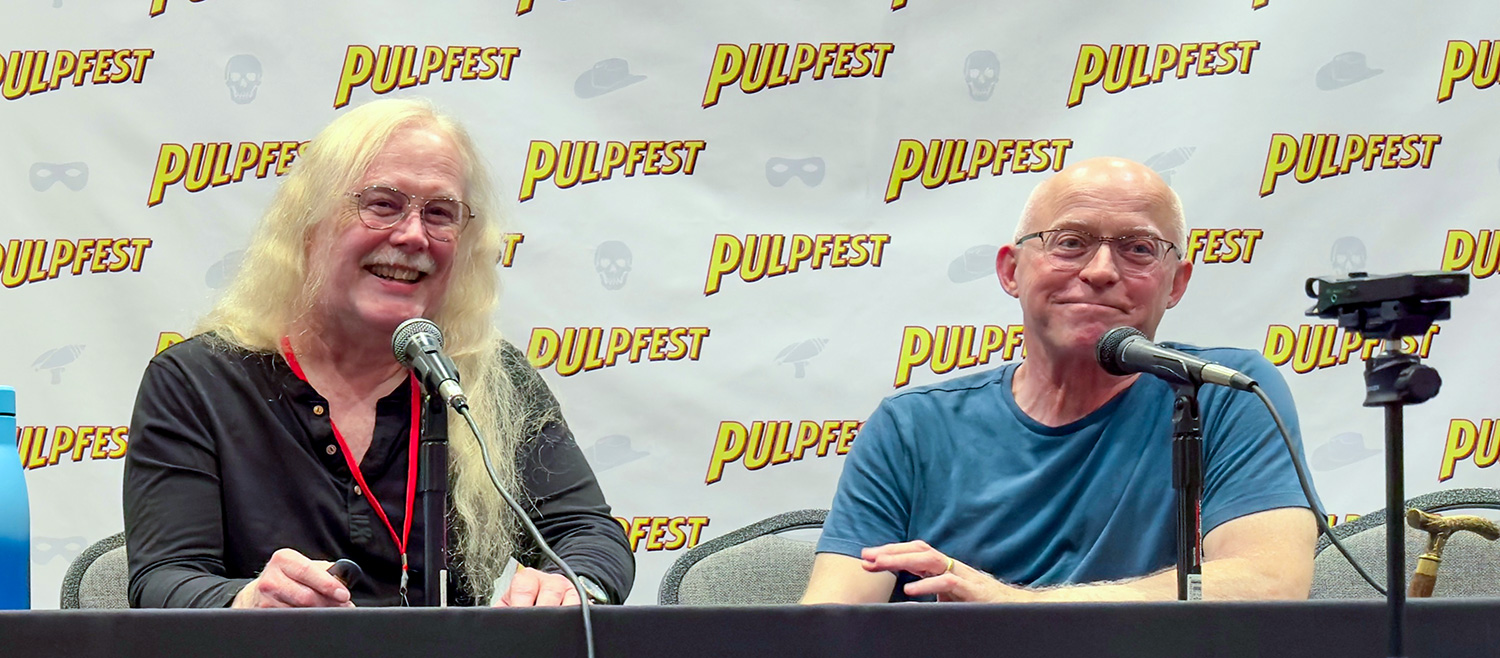
Artists Mark Wheatley and Douglas C. Klauba examine Tarzan’s illustrators as part of this year’s salute to the 150th anniversary of Edgar Rice Burroughs’ birth. This presentation was part of ERBFest, held in conjunction with PulpFest 2025. This Pulp Tales was recorded in Pittsburgh on Friday, Aug. 8.
Click to expand the transcript.
Pulp Tales Announcer: Welcome to Pulp Tales, fascinating stories of the pulp magazines and the creative minds that brought them to life. The fictioneers, the artists, the editors, and others. Brought to you by ThePulp.Net. Learn more about the pulp magazines through articles, blogs, bibliographies, links, over 100 episodes of this podcast, and much more at ThePulp.Net. Your link to the pulp magazines for almost 30 years online at thepulp.net.
Mark Wheatley: Frank Hoban. Today it’s hard to understand how influential his work was, but the generation of artists who we kind of grew up with in the 60s when the covers were starting to be done by Roy Krenkel and Frank Frazetta and Reed Crandall and the people that were working at that time, they were all very influenced by Frank Hoban.
Pulp Tales Announcer: In this episode Pulp Tales, artists Mark Wheatley and Douglas C. Klauba, examine Tarzan’s illustrators as part of this year’s salute to the 150th anniversary of Edgar Rice Burroughs’ birth. This presentation was part of ERBFest, held in conjunction with PulpFest 2025. This Pulp Tales was recorded in Pittsburgh on Friday, Aug. 8, 2025. Mark begins.
Mark Wheatley: So I thank everybody for coming and investing the time tonight to begin our three-day seminar in the Masters of Tarzan illustration. Wait, wait, wait. The fact that you invested…
Wait, Mark, what? Three-day? Yeah, three…
This is 45 minutes. Oh, then we better get started. Okay.
All right, so let’s see. Masters of Tarzan illustration. Tarzan, been blessed with a lot of really great illustrators.
Here’s a partial list. A lot of these guys are in our presentation tonight, so we’ll have to keep it moving. Do you have a personal favorite?
Douglas Klauba: I see a name, and I say yes, and then you go to the next name.
Mark Wheatley: Yeah, see, that’s the problem.
Douglas Klauba: And it’s when Mark said, do you want to hang out with me while I present this? I’m like, where do we even begin?
Mark Wheatley: Well, this is it. It’s huge. It’s kind of situational, depending on the place.
Definitely. So to get this out of the way, this is one really excellent Tarzan artist who’s happened to be on the stage here. Thank you.
And then I shoved this in because I had some influence. Now, this is the real version of the all-story cover. And this is Clinton Pettee.
And I don’t know that he did much more for Tarzan, but this really was a great start. Absolutely. If I was a kid, when this came out, it would have called to me.
This is Fred W. Small, who I think, even though he just did the title cut for the beginning of the story, was very influential because I think his title cut informed what eventually became the dust jacket for the publication of the first novel. This is it by Fred J. Arting. Isn’t that great? Would you like to be an artist whose name was Arting?
Arting. Yeah, he was doomed from birth. All day long.
Yeah. N.C. Wyeth.
Now, N.C. Wyeth is one of my all-time favorite, most influential artists from my own work. But I’m not sure he was the best Tarzan artist.
It wasn’t bad, but I don’t think he quite caught it. I actually like the horse rider for the sequel better than actually Tarzan of the A. This guy is probably associated with Tarzan more than anybody in many ways. He informed so much about what we think about the character visually these days.
Harold Foster. The man was raised in the wild, and I think he identified with Tarzan, even though it was Canada rather than Africa. This informed all the comics that followed, And I think if I know correctly that Burroughs really wanted Foster to illustrate his novels as well, but he couldn’t get him.
He had some help from studio mates, a Chicago artist like Doug. His imprint was very strong. Now, PJ Monahan, who helped Doug win.
An interesting approach, right? Kind of like a god of the jungle sort of look. I love the color scheme on this.
But again, doesn’t quite really define Tarzan for me yet.
Douglas Klauba: I could see where he was going with like the savage look against the romantic of the female.
Mark Wheatley: But here’s another version, another one of his. And this is one of the definitive images striking. Yeah, this is like, you know, it’s been rendered by St. John.
It’s been rendered by Roy Krenkel. Everybody, you know, takes a pass at this because it just says so much. When it comes to the pulps, I think Herndon had a lot of the energy that you wanted to see with Tarzan, and he was an excellent painter, and he had the ability to draw and paint from his imagination, which gave it a lot of sense of movement.
I’m surprised always though to see Tarzan portrayed as a blonde yeah I grew up in the swamp so I kind of identified with him but yeah I never thought I was really towards Frank Hoban today it’s hard to understand how influential his work was but the generation of artists who we kind of grew up with and there’s kind of an age group here. In the 60s when the covers were starting to be done by Roy Krenkel and Frank Frazetta and Reed Crandall and the people that were working at that time, they were all very influenced by Frank Hoban. An artist I became friends with and worked with was Al Williamson and his favorite all time illustrator was Frank Hoban.
He had gone out of his way to collect every pulp than Frank Hoban ever had an illustration in. He’s mostly was revered for his black and white illustrations on the inside of the books. He brought a sense of seriousness and conviction to the work.
Are you familiar with Hoban’s work much? Not as much,
Douglas Klauba: but definitely.
Mark Wheatley: I love the faces on these people here though. So unheroic compared to what we’ve kind of, We’ve kind of refined everything to a type. These people look real.
All right, this is the guy I think who nailed it. Absolutely. Yeah?
Yeah. Now again, a Chicagoan. A Chicagoan, yes.
You wanna speak to him?
Douglas Klauba: J. Allen St. John’s studio in Tree Studios right in the heart of Chicago, right off Michigan Avenue, Magnificent Mile. A little fun fact, I have friends in Tree Studios much later on and on the door of his studio was still a poster as I would walk in I would just see that post and then touch the doorknob as I would walk in every single time.
Mark Wheatley: Now where did J. Allen St. John teach? American Academy of Art.
And you went there? Yeah. There you go.
DNA!
Douglas Klauba: Almost every artist at Chicago pretty much went either to Chicago Academy or the American Academy.
Mark Wheatley: They didn’t go on to illustrate Tarzan, did they? No.
Douglas Klauba: Well, Gary Gianni did, but he was at the Chicago Academy.
Mark Wheatley: Yeah. Well, there you go. So it’s only you.
I mean, this just, for me, there’s a Victorian quality to Tarzan. And the problem with Victorian illustrators is they were pretty uptight and conservative. But St. John managed to convey a Victorian attitude and yet just go, you know, balls to the wall with his work.
I can see why everybody responded to it. Alright, so playing off of the Monahan piece, here’s St. John, right? And this really was the one that became iconic.
But the Monahan, it wouldn’t exist without the Monahan. Painted many years later. This was a fan commission if I understand correctly.
Is that correct? So this is interesting. I did not know this for many years.
I had picked up on this. These illustrations were done for Liberty Magazine by an artist who was credited as Ray Dean. And I only, in the process of putting this together, found out that he was actually a pseudonym for Stockton Mulford.
But these are really powerful pieces that he did. He had quite a vision for Tarzan. And under his own name, he also did illustrate Tarzan.
Although Tarzan here looks like he’s in his late 50s. Yeah. All right, so Hubert Rogers, not really identified with Tarzan, but a credible approach. Again, blonde, though.
And Rudolph Belarski, who did so many wonderful pulp covers. Both of these guys did. And as far as I know, this is pretty much their association with Tarzan.
But I really think that Belarski caught it quite nicely. I think that if I’m, was this Red Star? Yeah, yeah.
So essentially it wasn’t actually a Burroughs novel. It was completely rewritten for the pulps and doesn’t really hold up, you know, compare word for word with what eventually ended up in the books. But yeah, quite powerful.
And here’s a guy who came by it honestly, and I think he had a pretty good feel for it. I think he definitely was in tune with his father’s character. I think John Coleman Burroughs had a feel for the attitude and the drawing and the energy and the excitement.
I’ve never warmed up to his color use. This is about the only color piece he ever did that I really thought was good. But his tonal work was absolutely excellent.
Just the brushwork. Yeah. Burne Hogarth, I’m gonna let you talk about him.
Douglas Klauba: Well, this is pretty much where I started finding out about Tarzan a little bit more is when coming across Burne Hogarth’s work. So for me, that was at a young artist stage finding out Burne Hogarth, and then later on finding out about his anatomy books. So he was really an artist to artist and a collector’s artist as well, but yeah. From all there.
Mark Wheatley: And ended up personally training so many of the comic artists who came after him. Not all he has talked about, but I think he did a very strong job on the strips, especially these Sundays. Ruben Moreira, who was known as Rubimor, had a much more extensive career in comic books than he did in newspapers.
Douglas Klauba: That’s good stuff.
Mark Wheatley: Yeah. Russ Manning. Now for my generation again, he kind of defined Tarzan for quite some time and did a beautiful job.
And not only was a excellent illustrator, he was a diehard Burroughs fan himself and not a bad writer. I mean, he told some really good stories. they felt convincing and real.
This is from a graphic novel he did in Europe, which probably has some assistance from people like Dave Stevens and Mike Breuer. He had quite a team working for him. All right, so my buddy, Gray Morrow, who was part of our studio for a number of years, I think technically is the longest running newspaper strip artists for Tarzan.
But it was at a time when I think it was only in five American newspapers. So he was probably the least seen and the longest running Tarzan artist. But I think he really embodied the modern view of Tarzan in the sense that his Tarzan seems like a real person to me.
Yeah, there’s a convincing quality about the anatomy and the attitudes and the emotions that come through the body language. And he did his research on costuming and quite nice stuff. And this is not the me Jane, me Tarzan, you Jane approach.
I mean, he was definitely treating it as serious as Manning. Gil Kane, who was a student of Hogarth, and I think probably at an earlier stage in his career probably would have been the perfect Tarzan artist, but I don’t think he had a very brief association with it. But still very nice.
I was gonna say I didn’t even realize. Yeah, again, this is during the time when it was only in a few papers. Most of them in Europe.
Now this is Mike Grell’s approach to Tarzan. Mike is a huge Burroughs fan and a good friend. And I know we’ve spent many a dinner talking about Burroughs and Tarzan and things.
So it was quite a trip for him to be able to do it. I know he was thrilled to have the chance. And again, a very brief association.
He did do a number of Tarzan stories for the Dark Horse. All right, now, so we’ve established a kind of a look for Tarzan between pulps and the comics, but I think probably the most influential images for the public probably came from the motion pictures. And the posters that were painted for those movies, you know, we’ve forgotten them, right?
But I think they’re in the DNA of everything every illustrator has done. Absolutely. And they’re really quite nice.
The Adventures of Tarzan poster is just gorgeous, and I didn’t see that until a couple years ago, and yet I really feel like it was in my DNA of approach to Tarzan, because I had seen so many other illustrators who obviously had been influenced by it. And you can see the evolving look of Tarzan as the years pass, again all informed by the motion pictures, until we get to the 1960s, and it looks very contemporary. I mean, you could even see a hint of some of the Frazetta approach on the novels in this.
You know, Mike Henry always struck me as Frazetta’s Tarzan.
Douglas Klauba: And probably looking more like real people than characters.
Mark Wheatley: Yeah. And he wasn’t a monosyllatic. I mean, he could have a conversation.
He was an English lord. He actually made the point of that. All right.
So during the same time as the movies, Richard Powers was chosen to cover all of the novels. And he was a bold approach because he was very graphic in his approach. He had been known for science fiction work that was almost abstract in its beauty.
And he’s not my personal favorite, but these are absolutely striking, eye-catching covers. But it didn’t take very long before they decided to give it a different look. And that was Robert Abbett.
And Abbett, for me, was a top-flight guy. I mean, I would worship at his feet. He’s an amazing artist.
And his ease of use was his medium, which is watercolor and wash. He could lay down an image with the fewest strokes I’ve ever seen. If you’ve ever been able to inspect one of his paintings up close, there’s so little there when you look at it close, but when you see it reproduced, small, reduced down, it’s all there.
It all closes up and your mind finishes the piece. Now, personally, I think he was better suited for the Barsoom stories, but his Tarzan work is stellar. Here’s a sampling of a number of the cover images.
By the way, I think this piece on the end was a big influence on Steranko’s cover he did for what, the Mighty Swordsman or something it was, where the guys riding a horse over that same color.
Audience 1: I think that was Warlocks and Warriors. Yeah,
Mark Wheatley: Warlocks and Warriors.
Audience 1: I call it every dealer here.
Mark Wheatley: Yeah, but can you see it? Oh, yeah. Yeah, yeah.
Audience 1: That had a rock around. That wasn’t a wraparound, though, was it?
Mark Wheatley: No. And then, of course, Frank Frazetta comes along, and for a lot of us, including me, just blew our socks off. And again, a friend of mine owned the Masters of Adventure Beasts of Tarzan red cover, and it used to hang in his bathroom. And I would inspect it very closely while I was relieving myself.
Washing your hands. Yes, washing my hands. That’s what I always do, yes.
And it’s a tiny little painting, but the power, I mean, the size I’m showing it to you here, you could put 10 of the real painting into that shape, that face. So, really powerful. The thing that Frazetta brings to it, it’s interesting, isn’t it?
Because I think we talk about the idea of Victorianism defining an aspect of Tarzan. I think that starts to disappear here. We really get into total savagery.
Savagery? No, savagery. There it is.
And this is during the Vietnam War and unrest in the streets. And so that reflects the attitude of the 1960s, right? And it just felt right to me as a kid growing up at that time.
Powerful stuff. And he had something to prove because nobody had wanted to hire him for a long time. He had been ghosting Li’l Abner for years and got fired and could not get work.
Every time he walked in to show an art director’s stuff, they said, no, Frank, your stuff looks like the 1940s. No one wants it. So when he got this gig, he put everything he had into it. The painting on the far side there was his sample piece that he whipped out over a weekend to show to Don Wollheim that he could actually do a Tarzan painting.
His friend, Roy Krenkel, had the gig already and couldn’t keep up to the publication deadlines, and so he was trying to bring Frank on board. At the same time, Reed Crandall was doing it, and I think Reed, if you’re familiar with Lou Fine, Reed Crandall and Lou Fine defined the look of quality comics in the 1940s, and they were known for their amazing understanding of the human body and its ability to look like it could fly. What a wonderful choice to illustrate Tarzan.
We don’t talk about Burien very much because he didn’t get much exposure here in the United States, but for the rest of the world, for a very long time, he defined the look of Tarzan. And he brought a certain convincing realism to his work. And if you were reading Tarzan, you could feel like he was part of the world you lived in.
Are you familiar with Burel’s work? No. And what do we see here again? The echoes of the past again.
Monahan is brought forward by Krenkel. And for so many artists, this ends up being the iconic defining moment for Tarzan. Man and beast.
So this is Roy Krenkel, and he was known for his ability to just doodle, doodle, doodle all day long, and all of his doodles were just beautiful little tiny gems, and he thought he wasn’t that great. I only met him once, but he was a fascinating guy. The painting here that he did is one of my favorites of his, but it’s not pure Krenkel.
The figure of Tarzan was actually finished by Frazetta. I love the colors he brings to it. I grew up in the corner of the Great Dismal Swamp, and this just looked right to me.
This is the kind of lighting under the trees that I saw. It was just, these jungles just talked to me. Now, Morris Golub, he was an excellent cover painter for the Dell comics and again, to find a certain look for Tarzan from many folks in the 60s. The very first professional comic series I sold was called GASM and my letterer was Morris Golub and I had no idea who he was.
All I knew is he was a guy who could letter and I was paying him like 20 bucks a page to letter my stuff. And I was doing a fully painted comic strip, and I didn’t know when he was looking at the stuff and telling me, you really got a feel for it. This is pretty cool stuff.
It’s amazing you can get all this done in the time you have to get a comic strip done every month. And I’m thinking, oh yeah, cool, thanks. It wasn’t until like a year later that I found out who he was.
Because they never credited these covers. He was defining a look, but we didn’t know what his name was.
Douglas Klauba: Did you end up talking to him about these covers then?
Mark Wheatley: No, no, because by that point, he was no longer lettering for me. He was back in the Bronx, and I was in New Jersey. George Wilson.
He’s like the favorite of the Dell cover painters for many people. And again, these guys were turning out, what, four of these a week? I mean, it’s amazing to think.
Douglas Klauba: Waiting for the better paying jobs.
Mark Wheatley: Yeah. This is where pulp artists go to die. Neal Adams defined the look of Tarzan for a lot of people.
And Neal came from advertising. And advertising informed us what the world was supposed to look like. He worked for the Johnstone Cushing Agency.
And so many of our ads that we had seen in magazines and newspapers had been drawn by Neal or his contemporaries who all had a similar style. And when he started doing this stuff, it seemed more real to us because reality had already been defined for us in the advertising he was doing. He worked in pen and ink for the basic drawing and painted in something called Dr. Martin’s dyes, which are incredibly fugitive.
If they’re, you don’t even have to expose it to UV light, it will fade. So most of these paintings don’t even look slightly like this anymore today, no. Powerful work though, he really had, he could really sink himself into the personality of the characters. Neal got me my first professional work and saved my life one.
Now, Neal couldn’t finish the whole run and fast enough for them to get the books out and so they brought on board a guy by the name Boris Vallejo, who I’m not, I don’t know if he actually ever really defined the look of Tarzan, but he certainly turned out a lot of really nice covers. Oh yeah. So between them, they were responsible for the whole series, 24 books.
And you can see that Boris is playing off the color scheme approach that Neal Adams had already established when he was brought on board. This is probably my favorite of his, and it was for the cover of the calendar that was released with his work for Tarzan. I think for my taste, when Boris actually was drawing and painting, it was the best.
When he was leaning on photographs that were traced, it tended to look a bit like Polaroids that were beautifully painted. He would pose for Tarzan himself. He was a bit of a bodybuilder.
Now, Doug Wildey, known for creating Jonny Quest. I think he did a wonderful job on Tarzan, but didn’t have more than, you know what, maybe six issues of the Dells that he did. Beautifully done, very convincing, had a certain grit to it that made it seem convincing.
Douglas Klauba: He had a nice illustration style.
Mark Wheatley: Yeah. – Comic book work. Yeah, very painterly with a pen and brush, yeah.
And shapes. Yeah. Light and shadow.
I mean, a lot of comic artists are outline guys. He was a light, he’s defined everything by shadow. somebody like Bernie Wrightson the same way, or Toth.
Yeah, yeah. Very different styles ultimately, but you respond to it in the same level because of the establishment of weight and volume. Now, Harold Foster has been reincarnated as Joe Kubert.
Joe was an absolute worshiper of Harold Foster’s work, and I think brought a new level of sophistication I loved what he did with the Tarzan comics. I had some regret at some point of never being able to attend his school. I was graduating from college about the time the school opened.
His ability to draw the motion, the freedom of his rendering, the line work, which is perfect for Tarzan because it seems savage and undisciplined, yet it’s, you know. Being able to do loose artwork is the result of an incredible ability. You have no room for mistakes.
He was also the editor and the author. So, I mean, he had a lot of responsibility on these books. Then it went to Marvel and John Buscema, another amazing artist.
The list of artists who were just incredible and worked on Tarzan is insane. Buscema, really, though, was more influenced by Alex Raymond. but his inking style definitely owed a lot to Foster.
And I think you can see that in the black and white piece here. Not very many examples of Buscema’s pencils survive, but this is how his drawing would look before he put ink on it. He really understands the human form.
And, you know, like Kirby, he could turn out page after page after page in a single day. He kept teams of inkers working.
Douglas Klauba: Now, so we’re looking at some movie comp work for Hollywood when Greystoke was being Started to be marketed this by an illustrator Michael Dudash Who’s more of a Western painter right now? he’s done special effect work CGI work in Hollywood, but He was one of the go-to comp artists These these are just really beautiful pieces for the movie. Oil paints.
Mark Wheatley: Kind of a Bernie Fuchs sort of thing.
Douglas Klauba: And then the next one is Kazuhiko Sano, who was one of my instructors when I was going to school in San Francisco. Now, Kazuhiko, being from Japan, I never got to ask him if he actually knew about American, how much of American culture he knew, especially Tarzan, but just knowing what he would put into an illustration, one of the things I’ll never forget is an illustrator is a journalist. You have to go and do your research before painting it. So I know he went and dug deep on this. And this is one of my favorite pieces by him and one of my favorite Tarzan movie pieces.
Mark Wheatley: Yeah, I don’t know about you, but I often spend more time on research than rendering. And that’s the fun part. Yeah.
You don’t know Charles Wren? No. Charles Wren was the artist I think most associated with the release of, which one was it? Greystoke, yeah, Greystoke.
And his posters ended up being reproduced on the books that were released, the comic books, record albums, you know, everything. They showed up over and over again. I think they were on Happy Meals.
I am. Yeah. And they’re nice, they have a nice design quality to them You can see the comic book designer struggling to figure out how to fit them on the cover.
Glen Keane, who is the son of Little Billy, he was Little Billy, yeah, yeah, yeah, from Family Circus, yeah. Grew up to draw Tarzan and the man can absolutely draw. no matter what you thought, for many people, this Tarzan, this animated Tarzan defined the look of Tarzan for at least a generation.
A long time. Yeah. And it’s a very credible approach.
Here’s some of his freehand drawings. I had the fun of watching him sketch like this at one of the San Diego cons for about an hour while we talked, he’s amazing. He just doodle, doodle, doodle.
Mark Schultz, and we’re back to Foster, and Frazetta, Williamson, and St. John. He’s a traditionalist, and definitely, and I think a little bit of the Victorian is back. Yeah,
Douglas Klauba: there it is.
Mark Wheatley: Yeah. Jeffrey Catherine Jones really enjoyed the works of Burroughs and was drawn back to the works on a number of occasions, and probably towards the end of her painting career, you know, really got into it again. Some really nice pieces.
Maybe we see a little N.C. Wyeth. Very much, well, actually Frank Schoonover. Oh, oh there you go.
Yeah, she was really into Schoonover. But any of the Brandywine people, I mean. And Thomas Yeates, who has been associated with Burroughs for a long time and does amazing work.
Mostly known for pen and ink work, but this is a beautiful painting. And again, somebody who really reveres the character and the books and the stories and brings so much respect and knowledge to his work. Currently illustrating Prince Valiant, and I think the perfect successor to Harold Foster.
Back to Foster again. Joe Jusko, he’s knocked himself out doing an amazing job on the new releases on all of the Tarzans and the new Barsoom books. He’s a machine, it’s amazing.
He just cranks them out and he does an amazing job and a great guy too. Yeah, great guy. Tom Grindberg, who is the Rich Little of comics and he’s essentially turned himself into everybody who ever did something really cool with the character and becomes his own artist doing it.
I mean, I look at this and I see Frazetta and I see Alex Nino and I see Russ Manning and I see Jones and even some Adams. I mean, he ghosted Adams’ work for many years. I met him when he was in high school and I bought a Ka-Zar sample page he had from him.
And he was like 16 years old, and it was drawn with every bit of ability that you can see here, and he’s probably in his 50s now. It’s a beautiful work. He actually did the Tarzan strip that was online at the Edgar Rice Burroughs site with Roy Thomas when they relaunched it.
It’s a beautiful run. And Benito Gallego, I hope I’m saying that right, is again we’re back to Foster by way of John Buscema and Benito has been doing a really nice job on the strip now for a while and that’s it And I think we actually have a few minutes left. Any questions?
Any thoughts? Yes?
Audience 1: Did the illustration most part have to force the land to ever turn to the state in order to get the jobs?
Mark Wheatley: Yeah, they’re like ninjas. They have to break in at night.
Audience 1: They pick up their phone and say hey, we need to deal with a new audience.
Mark Wheatley: Well, I’m not the person to really say. I know in my case, I would… Okay, so I get a phone call one day at the studio.
I ran an art studio for 37 years called Insight Studios, and we produced comics for the entire industry and did production work for publishers everywhere. And the phone rings, and I get a call, and the guy says, Hello, I am looking for Mark Wheatley. And I said, speaking, he says, oh good, I am Henning Kjöhr from Denmark, and I understand that you like Tafan.
And I’m like, I’m sorry, what? And he said, Tafan. And I’m trying to think, is that one of those funny comics in Europe or something?
And he said, no, no, Tafan. I’m like, well, I said, well, I don’t know that I understand exactly, but let’s just assume that you’re right, and let’s go ahead and talk about this. He says, yeah, you know, Edgar Rice, the Burroughs, Tarzan.
And from that, we became great friends, and I ended up packaging and writing the Tarzan comics in the early ’90s, and from that point on, you know, I’ve been part of the Burroughs Bibliophiles, and we’ve been doing the Burroughs, the Panthons journal, I think we’re up to 300 and- What’s he doing? 59, yeah, and I’ve been doing covers for them. We were trying to figure out how many covers I’ve done for this thing.
I mean, have I done a couple hundred? I don’t know. So, I mean, and you know, I’ve got all the Tarzan novels and I’ve, you know, everything Burr’s done.
I’ve had it since I was a kid. I’ve built tree houses after tree house. So, I mean, you just kind of throw yourself in front of the truck and it eventually runs over you.
So, I mean, that’s, you know. I guess the same question for Doug.
Douglas Klauba: Can you repeat the question? How did you get in? Oh, you know, I kind of talked about this with Mark a little bit, not how I got into it, but the pressure behind actually stepping into those shoes of people that have come before you.
I’ve never really ever thought I’d ever do Tarzan. I never really pursued him. I was just doing other burrows type work or other heroic work.
And Christopher Paul Carey must have seen something and said, I’ll give Doug a shot at this. And I was shaking in my boots when he asked me if I wanted to do it. And I still remember the pressure that I was putting upon myself, not what Chris was giving to me, but there’s a lot of stuff that’s come before all these other artists in front of us.
I mean, so much. And we just touched just a little bit of it here.
Mark Wheatley: Because they wouldn’t let us have three days.
Douglas Klauba: Yeah, you wanted to start it last night, go tonight, and then finish up tomorrow on Sunday. But yeah, it’s just, again, never wanted to just say I’m going to be a Tarzan artist. It was almost like when you’re in art school, they say when you want to do comic books, you don’t say I’m going to go do Batman because there are a thousand other artists that are going to DC Comics saying, here’s my Batman portfolio.
We’ll put that in the stack with a thousand other artists. I just felt the same way. If I wanted to do Tarzan, there’s a thousand other artists before me that would want to do it too.
Mark Wheatley: All you have to do is slip Chris five bucks. I hope I answered your question. Anybody else? Yes, Henry.
Audience 1: I’m going to make a shameless plug. As you know, we’re doing a big race car show. We’re doing a second day tomorrow from 1.30 a.m. to 1.30.
Mark Wheatley: Where is this art show, Henry?
Audience 1: It’s in the chestnut room, which is right from the main alley.
Mark Wheatley: Are you roasting chestnuts?
Audience 1: No. No. And you’ll see some art, original artworks.
Mark Wheatley: Who? Who’s in your show? Russ Manning. You can’t remember?
Audience 1: Izzy Greenberg and Russ Manning.
Mark Wheatley: Yeah.
Audience 1: John Fulton.
Mark Wheatley: Yeah. We should have held this in there. Gil Kane.
I have to check this out. Maybe one more. That’s it.
That’s it. That’s it.
Pulp Tales Announcer: You’ve been listening to Pulp Tales, fascinating stories of the pulp magazines and the creative minds that brought them to life. Brought to you by ThePulp.Net. Learn more about The Pulp Magazines through articles, blogs, bibliographies, links, over 100 episodes of this podcast, and much more at ThePulp.Net.
Your link to The Pulp Magazines for almost 30 years. Online at thepulp.net. Subscribe to Pulp Tales on your favorite podcast platform or listen to us on the web at ThePulp.Net.
If you enjoy our content, please like us or leave us a review. And tell your fellow Pulp fans about Pulp Tales. Thank you for listening, and keep reading the Pulps.
Pulp Tales is copyright 2025 by William P. Lampkin.
This transcript was generated automatically and may contain transcription errors, typos, or other inaccuracies.


