

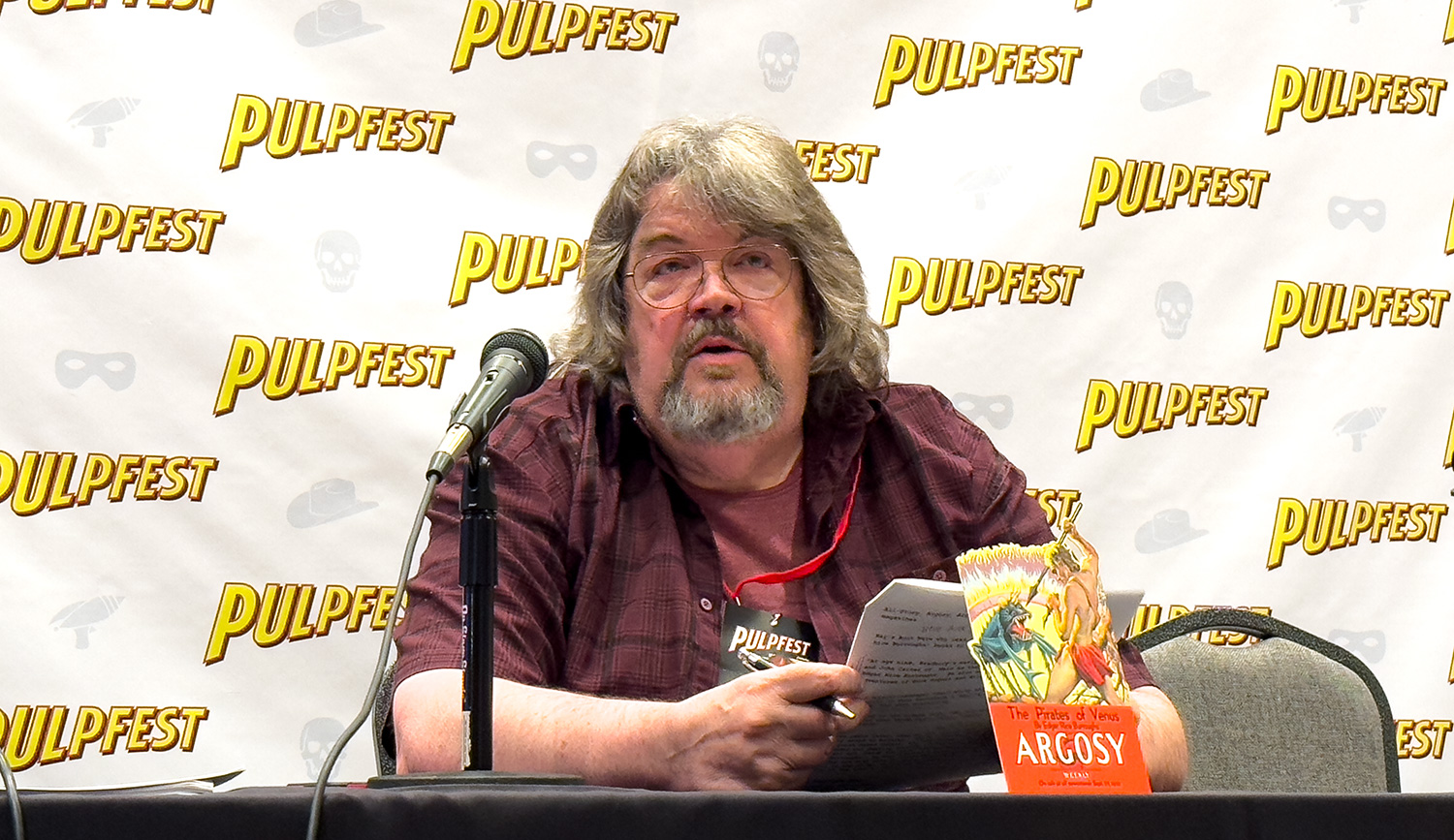
Editor and pulp historian Garyn Roberts discusses the influence of Edgar Rice Burroughs on the life and works of the Science Fiction Grand Master and Poet of the Pulps, Ray Bradbury. This Pulp Tales was recorded in Pittsburgh on Saturday, Aug. 9, 2025.
Click to expand the transcript.
Pulp Tales Announcer: Welcome to Pulp Tales, fascinating stories of the pulp magazines and the creative minds that brought them to life. The fictioneers, the artists, the editors, and others. Brought to you by ThePulp.Net.
Learn more about the pulp magazines through articles, blogs, bibliographies, links, over 100 episodes of this podcast, and much more at ThePulp.Net. Your link to the pulp magazines for almost 30 years. Online at thepulp.net.
Garyn Roberts: Here’s what he says. In 1930, 10-year-old Ray Bradbury made the summer unbearable for everyone. He said, you see, my problem was Edgar Rice Burroughs and Tarzan and John Carter, Warlord of Mars.
I couldn’t stop reading those books. I couldn’t stop memorizing them line by line and page by page. Worst of all, when I saw my friends, I couldn’t stop my mouth.
The words just babbled out. Tarzan this and Jane that, John Carter here and Dejah Thoris there, and when it wasn’t those incredible people, it was Tanar or Pellucidar, or I was making noises like a Tyrannosaurus rex and behaving like a Martian thoat, which, everyone knows, has eight legs because of the sheer romantic impossibility of Burroughs Mars and its fairy tale people. How can one resist walking out on a summer night to stand in the middle of one’s lawn to look up at the red fire of Mars quivering in the sky whisper, take me home.
Pulp Tales Announcer: In this episode of Pulp Tales, editor and pulp historian Garyn Roberts discusses the influence of Edgar Rice Burroughs on the life and works of the science fiction grandmaster and poet of the pulps, Ray Bradbury. This presentation was part of ERBFest, held in conjunction with PulpFest 2025. This Pulp Tales was recorded in Pittsburgh on Saturday, Aug. 9.
Garyn Roberts: Thank you for being here. The scope of our topic tonight is partially due to Mike Chomko. It was about a year ago, he said, Garyn, why don’t you do something on how Edgar Rice Burroughs affected Ray Bradbury?
Everybody knows that he did. Oh, what a good idea, right? Why don’t you just describe the whole world and agree to that?
It was that, that, I thought, sounded good at the time. And then in January, I thought, you know, I better start thinking about this topic. I know lots about Ray.
Ray was my buddy when I met him in 1982, and I knew him until his passing in 2012. 30 years. We toured together.
We did community reads projects. And the single biggest thing I’d tell you about Ray Bradbury is, as great as he was as a writer, and I love his stuff, he was an even nicer man. Was he perfect?
Not even close. He was a man, as we’ve already heard from John Betancourt in the back, who loved to go to hyperbole and to extremes. I love Burroughs a lot.
And maybe he is the greatest writer of the 20th century. But Ray, you know, he just went… I sent my first book to him in 1983.
A collection of Fred Davis’s… Karen’s not here today. Fred Davis’s granddaughter. The Night Nemesis.
Moon Man Stories from 10 Detective Aces. I sent it to Ray. Ray says, oh God, Garyn, I love this stuff.
He said, I read every one when I was a kid. There’s no way he did. Okay?
But Ray liked to go to extremes, and his heart was in the right place. Reality, not always. He loved hyperbole and all that.
David Saunders likes when I tell a story. I’d always call August 22nd and talk to him out in Los Angeles. That time I was living in Michigan, and I’d say, Ray, happy birthday.
And we’d talk for five, ten minutes, and he’d say, it always ends every conversation. I love you, Garyn. I said, I love you too, Ray.
He was a neat man. Well, as we’ve established, this topic is very big. So I thought, let’s do something sort of informal that doesn’t cover everything at all, but begins to give us an idea.
So that’s why I went with the handout. I’m okay technology-wise, but I was a little more comfortable with this this year than a slideshow presentation. And besides, don’t we all like to take stuff home from PulpFest?
And to heck with what I wrote, you got some neat pictures there on the front. Right? So there’s a couple things in here I’d like to point out and mention as we go here.
This is kind of informal, to say the least. My notes are rough. They’re incomplete.
I’m trying to cover the world in a matter of about 40, 45 minutes. Bradbury was indeed affected very, very profoundly by the works of Edgar Rice Burroughs. and you can read all kinds of things about this, and it really moves you.
He was born in Waukegan, Illinois, and I don’t know if any of you know where Waukegan is. It’s on Lake Michigan. It’s between Chicago, and you go up to Kenosha, Racine, and then Milwaukee.
But anyway, Ray grew up in Waukegan on Lake Michigan. One of the publications we didn’t mention in passing, there’s other ones. We mentioned planet stories, thrilling wonder stories, but Ray cut his teeth on weird tales.
and many of those weird tales would later appear in Dark Carnival in 1947 published of all places out of Wisconsin by August Derleth and the Minnesota guy Donald Wandrei both wonderful, wonderful guys a hell of a publishing house, many of you know about that some of you may have even been there through the years I was in much younger days but the story goes like this Ray had this wonderful aunt and the more and more you read about Ray this aunt comes up all the time in his biography and his autobiography her name was Aunt Neva she actually appeared as a character in some of his stories speaking of characters have you ever seen the 1953 Oh creature feature It Came From Outer Space — Ray Bradbury script, you know — Russell Johnson from Gilligan’s Island and the other guy in there they played a telephone lineman that was Ray’s tribute to his dad because when he was about 10 or so, Ray’s dad in the heart of the Depression did the Joad family thing in Steinbeck’s work. And Mr. Bradbury, Ray’s dad, hauled him first to Arizona and then to California where Ray would become famous. Well, when he was in Arizona, Ray’s dad was a telephone lineman, just like those guys that’s Ray’s tribute to his dad and It Came From Outer Space.
Here’s what he says. In 1930, 10-year-old Ray Bradbury made the summer unbearable for everyone. He said, you see, my problem was Edgar Rice Burroughs and Tarzan and John Carter, Warlord of Mars.
I couldn’t stop reading those books. I couldn’t stop memorizing them line by line and page by page. Worst of all, when I saw my friends, I couldn’t stop my mouth.
The words just babbled out. Tarzan this and Jane that, John Carter here and Dejah Thoris there. And when it wasn’t those incredible people, it was Tanar or Pellucidar, or I was making noises like a Tyrannosaurus Rex and behaving like a Martian thoat, which, everyone knows, has eight legs because of the sheer romantic impossibility of Burroughs Mars and its fairy tale people.
How can one resist walking out on a summer night to stand in the middle of one’s lawn to look up at the red fire of Mars quivering in the sky and whisper, take me home. There’s all kinds of crossover themes. Many of them inspired Bradbury’s aunt read him.
Burroughs was number one and right along with that were the L. Frank Baum stories that started in 1899 with the Wizard of Oz. Baum was from Chicago and that is a whole other story and it’s wonderful. And so this is Bradbury’s youth before they start making the trip to Arizona.
just like in the Grapes of Wrath with Steinbeck. So he even lost a cousin in Lake Michigan drowning. Many of you may know this story.
Ever read the weird tale of the lake? That’s a true story based on his cousin drowning in Lake Michigan. Very powerful story.
So there was Ray, and we have a list on the back of several pages in of some general themes that Ray not only took from Burroughs and sort of claimed for his own expanded, but themes and genres that had already existed. And while Burroughs was unbelievable, and I’m a pretty big A-plus fan of Burroughs, he didn’t invent all this stuff. He articulated it and developed it.
He didn’t invent the Western story, but he sure did a good job with it. He didn’t invent stories of the old knights and all that kind of stuff and chivalry. Even stories of apocalypse, post-apocalypse, which seems to me we live every day anyway.
Autobiography. He was very good at this. And all of this affected Bradbury.
He read this stuff voraciously. He was obsessive in a good way. Classical literature, a lot of references there.
Detective fiction. Frontier Western future history. Time travel.
You can read the list there. There’s all kinds of stuff. And Bradbury kind of, in a modest way, and it was modest.
It wasn’t, Burroughs was something else. He took a lot of that forward and went with it. And Ray used to say, you know, and this was in several instances and interviews, he’d say, no other author than me, sounds a little arrogant, I guess, but I think it was probably true, loved other authors more than I did.
He said, I’ve written about them all and written from all our experiences, everybody from Melville and then, of course, Burroughs. At the bottom of the second side that’s all typeset, and by the way, forgive me for my formatting. I was more interested in getting stuff down, but I think I got a lot of the errors out of it.
There’s the header from Planet Stories, Volume 3, Number 3, Summer of ’46, for the story by Leigh Brackett and Ray Bradbury called Lorelei of the Red Mist. Now that picture is not only in your handout here, it’s on the website. And it’s a pretty darn good story.
But if you read this heading and you didn’t know who wrote that, you would say, "That’s Edgar Rice Burroughs. That is classic Edgar Rice Burroughs stuff right there. And it’s really good, you know.
So you don’t need me to read that to you, but look at that. And holy cow, I pulled out, I’m kind of obsessive myself, one of my multiple copies of that pulp, and typed that right up for you because it really hit me. Of course, Burroughs was involved, as a nice gentleman here was talking about, with a lot of Munsey pulps.
And other pulps as well. All Story, Argosy, Argosy All Story, and others. Blue Book, all kinds of things he was in.
He was in the 40s and Fantastic Adventures and all kinds of stuff. So before we start going out to Arizona and Ray going to Hollywood and being kicked by W.C. Fields, W.C. Fields did not like him.
He was kind of a jerk, W.C. Fields. He was rough on kids.
He had all kinds of other bad qualities, which I won’t enumerate. Ray was reading Burroughs. He was getting every piece of Burroughs he could get.
His aunt was reading it to him. He was reading L. Frank Baum, and he was collecting Buck Rogers comic strips and pasting them in a book. The problem that happened there, and Ray said it was the last time it ever happened in his life, people started to make fun of him, and they said, what the hell are you doing pasting Buck Rogers?
Of course, we know Buck Rogers started, you remember where? Amazing stories, right, in the pulps? That great yellow cover, that is not Buck Rogers.
That’s an E.E. Doc Smith character. But nonetheless, in that particular pulp, that’s where Buck Rogers started.
So Ray was listening to some of his peers, and they said, why are you pasting this stuff and keeping it and all that? And Ray took him very seriously. His self-esteem was at an all-time low, And he burned and discarded all of his, Edgar Rice Burroughs, years of pasting and collecting.
And he said, I will never do that again. He said, it’s too important. Ray got to Hollywood.
He was peddling newspapers on the stands. They got to Hollywood, and Ray found some friends there. And they were reading wonder stories and Hugo Gernsback’s amazing stories, which we’re celebrating next year for the 100th anniversary.
That’s a wonderful story. And he received a toy typewriter about this time for his birthday, and he wrote his first story. It was a lusty, immature, young sequel to one of Edgar Rice Burroughs stories.
He couldn’t afford the books. He could only borrow the pulps when they were available, And it really was the depression for the Bradbury family as his dad was climbing telephone poles and all that kind of stuff. Through the years, Ray’s probably number one biographer, and there have been many people who have done really good work on his behalf, was Bill Nolan.
Now, Bill Nolan was one of our guests of honor. I think we were still back in Columbus in those days. I don’t know, 10, 12, 15 years ago.
Remember that, Mike, when Bill? Bill was a hell of a guy. I liked him, and he was like Ray.
He not only had this renaissance quality where he could write, he could do all this, he could do art, he could do all kinds of stuff, screenplays, of course, Logan’s Run, and on and on and on, but he was just a darn fine guy. Well, I met him in 82 with Ray. They’d come to Bowling Green.
I’m working on my graduate degree. I’m about, when is that, 83? I’d have been like 24.
We’re talking ancient history here. And I got to spend the week with Bill and Ray, while not only making good friends with Ray, I got to meet Bill Nolan really well. And up until the time he passed, Bill wrote me whole manuscripts of pulp history, really, really nice stuff, and he’d have to pay extra postage to send them, even back in the 80s, 90s, and turn of the century.
But Bill was really probably the single most important biographer in Bradbury’s life. And Bill knew way back in the 50s when he started chronicling Bradbury’s biography how central Edgar Rice Burroughs was to who Ray Bradbury would become. Everything from the Martian stories, we know about the Martian chronicles.
We know about the British variant with a really neat title, the Silver Locust. Think about that title sometime, the Invading Silver Rockets. Yeah.
That one was a little bit different like a couple of other British publications. And there was a lot of his stories, Martian stories and weird tales that weren’t collected at the time. There were a lot more Martian stories by Bradbury, influenced by Burroughs, that never made it into the Martian Chronicles.
Over time, those would be expanded. There’d be other volumes and so on and so forth. And the British did a good job.
They had a couple of volumes that they produced that were never printed in this country. About 1950, early ’50s was the book, The Day It Rain Forever. Can’t get that book in this, anything but a British edition.
Beautiful book. In 1962, they did The Small Assassin, which filled in all the reprinted weird menace stories. And then Bradbury, of course, loved detective fiction.
He thought he was terrible at it. The executors of his estate, his son, Michael Congdon of Don Congdon, I talked to him about a year ago. I said, Don, I really want to publish these popular…
Well, Hard Case had done this book, Killer, Come Back to Me, and it was neat and everything. No, no, no, no, no, no, no. I want the popular stories from, you know, new detective and dime mystery and dime detective you know all of that that Ray had done and uh Ray’s now agent the son of his original agent said no Garyn but Ray made me promise when he died that they would not be reprinted because he was so embarrassed by them and of course I love them of course there’s no accounting for taste but I love them some of them were reprinted in 1984 in a paperback called A Memory for Murder, which is a neat little book with a Weird Menace cover on it. I like that book.
Did I say I was obsessive? I’ve got at least 15 copies of that. I’ve read it multiple times, and it’s missing a lot of the old stories.
Ray has an error in his introduction historically, but it’s a beautiful book. And if you can find a copy, I haven’t seen any around. Maybe somebody’s got one in the dealer’s Yeah, we’re talking, they’re starting at about $25 a piece, because they’ll never be reprinted, and the Congdon family, you know.
Anyway, Bradbury’s out in Hollywood. He’s being kicked by all these people. He’s writing radio plays for George Burns and Gracie Allen, and he knows Norman Corwin and a number of other people.
By the 50s, he would be, of course, working with the very famous John Huston, the creator of my all-time single best, not to be disputed in my lifetime, best movie I’ve ever seen, The Maltese Falcon, 1941. But in 53, he was working with John Huston over in Ireland. And you want to read a good story about the biography of what happened in Ireland?
John Huston, of course, was a nut. Of course, aren’t we all? But Ray worked for him over in Ireland for about a year, which was quite a deal because Ray, he wouldn’t fly.
He didn’t fly. So he had to get there later by boat and all that kind of stuff. But if you ever want to read a great account of that, his biography of that is called Green Shadows, White Whale.
And oh, goodness, is that. It’s sort of a sequel in some ways to Dandelion Wine and Farewell Summer. All of this stuff is infused by this guy here, Edgar Rice Burroughs.
Bradbury had never read Melville before, and so he spent all the time going across on the boat to get over to film this thing. They damn near killed Gregory Peck, you know that story. He got pneumonia real bad as they just about drowned him to pieces.
And then for years afterwards, pieces of the rubber whale were floating around Ireland and England. This went on for decades. So Ray did that, and he thought all about that.
Ray talked, I should mention about some other characters, too. He talked about a group of guys and gals, the most important may have been Leigh Brackett. He called the Burroughs boys, that’s in quotes.
And he was referring to all kinds of neat people. Ray Cummings, Otis Adelbert Kline, all these imitators, you know, and some of them are listed in this handout. And he’d read them too, and they were pretty good but, you know, they weren’t Edgar Rice Burroughs.
There’s some discussion in here about some of his early writings, some of his early Martian stories, and all of that. A lot of this comes from the work of people like Bill Nolan. But other things are in here as well.
There are some contemporary scholars who I love who talk about this stuff. I just admire tremendously. They’re not here.
They were here in Chicago here a few months back. John Coker and the father and son team of Dan and David Ritter. Have you seen their books on fanzines?
They did one book on the earliest Bradbury, his earliest fanzines. and there was a lot of crud in it, a lot of junk, but there was some neat stuff too. And those guys, if you ever get a chance to get any of their volumes on their fanzines, they are lost history, beautiful color pages, unbelievable stuff.
So I thought very, very highly of those guys. Now, as we’re talking about Burroughs influencing Bradbury and all the things we can connect to, Laurel that Lyle, the Red Mist, or whatever, There’s a piece that’s missing here, and I’m not just saying it for the people here, like my friend Paul and Michael and that kind of thing. Philip Jose Farmer was a really central piece to all of this.
You look at some of the bridges that he made and the advancements. I love the Barnstormer and Oz. I love the Tiers stories.
I love the river world stories. Jesus on Mars is one I like. You can’t kind of forget Farmer in this mix either.
There are others. There were the Burroughs boys. But that’s an important part of the story.
There are several people in here that there’s a lot of thanks I want to extend. And the problem is, is you always miss people. There’s organizations like the Edgar Rice Burroughs groups, and there’s several of them.
I’ve already mentioned Christopher and Kathy. I think the absolute world of Henry as well in the front row here. Henry does yeoman’s work with incredible details that would be lost.
And if you haven’t gotten, oh, I love the old stuff. I actually have a first edition of the very first Tarzan, you know, that particular combination thing with the oak leaf or the maple leaf or whatever the hell it is. But I paid $9 for my copy about 30 years ago.
It was in a bookstore. But this is good stuff. The Burroughs people, the Farmer people, Phil and his wife Bette.
And one day I was there and Phil Farmer, who many of you know better than I did, he was nice and he talked to me. And my perception of him was that he was very quietly intelligent. He was a tall, handsome guy.
He was quiet and intelligent. And one day he was looking. We were in Dayton at a Pulpcon.
My first Pulpcon was 1982. So I’m kind of old. I was like 23 at the time.
I was there with my son. I’d driven down with enough gas miles in my little compact car to get there and back. I had just a handful of dollars in my pocket.
I was talking to Mr. Farmer and his wife came up. Bette came up and said, can I take your son for a while and play with him? Sure.
Great, great. She took him for the rest of the day. She bought him ice cream.
It was the coolest thing. The Bradbury Center, the Bradbury Scholars are interesting a lot. They’ve come through the generations.
Some of them have a little bit of an ego problem. They think they’re more important than others. That happens in all of fandom.
I love them all. My favorite are the Congdons and Bradbury’s and his wife, Marguerite’s, four daughters. They were my favorite representatives of Ray.
But there’s a neat center in Indianapolis run by a couple of guys and now some successors. and I like their work a lot. Eh, a little bit full of themselves, if you ask me.
Okay, and then, of course, the Special Collections Department at Bowling Green, my alma mater for my master’s and doctorate. And in 82, when Bill Nolan pulled up the rented brown station wagon, clunking in from California because neither he nor Ray, well, he’s driving Ray because Ray won’t drive, he won’t fly a plane, none of that stuff. They come in the special collections of Bowling Green, which is, I’m biased, but it’s one of the great libraries in the whole world for popular culture and pulp studies.
And my mentor, Professor Ray Browne, loved the pulps and used to come to PulpFest. He’s been gone now about 20 years. But the special collections, and then there’s even some people here who’ve worked there that I’ve met.
The original manuscript for Fahrenheit 451 is there. I have a Xerox copy of it, color. You know why it’s neat, it’s in color?
Because he did all his revisions in hand in different colors of ink, each different revision. It’s pretty neat. So I’m very biased, and there’s a really nice young couple that’s here every year at PulpFest.
And the lady, Lee, worked there and was part of all of that. And then I’ve created an incomplete list of people who’ve influenced me and who’ve helped me with this stuff from day one. And the only problem with this list is it’s incomplete.
So we’ve got that there. We’ve got a list of publications you can pursue, but there’s some really wonderful books there. Sam Weller, later in Bradbury’s life, did a really good job and captured some of that connection between Burroughs and Bradbury.
He specifically asked him about that. And within the works of Sam Weller and in the interviews with Ray Bradbury that Sam did at the end of Ray’s life, there’s some good connections there. Again, Mike and I had this great idea last year.
What a good topic, right? oh, that’s a great topic, but how vast and broad it is. And so it became kind of a treasure hunt for me to see, where could I find this stuff, right?
Back to 1953, Bill Nolan’s first Bradbury Review. All these things. You guys with names like Eller and Touponce.
I think Mike has one of their books out on his bookshelf. It’s a reference book. And, of course, I had to put Henry in again.
I’ve become a big Henry fan the last five years. Finally got to know him. I used to see this little guy running around.
He’s busy. I wonder who he is. Well, now I know.
He’s pretty cool. There’s a piece by Henry Kuttner that goes way back, Bradbury Themes, and he talks about, of course, we know about Henry Hank Kuttner. Probably none of us met him because he was gone by about the time I was born in 58.
There’s some other neat books. Some of these I’ve gotten. One I’d point out, besides the Ritters, and, of course, there’s some really good Burroughs work that is just, I love this stuff.
There’s one that’s come out last year that I really, really like. It’s from one of my old publishers, McFarland, and it’s by a guy named Orty Ortwein. That’s quite a name.
Anyway, the book is entitled The First Geeks, Ray Bradbury, Forrest J. Ackerman, but this Orty guy, Orty Ortwein, and I say that with all dear respect, this is a pretty neat book, and he’s talking about this. talks about how Ackerman, who actually helped me with one of my award-winning science fiction anthologies, actually went to Burroughs’ house in Tarzana there, to his estate. And Burroughs was very gracious to him and talked to him. Ray Bradbury didn’t go that far, even though he was good friends with Forrey Ackerman.
He didn’t go that far because he was so intimidated by Mr. Burroughs. He thought he was just the best. And, you know, he was right.
Other sources here, yeah, the Ritter Brothers and Fandom, Father and Son, and then a few ramblings I published through the years, and then some more individuals who have helped a lot. And then I look here, and I’ve gotten off the topic, and I haven’t necessarily said everything right and missed a few pieces and all this and that. Make sure you do get a handout, though. The pictures are worth having.
There were some people who have been gone, and there isn’t a day I don’t miss any of them. Dr. Browne was an amazing man. I gave up seven job offers in the world of business back in 1981 to go study with him in Bowling Green.
Anyway, these were people who framed my life in those early days, and two that I never forget are Jack Deveney from Minnesota, and I would go up to Jack and Helen’s house, and they would set me up. Jack had this; some of you who are a little longer in the tooth will remember Jack and Helen. Jack was a World War II airplane ace.
He was also one of the first pilots for Northwest Airlines out of the Twin Cities. He’d sit me down in his office and he had had this beautiful floor model radio and it had all kinds of bubbles and lights and colors that went around and it was set to a minneapolis station or st. Paul station that played big band music five hours later I would leave and I would leave and I’d walk out of there with the boxes of pulps and I mean good pulse early weird tales, early shadows, and all that and Jack would say Garyn these are yours to keep he said if you want to trade any in or exchange them after you read them let me know holy moly well it was Jack’s collection that became the basis of Girasol publishers you know Leigh and Neal up in up north in the great country excuse my editorial we’re not treating very nicely these days and that Jack’s collection was the basis for Girasol Publications, Leigh and Neal’s work. So there’s a lot of neat people.
Nick Carr, the cousin of the very famous mystery writer, John Dickson Carr. We love Nick. He was a good man.
Early scholar. Rusty Hevelin, he was a character. Mark’s dad, Lynn Hickman.
I love Gordon Huber. He did some really good indexing and things of lost adolescent series and things. Sheldon Jaffery, the Cleveland attorney, and the guy who we lost just recently, Rick Lay.
And Doris is still with us, but her husband, Jack McGonagall, passed a while ago. Bob Sampson, a NASA employee. Bob was a neat guy, and you know when he died, so think about this and let it be a warning to you.
His sons had a garage sale and gave away and disposed of and burned and recycled all his pulps. So that was down in Alabama. Wow.
Al Tonik, the consummate librarian from the great state of Pennsylvania. Al was a great guy. The late Scott Turk, a dear friend and husband of my dear friend and wonderful lady Kim over there.
And Bob Weinberg. And you know something about Bob Weinberg since I’m being opinionated? Bob was a really good guy.
He could be a stark raving ass in earlier years. He could be just an absolute jerk. He even tried some things that weren’t all that ethical.
But by the time he went to his reward, Bob mellowed out, and he was one hell of a good man. But there were cranky days back in the 80s. Holy cow. I’d call up there, and I would just be thanking God that I got a hold of Phyllis and not Bob.
Yeah. Yeah. Well, I’ve wandered off the topic far enough.
but the scope of Burroughs and what he’s done not only to Bradbury but to the world is like, holy cow how can you describe that, you know? You can’t. It’s really, really important stuff and Bradbury just thought he was the single best author ever and like I said, Ray was given to hyperbole at the time but he was also passionate about what he believed so he believed that and I like this stuff. Alright, enough of my rambling.
Does anybody have any specific questions or insights you’d like to make? Yeah, Michelle?
Michelle Nolan: Yeah, I knew Ray pretty well. Got to know him in the 90s. We hit it off really well. I found a copy of Memory of Murder from, I think it was 1983, and it had a skeleton on the cover, and it was cool.
I paid 20 bucks for it, and I walked over to Ray and said, "Hey, Ray, I’ve got a book for you to sign." And he said, "What’d you pay for this?" And I said, "20 bucks, it’s a collectible."
He said, "You’re an idiot." And then he said-
Garyn Roberts: That sounds about right.
Michelle Nolan: Yeah, and then he said, "What do you want me to do?"
I said, "Please sign it." He signed it like this. Yeah, I’m a little paraphrasing, it’s been a while.
"Dear Michelle, I love you, but please don’t read this bleep. The first story is passable, the rest are pure bleep." And he said more than bleep, but anyway.
And he said, bleepingly yours, Ray. And he really told me verbally that he said, I was a terrible mystery writer. It was pure garbage.
I love it. I still love it. Well, I read them, and I thought they were pretty good.
Yeah. But I didn’t dare tell them.
Garyn Roberts: Yeah, right. Great mysteries, absolutely not. Yeah.
But fun and entertaining little adventures, set at carnivals and stuff like that. I love them, yeah. But they’re never going to see print again as long as…
Ray would be turning over this grave. I got all kinds of multiple copies of it. Every one of them, though.
There’s that OCD again. Anybody else? Yeah, John?
Audience 2: What’s going on at Bowling Green these days?
Garyn Roberts: That’s a good question. I haven’t been there for a while. I drive by with happy memories when I’m down on the interstate.
We’ll drive by tomorrow some way on the way back. It’s changed. It’s gotten bigger.
The popular culture house isn’t there. The day they tore it down, it was this historic building. It was a fabricated house from, I think it was Wards, Montgomery Wards.
And it was, I had an office there for years. The day they were tearing it down, they had all kinds of protests and stuff. The library is still there.
It’s still one of the very best libraries in the whole world. Better than the Library of Congress. It’s better than, I got those stories too.
And it’s got the best sound recording archives maybe in the world is at Bowling Green. And it’s a heck of a wonderful place. But the day they were tearing down the building, the historic building, I drove up and I watched these guys with these wrecking balls and stuff.
And I went up and I was starting to take pictures, you know, as an amateur fan would do. And the guys came up and they were in their hard hats and helmets, these big, burly, tough guys. Well, they’re not much bigger than me, but they are, you know, a little rougher looking.
And they said, are you here to cause trouble because we’ve had riots and stuff? And I said, no. I said, I just would like to take a few pictures. I had an office in the 80s up on the second floor.
And I had a lot of students that came through this building. So I still love Bowling Green. I don’t know much about what’s going on.
They still have a popular culture program, but Ray Browne was the pioneer of all that stuff. He was the genius of that. Yeah.
Anybody else? I’m sorry about the rambling. I told you I was going to get off the topic.
Yes?
Audience 1: I was very fortunate to attend Ray’s appearance at Bowling Green. Yes. I was a teenager and I was just awestruck by him.
Garyn Roberts: Do you remember his speech?
Audience 1: Yes, I do because… Holy cow? Years later he appeared in Toledo.
I mean, many years later he gave the exact same speech I remember. And he added a little new part at the end. But he told the story about the magic man that he saw that he said, live forever.
Yes. God bless him. But as soon as he was done speaking at Bowling Green, he started to walk off the stage, and everybody at the front of the crowd was waiting right on him.
He couldn’t move much after that. Started handing him things in. And I wormed my way up in there.
I had a science fiction book club edition of Martian Chronicles. And I stuck my arm in there to get it. Everybody was just deathly quiet.
And he finally got fed up. And he goes, somebody asked me a question. Yes, I remember that.
So I just, off the top of my head, I asked him about his story, Strawberry Window. And he answered it, and I floated away. And it was just, you know.
Garyn Roberts: Yeah, he signed a Weird Tales for me that day. I’ve taken up too much time. Does anybody else have any questions? Thank you for your tolerance.
Pulp Tales Announcer: You’ve been listening to Pulp Tales, fascinating stories of the pulp magazines and the creative minds that brought them to life. Brought to you by ThePulp.Net. Learn more about the pulp magazines through articles, blogs, bibliographies, links, over 100 episodes of this podcast, and much more at ThePulp.Net.
You’re linked to The Pulp Magazines for almost 30 years. Online at thepulp.net. Subscribe to Pulp Tales on your favorite podcast platform or listen to us on the web at ThePulp.Net.
If you enjoy our content, please like us or leave us a review. And tell your fellow Pulp fans about Pulp Tales. Thank you for listening and keep reading the Pulps.
Pulp Tales is copyright 2025 by William P. Lampkin.
This transcript was generated automatically and may contain transcription errors, typos, or other inaccuracies.


