

One of the earliest specialized pulp magazines was The Ocean, published by the Frank A. Munsey Co. in 1907 and 1908 for 11 issues. As indicated by its title, it published sea stories from a variety of authors.
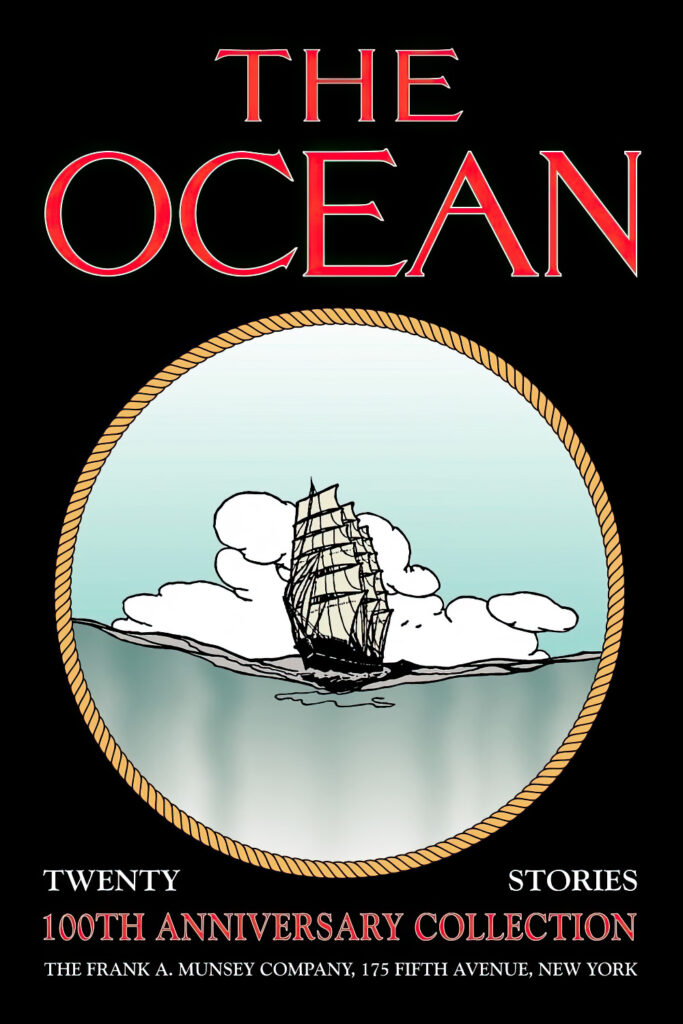 In 2008, John Locke published The Ocean: 100th Anniversary Collection through his Off-Trail Publications, which brings together 20 stories from the magazine, along with additional material.
The collection kicks off with a great introduction by Locke on The Ocean and its history. We get a good overview of Frank Munsey‘s career as a publisher and the launch of The Golden Argosy, later to become The Argosy, and then the launch of Munsey’s,
As this was the early days of pulps, genre-specific magazines were still rare. Railroad Men’s Magazine had recently appeared. It is interesting that while many pulps ran various sea stories, as a separate genre with its own magazines, they were never successful. Street & Smith did the short-lived Sea Stories Magazine, and Hugo Gernsback did the short-lived Pirate Stories and High-Seas Adventures pulps.
The Ocean itself only lasted 11 issues, quickly being converted to The Live Wire, a general fiction pulp, where the few unfinished series from The Ocean concluded. And it too was short-lived, lasting only 8 issues before merging into The Scrap Book.
We also get a good bibliography section on all the editors and authors, as was known at the time of this collection. There are several for which nothing is known, only ever producing one story. But of the others. I think the strangest has to be T. Jenkins Hains, who was tried for murdering his friend (he claimed self-defense) and then was involved with his brother, who shot the man who was having an affair with his wife. And he did so in full view of a crowd of others. If someone had written this all up as a story, I don’t think people would accept it.
So I read a few of the stories to see how they are. From Herbert Hamblen, a former sailor and later railroad engineer, is “A Crusoe of the Antarctic.” It tells the story of a lone man marooned on the Antarctic coast until found by a small whaling crew. The main character works out the man’s story and the ship he came from. Burke Jenkins, who was an early pulp author of sea stories and westerns, provides “Under the Black Flag,” a short-short story about a couple of reporters in a small yacht trying their hand at piracy, though it doesn’t go quite as they thought.
The longest story here is “In the Land of To-Morrow,” a sf tale about a secret science island. It’s by Epes Winthrop Sargent, who was a co-founder of Variety and a long-time literary critic known as Chic. He did a little pulp writing on the side. Our hero is a despondent inventor contemplating suicide. He is rescued and taken to Century Island. But he finds it less of a paradise than he expected, as well as falling in love. Will he be able to escape with the woman he loves?
Hains’ story is “When All Were Equal,” which is about a ship that makes it through a violent storm at sea, and the actions of its master and crew. Hains was a sailor for a period of time, and later a yachtsman, and had experienced a hurricane, so he’s writing from firsthand experience.
Finishing up the collection are a couple of articles by Munsey, one announcing the change of The Ocean into The Live Wire, while the other is from The Live Wire introducing the new magazine.
If you like sea stories of all kinds, this is a great collection of early pulp sea stories. There is a wide variety within that genre here, and I found every story an interesting one. But they should be, as I hope these were the best ones that appeared.


Your comments