

The Art of Allen Anderson is another great book on a pulp artist by David Saunders. This 2019 book from the Illustrated Press grew out of the cover article in Illustration #18 (Winter 2006).
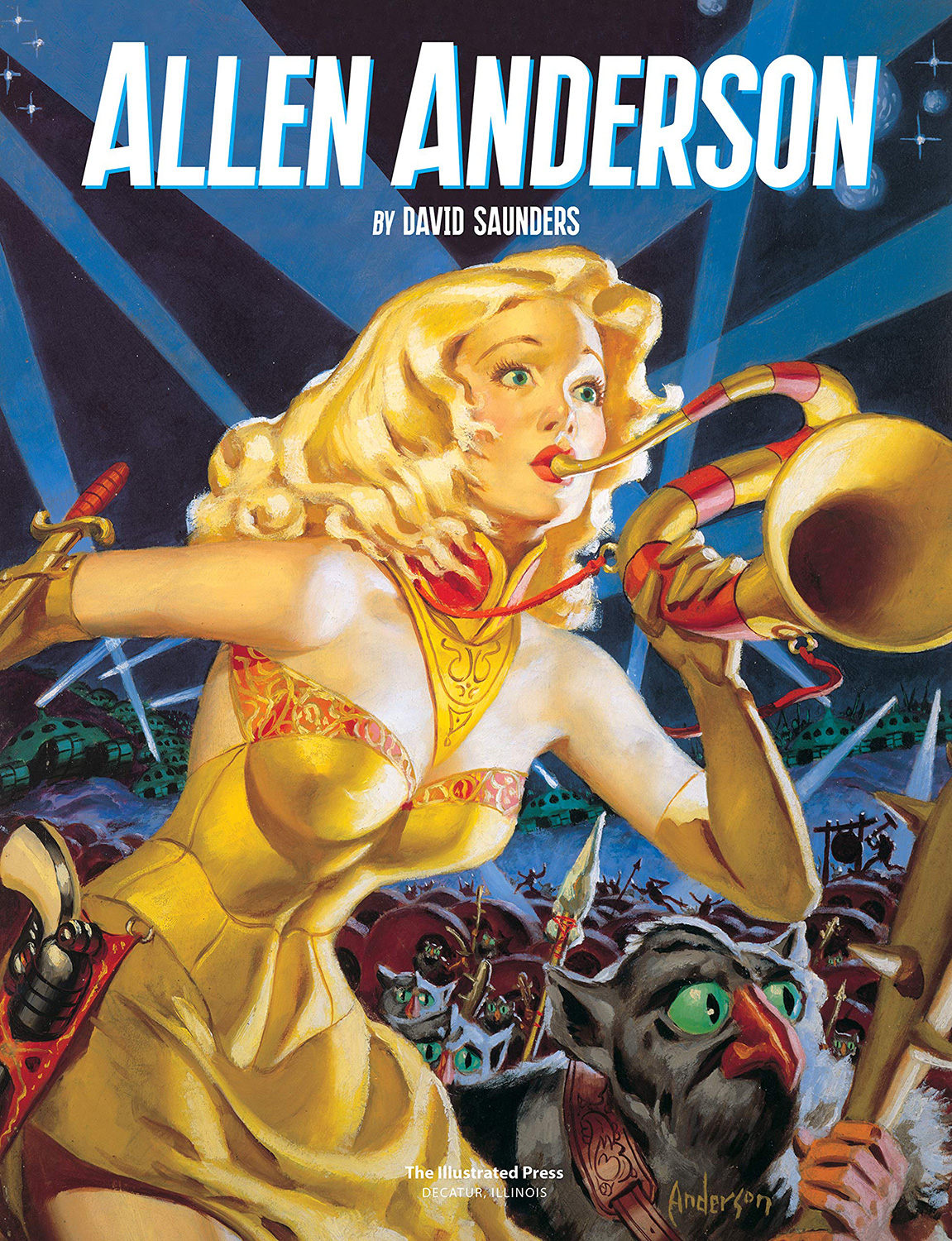 Allen Anderson (1908-1995) is best known for his covers on Planet Stories, but he did other genres including western, detective, spicy, and more.
Anderson studied art via correspondence courses through the Federal Schools, getting his diploma in 1928. From there, he worked as a staff artist at Fawcett Publications. There he did work for such magazines as Captain Billy’s Whiz Bang and Modern Mechanics. It was also here that he met fellow artists Carl Buettner, Ralph Carlson, and Norman Saunders. Saunders would be his lifelong best friend, so I think it’s appropriate that Norman Saunders’ son, David, did this biography.
Inspired by his friends who had already done so, he moved to New York City in 1940 and started work as a freelance pulp-cover artist for such companies as Ace and Fiction House, as well as Harry Donenfeld and Martin Goodman.
I thought it was interesting that many of his models for the covers he painted were actors and actresses, rather than models. He would marry his first wife, Aline, in 1942. Sadly, it would end after he returned from World War II. He was in the Navy, but didn’t see combat.
After the war, he returned to painting pulp covers, but also did covers for Ziff-Davis’s comicbook line from 1949 to 1953. I thought it was interesting that his post-war covers featured the “Sex Queen” who would share it with only three types of men: the “Jolly Companion,” the “Make-Believe Villain,” and the “Passionate Dwarf.” See if you can figure out which of the three is used on these covers. Start with the cover of the book itself.

Unlike other pulp artists, he wasn’t able to find new work after the demise of the pulps. I don’t understand why. Others were successful in moving into paperback and men’s adventure magazine work, but he wasn’t.
In 1953, Anderson married his second wife, Joan, and they would then move to Tillson, N.Y. There, they opened a small ad agency and sign-painting business. While small, it was enough for them to live on. Allen passed away in 1995, preceded by his wife. I thought it was sad that his family in Michigan wasn’t aware of his passing, and there was no grave. Instead, his ashes were scattered in the Catskills by a neighbor.
The overall book is 224 pages long. The biography, largely taken from the original article, takes up about 20 pages. The rest is taken up by his cover artwork, usually full page, but occasionally four to a page, organized by genres: detective, western, spicy, sports, romance, aviation, jungle, and science fiction. Another section has many of his Ziff-Davis comic book covers. It was interesting to see several covers I was familiar with that he painted, including two of The Black Hood pulps and several Planet Stories covers, among others. The only thing missing is a listing of his published works.
Like other such volumes, this goes on my shelf with the rest of my pulp artists volumes. If you can find a copy at a reasonable price, do so. It’s worth it just for the great cover reproductions.

Your comments