

The Gernsback Days by Mike Ashley and Robert A.W. Lowndes is a big, 500-page book from Wildside Press that contains several related items. It is subtitled “A study of the evolution of modern science fiction from 1911 to 1936.”
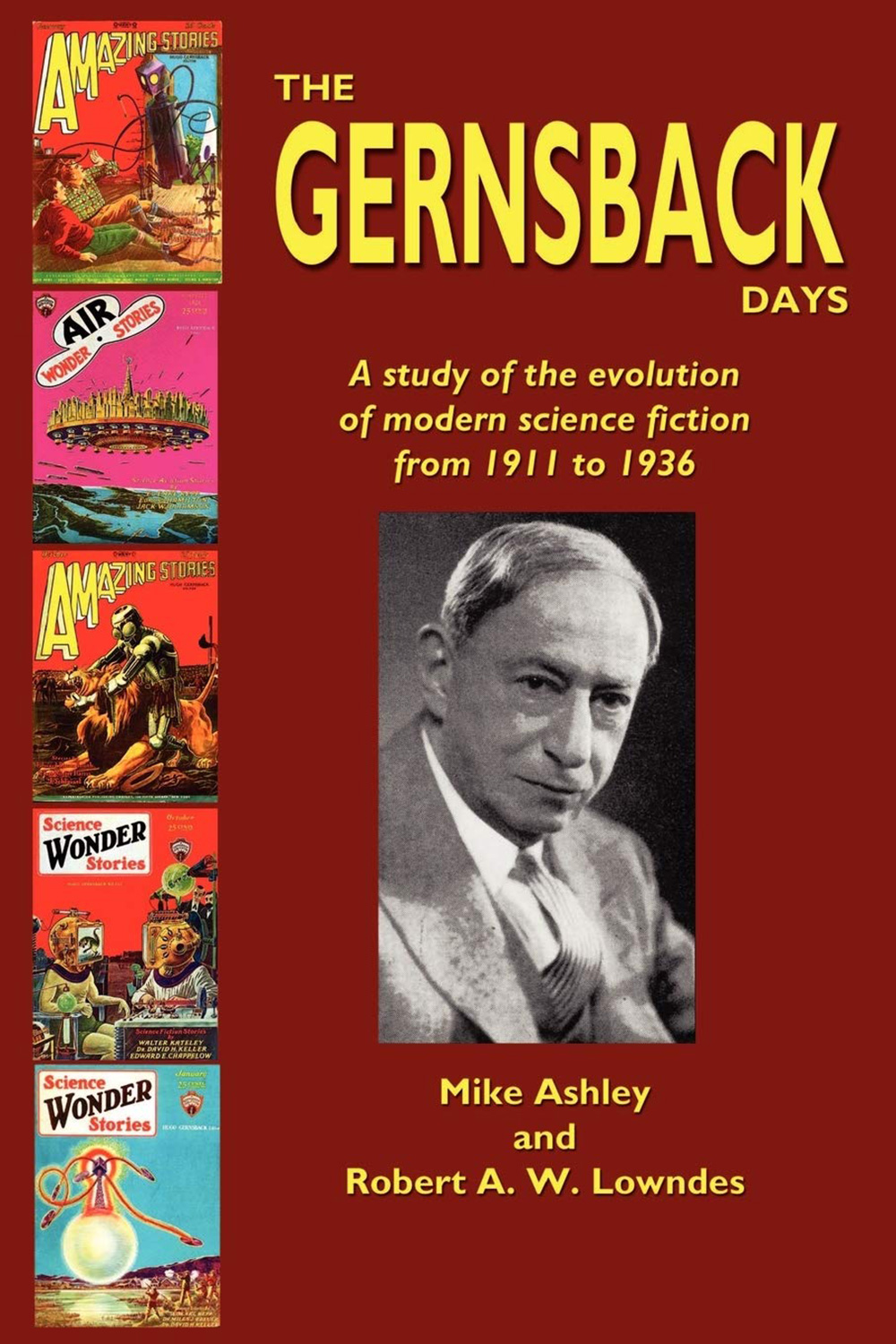 Half of the volume is taken up by “The Gernsback Days” by Ashley, which is a re-evaluation of Hugo Gernsback (1884-1967) from that period. A fourth of the book contains “Yesterday’s Worlds of Tomorrow” by Lowndes, which is a deep read of the science fiction published in the Gernsback magazines from 1926 to 1936. The rest is various appendices, mostly indexes.
Mike Ashley is a well-known researcher and editor of science fiction, fantasy, and mystery. Robert Lowndes was a sf author and editor, and has a complete collection of sf magazines of the period.
So, who is Hugo Gernsback, and why should we care? Well, as someone who is reading histories of science fiction, especially the period in the early 20th century, Gernsback was very important for bringing about fiction magazines focused on just science fiction. But many have had a negative view of him, for good or bad.
If I had to describe him, based on what I remembered from my reading, I would say this: Gernsback was publishing magazines on radio experimentation. He then expanded by launching Amazing Stories, the first sf pulp magazine. At the time, he used the term “scientification,” which I hate. And he even wrote a science fiction novel, “Ralph 124C 41+.” For some reason, he lost the magazine in bankruptcy, though it thankfully continued to be published. And then a little while later, he came out with new magazines that became Wonder Stories before selling that to Thrilling, leaving the field. But later, they named the Hugo Awards, given by the World Science Fiction Society.
Now, before anyone complains, the above is based on my memory from what I read as a kid. There is a lot more to the story than that, and Mike Ashley covers it excellently.
I learned a lot about Gernsback, his various business activities, and what was going on behind the scenes. Gernsback got into publishing as an adjunct to his other business, which was selling radio-related materials. He also got into radio broadcasting for a while. He was already publishing science fiction in some of his other magazines before he even launched Amazing Stories.
He lost Amazing Stories due to bankruptcy, which is puzzling. Weren’t his magazines successful enough to pay their bills? And once he lost Amazing Stories, he almost immediately launched both Air Wonder Stories and Science Wonder Stories. That’s kind of surprising. These would merge into Wonder Stories, which lasted a few years before he sold it to Thrilling, where it became Thrilling Wonder Stories, of course.
The only other fiction magazines he did were the short-lived Pirate Stories and High-Seas Adventures. And this was during the explosion of pulp heroes, which he didn’t get into. After that, he stayed out of fiction publishing, focused on magazines aimed at electronic experimenters.
Robert Lowdney’s contribution is a detailed reading of the science-fiction stories that appeared in the Gernsback magazines year by year. Some stories get a sentence or two, others might get a whole paragraph. Overall, this was interesting, especially as more of these works are getting reprinted by companies like Armchair Fiction and Pulpville Press.
For the rest, we get a memoir from Charles Horning, a former editor at Wonder. Then we get various indices of Gernsback’s science-fiction related magazines.
This is an overall excellent work. The only complaint I have is that we get no artwork from the pulps, either cover or interior, in the work. If you read Ashley’s introduction, where he tells how this work came about, you will see that this was planned, but fell through by the time it came to Wildside. It would probably have increased the size and cost of the work.
But despite that, it’s still a great book, and a great history and coverage of the major part of science fiction in the early 20th century. If you want to learn more about Gernsback and pulp science fiction of the 1930s, this is a book worth reading.


Your comments