

I have posted on Harry Dickson, the American Sherlock Holmes, a popular character and series in Europe. As I noted, he started as a German pastiche series, with Holmes now helped by Harry Taxson, later renamed Tom Wills in the Dutch version.
 Then a Belgian publisher had author Jean Ray translate the Dutch series into French for sale in Belgium and France. This series would run from 1929 to 1938, for nearly 180 issues. Ray did not start doing translations until around No. 20, and it wasn’t until a little later that he started to make improvements.
Jean Ray quickly tired of translating mediocre stories, and soon started to write his own, using just the book titles and Alfred Roloff’s covers as inspiration. This apparently started around No. 65. Further, Jean Ray was an author of fantastical works and had been called the French equivalent of Edgar Allan Poe and H.P. Lovecraft.
Even before Ray got involved, Dickson went up against more fantastical villains than Holmes did. One such was the sinister Professor Flax, later replaced by his daughter, Georgette Cuvelier, The Spider. Ray did not create Flax, but he did create The Spider. Other foes Dickson faced included Gurrhu, an Aztec god living in a hidden temple under London; a tuxedo-wearing avenger called Kric-Kroc, the Walking Dead; the supervillain Mysteras and his deadly illusions; and many more.
Harry Dickson is supposedly as popular in France as Arsène Lupin and Sherlock Holmes. Many of the Ray-written tales have been reprinted, now crediting him, and Black Coat Press has translated a few of those stories. Dickson has also had comic-book versions, though these are Franco-Belgian comics, sometimes called bande dessinée.
The comics may appear first in magazines and then be collected in large-format albums. More recently, the albums are created instead. I have read many of these series that have been reprinted in English, such as Asterix, Tintin, Blake & Mortimer, Valerian, XIII, Blueberry, Largo Winch, and others. In recent years, the U.K. publisher Cinebook has been translating and publishing many of these series both in the U.K. and here.
Black Coat Press’s associated website, Cool French Comics, on their Harry Dickson page lists two Harry Dickson comic series. The first, by Dargaud, ran for eight albums from 1986 to 2003. This one included works based on Jean Ray’s original stories. The second, from Soleil, ran for 12 albums from 1992 to 2008, but these are all original. I do wish we could get these translated into English.
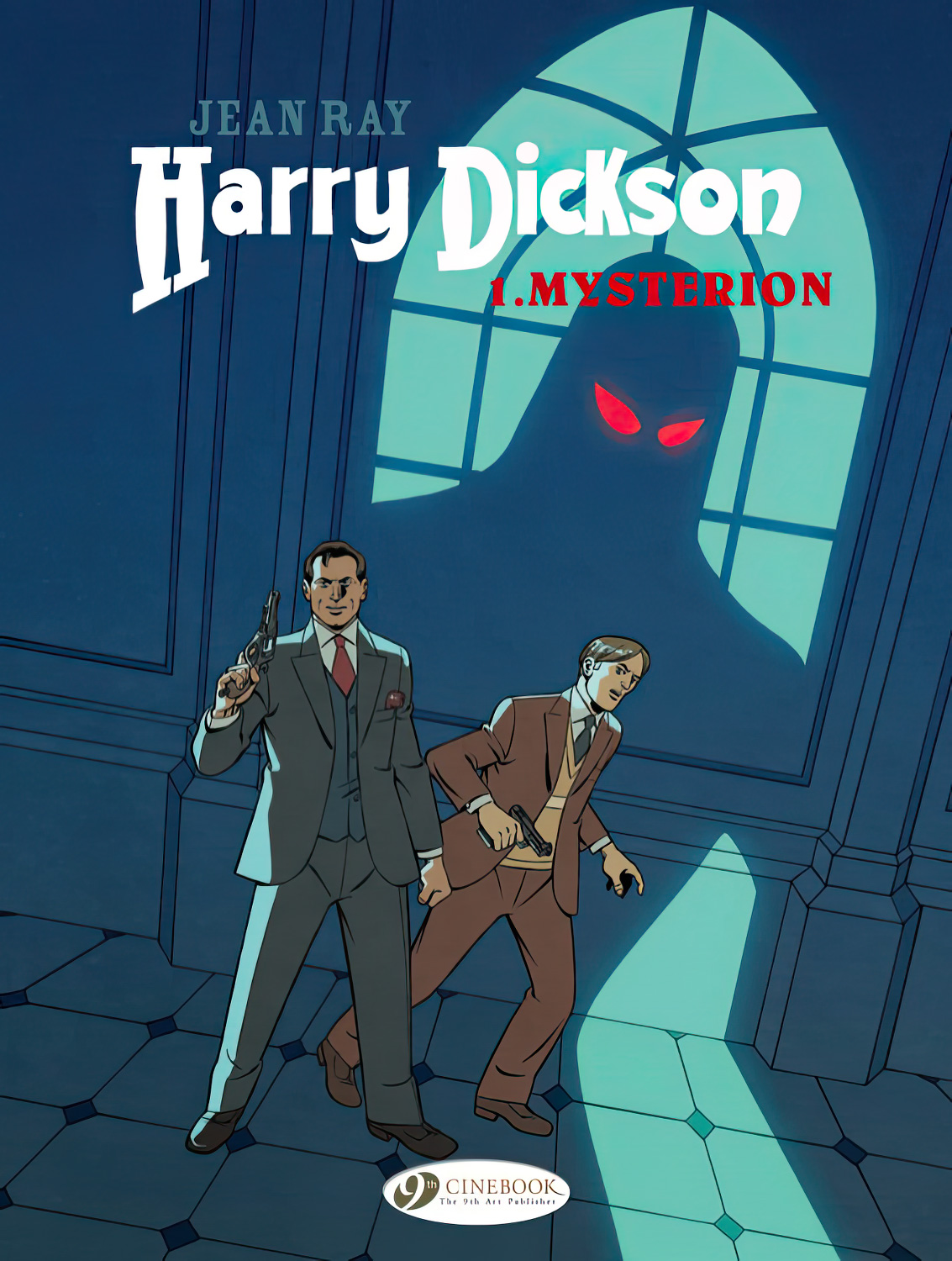
However, last year Cinebook came out with the first of a new Harry Dickson comic-album series, explicitly based on Jean Ray’s work. I was annoyed when I got the first one and discovered it was a two-part story, and I only recently got the second one. Thankfully, these two are based on Jean Ray’s stories that have been translated and published by Black Coat Press, so I was familiar with them.
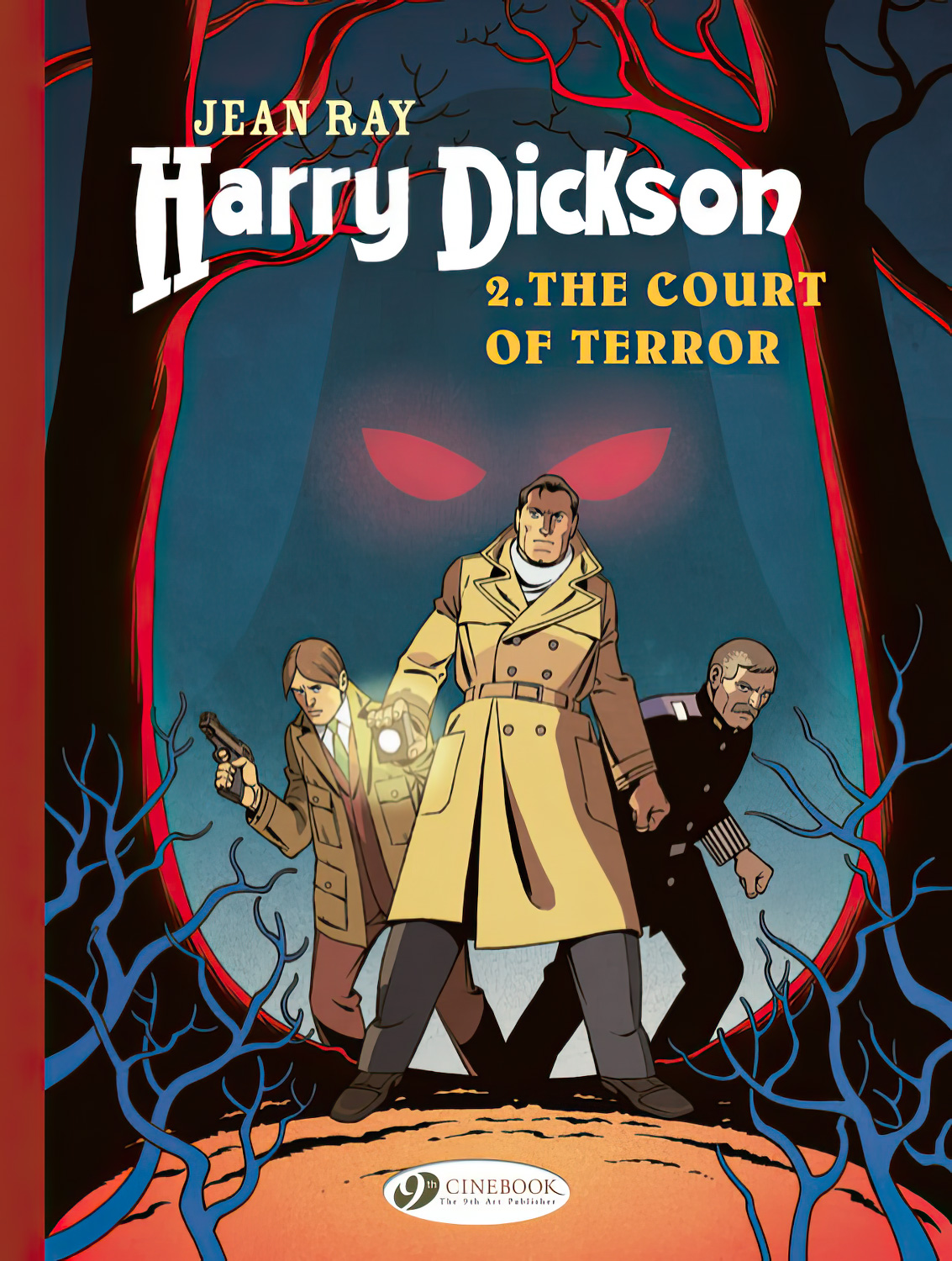 Volume one is titled Mysterion and the second is The Court of Terror. These are based on No. 103 Mystéras and No. 104 La Cour d’Épouvante (The Tribunal of Terror), both from 1933. These are included in the collection Harry Dickson vs. Mysteras. Clearly Mystéras has become Mysterion.
In volume one, we meet Delphina Cruikshank, an author already rich from an inheritance, who, due to her popularity, is even wealthier. She lives at the top of a strange tower that can only be reached by an elevator she controls, and she never leaves. She has a telescope and can see a nearby prison, where she saw the execution of a prisoner by Dr. Browless. But strangely, after the execution, when the doctor was examining the body, he was found brutally slain. At the same time, the author disappears from her tower, which her staff says is haunted. Dickson starts to look into it.
Dickson finds her next unfinished novel, titled Mysterion, which tells of a noble family that owns a valuable rifle presented by the ruler of Nepal. But also, that they had stolen the ruler’s treasure without his knowledge. And a mysterious figure brings vengeance to them. Then a real crime occurs, with a nobleman killed who owns a valuable rifle presented by the ruler of Nepal. How can this be? Are these connected?
Then we get a battle between a plane and submarines, and soon Dickson has a confrontation with Mysterion in the tower apartment. He is unmasked, and the whole mystery is resolved. But the villain escapes.
In volume two, we start off with Mr. Hamilton, a retired industrialist, who comes to Scotland Yard after a weird series of dreams. He is confronted with a “court of terror” that demands he give three-fourths of his fortune for taking it unjustly, which he hadn’t. But it doesn’t make sense. Dickson and Inspector Goodfield decide to stay at his mansion near the sea to find out. But Dickson is tricked into returning to London, thinking his assistant Tom is in danger. But he is not.
Dickson is able to figure out what is behind the Court, and soon learns who is behind it: Mysterion. While Dickson has foiled his plans, Mysterion is still out there. And he has sworn vengeance against Dickson. He tries again and fails, then tries another gambit. Will Dickson be able to stop him, maybe permanently?
We are promised that the next volume will be The Red-Eyed Vampire. Now, I know Dickson did go up against some vampires, but I have no idea if this story has been translated by Black Coat Press. Plus, I have no idea if this will be a two-album story or not. As these seem to come out once a year, I guess we’ll have to wait until next year.
Both volumes have some additional material. In volume one, we get a great overview of Harry Dickson and Jean Ray, where we learn he is really Raymond Jean-Marie De Kremer (1887–1964). Volume two has a similar piece, though more focused on Dickson’s foes.
Your comments