L. Patrick Greene (1891-1971) is a pulp author probably best known for his series about English adventurer Aubrey St. John Major, aka the Major.
 This series ran from 1919 to 1939, with a few in 1947 and ’48 for over 100 stories in Short Stories and other pulps. Steeger Books is reprinting these, and has put out six volumes so far, with almost half of the stories reprinted. Stories range in length from short stories to novellas, so I am uncertain how many further volumes will be needed. I have recently gotten the first two volumes.
Born in England, Greene worked as a young man in Rhodesia for several years as a mounted policeman before being sent home after hurting his back. He would use this experience in his writing, setting almost all his works in Africa. He moved to the U.S. in 1913 and became a U.S. citizen.
In 1918, he started to write fiction for Adventure magazine, where the Major first appeared. He soon became an associate editor at Adventure, which forced him to write for other pulps. The Major moved to Short Stories where he mainly appeared from then on.
Greene wrote for other pulps as well, including Action Stories, Everybody’s, Blue Book, and many more. The Major was a popular character at the time, as it looks like there are several books collecting his stories put out in the 1920s and ’30s.
He would return to England, I think in the 1930s, and would join the RAF in 1939, which caused a pause in his writing career, which he restarted after the war.
As noted, his major (though not only) series character is Aubrey St. John Major. Aided by his servant and friend Jim the Hottentot, the Major was an “illicit diamond buyer,” illegally trading diamonds in South Africa. Basically, if you bought diamonds from the locals instead of the diamond cartels, it was considered illegal and you were a criminal. But despite this, he often helped the innocent and sent criminals to jail (or ensured they came to justice), and was respected by the locals as a “man among men.” And did so often, tweaking the noses of the bad guys and the authorities.
The Major is a real character. He is always dressed in immaculate, white linen clothing, with a pith helmet and weapons. He wears a monocle in his right eye. His manner of speaking with a drawl makes him seem a fop and an easy target. But those who cross him soon discover otherwise. In one story I read, he bodily picks up a man, holds him over his head, then turns him over his knee and spanks him like a misbehaving child.
Having read a few Major stories before, I knew what to expect when I got the first two volumes.
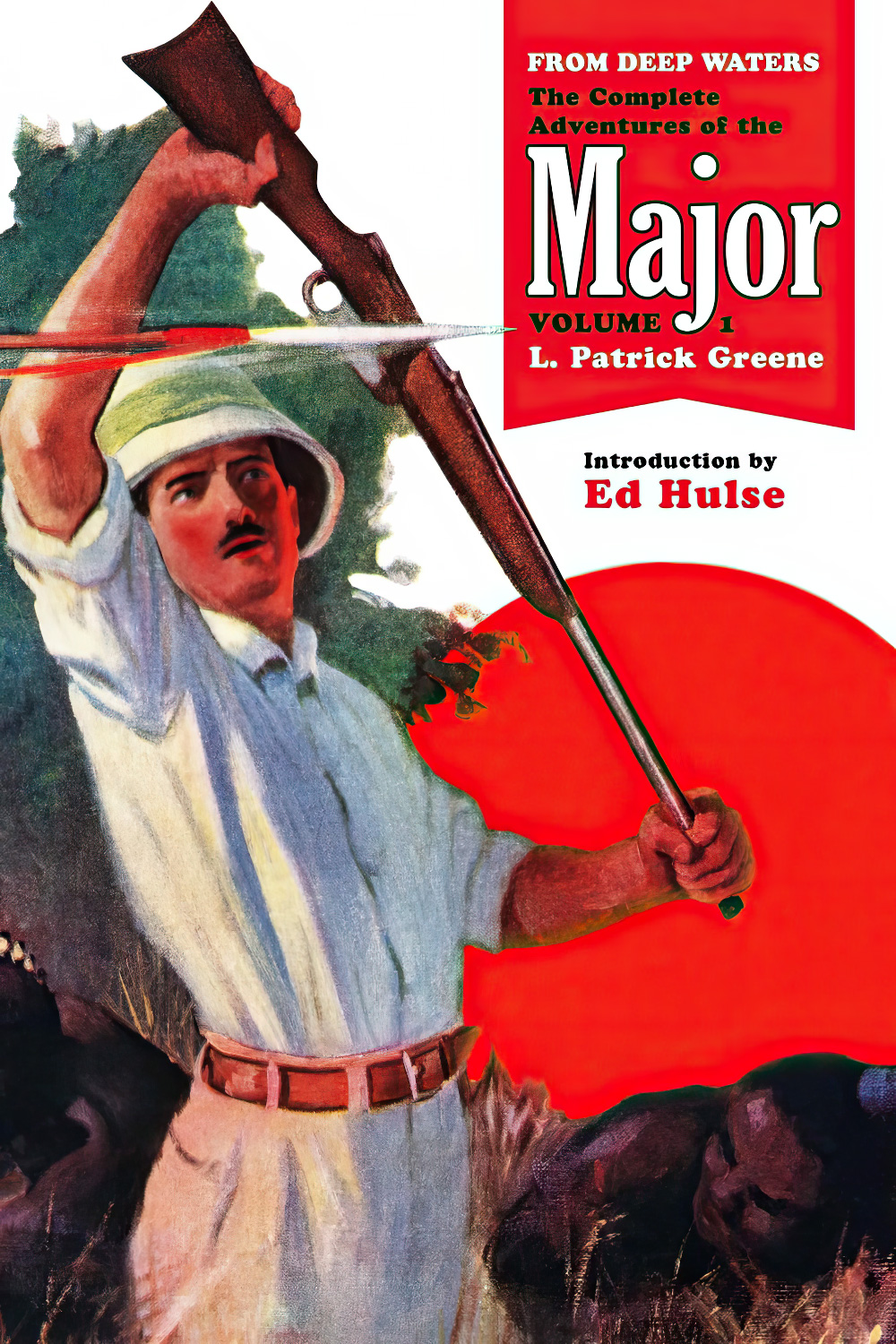
Volume 1, subtitled From Deep Waters, has the first 12 stories, with illustrations. It also has an excellent intro by Ed Hulse on Greene, as well as three additional works. One is on “South African Terms,” I assume by Greene, but I’m not sure of the source. Next is a collection of correspondence from Greene on the stories, taken from Adventure, which was common there. Third is an article on writing short story series by A.H. Bittner from Author & Journalist in 1925, included as it makes use of Greene’s stories as examples. Bittner was an editor at Short Stories for a period. One thing I discovered in reading these in order was that several secondary characters appeared more than once, so this is a series you do need to read in order. In several of the earlier stories, he has to deal with a crooked policeman, later ex-policeman, named “Dirty” Norton, whose schemes might have led to the Major’s death.
The first story, “No Evidence,” is a good intro to the Major and his character. He is hauled before a judge for illicit diamond buying, but then the two policemen can’t find the diamond he apparently bought, so he is freed. Then the Major is told of an opportunity to obtain diamonds from a local chief if he brings him a machine gun to sell. But selling guns to the natives is also illegal. But he heads out, has an encounter with a Boer trader who is pretty despicable, before getting to the chief’s land. But the two policemen have followed him, hoping to nab him for gunrunning. Things don’t go quite as some had hoped, but of course, the Major gets away scot free.
The second story, “Two of a Kind,” gives a hint at a sort of “origin” to the Major, why he does what he does. We met a corrupt mounted policeman, “Dirty” Norton, who is working with another crooked character. They hope to trick another man, whom they think is the Major, and frame him for illicit diamond buying. We are also told that a new regional police chief is honest, making things difficult for corrupt police. Things seem to go well for their scheme, only to have the Major swoop in and take their diamonds. It seems their mark isn’t the Major, but the new regional chief. After all the dust settles, the chief tries to recruit the Major, to no avail. But maybe the Major has a new friend with the police.
The third story, “Lines of Cleavage,” shows us the respect the locals hold for the Major when he is approached by a local native chief, Mangwato, who doesn’t care for white men. He asks for the Major’s help in protecting some of his people, especially his son, who are returning from working in the mines, from being robbed and maybe killed by evil white men. In a secondary storyline, the Major helps two women get out from the thumb of a blackmailer. This element of chivalry is part of his character.
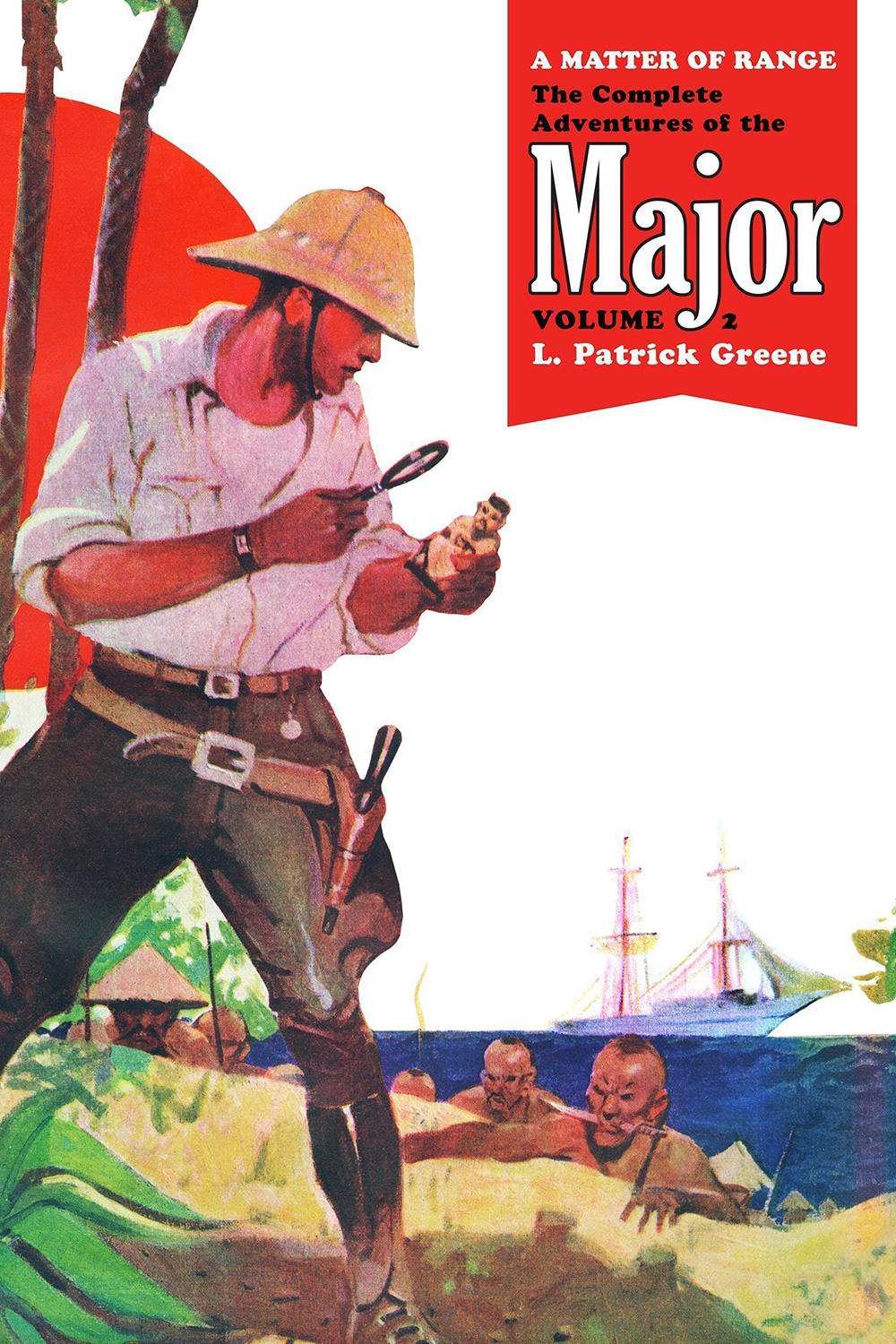 Volume 2, subtitled A Matter of Range, has the next nine stories, plus a bonus Greene story. In the first story, the Major gains a new horse, named Satan. This happened when the wife of a young policeman tricked the Major, forcing her husband to take him in. She hopes for the reward money so they can buy a farm. But on the way, the two men are attacked by a pair of lions. The Major is able to kill the two lions and save the policeman, who has been injured. Taking the man home, the wife regrets what she did and gives him the horse.
In another, we learn that Jim is really Mytata, the son of a chief. When his father died, his younger brother wanted to be chief, and so to avoid a conflict over the chieftainship, he left his four wives. That was 10 years prior. The Major sends Jim back to his valley, where he discovers that his brother has died without a son. He works to take back the position of chief, but soon realizes it’s not worth it. Thus, he leaves and returns to the Major, to just be “Jim, his servant.” This one mainly has Jim with little of the Major.
In most of the stories here, the Major deals with a blackmailer named “Whispering” Smith. In the last story in this volume, it seems like the Major has finally defeated Smith. But I wonder if he will be back in the next volume? I will have to get it to find out.
All the stories are interesting. They are never repetitive. Sometimes the Major comes along later, sometimes he’s there from the start. In some, we start in the middle of what is going on. Several times, the bad guys get one over on the Major, but in the end, he gets out of these situations, and often it’s a close call.
As I noted, the Major is an interesting character. His relationship with Jim is more partner/friend than master/servant. There has to be a lot of trust between the two. Jim sometimes pretends to be disloyal or the like to trick the bad guys, or allows the bad guys to think they have plied him with booze to loosen his tongue. The Major never punishes Jim, and there have been times were he has had to nurse Jim after some injury or illness. And Jim has done the same for the Major.
The Major is respected by the locals and is a friend to many of them. This is one way you know the difference between him and the other characters, especially the bad ones. His only “criminal” activity is buying diamonds from the locals, but he opposes all other crimes. Some police do come to trust him in that regard, as at least the honest police see illicit diamond buying as more of a political matter than a criminal one. Plus, he has several times gotten some of them out of a tight situation.
Clearly, he was a popular character to last as long as he did. In these stories, the bad guys are almost always white men, usually Boers, who often mistreat the natives. Keep in mind Greene’s past career of working in the area himself.
I enjoyed these stories, but as with all of these short story series, it’s best to read these works in between other works, and not all in one sitting. They are fun stories, and it’s always interesting to see how the Major turns the tables on his foes and tweaks their noses in the end.