

Well, it’s nearing the end of July 2026, and coming up, we have this year’s PulpFest along with a new issue of The Pulpster, the convention book, now up to #35. This year, it runs 72 pages, many in color. And this will be my fourth time attending the event.
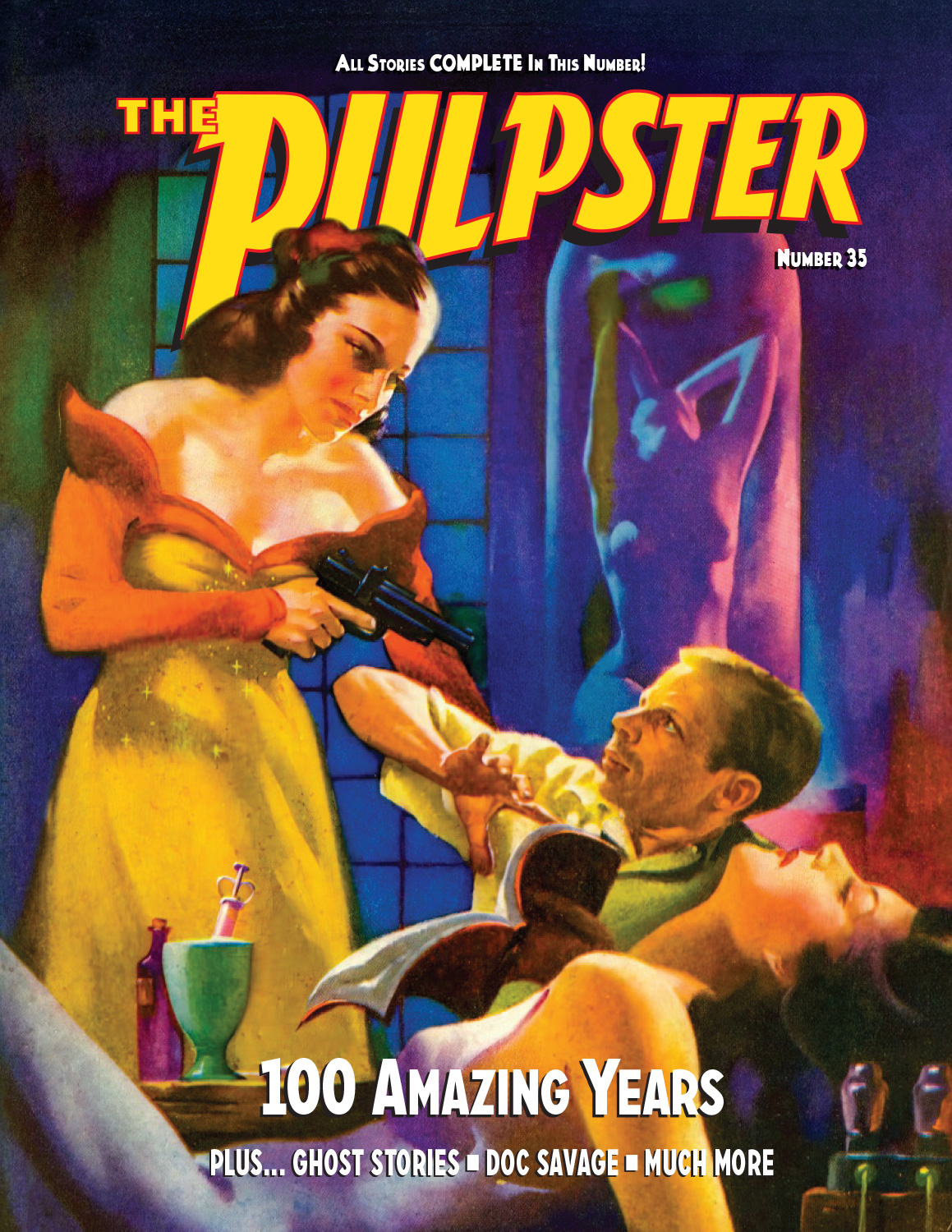
The focus this time is on three anniversaries: the 100th anniversary of Ghost Stories, the 100th anniversary of Amazing Stories, and the 130th anniversary of the pulps, with the publication of the first all-fiction number of The Argosy. And this year’s PulpFest also includes Doc Con, FarmerCon XXI, and, for the first time, The Shadow Con. That should be cool.
For those not aware, Ghost Stories was published by Bernarr Macfadden, who mainly focused on “physical culture” magazines. But Ghost Stories was a true-confessions magazine about, well, ghost stories. This was a genre that Macfadden created when he launched True Story Magazine in 1919. We get two articles looking at this magazine. The first is from pulp researcher Will Murray, who tells us how this confessions magazine turned into a pulp. The other is by David Walker, who delves deeper into the stories that ran in it and how they compared to works in other pulps of the time.
While the pulps had included science-fiction stories, it was with the launch of Amazing Stories by Hugo Gernsback that we finally got a magazine devoted to science fiction. But one of its most controversial episodes was the introduction by editor Raymond A. Palmer of the “Shaver Mystery,” bizarre stories pitched as being true accounts of strange and sinister underground inhabitants called deros.
Jeffrey Shanks examines the whole thing that still has people talking about it today. He tells how Richard Shaver‘s letters to Palmer turned into a series of stories and a whole phenomenon created by Palmer that might be the foundation of the UFO craze. This is a pretty good introduction to it all. And Tony Davis has an interview with Lloyd Penney, the current editor-in-chief of Amazing Stories, which is still being published. They discuss several topics, including where the magazine is going.
William Lampkin looks at the birth of the pulps, examining how Frank A. Munsey converted his magazine The Golden Argosy into the pulp-paper magazine The Argosy. This was a success for Munsey and launched the pulp magazine field, soon replacing the story papers and dime novels.
Rounding out the issue are several more articles, most on pulp authors. Will Murray tells of looking into the career of Vaughn Bryant, after reading a letter from him in Writer’s Digest. It appears he only wrote two stories for the pulps, mainly being a journalist. He’s probably not the only one whose pulp career turned out that way. Tony Davis looks at the career of artist Emmett Watson (1893-1955), who went from the slicks to the pulps and back again. The article is based on an interview with his grandson. He did both covers and interior work. Illustration magazine did an article on him in No. 91.
John C. Bruening looks at Richard Matheson‘s career from pulp author to film and television writer. Matheson is known for such works as I Am Legend, The Last Man on Earth, The Incredible Shrinking Man, and more. You may be surprised at all that he did. Michael Chomko tells us about Franklin Martin, a war hero who became a pulp author, though his pulp career only lasted from about 1931 to 1941. Craig McDonald examines the possible connections between Ian Fleming‘s Dr. No and Lester Dent‘s Doc Savage adventure “The Fantastic Island.”
As always, we get the “Final Chapters,” which notes the passing of several pulp-related people, including Ted White, author and editor, and past Guest of Honor at PulpFest, and Patrick Lucien Price, a former editor of Amazing Stories.
Again, editor William Lampkin and publisher Michael Chomko have put together another great issue. I always look forward to getting these each year. Even if you aren’t able to attend PulpFest, The Pulpster is worth obtaining.


Add Comment