The artist holds nothing back when talking about other artists, both classic and contemporary.
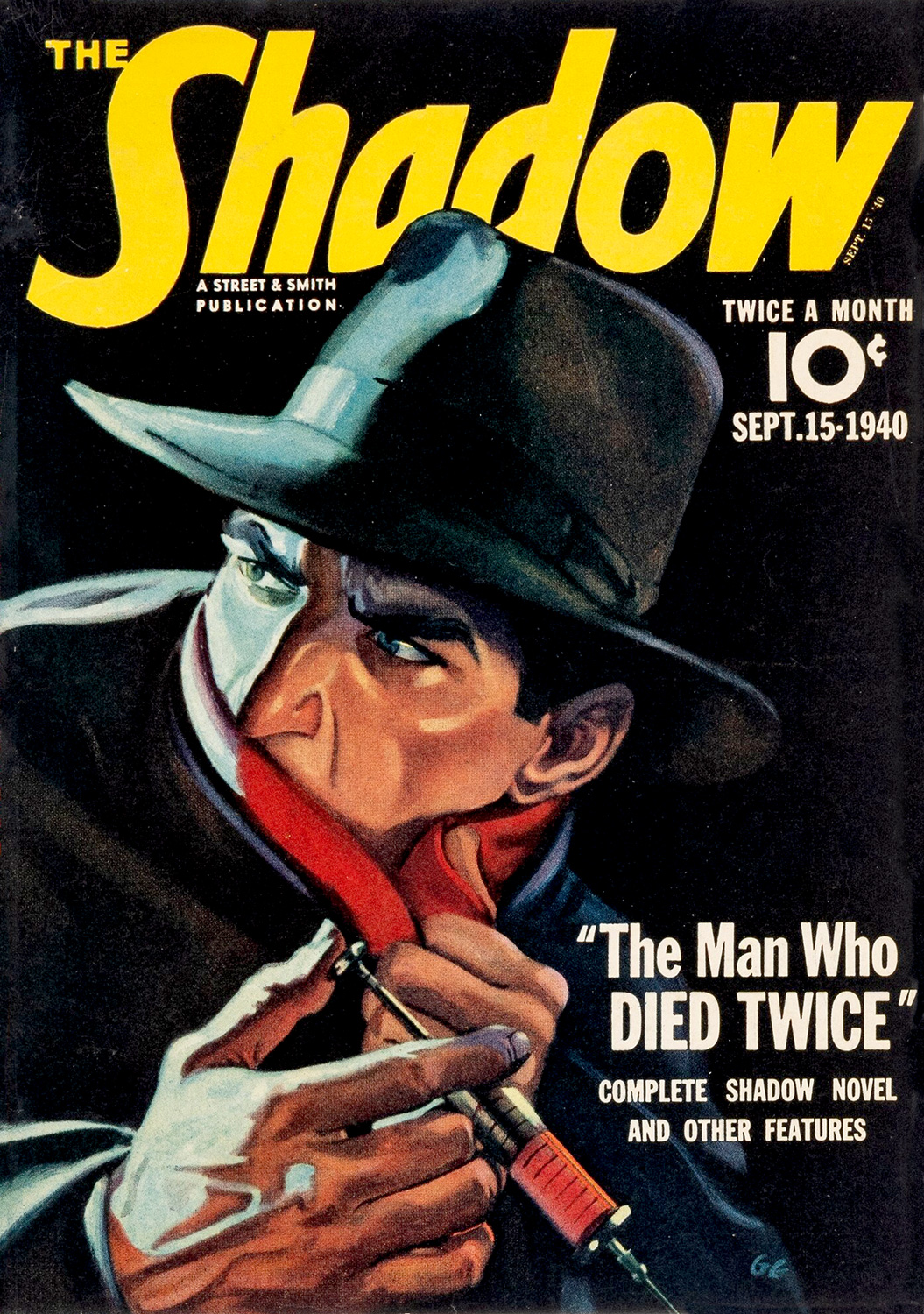
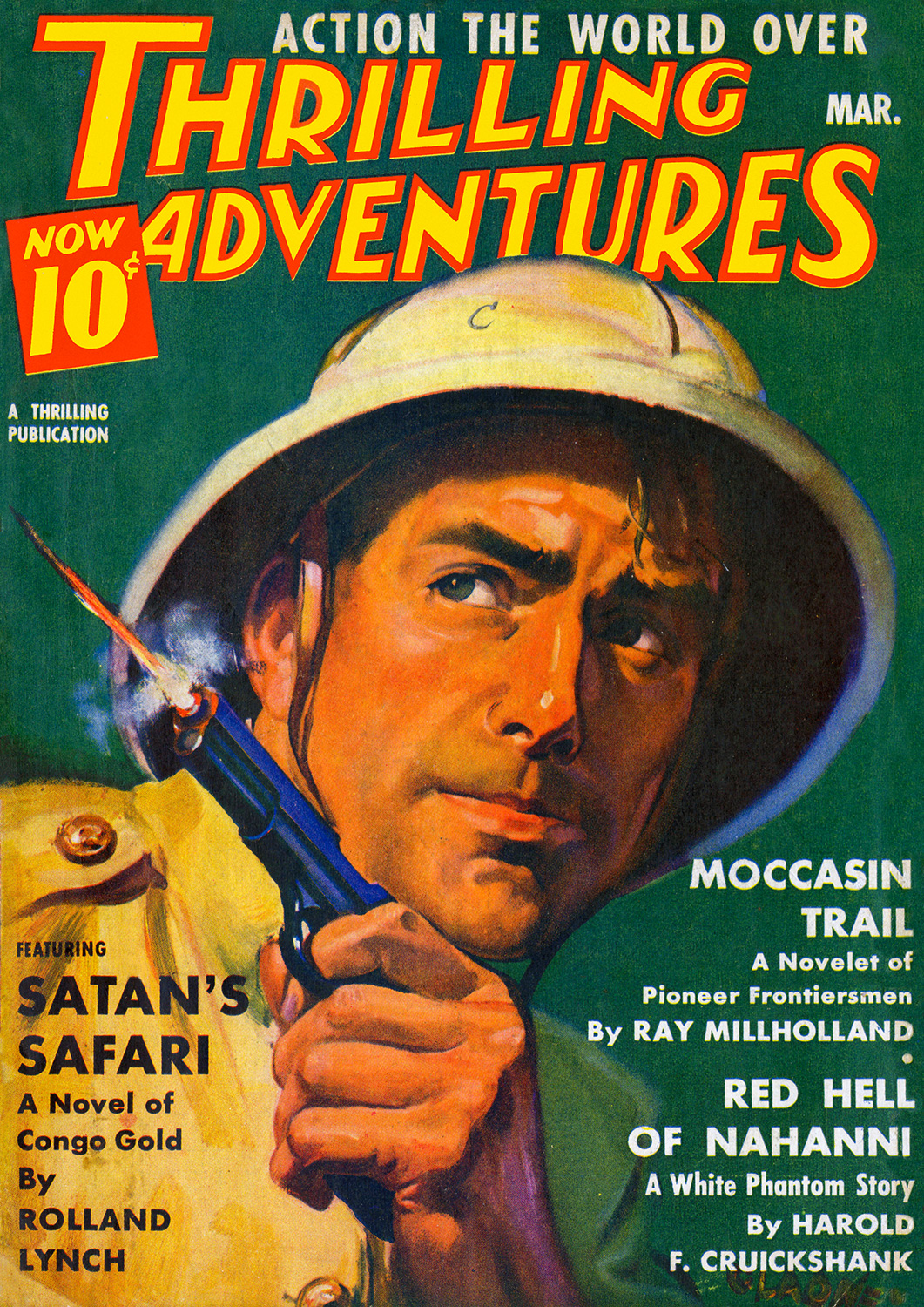
Graves Gladney painted some of the most iconic covers for The Shadow. He produced 62 covers between March 1939 and Sept. 15, 1941.
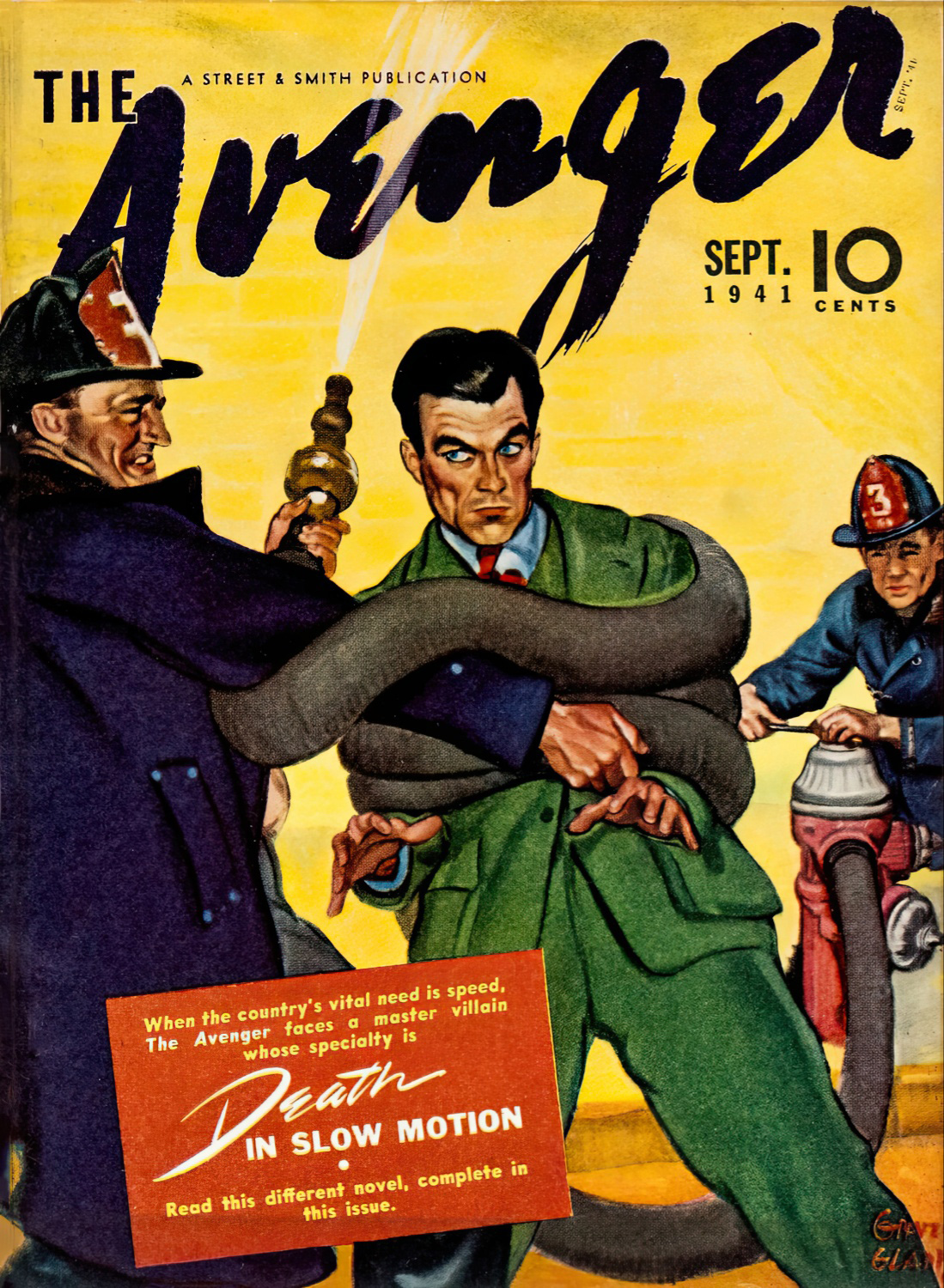
During his relatively brief career in the pulps, Graves Gladney also created covers for Lariat Story Magazine, for Fiction House; Adventure and Dime Mystery Magazine, for Popular Publications; and Astounding Science-Fiction, The Avenger, Clues Detective Stories, Crime Busters, Street & Smith’s Mystery Magazine, Street & Smith’s Sport Story Magazine, and Unknown, for Street & Smith Publications.
A few years before his death at age 68 in early 1976, two pulp fans — Terry Klasek and Kenn Thomas — visited Gladney at his home in Clayton, Mo., just west of St. Louis.
After their initial interview, the pair met with Gladney once more to resume their talk. The discussion continues below.
Q: Many times, the covers you painted are reproduced in pulp history hooks and other magazines. Do you receive any royalties for these reproductions?
Graves Gladney: No. By original contract, I should get second and third rights any time any of my work is reproduced, but I realized long ago that this is strictly an empty clause — a meaningless promise. Since it’s been some time since I needed the money, I don’t really care. The thing I object to more than anything else is that I have seen several of my covers re-worked and reversed, published under another title. Fortunately, my name is never associated with it, but this stuff is grossly inept and coarse.
Fanzine flashback
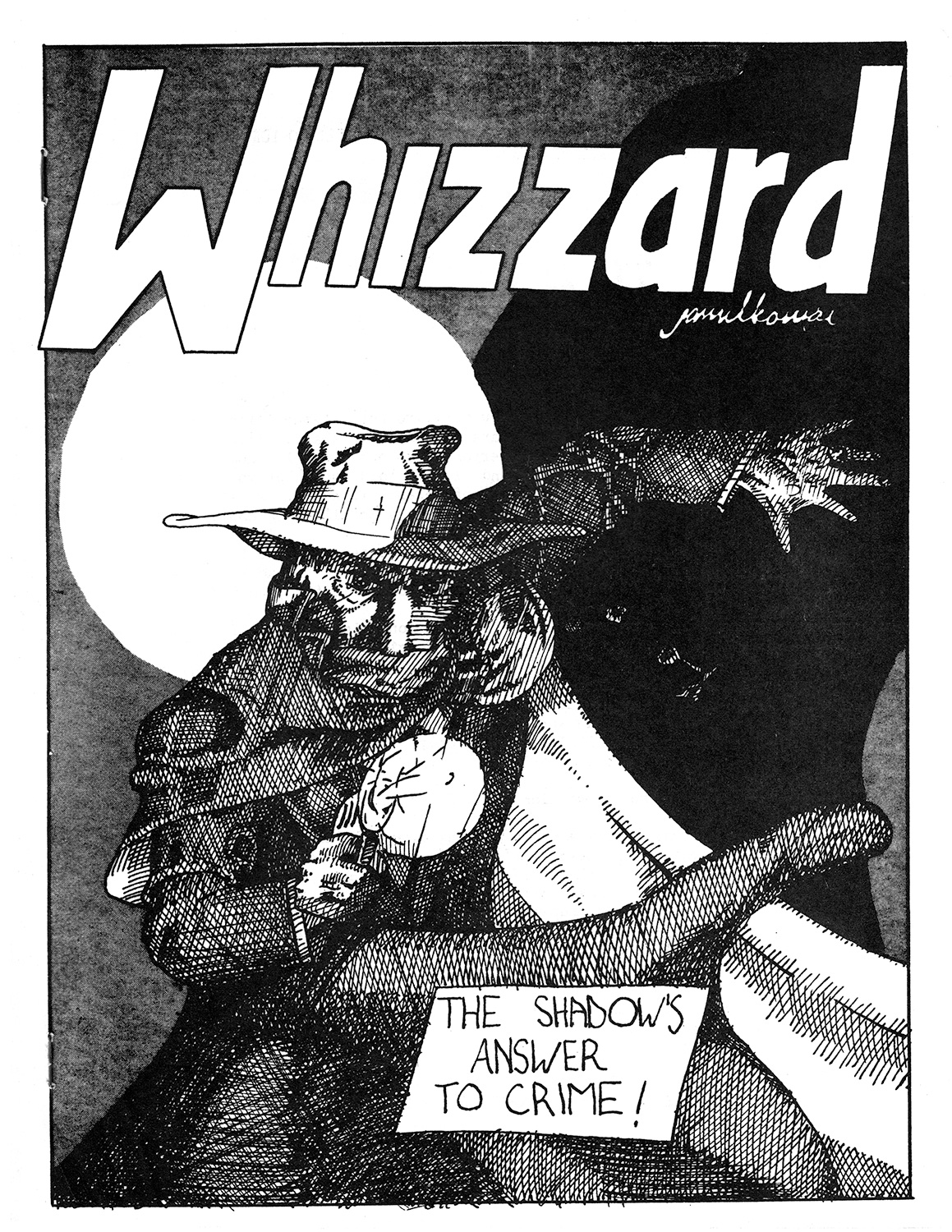
This interview originally appeared in three parts in the fanzine Whizzard. This portion of the interview appeared in Whizzard (No. 8, Winter 1976). It has been edited and corrected.
Q: Do you own your own paintings?
Gladney: The ones that I have here in the house, I should say about 25 or 30. I have given as many away to relatives or friends. Of course, I own them, but as a matter of fact, back before Pearl Harbor, I bribed a custodian of the stock room of Street and Smith to let me steal my own paintings. I got as many as I could, which was about 50, and I sent them out to my sister, here in St. Louis. She had her own rathskeller, and she decorated it with a number of old Shadow covers. She regarded it as quaint.
To me, it is a constant irritation that people know nothing about the quality of the painting, whether it is good or bad, only the subject matter. Naturally, the subject matter of pulp paintings is a focal point of derision by most people. Nevertheless, all of us painted as well as we could; the subject matter made no difference.
Q: Do you still paint in your free time?
Gladney: I paint a great deal. I do not show it anymore for the simple reason that, to me, the word “art” is a nasty word. There are so many completely incompetent fools that are now painting. The stuff that they paint is unrecognizable, a pastiche, the work of completely inept painters who have somehow become famous through unscrupulous or ambitious art dealers. In short, I don’t want to be associated with the notion “art world.”
While I still paint, there is no point in showing or talking about my paintings to anyone. I have some ex-students who are now successful painters, making a living at it, who come and ask for criticism, advice, or help. This I give because I consider instruction a reasonable field of endeavor. If anyone is smart enough to see what I have to offer and I am able to help them, I am glad to do so.
The plain fact of the matter is that most of the so-called painters could not tell Rembrandt from a house painter, so I never bother with them at all.
Q: You are talking, perhaps, about abstract artists?
Gladney: As I have many, many times told my students, there are only two kinds of art, good and bad. There are many shades in between. In the good art, some of it is superb, some is good, and some is merely competent. But it is all respectable. Whereas, in the bad art, it stems from people who want to be something, rather than do something. They get a baseball cap and spend $10 for brushes, and immediately they are artists with a big capital “A.” This sort of stuff really makes me angry and ill at the stomach.
Q: Would you care to be more specific, talk about Picasso perhaps?
Q: I heard somewhere that Picasso was quoted as saying it took him 60 years to learn how to draw as a child.
Gladney: That’s about right.
Q: Could you pinpoint one artist who has influenced your work the most?
Gladney: Oh, a lot of them. Naturally, my tastes are extremely conventional and conservative. I think that the first painter I was really struck by was Velázquez, a Spanish painter. And of course, Rembrandt. Among the American painters, I have always been extremely fond of Thomas Eakins, who lived in Philadelphia, born in 1844 and died in 1916, a very fine painter, one of our best.
Q: In our previous interview, you mentioned that a few painters had pointed you in the direction of pulp painting. Who were they, specifically?
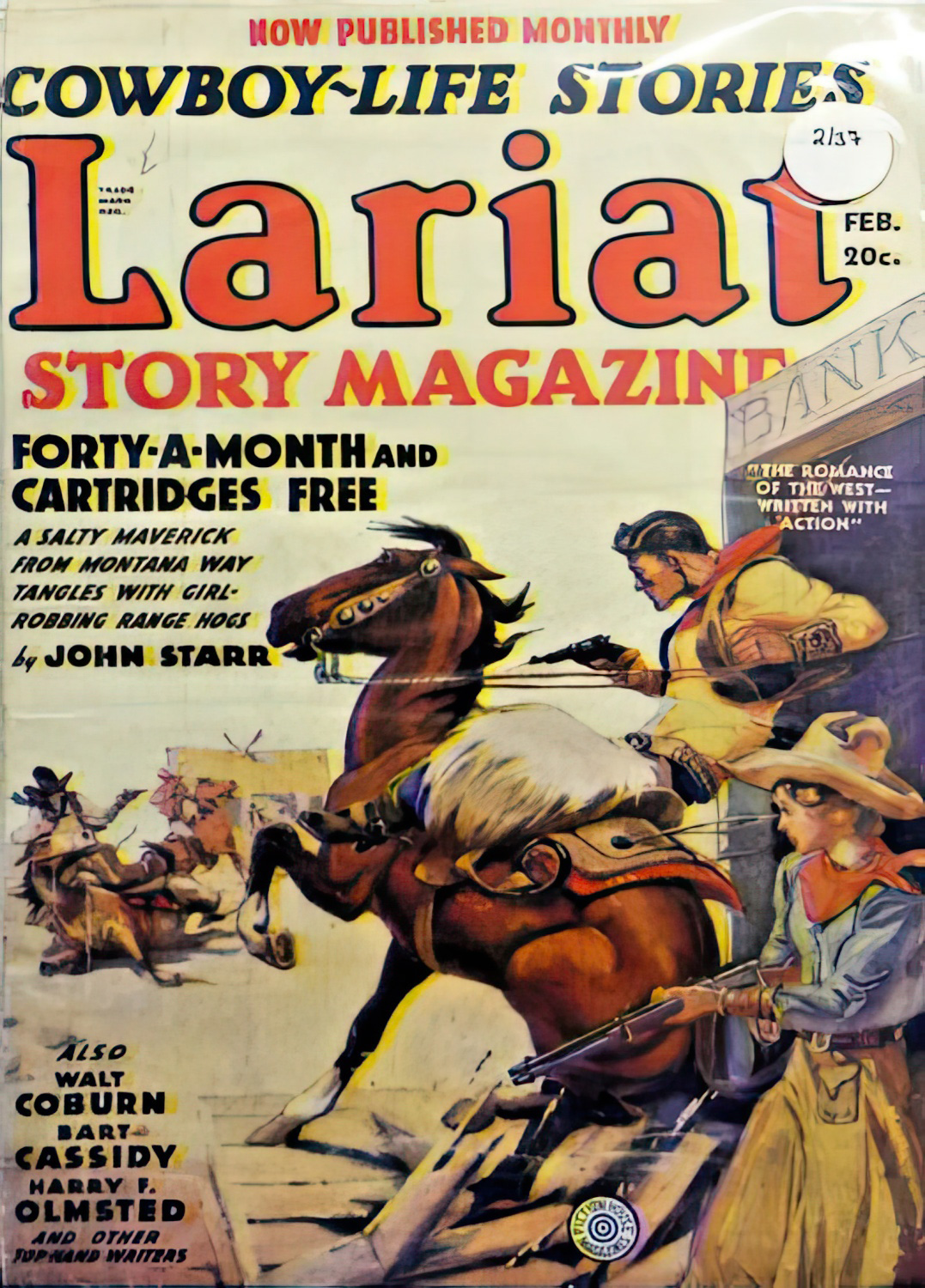
Following their advice, I went back and, laboriously and with much fear and trembling, I produced a western cover which I sold to Fiction House for their magazine Lariat. I painted that cover in December of 1936. That was the start of it. After that, I began to make similar thrusts at Popular Publications, which was run by Harry Steeger. I began to sell them covers. Not as many as I would like to have, but it was hard going, and Steeger himself was a no-good, sunnuva bitch.
Q: May we quote you on that?
Gladney: You may indeed. He ran Popular Publications poorly, and why somebody at the time did not kill him is beyond me. But that’s a long story. That opinion, incidentally, is not only mine.
It is shared by almost everyone whoever worked for Harry Steeger. One of the big artists for Popular Publication was Walter Baumhoffer, who is a helluva competent painter. Steeger, who knew nothing at all about painting, just fell all over himself about Baumhoffer, but literally abused anyone else. He had a lot of other good painters who sort of got the crumbs off his table. Baumhoffer got every consideration.
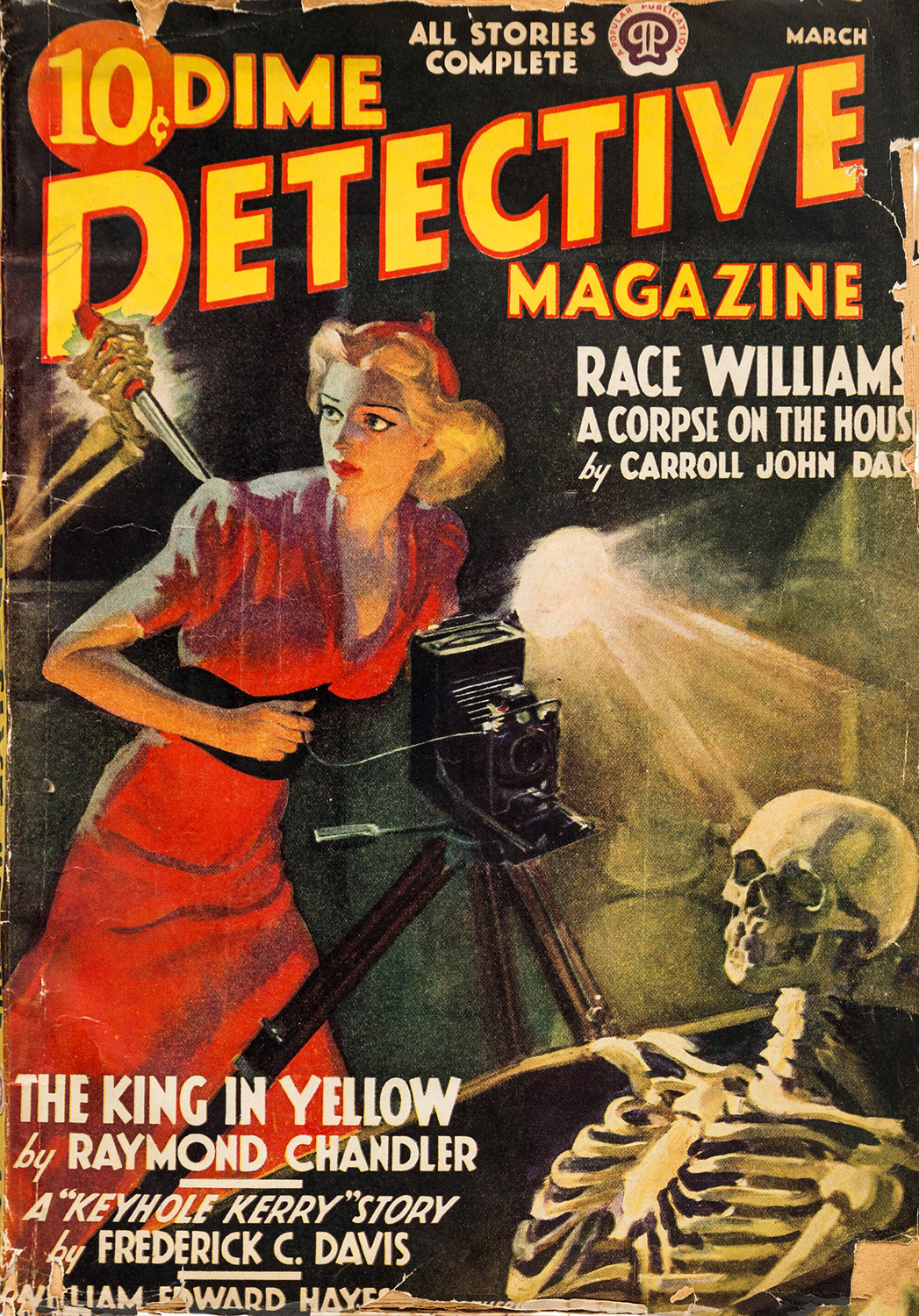
with a cover by Walter Baumhofer
However, [Harold] Goldsmith, who was his partner, and a very good friend of mine, a man whom I admired greatly, Tom Lovell, who also painted for Popular Publications, got along fine. Goldsmith told Steeger to keep his cotton-pickin’ hands off of Tom Lovell’s stuff or he’d be in real trouble. So Lovell never had any trouble down there at all. Steeger wasn’t allowed to open his yap.
Emery Clarke, another friend of mine, worked for Steeger and hated him almost as much as I did. To give you an example: One of Steeger’s editors called up on Friday and said, “Clarke, we’re missing this cover, the man that was supposed to do it didn’t finish it. If you can do the cover and get it in here by Monday, we’ll pay you double.” Emery said, “Oh boy,” and beat his brains out painting all day Saturday and Sunday, staggered in there Monday morning with the picture, put it on the easel, and the editor said, “Well, I see you’ve got another stinker.” Simply because that in the interim Steeger had changed his mind. The editor himself was just a “yes” man, no use getting angry with him, no more than you would at Charlie McCarthy.
Q: Then the Lariat cover was the first pulp cover you ever did?
Gladney: Yes. I sort of blush when I show it now. It was alright, a typical thing of a cowboy and a cowgirl escaping unknown danger, firing backwards, with a background of mountains.
Q: You weren’t too particularly fond of western pulps, were you?
Gladney: No, because they’re so god damn phony. I’ve been shooting and hunting all over the world, handling firearms all of my life, and the average pulp cover has no atmosphere, reflects no reality to it at all.
One of the essentials of good writing or painting is to present a good atmosphere. Like Sir Arthur Conan Doyle’s Sherlock Holmes, those that have been to England know that the atmosphere was perfect. You can see Sherlock Holmes venturing out into the night, with the soft rain falling. The western pulps had none of this at all.
Bob Harris, who did a helluva lot of western covers, was never west of Kansas City. A horse? He couldn’t tell a horse from a four-cylinder motorcycle. Yet he wore a big cowboy hat and boots down to Street and Smith.
Q: Did you have any trouble with the atmosphere of The Shadow?
Gladney: It’s hard for me to say. Because when you talk about The Shadow, you have to realize that when I got The Shadow contract, it was almost like stepping into a financial heaven. It meant that I would earn $5,000 or more a year, which in 1938 was a considerable amount of money.
So I attacked the job with almost religious fervor. As a matter of fact, with religious fervor, I had no religion. I did the very best I could. I’m ashamed to say that I got on my knees to sell my paintings. A conscientious artist should not be subjected to criticism by the likes of Flynn, Sniffen, or Nanovic. I should have punched one of them in the jaw and said to hell with it.
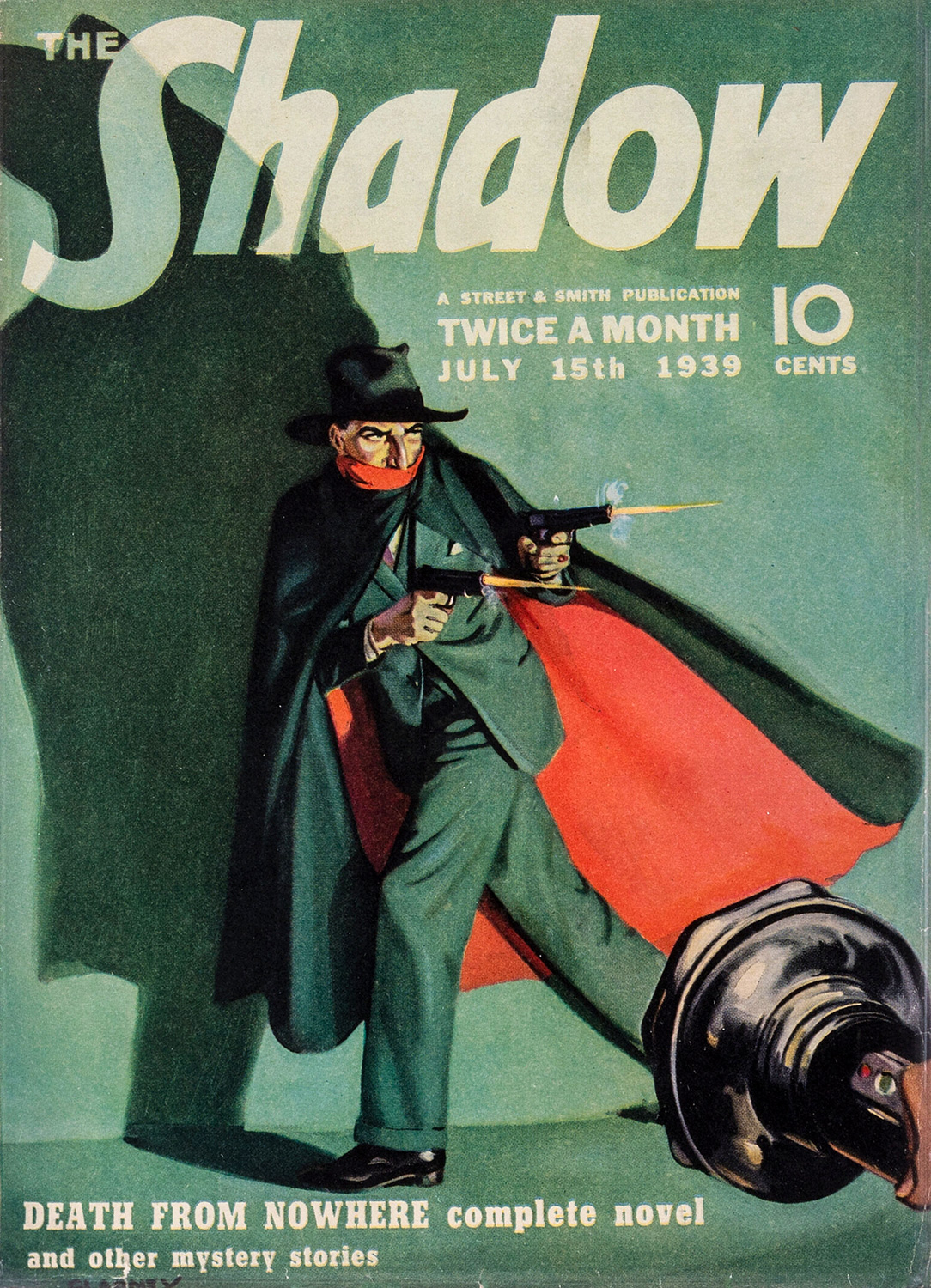
Gladney: Actually, it wasn’t as bad as all that. It is never difficult to work for somebody if he knows what he wants, and as a rule, they did. Now, what they wanted was sometimes childish to an extreme.
As for the atmosphere of The Shadow, after the first year, I hired high school kids to read them and give me a synopsis. I, frankly, can’t stand the junk.
Q: What about today’s “pulp” paperback artwork: James Bama’s Doc Savage, George Gross’s The Avenger, and Jim Steranko’s The Shadow?
Gladney: In my day, nobody started off with the idea of painting pulp covers. Nobody knew what it was. The pulp painters were graduates of good art schools and men who were trying to be good painters. Now these men are obviously trying to imitate the results of these former painters without the experience or the skill.
Q: Then you don’t particularly care for these covers?
Gladney: I don’t dislike them, but they fall into the category of extremely hack, uninspired work.
I could literally, impersonally, lecture for an hour on what is wrong with this stuff. Some of the things are right. For example, this one [referring to The Avenger #28, “Dr. Time,” Warner Books, 1974] is extraordinarily conscientious. It is a very capable copy of a photograph. This man doesn’t leave enough of a trail of his personality in what he does.
Q: What do you say about Mr. Steranko’s rendition of The Shadow?
Gladney: This [referring to The Shadow #1, “The Living Shadow,” Pyramid Books, 1974] is a careful, rather crude copy of one of Rosen’s many [covers]. Rosen, the original one to ever paint The Shadow, was a conscientious man but strictly a commercial artist. His ability was unmistakable, whereas this man has copied all of Rosen’s bad points and left none of the good. He’s gotten the strong reflected lights and the hair’s strong edges characteristic of Rosen’s work, but without really understanding what was going on. He’s trying to satisfy his employers but doesn’t really have a helluva lot of talent.
Gladney: In the late ’30s and early ’40s, I knew almost all painters of consequence in and around New York City. Originally, most of them lived in New Rochelle, but Rockwell moved to Vermont.
You needn’t put it in the past tense; he’s not dead yet, so far as I know.
Q: How do you evaluate his work?
Gladney: He is an extremely able painter. The most melancholy thing about Rockwell is that he is what I would call a “sore-toe” artist. Human Interest. He wants to make a little boy with a tooth missing, a bandage on his toe, fishing with a bent pin, with a long string of fish, and over there would be some fathead with a million dollars worth of equipment and only one little fish. Technically, Rockwell is a helluva painter. He’s kinda gone downhill because, I think, he’s lost his urge. He has done everything, made all of the money he has ever wanted. His pictures require a tremendous amount of effort. He has a passion for detail, authenticity, and quality. Rockwell is a very able, able man.
The thought that I would like you to walk away with is, to quote Shakespeare’s Macbeth, “I neither beg your favor nor fear your scorn.” I no longer care what people think about my work. I am a good painter, but so few people know what that means.
Their interview with Gladney continues in “Gladney on his covers for The Shadow.”
About the authors
Terry Klasek and Kenn Thomas were longtime pulp fans. Klasek died May 14, 2011, at age 64; and Thomas died Sept. 22, 2023, at age 65.