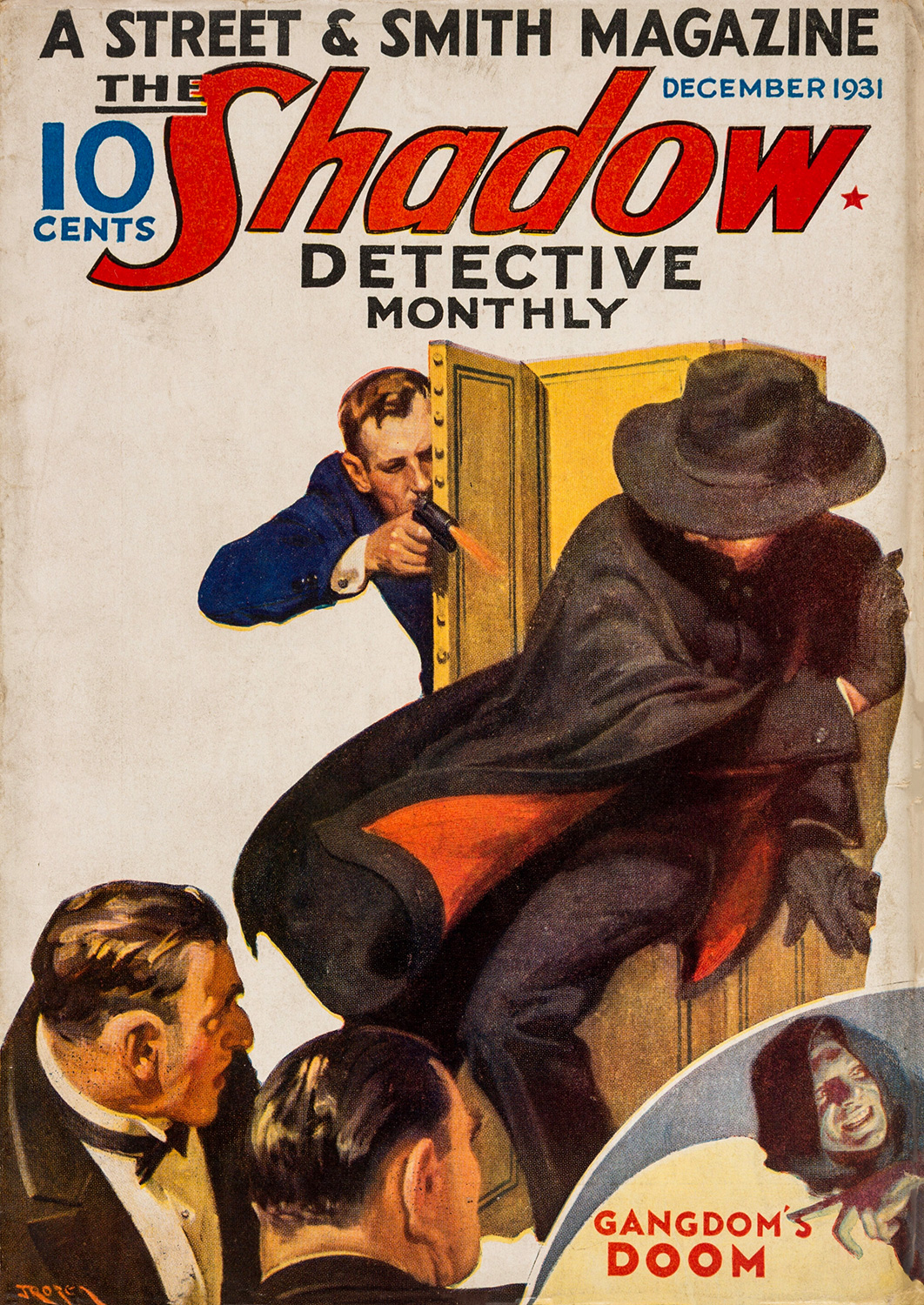
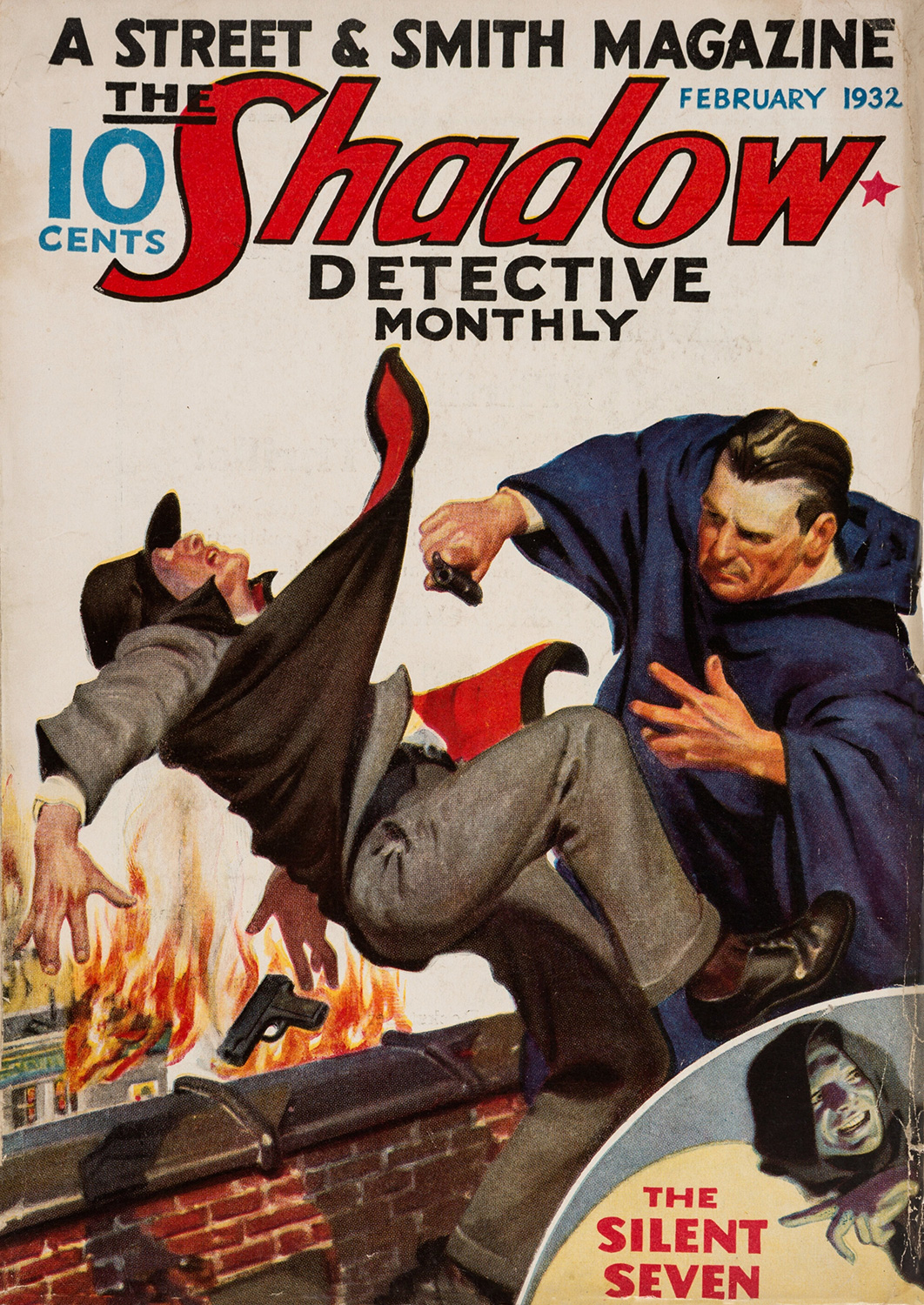
This Rozen twin introduced pulp readers to the first familiar image of The Shadow.
I had been to Pulpcon many times and met a number of remarkable people, some of whom I like to think of as friends. I categorize Tony Tollin in this class.
Tony had been after me for several years to commission Jerome Rozen to do a cover recreation for me. But ol’ cheap Tonik could not see spending that much money. I have seen several paintings sold by dealers and resented the fact that none of the profits ever went back to the original artist. So finally, I let myself be talked into ordering a painting from Jerome Rozen, realizing that all the money was going to one of the great pulp magazine cover artists.
Now came the tough decision: Which cover of The Shadow did I want? Since I had no Shadow magazines, I went through all the books and fanzines with cover reproductions. Finally, I settled on the cover for “The Whispering Eyes” (Summer 1949), since it was the last cover (and of some historical interest), and it featured a cat (and I have had cats for most of my life), and it was immortalized by Frank Hamilton in Duende #2 in 1976. The original cover had been painted by Jerome’s twin brother, George.
I was told in September 1983 that I could pick up my painting by driving to the home of Jerome Rozen in Englewood, N.J. I did, and I was delighted, not only with the beautiful recreation but in meeting the wonderful Jerome Rozen and his gracious wife, Doris. It was such a great visit that I returned several times since then.
Fanzine flashback
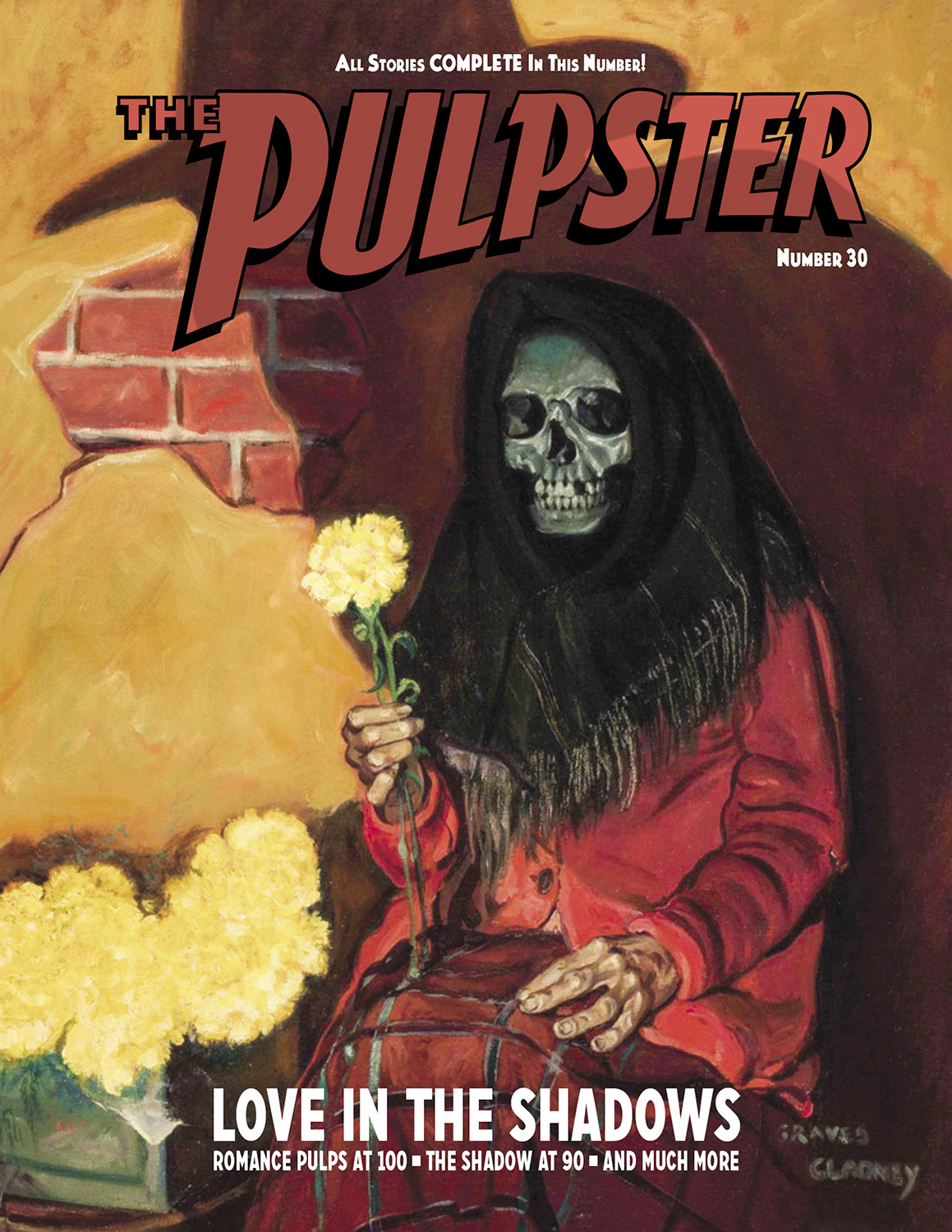
This interview appeared in The Pulpster (No. 30; August 2021). A version of this interview appeared in The Pulp Collector (No. 9; Summer 1987). It has been edited and updated.
Pulp Tales
Listen to this interview with George Rozen conducted by Al Tonik in 1983. It’s the first installment of The Tonik Tapes in the Pulp Tales podcast.
Jerome might have been an octogenarian, but he had a sharp and quick mind. He may not have been able to walk without the use of a cane, but he got out to his studio (a converted garage behind his house) and painted up a storm.
His sparkling personality has been stilled forever. [Jerome Rozen died July 10, 1987.] But on Tuesday, Sept. 27, 1983, I persuaded him to talk into a tape recorder. So, his voice is still with us.
Here is what he said, along with Doris and Helen, their resident housekeeper.
Doris: We’ve done this before, I don’t know how many times.
Q: You have been written about before?
Jerome: Yes. I have had a few.
Q: Would you like an article about yourself in a pulp journal?
Jerome: It wouldn’t make any difference to me.
Q: When were you born?
Jerome: (Laughs) Three o’clock this morning. No, I was born in 1895, believe it or not.
Q: Where?
Jerome: In Chicago.
Q: You were an identical twin with George?
Jerome: Yes. His name was George Jerome, and mine is Jerome George. That made it sticky.
Q: Which art school did you attend?
Jerome: Art Institute of Chicago. I taught there for a while. Before that, everybody shows you some technique. A man by the name of James Swinnerton was the one that really got us going. He used to draw “Little Jimmy” in the newspapers. He lived in the Weatherford Hotel in Flagstaff [Ariz.]. We got acquainted with him. We used to sketch together. He introduced us to a new paint color I had never seen before, called Maratta. You can’t buy it anymore. It gave all kinds of grays. It was very handy. We liked it.
The Rozen Brothers
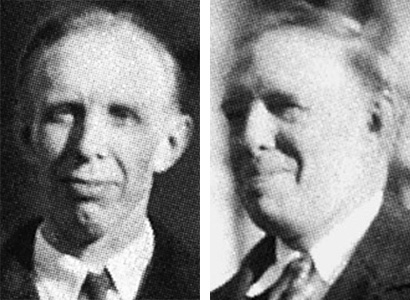
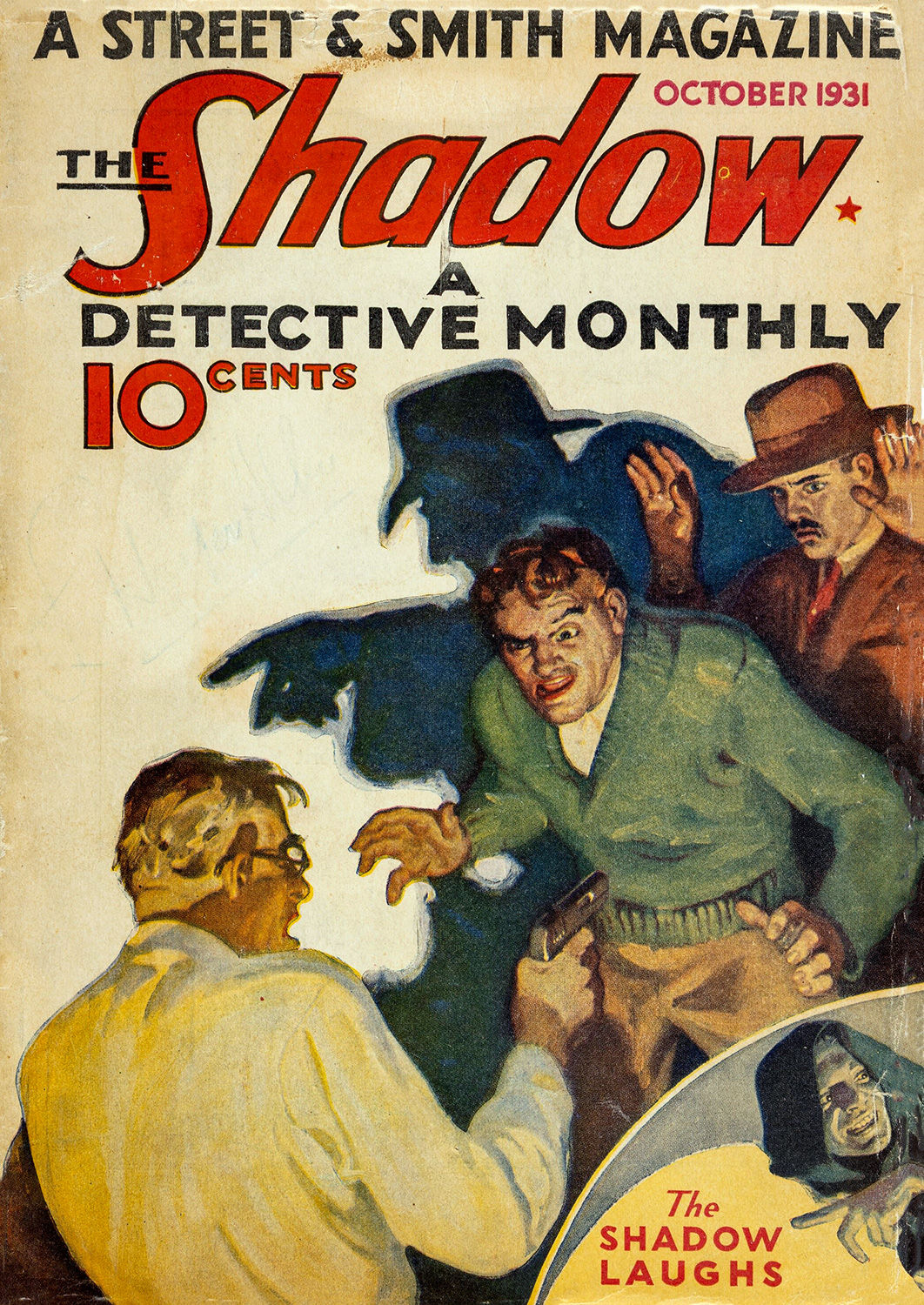
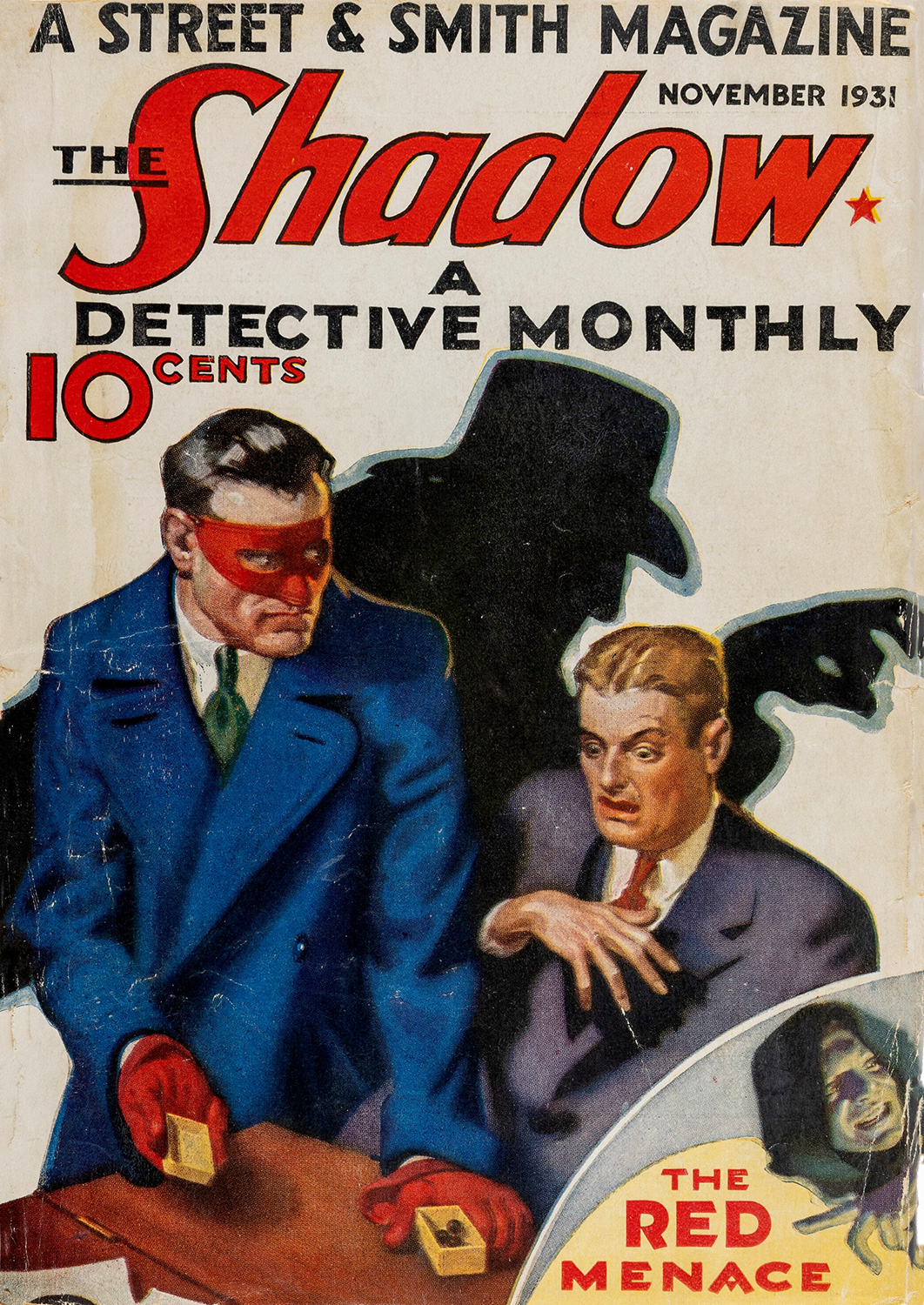
Jerome Rozen painted four of the early covers for The Shadow that were the first numbers of the magazine that didn’t use reprinted artwork: October, November, and December 1931, and February 1932.
His twin brother, George Rozen, replaced him as the cover artist for The Shadow in 1932. George Rozen’s covers appeared during several periods: January 1932; March 1932-March 15, 1939; Oct. 1, 1941-July 15, 1942; Aug. 15, 1942-Dec. 15, 1943; Jan. 1, 1943-Feb. 15, 1943; and Fall 1948-Summer 1949, for almost 200 covers of The Shadow. He also painted covers for the first two Shadow Annuals (1942 and ‘43), and his artwork was used on the first six issues of Shadow Comics.
Q: Did you and George both start in commercial work at the same time?
Jerome: It went like this. George was the manager of Western Union in Flagstaff. They had a repeater station. He gave that up when he went into the Army. He was stationed somewhere in Michigan. I went to the Art Institute. He got the idea when he got out, and he tried the same stunt, studying art. He went to the Art Institute in Chicago one year behind me.
Q: Didn’t one of you go to the Pratt Institute? Walter Baumhofer said he was in the same class with one of you.
Jerome: It must have been George, not me. George did a lot of things. I studied sculpting at night. That was not much of a school. I sculpt out of clay and cast in bronze.
Q: You said you were in France during World War I.
Jerome: Yes. I was in Langres, France. I was a soldier and in the trenches, but not at the front. I was on my way up there when they pulled me out and sent me to officers’ training school at Langres. While I was there, my outfit was sent to the front, and they got badly shot up. I lost a very dear friend, Mark Moore, from Flagstaff. When I got out of there, I went to Bordeaux. I was taken back to America on a warship. We went over there on an old freighter.
Q: You said you were born in Chicago and went to Flagstaff, but attended art school in Chicago. When were you in Flagstaff?
Jerome: There were many trips back and forth. The first trip to Flagstaff was when I was 4 or 5 years old. I don’t know exactly. It was very early in my life. We did not stay there very long. I had a brother, and they thought that would help his health. But he passed away, and we came back to Chicago. But from then on, we went back and forth.
Q: When did you move to New York?
Jerome: That is hard. I can’t remember that as well as older events. It must have been about 1920 or 1922. At that time, I gave up teaching. I married about that time [to his first wife, Della, who died following a car crash in 1938]. Sorry, I can’t remember when. We got an apartment in New York. That’s about the time I started working for Boy’s Life.
Q: Did you do interior or cover illustrations?
Jerome: I did both, but most were interior illustrations. They would send me a serial, and I would carry it with me when I went on my frequent trips. I would make illustrations in Chicago and Arizona, and send them in. I did that for years.
Jerome: Yes. That is how I met her, at school in Chicago.
Q: How did you go to Street & Smith?
Jerome: I used two legs.
Q: How did you hear about them?
Jerome: I looked around in magazines to see what was being done. I went to Street & Smith and talked to [art editor William] “Pop” Hines. There is still a marker on the corner of the building that says Street & Smith. Go there, you can still see it. I can’t remember what Pop Hines’ first name was. Doris, do you remember? She got to know him better than I.
Doris: No.
Q: Do you remember which magazine this cover was for?
Jerome: No.
Q: But you did do some of the early Shadow covers.
Jerome: Yes. I think they had me down for three.
Q: You did the ones with the hooded Shadow.
Jerome [who seems to misunderstand the question]: No. They had not developed into that yet.
At that time, I did a lot of searching around. I went to different magazines and got hooked up with Redbook magazine. I did a lot of illustrations for them.
Q: Was this before your accident?
Jerome: No. That must have been after. After I cracked up, I was out of painting for a long time. I was driving my car, and a big bus was deadheading back and smacked into me. My wife [Della] was seated next to me. She died. I was in the hospital for months, but I pulled through.
I paid rent on my studio all that time. My things were in there. John Newton Howitt was in the front room in that building. He had a big studio. Then Les Thrasher took over another studio. He did Liberty covers. He was next to me. There were Howitt, Thrasher, and myself.
Doris: [Harry “A”] Chessler was on that floor.
Jerome: Chessler came in later. He took over Howitt’s studio. Howitt moved into the back studio, which was a little one, when Leslie Thrasher pulled out. I think he was killed. I took over the middle studio. That is where I stayed for most of my career.
Q: When did you meet Doris?
Jerome: Where did I meet you?
Doris: Through mutual friends and other artists. We were casual friends. I was assigned a book to illustrate. I did not have a studio. Jerome invited me to use his. We had fun. We formed a very nice little group there. There was an artist, Ray Wilber, in the building next door, and a photographer downstairs by the name of Marsh. We had nice parties. It was 10 years before we were married. We have only been married for 32 years.
Jerome: It seems like a century. (Laughs)
We did a lot of traveling. We bought some land out in Arizona and were going to do something with it. We still have it. It has gone up in value.
Doris: George and Ellen [Rozen] had a beautiful home in East Williston, Long Island. They sold it and moved to Arizona. Jerome’s family is out there. They had all the plans made by Jerome’s son, a beautiful house with a huge studio. George came to the studio one day with a bunch of pictures he took out there. I have never been there. I was just carried away. I was entranced. We went there, and they showed us the ground. When Jerome saw how keen I was, he bought some ground. We were going to build studios together. But Ellen developed cancer and died. Things fell apart after that, and we are still here.
Q: Did you ever go back and do any more pulp work?
Jerome: I am doing pulp work now [reproduction covers].
All through my career, I kept all these things going. At one point, I hooked up with another concern called Carl Percy. They had window displays. I hooked into an account called Mail Pouch, a chewing tobacco. I made all their ads for over 15 years. Richard Clear had a lot of the copies in Ohio. There were tons of that stuff. I would do a pencil sketch for their approval, and then paint them. The window display was called a triptych — one center picture, flanked by two smaller ones. Later on, Carl Percy died, and I took back all my paintings.
Doris: After that, Jerome got into advertising.
Jerome: Al Paul Lefton gave me the start, and I worked for a good number of the agencies. Al Paul Lefton had the Pennsylvania Railroad account. That used to drive me crazy with the amount of work they would throw at me. They would give me one job, and before I got it done, they would send a man after it and shoot me another to do. On some of the accounts, they could not make up their mind; they did not know what they wanted. But we got along. We made money out of it, and they were happy with the result.
Doris: Then, after that, you did a lot of other things for Baker.
Jerome: Then I got tied up with a man named George Baker. You know more about this than I do. (Laughter) I did Schiltz Beer and Shell Gas. I did a terrific number of billboards for them. And that pretty well sums it up.
Q: Most of the advertising in those days was art rather than photographs, wasn’t it?
Jerome: That is right. Photographs were secondary. In fact, if you used retouched photographs, your name was mud. That changed after a while. Now it is all photographs. I had several men do the photography for me that I needed for my art. Don Selchow — he is pretty well known — used to be on 42nd Street.
Doris: That is where I thought you might have seen Baumhofer.
Jerome: I may have, Doris. I can’t be sure.
Doris: Jerome has had a checkered career.
Did he tell you that he started to paint after the war, when he went to the Chicago Art Institute?
Jerome: I had no training before that.
Name that Shadow
The Shadow magazine went through several title changes during its 18-year run.
Doris: And in nothing flat, he was teaching there.
Q: You closed up in 1964?
Jerome: As near as I can place it. I gave up the studio at 163 W 23rd [St., New York City].
Doris: It was a good studio. It had two skylights. How big was the studio, Jerome?
Jerome: I think it measured something like 45 feet long and 20 feet wide. I bought this house in 1932 when it was 2 years old.
Q: You lived here and worked in New York City.
Jerome: I took the bus into the city. It was handy for me then. Now it would be a pain in the neck.
Q: George stayed with the pulps, didn’t he?
Jerome: He did.
Q: John Howitt stayed with the pulps as well.
Jerome: He did not want to. Just between you, me, and the gatepost, he did them because it was a means of a livelihood. John did not fare too well financially.
Doris: Didn’t John paint a number of pulps?
Jerome: More than I thought. A book came out later with John’s name on a number of covers.
Doris: I never saw him painting pulp covers in his studio.
Jerome: That was funny. I knew John very well. He figured if you were known for doing pulps, you would never get any other kind of work. It limited you to a low-down class; he was shooting for higher-ups, such as portraiture.
Doris: Didn’t they look down on illustrators?
Q: He was an editor for Dell on War Birds and Sky Birds.
Jerome: When he started his own company, he called me in for some more work. I didn’t do much because the 15 pictures a year for Mail Pouch were almost enough. I just needed a few more on the outside to keep me going. At the time, I could cuss it. But looking back at it, it was fun.
Doris: The sting is out. There isn’t the pressure anymore.
Jerome: There was competition. It was stimulating.
Doris: Later, Jerome was working for J. Walter Thompson. They would go through the presentation of what they wanted. Then they would give a due date, which was before the date of the presentation. Jerome said that it would happen sometime, and it did.
Jerome: The one that really ran me ragged was Al Paul Lefton [ad agency]. I saved some of their letters and went over them a couple of months ago. It made me laugh to see how they handled things. You do a job, and they had a colored man on his way down to pick it up, and with something else to do. They kept me running. They wanted me to do a big picture for Penn Station. It went up, but I never got to see it. It was a series of heads.
■ ■ ■
The tape ran out at this point. So ended my interview with Jerome Rozen, one of the great illustrators. I am sure he will find rainbows to paint and make it brighter wherever he is.
About the authors
Al Tonik (1926-2018) was a long-time pulp fan who wrote dozens of articles about the pulp magazines and their creators. He was the recipient of the 1994 Lamont Award.