

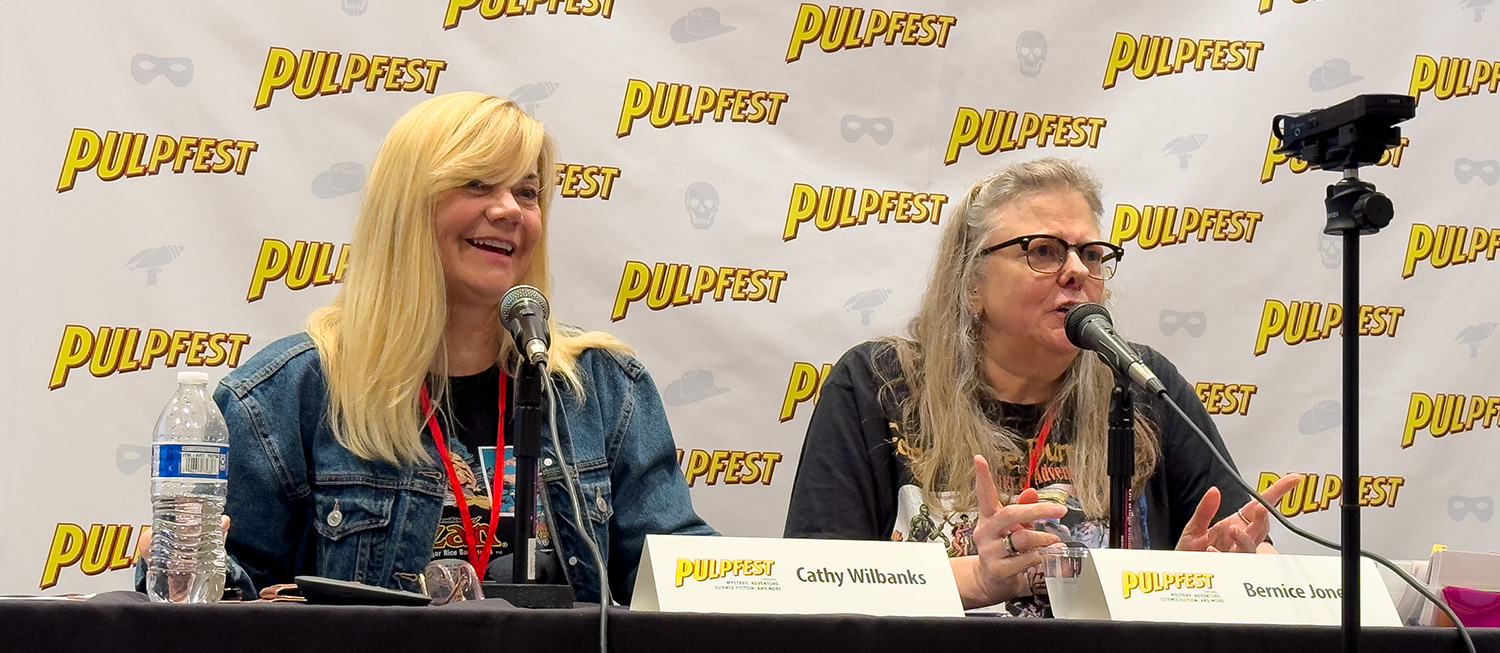
Cathy Wilbanks, vice president of operations at Edgar Rice Burroughs Inc., and longtime fan Bernice Jones discuss the great men that Edgar Rice Burroughs brought to life in novel after novel. This presentation was part of ERBFest, held in conjunction with PulpFest 2025. This Pulp Tales was recorded in Pittsburgh on Thursday, Aug. 7.
Click to expand the transcript.
Pulp Tales Announcer: Welcome to Pulp Tales, fascinating stories of the pulp magazines and the creative minds that brought them to life. The fictioneers, the artists, the editors, and others. Brought to you by ThePulp.Net. Learn more about the pulp magazines through articles, blogs, bibliographies, links, over 100 episodes of this podcast, and much more at ThePulp.Net. Your link to the pulp magazines for almost 30 years, online at thepulp.net.
Bernice Jones: Bloodline is a very important concept in Edgar Rice Burroughs’ writings. He was definitely a believer in nature over nurture, and that’s what Tarzan showed.
Pulp Tales Announcer: In this episode of Pulp Tales, Kathy Wilbanks, vice president of operations at Edgar Rice Burroughs, Inc., and longtime fan Bernice Jones, discuss the great men that Edgar Rice Burroughs brought to life in novel after novel. This presentation was part of ERBFest, held in conjunction with PulpFest 2025. This Pulp Tales was recorded in Pittsburgh on Thursday, August 7, 2025. Bernice begins.
Bernice Jones: We have the honor and joy of kicking off not only PulpFest, but ERBFest. Woo! and tonight we will be talking about Edgar Rice Burroughs and the ideal man.
If any of you guys were here last year you know that we covered the women of Edgar Rice Burroughs. So we’re just kind of giving the guys a little bit of time. From a women’s perspective that is.
Kathy Wilbanks: Yes, very much so. So this question has been pondered for centuries by a lot of philosophers. What does it mean to be an ideal man or male.
Well, we did a little bit of research just to kind of get an idea. And the thing is, is we wonder, is it just an answer that comes from your own perspective? Does it depend on who’s asking the question?
Does it depend on what’s going on in society? What’s the backdrop? What’s your own personal experience with your role models?
There’s a lot of factors that go into it. So I know based on some of the research we did, we came up with a couple of conceptions of what an ideal man, what the main goal of that whole concept is, and that is to reach beyond human details to develop a greater excellence. And I think the main thing in order to achieve that main goal is to look at the virtues involved in creating that final realization.
So, that being said, we’re going to go on and we’re going to talk about ERB.
Bernice Jones: Do you think he thought he had traits of the ideal man? No.
Kathy Wilbanks: Already then. Maybe. But I know that given his experience, he had some ideas and thoughts on what that meant.
And whether he actually thought about it or whether he just subconsciously created these heroes based on the experiences that he had in his life is the main question. So we want to go ahead and explore that a little bit. Yeah.
Many of you know that he was born in 1875, passed away in 1950. And given that time frame, we ask about his environment and what were his… Okay.
Hello. What were his influences and what was it like for him? What was going on in the world?
and who were his heroes at that time.
Bernice Jones: The big issue at the beginning of the 20th century, and this is the elite folks, so basically the rich white guys sitting in their offices, what they were very concerned about, one of many things, was something called degeneration. What happened was it was early 20th century America. It was a time of expansion.
It was a time of imperialism. Well, we’re taking over land left and right. England was, you know, everybody was.
There was a lot of industrial growth, so there were people doing different jobs. There was different paradigms for work. And then the youth, see if this is familiar guys, the youth had more leisure time.
So, you know, they had too much time. And many of the young men were soft, effete, really couldn’t help themselves out of a paper bag, even though they tried, yes. But so they were degenerating, and they weren’t going to be the big, burly American men that we needed to move forward in the century.
So yeah, that was a concern, and it shines through some of ERB’s work, and we will get to that in a few minutes. But Edgar Rice Burroughs actually had an ideal man right there, right in front of him, Theodore Roosevelt. Theodore Roosevelt was a very sickly child.
He could barely get out of bed many times. He was very, very ill. But he managed to get himself out of bed and pulled himself out, made himself into a strong man who spent a lot of time in the outdoors.
He loved doing that sort of thing. So that would be one role model that he would have had, would have been Theodore Roosevelt.
Kathy Wilbanks: Another one would have been his father. His dad. Yep.
And what was that relationship like? And how was he an ideal man? And how did he influence ERB with his upbringing?
And so, as we know, Major George Tyler Burroughs was a major source. He was a military man, and he believed in structure, and he believed in really being involved in his community, and he was extremely active, and ERB saw all of that in a protective manner. You know, like making the right choices, working for people, and doing the right things, and always reinforcing that with ERB.
Bernice Jones: Actually, Major Burroughs made his first fortune in whiskey in Chicago. Then his distillery burned down. So he said, okay, no big deal.
And he went and he founded the American Battery Company and promptly made his second fortune. So ERB grew up as a rich kid. He did not lack for resources.
And though he likes to talk about how much he was close to his mother, his dad indulged him. He needed money. He got it. He was in some sort of problem.
Daddy paid for to get him out of it or pulled military strings. Yeah, so dad would have been a role model. He would have been very much an ideal man in little Eddie’s eyes.
Kathy Wilbanks: Another influence, probably even more so than his father, was General Charles King.
Bernice Jones: Yeah, we have a quote. We do, but hold on a second here. General King, General Charles King, 1844 to 1933, he was considered a pillar of the army.
The man served for 70 years. he took place in all the big battles of the time the Philippine uprising of course the Civil War Spanish-American War he trained troops for World War I so he was very active but in 1892 he took a brief assignment at the Michigan Military Academy and there just so happened to be a young man sent to military school because he always got in trouble at home, who proceeded to always get in trouble at school. And when he came back from running away one time, Charles King basically said, "Yeah, I know, you need to have some sort of punishment, but…"
And in fact, he wrote 62 books, over 200 short stories. He also edited and edited. at the academy all the good editor for only a brief period he was invented the western romance consideration and his numerous accomplishments created an ed an intense so based on these
Kathy Wilbanks: influences based on what was going on in society and based on his own process of growing up and his own experiences we’ve gone through several of the novels obviously and we’ve come up with a list of our our ideal characteristics that erb infused with a lot of the characters so here they are here now we’re not saying this is everything we’re saying this is probably just our perspective from coming from from our own experience with erb so here’s our characteristics and we’re going to
Bernice Jones: be talking about five of burrows heroes uh tarzan john carter carson napier norman of torn and wall Waldo Emerson Smith Jones. No relation.
Kathy Wilbanks: And my favorite. Okay. So we’ve got physical presence.
Obviously, tall stature. You know, always good looking, very athletic. A lot of physical attributes.
Intellectual.
Bernice Jones: I mean, every single one of Burroughs’ heroes learned some sort of language in about five minutes so that he could communicate.
Kathy Wilbanks: It didn’t matter what it was. No, exactly. Emotionally reserved. They weren’t very, you know, communicative in that. They weren’t like, you know, soft and warm, fuzzy women, emotional thing.
Bernice Jones: If you wanted to see emotion from John Carter, good luck. Yeah. If you wanted to see emotion from Tarzan, threaten his wife.
He was very jealous. Carson of Venus, he’s a little different though. Yeah.
Kathy Wilbanks: They were all leaders. They were all respectful of women. They all had strong moral codes, and they were all above all protectors. So those were the majority of the virtues and the attributes that we have identified. So we’re going to first of all talk about Mr. Tarzan of the Apes.
Bernice Jones: John Clayton, Lord Greystrokes. Okay. Tarzan was an example of an uncorrupted man.
He actually had zero European influence in his life until he was probably in his early 20s. The only other human beings he saw were cannibal tribes in the jungle. So he was not influenced by decadent European culture or Western culture ever until he was found out to be Lord Greystone. He was by necessity athletic and self-sufficient.
And he had to learn some tricks that some people never have to learn, but that’s part of being a hero, I think. As the scion of an aristocratic English family, his genetics made him superior. I made air quotes.
And many of his actions, his way of thinking, etc., were almost instinctual due to his bloodline. Bloodline is a very important concept in Edgar Rice Burroughs’ writings. He was definitely a believer in nature over nurture, and that’s what Tarzan showed.
But of course he was a leader. He protected Jane. He protected their little party.
But his bloodline was so good that he easily adapted to European life when it came to that. Just nothing. He didn’t have to have years of therapy or anything to…
But he went right in, sat in a seat at the House of Lords, and said, okay, let’s get this going.
Kathy Wilbanks: So most of you know, this is the first cover, this is the first time that he was actually appeared, and that was the 1912 All-Story Pulp Magazine, and then we’ve got the cover for the 1914 book there, and I always find it really interesting that they just used just like a black version of it, like you couldn’t see any of the details. Could it be any man? Could it be just this mysterious person that just existed in the jungle?
That’s what ERB wanted. So we’re going to show you a couple of renditions of him throughout the development over the past 100 years. This was done by St. John, and it shows another version of him where he’s lean and he’s not very muscular.
He doesn’t seem to be an overwhelming presence, but don’t get him mad. Don’t make the scar go, guys. Yeah, exactly.
And then we’ve got one of our favorites, Forrest Vallejo. And that shows… Oh, that’s Neil Adams.
I’m sorry, Neil Adams. Yep. Both of them did the…
Yeah. So this is Neil Adams when he was angry and being very much of a protector. And we’ve got there another version where he’s a little bit more cut.
Neil Adams. Yep, Neil Adams. And then finally, one of our most favorite is Joe Jesko.
We love Joe Jesko. Yeah, we love Joe Jesko.
Bernice Jones: And please notice… It is, yes, exactly right. Please notice that in Jesko’s renditions of Tarzan, the man is cut. Every muscle is defined. He could walk into Mr. Universe and win just naturally. and as you see and we’re going to give a couple more don’t we yeah and as we see even in the movies we started out with a guy he was a swimmer Johnny Woismyler was a swimmer and so he had that smooth body not a lot of muscles but he was a hottie in his day don’t think that girls didn’t go to the movies to take a good look at Johnny Woismyler in a morning class come on yeah but as movies grew and as they progressed as the times progressed we get
Kathy Wilbanks: yeah but this does bring up another question um so we’ve got one one version that was shown through the movies and then we have another version that was thrown in that was that was actually developed in the novels so we’re really exploring that the development of the erb character, not necessarily of the movies. Because Ideal Man, again, just like we said in the beginning, there’s many different interpretations and philosophical conversations that go on with
Bernice Jones: this. And many women went to see this because Alexander Skarsgård is another hottie. Yeah.
But even this, if that’s not a Justo painting, Justo, he’s big, he’s Schwarzenegger. Here, he’s a little more slimmed down. He looked like he would be swinging through trees.
He didn’t need that extra weight. So he’s a slimmer version of what, like, Joe Jusko paints him as.
Kathy Wilbanks: So we’re going to move on. Yes. Let’s move on.
Fear me, Yaglande. Okay. Let’s do it.
Let’s talk about John Carter.
Bernice Jones: John Carter of Mars. John Carter is an ageless man. He had no idea how old he was, and he was probably, and yes, he was immortal, but he was a southern man of southern aristocracy.
So his morality, his treatment of women, his leadership qualities were all part of his life as a gentleman. This was imposed on him. It was taught to him if he ever was a young man.
but it was part of the Southern soldier right after the Civil War. And so he would have had a lot of these traits naturally simply because he was a Southern gentleman. He grew up in the saddle.
He was a good horseman. He was a good sharpshooter. If you ever notice in ERB, there are a lot of horses.
Ed loves horses. Yes, he does. And there’s also a lot of riding of things.
So, you know, most figure out how to ride whatever animal needs to be ridden. Yeah. His idealness fits in on Barsoom.
Once he learns the language and customs, his good breeding allowed him to easily adapt to Barsoomian culture. So much so that he became Jeddik of Jeddiks. Another leader.
Mm-hmm. And not just to the folks who looked like they were human. He and Tars Tarkis had a wonderful relationship working together.
And he’s about as far from a heliumite as you can get.
Kathy Wilbanks: And this is the most recent cover done by Joe Jesko for A Princess of Mars, which I’m sure all of you have seen it.
Bernice Jones: John Carter of Mars really should not be super muscular because the gravity on Mars is a lot less than it is on the pool, is less than it is on Earth. Yeah, he’d have muscles. He’d be high. But he would be slimmer and he would be, but very agile.
Kathy Wilbanks: Okay. So we’re going to move on again.
Bernice Jones: Yes, move on.
Kathy Wilbanks: All right. We’re going to go to talk about Carson.
Bernice Jones: Carson Napier. Napier actually, as in his youth, trained in the mystic arts. He had a guru who taught him some really fine tricks. One of them being projection of his image mentally. That’s how he talked to Ed in his office, was he would project himself or he would show up or he would leave a message for him in the dimensional world, more or less.
Kathy Wilbanks: He actually visited the office and I got to meet him too.
Bernice Jones: Woo-hoo! There’s a comic book out there, yeah. Yeah, girl.
Yes, it was very exciting. His dad was a major in the Army. Hmm, that sounds familiar.
Yeah. In the Indian Army. His mom was a Southern belle, and when they passed away, Carson took the money because, you know, guys in India made bank, and they were wealthy.
He took his money, and he cried really hard to have a misspent youth, but he didn’t like it. He really did not like all the partying and the wildlife, and he decided to take his money and his obvious intelligence, very intelligent man. He took it and he wanted to do something that he wanted to do, which was fly to Mars.
He missed, by the way.
Kathy Wilbanks: That’s one thing that’s different about Carson is that he has a little bit of a sense of humor. And as far as the characteristics, he may not be exactly at the very top of the levels for intelligence. However,
Bernice Jones: well, I think he was very intelligent. He did put the rockets and everything together. But his social intelligence was lacking.
He probably was on the spectrum if we’re going to psychoanalyze him. Not that we’re qualified or anything. Not that we’re qualified, yeah.
But Carson was very intelligent. He just was awkward in social situations. But he could laugh at himself, and he and Duare laughed often.
And that was something you would never see with John Carter or Tarzan. that they would gleefully laugh with their spouses.
Kathy Wilbanks: Okay, we’re moving on. We’re moving on. We’re moving on. All right, the next one,
Bernice Jones: Outlaw of Torn. Outlaw of Torn. I really liked this book.
This was the second novel that Burroughs tried to sell after A Princess of Mars. He had some issues. It actually wasn’t released until much later, but it was his second attempt at a novel.
Norman of Torn, he’s also known as Prince Richard because, well, yeah, that’s where he was born. He also used the name Roger de Conte when he was out trying to be mysterious. He was a child kidnapped by a villain and reared away from his natural habitat.
That, of course, being the court in London. So, I mean, he was only three when he was kidnapped. His kidnapper, whose name, by the way, is DeVille, teaches him only three things to start, starting when he was three to five.
And that was swordsmanship, French, and hatred of the English. DeVille was the fencing master in the court of Richard and, excuse me, in the court of his dad. and he was offended.
So you know how Frenchmen in medieval times were, right? "I shall be avenged!" So he kidnaps Prince Richard.
Norman has a lot of native intelligence, and we see this. He actually, when wandering about in Torn, he finds the priest who is living as kind of a semi-hermit, but he was in the area, and Father Cloud really liked him, kind of took him under his wing, taught him how to read and write, both in French, in English, and in Latin, and taught him some things that maybe he missed when he was with Deville, because Deville basically said, the only future for you, dear sweet Norman, is hanging on the end of a rope as an outlaw. And he told him this all the time.
but Father Claude had him see that there was a future for him, and it wasn’t necessarily that. And Norman becomes the best fighter in England. He surpasses his master, which was, yeah.
And he is innately respectful of women. Father Claude helped a little with that. And it’s very unlike Deville, who murdered several women, Lady Maude and his nanny, including his own sister, while kidnapping Richard.
And his innate moral code and intelligence are expanded upon by Father Claude. But, once again, bloodline. He was royalty.
He couldn’t act except in a noble way. And in the end, he actually kind of decides that the English aren’t so bad. He falls in love with his biological father’s best friend’s daughter.
So, you know, Bertrand. And yeah, that kind of changed him and pulled him to the English side. So the French thing was actually well and superficial.
Kathy Wilbanks: Yeah. Yeah.
Bernice Jones: Walder, Waldo. I say it wrong every time. Waldo Emerson Smith Jones, no relation.
He was a young man suffering with the societal scourge of degeneration. Waldo Emerson Smith Jones is the poster child for degeneration at the beginning of last century. Very much a morality story.
It’s very much a, oh, hey, look. He’s degenerate. He’s tied to his mommy’s apron strings.
He’s a Boston intellectual, but can’t do anything because he’s a Boston intellectual. He doesn’t have any useful skills. He’s terrified of everything.
So until he meets Nadara. Now, Nadara thinks he’s awesome. She’s like, oh, yeah.
And you’re like, I can help. She’s like, let me help you. So it was tutelage, and then it also was she was teaching him skills that he needed to live on this deserted island or desert island.
And she had a lot of faith in him. And at one point, he actually had to separate from her and go on his own and hone his skills in order to fully become an ideal man.
Kathy Wilbanks: He hadn’t embraced it at the time. You know, he was still just a really nervous person and just suffering from culture shock and being in a totally different place. And he was just frightened over the smallest things.
And he just didn’t know what direction he needed to go. And finally, when he had some soul searching and he got away from her and he kind of, like, figured out what his path needs to be, he made a decision. He made a choice.
And I think that’s what a lot of the ERB characters had to do. the male characters were forced to make a decision. Which way are you going to go?
Are you going to become that ideal man and fulfill all of your potential? Or are you going to just cave in and just let life take over? And they did.
They chose to stand up and take control. And through all these characteristics, good old Waldo, he becomes Thandar. And he, again, his physical presence totally changes.
This is one of my most favorite stories because it’s the biggest transformation in one of the characters that I’m aware of. He goes from just this weakling to a man of power. And it’s just incredible to read the whole transfer.
It’s his whole decision-making process as to how he grows and how he becomes and he fulfills. And it’s really inspiring, actually. It shows his intelligence.
he takes over as a leader of her people. He’s emotionally reserved, of course, ’cause he’s still figuring things out and he doesn’t wanna be vulnerable. I think that’s another really big important characteristic of a lot of the ERB male characters, the heroes.
They don’t wanna be vulnerable. They are definitely reserved and they’re leaders. They’re respectful of women.
He goes above and beyond to protect the women. He’s got a strong moral code. He always is fighting for the good And of course, he’s a strong protector of all animals and all things that are ripe.
Bernice Jones: And he scared his mama when they came and found him. She was like, who’s that? He actually was on the ship going somewhere to, he thought he had tuberculosis. So he was going for the cure. What he really suffered with was a really bad case of…
Kathy Wilbanks: I think his mom was over-medicating him. Psycho, what is it? Psychosomatic, yeah.
Yeah, I think it was maybe like her problem, you know, like have you heard these Oh, oh she coddled that boy. Yes, I think it was a problem with her. Yeah, yeah, yeah.
Yes. I’m not going to disagree. Yeah, I think that, yeah.
So those are a couple of images of one of our favorites, Waldo.
Bernice Jones: I’ve got a couple of perspectives from people who are authors or were authors. First off, there is an author named Nathan Long. You might have heard of him if you game at all, because he writes a lot of Warhammer universe stories.
However, he just came up with something based on John Carter and his love of John Carter, but as a female protagonist. And Jane Carver of war. Yes.
But anyway, he said, and we do not agree with this. No, we do not. I don’t think we agree with this at all.
It was actually really shocking when you told me about this. No, no, no, no, no, no. That’s not the right one. Oh, okay.
This one. This is a different one. This is they, Burroughs heroes, are all pretty much interchangeable.
Right. Tarzan and Mars would be John Carter, and John Carter in the jungle would be Tarzan. We say no.
Kathy Wilbanks: Right.
Bernice Jones: Why? Because Tarzan, without all of his experience as a child, learning, learning to adapt, learning to take care of himself, learning to be self-sufficient, would have made him into Tarzan. He needed that experience.
John Carter just kind of jumped into Mars and went, hey, I’m here. Look, I can jump really high. And he, having no idea how old he was, was easily able to slip into Barsoomian society because he had the experience.
Okay, he was a gentleman. Tarzan couldn’t have done that. And I really don’t think, you know, Carson of Venus, no, no, no, no, no. Okay, but believe it or not, Gore Vidal was a big, big fan of Tarzan, wrote him when he was a kid, revisited him, and wrote an essay in Esquire.
Yeah. Tarzan revisited. December of 63, if you want to go over and look for the Esquire that had this in.
But Vidal really loved Tarzan. He, and Edgar Ray’s Burroughs, he said, No matter how difficult the adventure, Tarzan, clad in only a loincloth, with no weapon, save a knife, wins against all odds, and returns to his shadowy wife. I think we proved to all of you last year that there was no such thing as a shadowy wife.
Jane was quite the girl. As far as we know, she still is. Oh, this is this one.
And I’m going to read this. And I really I want you guys to listen. And I want you to to let this sink in.
This is also Gore Vidal from the same essay. And he said, "These books are clearly for men. I have yet to meet a woman who has found Tarzan interesting.
No identification, as they say in series land. We beg to differ." One other thing, Kathy.
Yes. Do you think that someone who was not ideal man. Waldo doesn’t even count, but do you think a man who wasn’t quite ideal could he become ideal?
Absolutely, I think so. Yeah, let us bring up one William Cecil Clayton III, who was Tarzan’s cousin, though they didn’t know it. And William was engaged to Jane Porter at the time when this all went down, but Jane and Tarzan had already fallen in love and honor and all that good stuff so she had to marry William but when they were attacked in the little tree house on the beach next to the ocean William Clayton fought to protect not only Jane but the rest of the party and he um he took charge And I do believe that in his dying moments, he became an ideal man.
He met the criteria. He may not have longed to actually use it, but he died an ideal man just because of what he did and how he acted nobly at the beginning of the Return of Tarzan. It makes me a little reclaimed. I’m sorry.
Do you need a hug? Yes. There you go.
So that’s what we have for you. Yep. Anybody have a question or two?
We sincerely hope that you have a really excellent PulpFest. And that if you do have a question or if you want to talk Edgar Rice Burroughs,
Kathy Wilbanks: appreciate it. We love having conversations with you and hearing your perspectives. And we just like exploring this because it’s so close to our hearts.
And even though, you know, I mean, last time when we did it, we got a lot of compliments and we actually really enjoyed ourselves. We had a great time. Yeah, we had a great time. I had a great time, right?
So did I.
Bernice Jones: But yeah, we’re always willing and able to talk about this.
Audience 1: I do have a question.
Bernice Jones: Yeah.
Audience 1: I was interested, it’s a very good presentation, I liked it very much. When you were talking about the references on Edgar Cayce Barreros, and I was thinking about some of the literary influences beyond the cultural. And I just finished reading, rereading Ivanhoe, and I just wondered if you…
Bernice Jones: And he would have read Ivanhoe.
Audience 1: I had to figure, because all your criteria were matching everything…
Bernice Jones: He went to Harvard School in Chicago, private school, and yeah, he had to learn all of that stuff, English and literature and Latin and all of that. So yes, he would have had other literary influences, absolutely. But, and I say this lovely, you know, but General King, being a novelist, writing stories, would have later in his mind think, because he was reading the pulps and he said, man, these are just like the dreams I have, or what I think to myself before I go to bed, before I go to sleep.
And I think that when he read and said, oh, I could write, I could do better than this. But because one of his heroes was a prolific, very well-known author, once again, one of those authors that we’ve lost because time, think that let him actually write. That there wasn’t any stigma about writing a romance, there wasn’t any stigma about writing whatever.
The man invented Sword and Sandal. I’m sorry, that’s wrong. Sword and Planet.
And as romances. So, yeah, literary, absolutely. Not sure what he studied, but they had a pretty, he had a very comprehensive education.
So, yeah, awesome question. Thank you. Yes?
Audience 2: So there’s an attribute that at least some might ascribe to the ideal man, and that would be fatherly, fatherly, which Tarzan and John Carter both end up in. you didn’t really talk about in Burroughs fathers. And how does that play into the notion of an ideal man?
Bernice Jones: Well, I think that comes a lot under protector. It’s kind of an umbrella that will cover them being fathers. But like we said, two huge father figures in his life influenced how he saw the world.
It was… And yeah, thank goodness for General King. He wasn’t there very long, but he inspired Ed.
I had to punish him a lot, but the kid was wrecking. He did it lovingly. He would be, yeah.
We think he had ADHD. But, yeah, being fathers, of course. Yeah, because one of my favorite Tarzan novels is not a Tarzan novel.
It’s Son of Tarzan. But, yeah, I can see that. Definitely.
And like we said, these are traits we came up with. It’s between, you know, I’m sure there’s a lot of other, you know, characters that could apply.
Kathy Wilbanks: Tons more. But in my opinion, too, when you look at Tarzan and John Carter and how they were off on their own adventures here and there. And they were doing other things, too.
They weren’t always that doting father or that helicopter parent that you see these days. So I’m not quite sure. But I think that that does fall under the protector kind of theme.
Definitely. Yeah. Yes, sir.
Audience 3: We got here late. You might have covered this. I wondered what kind of cultural door did you two come in to get on this bus?
Bernice Jones: My story is long. When I was a little girl, my parents would take us to see my great-grandmother, my dad’s grandmother. And of course I would get bored because I like to do stuff.
And one day I asked my grandma, I said, grandma if I’m really, really careful, could I read the books in the barrister bookcase in the living room? And she said, yes, just be very, very careful. The first book I pulled out was Tarzan of the Apes.
Started reading at eight and never really stopped. I must, must, must credit my husband he got me into John Carter of Mars and that just it just snowballed from there they even have cats named after ERB characters I have my my big fat tutsi his name is uh Carter John Jones and then my our little girl Smokey Gray she’s beautiful but her name is Dejah Thoris Jones we also have two other cats I did not name them so we were watching Buffy at the time come on we’re not
Kathy Wilbanks: talking about that. No, we’re not talking about that. Well, for me, my mom actually started working at the corporation, Edgar Rice Burroughs Incorporated in 1976, and she was working for Manpower, which was at the time, she was a temporary secretary.
She was there for four days, and it turned into 40 years. So Marion Burroughs was the boss at the time, loved my mom, and made her, you know, stay on and offered her the full-time job. So my mom happily took it because it’s just such a great, great job.
It’s not like work because every day is different. There’s so many opportunities. I was talking to somebody about that earlier, how like every day is a little bit different.
And because he created so many different genres, there’s so many different opportunities and it’s just, the world is just open. So I was in high school at the time and they needed somebody in the warehouse. We kept getting loads of boxes from all over the world of comic books and books and all these things.
And I was working with Danton at the time. So Marion said, you’ve got a daughter. You need to bring her in so she can work part-time in the warehouse.
That was my start. So from there, I was like, what is this Tarzan of the Apes stuff? I love to read, but I started with Nancy Drew back in the day.
You didn’t. I know, right? So I cracked open the Tarzan of the Apes book and started reading, and I couldn’t put it down. I was like, oh my God, this is amazing. This is so fun.
So I just started reading through and I worked with Danton. He was the grandson of Edgar Rice Burroughs. So I got to learn so much from him and experience like, you know, what it was like to be in that world.
And it just, it just, I love it. It’s so fun. So I worked there for years and years and years.
I’ve got through college. Then for a little while I got my bachelor’s my master’s degree and I went and I was a teacher first grade for five years and in 2000 I came back to Burroughs and I’ve been there ever since now I’m the VP of operations and I’m you know Jim’s right-hand man and I love it and you know looking forward to just keeping moving forward and doing more so that’s my story I keep telling her I want her job no you
Bernice Jones: may not have it no it’s fine I can do remote I can work remote no you may not so so anyway that’s
Kathy Wilbanks: about us and yeah we just love like you know digging into it and finding like other themes that that that kind of are are intertwined in all of the stories and whether it be the women of ERB because that’s just such an untapped real topic that needs to be explored, or whether it’s about the heroes or maybe it’s about the villains. We don’t know. No, more questions, more questions.
Bernice Jones: We got some.
Kathy Wilbanks: More questions.
Bernice Jones: Yes, we have a, we’re blown down to villains. I’m sorry?
Kathy Wilbanks: Did you have a comment, Mike?
Bernice Jones: Villains. Mike, please.
Kathy Wilbanks: Oh, I’m not sure. I’m not sure. Yeah, so anyway, more to come, more to come. You have to keep coming back. Absolutely.
Bernice Jones: Because as long as there’s a PulpFest, I think we’ll be here. Or as long as we’re here, come to PulpFest.
Kathy Wilbanks: But we all appreciate you. Love talking with you all. Thank you so much.
And come and visit us, and we’re around. So, thank you. Oh.
Thank you so much. Thank you, Kevin. Thank you.
Pulp Tales Announcer: You’ve been listening to Pulp Tales, fascinating stories of the pulp magazines and the creative minds that brought them to life. Brought to you by ThePulp.Net. Learn more about The Pulp Magazines through articles, blogs, bibliographies, links, over 100 episodes of this podcast, and much more at ThePulp.Net.
Your link to The Pulp Magazines for almost 30 years. Online at thepulp.net. Subscribe to Pulp Tales on your favorite podcast platform or listen to us on the web at ThePulp.Net.
If you enjoy our content, please like us or leave us a review. And tell your fellow Pulp fans about Pulp Tales. Thank you for listening, and keep reading the Pulps.
Pulp Tales is copyright 2025 by William P. Lampkin.
This transcript was generated automatically, so it may include typos and other errors.


