Seabury Grandin Quinn (1889–1969) is best known to the pulp world today as the author of the occult detective Jules de Grandin. However, he wrote more than just those works. I have posted on a pair of volumes from Black Dog Books that include both his non-series works as well as samples of some of his other series.
 Among these are the “Washington Nights’ Entertainment” series, or Major Sturdevant series, which ran 24 stories; the Professor Forrester series of 13 stories; and the Hiji series of 16 stories. I have been waiting for someone to reprint the Sturdevant, Forrester, and Hiji series, and finally Black Dog Books did the Hiji stories.
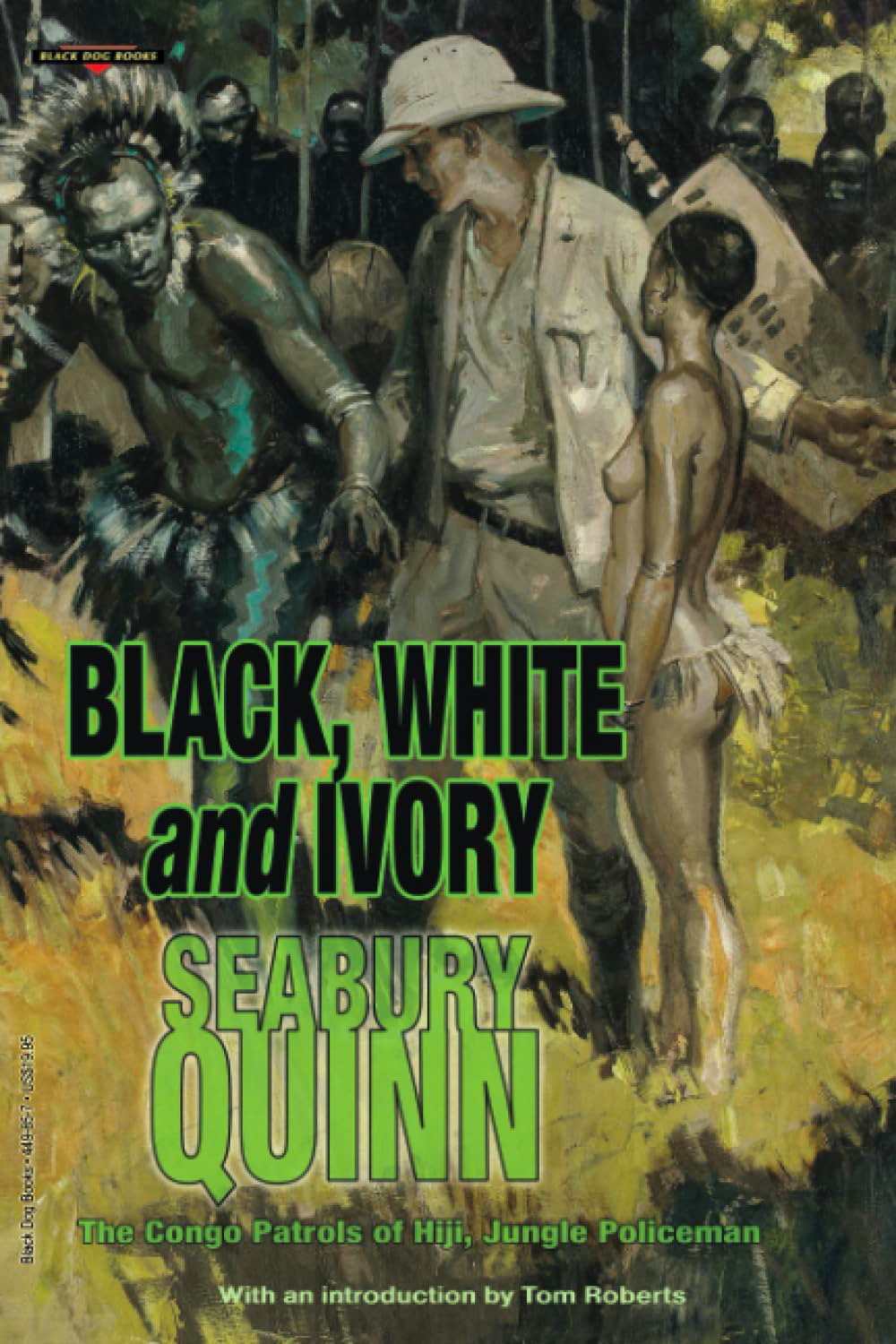
Black, White, and Ivory: The Congo Patrols of Hiji, Jungle Policeman reprints the complete series of Hiji stories, almost all of which appeared in Short Stories magazine. It includes a short introductory article on Hiji by Quinn that ran in Short Stories, and a great introduction by publisher Tom Roberts on Quinn and his work, as well as Short Stories.
The cover is by Herbert Morton Stoops (1888–1948), but I don’t know where it first appeared, though it fits perfectly for one of the stories.
This series ran from 1940 to 1947. It was created to replace L. Patrick Greene’s The Major, which I’ve posted on. It is a series about an illicit diamond buyer who fights against various criminals and evil men who try to take advantage of the natives in southern Africa.
Hiji, or to use his full name, Capt. Sir Haddingway Ingraham Jameson Ingraham, is introduced in the first story to our unnamed narrator, who is being told by a friend who has met him. Now working for the British embassy, Hiji — a nickname he gained in school from the initials of his name — was a former frontier policeman in central west Africa, who commanded a company of Houssa police. Hiji is also known as He-Who-Comes-When-No-Man-Thinks-Him-Near.
While not explicitly stated, I believe he was a veteran of the British Army during World War I, who returned home and found his family fortune gone, so he took a position in British West Africa before World War II. Where, exactly, isn’t clear, but I believe it’s in the interior along the Niger River. It’s noted as the Reserve Forest Area and near holdings of other colonial powers (France, Germany, Portugal), which has an effect on some stories.
When is also not always clear; the stories are set in the 1920s and ’30s (in one we are told it’s 1922), especially as few hint at the approaching World War II. There are almost no recurring characters other than Sgt. Bendigo, who appears in several and is later made a sergeant major.
Hiji also appeared in a quartet of Jules de Grandin stories, but I am uncertain if these occurred while he was stationed in Africa or afterward.
The stories are reprinted out of order, which, by and large, is okay, except for a trio of stories with some of the same characters and another toward the end that is in a loose sequence.
“Busman’s Holiday” (March 10, 1947) starts off with Hiji going on a two-week vacation after being in Africa for five years. He plans on flying to Paris, where he hadn’t been since the Armistice of World War I. But in this story, he gets stuck in Algeria for a couple of days and winds up helping the acting U.S. consul, whom he had met in Paris. He has a problem with a missing American woman, and Hiji steps in to help him, thanks to a couple of locals he had recently met in the native quarter.
“Policeman by Trade” (May 25, 1947) follows and is set in Paris. Visiting a casino, he sees something and decides to help someone who is in trouble, fouling up a Nazi plot in the years before the war. And finally, in “Spring Cleaning” (Sept. 10, 1947), he is back in Africa and has to deal with a problem with his French counterpart: an outbreak of slavery in the area. In the process, they find a missionary has been murdered and his daughter is missing. Hopefully, they will find her alive.
The first story, “Hiji” (Dec. 10, 1940), introduces us to Hiji. Most of the background information we get here won’t be repeated. It’s a pretty violent story, as Hiji and his men must take action at an outbreak of cannibalism from the leopard men. Hiji learns it appears to be at the behest of a German. In the process, not only are several native villages wiped out, but a missionary and his wife and daughter are all murdered. Hiji takes swift action against those responsible for these acts, including the Germans.
The next story, “The Golden Witch” (March 10, 1941), is actually the longest. This time, Hiji must deal with two problems. One is a witch doctor accusing people of witchcraft and putting them to death, from which he profits. The second is that Hiji must put up with a visit from a female American doctor of anthropology who is interested in native dance, being an expert in Native American dances, though hopelessly naive about how different Africa is. So he must put a stop to what the witch doctor is doing and save the naive American. Two stories following this one feature the further adventures of some of these characters, “The Racketeer” (June 25, 1942) and “Black Majesty” (Nov. 10, 1942).
The stories are quite varied. As with The Major stories, the villains are usually white men and will get what they deserve in the end. The natives are not shown in a negative way. Hiji deals with them fairly.
Overall, this is an enjoyable series. Having read The Major, Hiji is no copy of him. I find The Major to have more humor in the stories, with him tweaking the nose of the bad guys. Here, the bad guys are usually causing death and suffering, so there is little room for levity. But I think the point of this series was more to provide a jungle-based adventure series to readers.
I am glad that someone has finally reprinted this series. Now I wish we could get complete reprints of the Major Sturdevant and Professor Forrester series.