

Code Name: Intrepid is an interesting series from Robert J. Mendenhall, available through his own imprint Blue Planet Press.
 CNI is a special team of military and civilian experts who handle cases that are extraordinary or of an unusual order in the 1930s. Think strange creatures and tech, especially if it’s tied to a foreign nation.
It started as a short-story collection from Airship 27. It now consists of five novels, a short-story collection, and five anthologies with stories by other authors. All the books now sport covers and logos created by Jeffrey Ray Hayes, who has been doing work on the rest of the series, as well as other New Pulp works and series. This time, I’m looking at the second pair of anthology volumes.
Mendenhall’s background is as a former policeman, a former member of the U.S. Air Force, and a former journalist. This gives him the foundation for this series. And it’s not his only work, as he also has an SF series called Far Futures.
Formed in 1932, Code Name: Intrepid operates under the fictitious Office of Special Actions in the Department of War. The core team has five members, plus a consultant. Its leader is Lt. Col. Rick Justice, Army Air Corps. A double ace in World War I, he is a large man who is a capable leader, as well as a good observer. He is the character you see on all the covers.
Then you have Lt. Cmdr. Roger “Sky Hawk” Winchester, USN, who is a World War I ace. He is described as looking like Clark Gable. There is Gunnery Sgt. Dexter “Guns” Preston, who is a Marine and fighter. And there is Master Sgt. Michael “Hammer” Downe, who is a mechanic and test pilot. Rita Marshall is a former Department of War analyst and the daughter of an admiral, but she is just as capable a fighter as the rest. Finally, Dr. Stephen Lester, a former field surgeon in World War I, now works in forensics.
Over time, they are joined by other experts, both military and civilian, including Professor Lucius “Specs” Wellington, Professor Reginald “Digs” Jasper, Navy pilot and diver Lt. Cmdr. Kenneth “Sting Ray” Niles, Maj. George “Man Mountain” McGuire of the Army Corps of Engineers, and others. Early on, they get their own base with a dirigible and later add a decommissioned sub.
Their main foe is a special group of Nazis called the Sonderstaffel, which tries to make use of fringe science and the occult to create super weapons or even creatures to attack the enemies of Nazi Germany.
As noted, I look at the next volumes in CNI: Classified, which is the anthology series. We are looking at volumes 3 and 4.
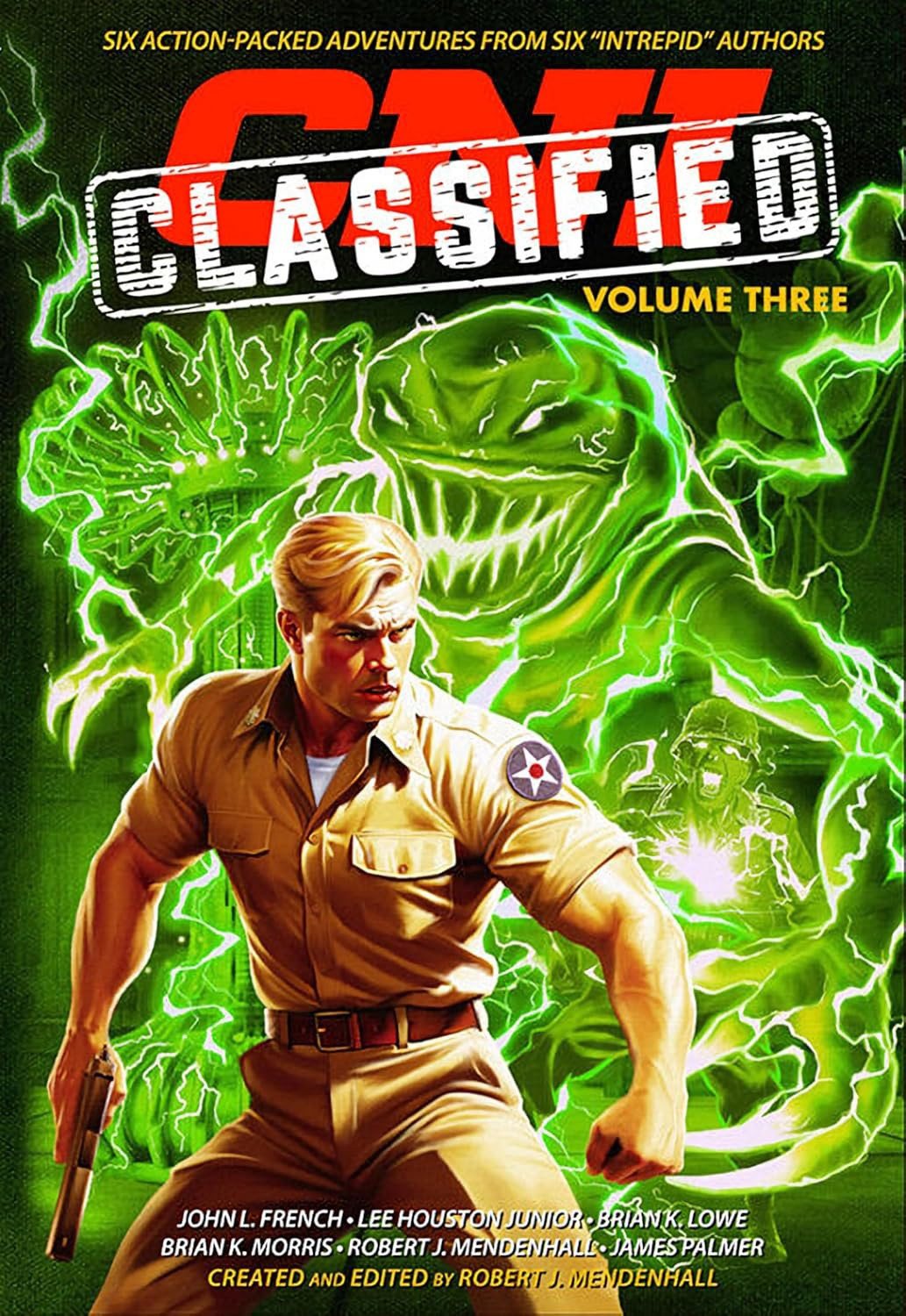
CNI: Classified, Vol. 3, gives us six stories from Mendenhall along with John L. French, Brian K. Lowe, Lee Houston Jr., Brian K. Morris, and James Palmer. These are set from 1935 to 1939. Mendenhall kicks things off with “Storm Front,” set in 1935. A strange message addressed to Intrepid shows up in the diplomatic pouch from Munich from Digs Jasper. Figuring out the message and visiting his office at the American Museum of Natural History, the team is off in a new DC-3 to France. From there, they head to Switzerland, where they meet up with Digs and deal with a group of Sonderstaffel. They soon learn that this was just a test of their new super weapon, and the plan is to attack U.S. forces in Belgium. Can the team stop this before any are killed?
From John L. French, we get “Operation Wayback,” set in 1936. Digs calls in Colonel Justice and Rita to meet Dr. Isaac “Izzy” Blake at the National Museum of Natural History. There, he shows them some anomalous items—items that should have been destroyed in various disasters in the past, but have recently been sold. Strange as it may be, it may point to someone having created a time machine. If so, can the team find it before someone else gets wind of it and searches it out as well?
Things kick off in “The Alpine Affair,” by Brian K. Lowe, set in 1937, when a remote small Norwegian village within the Arctic Circle is wiped out—apparently by the Sonderstaffel. The group is also setting up a base in a remote Alpine castle: Castle Frankenstein. Apparently, the story by Mary Shelley was based on real events, and the Sonderstaffel hope to learn how Dr. Frankenstein did what he apparently did. Will they succeed, or will Intrepid put a stop to it? And will Intrepid get assistance from a strange source?
Something big is killing cattle in 1938 New Mexico, and so Intrepid is sent to find out in Lee Houston Jr.’s “Operation Colossus.” There, they find what might be the culprit, a giant bobcat. But what caused it, and are there more? While investigating things, they run into the Sonderstaffel, being led by The White Man. But they are trying to take advantage of things. Can Intrepid find the source and put an end to things before more lives are lost?
Man Mountain McGuire and Rita investigate a meteor that took a strange turn in Brian K. Morris’s “Heavenly Unbound.” It lands in a small town in Illinois. Do we have a War of the Worlds scenario, or something else?
Finally, James Palmer’s “Fear of Clay” starts off in occupied Prague in 1939 with The White Man on a mission, looking for something. Meanwhile, Rita and Rick are looking for an associate of Digs, who appears to have been kidnapped. Once Intrepid learns what they are after, they head out in their Catalina PBY flying boat to a location between Poland and Czechoslovakia. Can they rescue Digs’ associate and put an end to the Sonderstaffel’s plans—especially when they get assistance from a strange source?
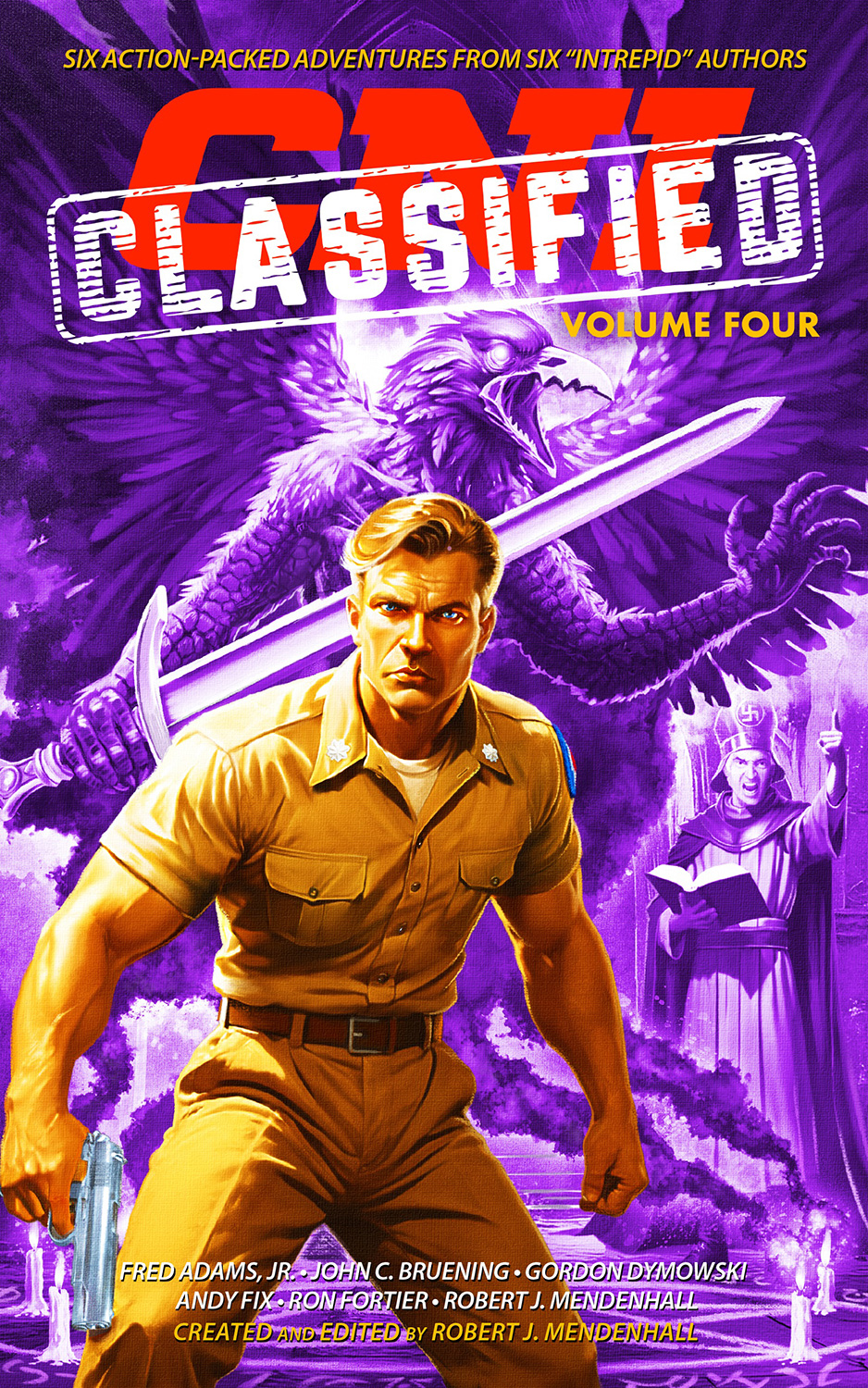 CNI: Classified, Vol. 4, again gives us six stories, with Mendenhall joined by Fred Adams Jr., John C. Bruening, Gordon Dymowski, Andy Fix, and Ron Fortier. The stories run from 1934 to 1940.
Mendenhall kicks things off with an adventure set in Alaska in 1934 in “Demon Rising.” The Sonderstaffel is up to something in an abandoned church in Alaska, which attracts the attention of a U.S. marshal, who is barely able to escape. Intrepid is informed of this and learns that the marshal is the son of their boss, Owen Drake, who joins them. Joined by Digs, they head out with their Catalina and their dirigible. Will they be able to figure out what the Nazis are trying to do and put a stop to it before things go badly?
We get a solo adventure of Hammer Downe in Ron Fortier’s “The Lost Jungle,” which takes him to Africa. He’s on the trail of a Sonderstaffel group looking for a possible “missing link,” led by a scientist who is into eugenics and the like. Is this a fossil or something living they are after? He soon discovers what, and thanks to some unusual help, he might be able to put a stop to things and return home.
When a tracker following a group of Sonderstaffel in West Virginia goes missing in Fred Adams Jr.’s “Code Name: Dunsinane,” Intrepid is called in. They head out to a certain mountain there and soon find the Sonderstaffel, or what is left of them. They were trying to call up something called “tree people,” but Intrepid’s problem isn’t so much stopping them as getting out alive.
Andy Fix’s “Deus Ex Machina” starts off with some of the team in the South Pacific in 1938 going after a German merchant ship that sent out a distress call, only to be chased off by a U-boat that proceeds to torpedo it. Using a Navy ship, they dive on the wreck with the assistance of Sting Ray Niles, along with Specs Wellington. They get some information before the U-boat returns. They soon figure that a nearby island is the source of what is going on, where the Sonderstaffel was doing experiments that went awry. But things get hairy, and they wind up teaming up with the U-boat crew to try to get out. Can they—and put a stop to things?
Digs is visiting one of his old instructors in Gordon Dymowski’s “The Mists of Koramu,” who has information. But he finds a German agent killing his friend and taking the information. All he gets is one clue: “Koramu.” We learn that there is a race going on to obtain the mythical Philosopher’s Stone. An American traitor is working to find it, and a strange island has just appeared. The race is on between Intrepid and the Nazis to see who — if any — will get the Stone.
Finally, in John C. Bruening’s “Into the Mirror World,” the team is alerted to strange activity on a remote island in the Azores. Looks like German U-boats are ferrying men and equipment there. So the team heads out to investigate. When they get there, they learn that the Sonderstaffel has made use of the knowledge learned from past events, such as the Hades’ Gate and the Forge Sword, to open up a gateway to another world—one where the Nazis have already taken over. But outnumbered, can Intrepid close the gate permanently?
A nice touch with both volumes is that, in addition to giving brief bios on all the other authors, we also get a sample of their other writing, which may lead folks to check out their other works, many of which I’ve reviewed here as well.
If you want to get into this series, I think that either the first novel or the first short-story collection is the way to go. I will be getting to the fifth anthology soon, as well as the upcoming second short-story collection. A further novel is also in the works. This has been a fun series, and I hope we will get more.

Your comments