

The first book-length work on Edgar Rice Burroughs (1875–1950) and his characters and fiction was Richard A. Lupoff’s Master of Adventure: The Worlds of Edgar Rice Burroughs, which has gone through four editions.
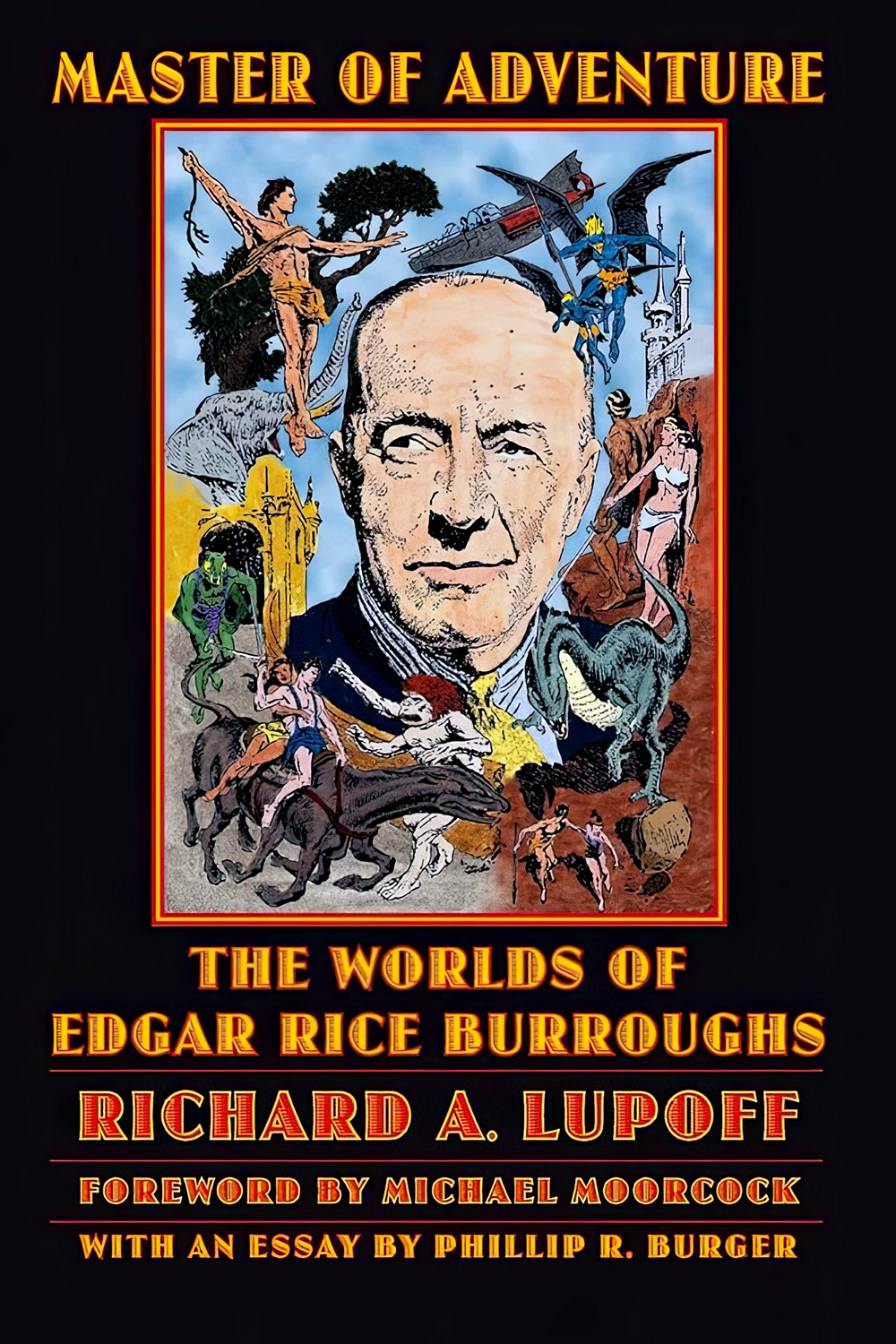 It first came out in hardcover from Canaveral Press in 1965, where Lupoff worked. Ace published the next two editions in 1968 and 1975, both with different covers by Frank Frazetta. Strangely, I got into Burroughs in the 1970s and somehow missed this.
More recently, Bison Books put out a fourth edition in 2005, now more than 20 years ago. This edition includes a new foreword, a new introduction by Lupoff, and an essay that updates the work. It still has the original introduction and the preface by Henry Hardy Heins.
Michael Moorcock, best known for Elric of Melniboné, touches on how Burroughs inspired him, including by creating his own Burroughs pastiche works like the Michael Kane trilogy. Phillip R. Burger provides an essay over 30 pages long that appears as the final chapter, bringing the book up to 2005, covering the previously unpublished works that came out in the past 40 years, as well as the many pastiches and inspired works by many authors since the previous edition, along with all the other updates in the world of Burroughs.
Lupoff spends the first half giving us background on Burroughs and going over his writing career in chronological order, other than Tarzan. He touches on both ERB’s well-known series, such as John Carter/Barsoom, Venus, Pellucidar, and others, but also on his several one-off works in the areas of Westerns, historical fiction, and mainstream fiction.
Lupoff puts forth the idea that Burroughs’ best science-fiction works were The Land That Time Forgot trilogy and the Moon trilogy. Unfortunately, he also puts forth the idea that Burroughs was influenced by Lieut. Gullivar Jones: His Vacation (1905) by Edwin Lester Arnold, despite the absence of any evidence that Burroughs had read it. There may have been an inspiration from his earlier The Wonderful Adventures of Phra the Phoenician (1890), which Burroughs did own a copy of.
The latter half of the book covers Tarzan and his many books before getting into the many works inspired by Tarzan that came out around the same time. Another chapter looks into how to create an “essential library” of Burroughs, which may be easier now that ERB Inc. has embarked on bringing back many of his works into print, often as “definitive” editions. And finally, there is a look at some of the then-unpublished works of Burroughs, many of which have now been published.
There are two appendices. One lists all the Burroughs books that have been published, updated to 2005. Be aware that they are listed in order of book publication, not their original publication in the pulps. Another lists fanzines, though folks should check, as some of these are gone and others are located elsewhere. And we get a bibliography and index as well.
I hope Bison Books, an imprint of the University of Nebraska Press, keeps this one available. My copy was done via POD from Amazon.
If you are new to Burroughs, this is an excellent entry point to his works. You can start from the beginning and read it through, or skip around to specific series or books.
Seeing as how it has now been 20 years since the last edition, I almost want to see a further update, considering all the new activity coming from ERB Inc.
Add Comment