

Well, I guess I’m a glutton for punishment, but here we are with round three. Some time back, I did a review of the first two Alchemy Press Book of Pulp Heroes volumes. And I was a bit disappointed. Well, a lot disappointed.
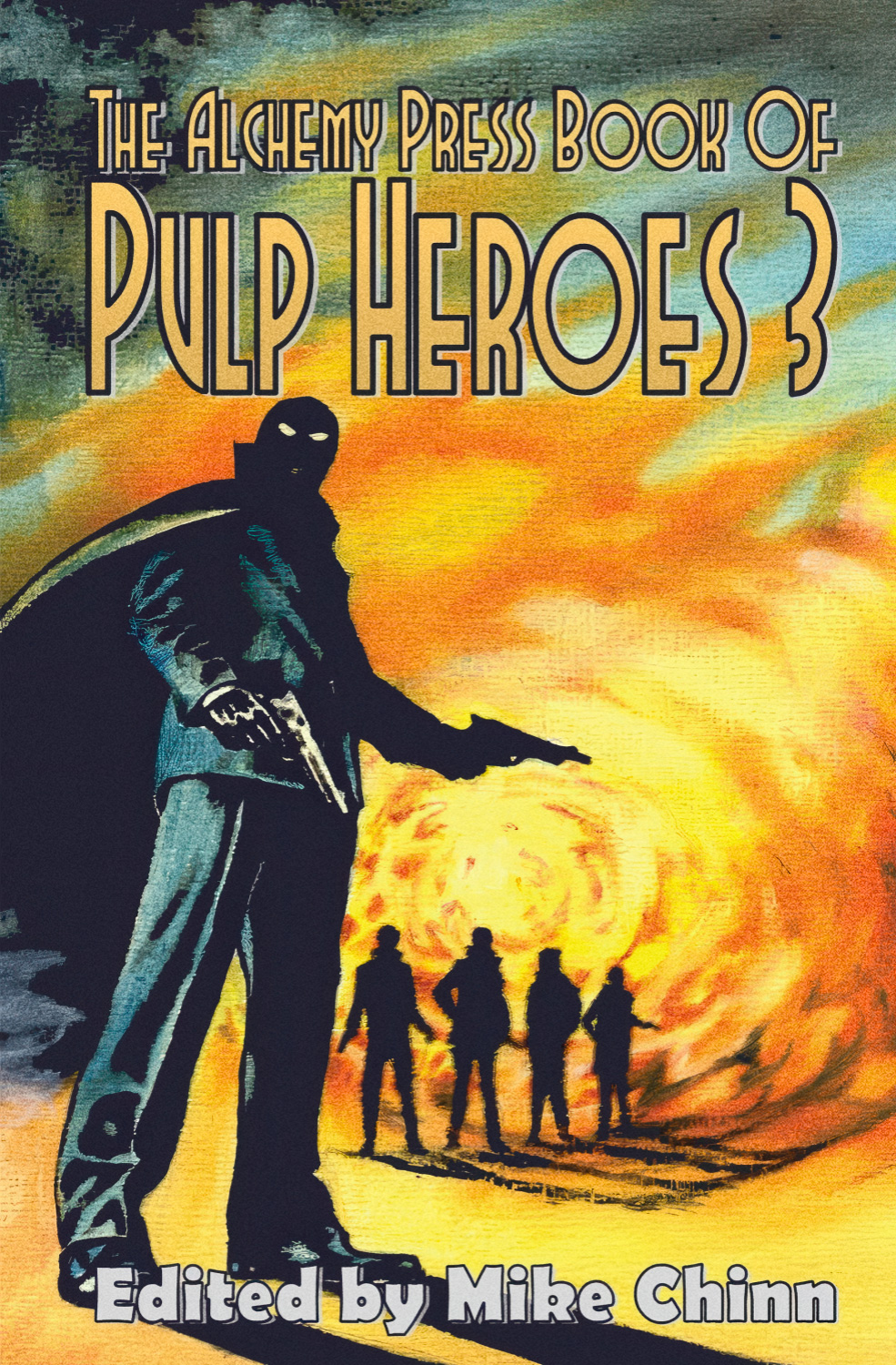 I was very much on the fence about whether I was going to bother with the third and final volume. Then I noticed it was available on Amazon for a reasonable price and figured I should probably get it while I could. It came out in 2014, after all.
As I’ve noted, New Pulp is great, but too many people slap the word “pulp” on works that have little to do with pulp fiction. And if you are going to put out a volume of “pulp heroes,” then please give us a volume of pulp heroes — not stories based more on comic-book superheroes. Not stories that would better fit into a volume of adventure tales, detective tales, or even science fiction tales. And certainly not postmodern tales that deconstruct the hero or give them a lot of emotional/psychological baggage. Pulp heroes have none of that.
Give us tales with larger-than-life heroes that would or could have appeared in the pulp magazines. I don’t think that’s too much to ask. I feel I should be channeling Razörfist and his mantra of “reject modernity, embrace pulp heroism.”
And thus I got The Alchemy Press Book of Pulp Heroes 3. Alchemy Press is a British publisher that has published several anthologies, and this one is again edited by Mike Chinn. Chinn created pulp-inspired hero Damian Paladin. As noted, this is their last “pulp hero” volume.
This time, we get 12 works by various authors, only a handful of whom have done what I’d call New Pulp. One is a reprint, but the rest are original to this volume. As with the previous volumes, I think a big part of the problem is that, if this is a collection mainly of British authors, they really don’t have much experience with pulp fiction, which was largely an American phenomenon. But let’s see how they do.
First up is a story about a city dealing with a rise in “pulp” villains. A crime lord known as Kid Kafka had been keeping things under control, but a new Doctor Pulp has been causing problems. Our main character is a police detective who lost her infant child due to one of these pulp villains. But where are the pulp heroes to keep them in line? None are to be seen. We have characters asking what “pulp” means without an answer. So, not a good start.
Then we get a reprint of Kim Newman‘s “Angels of Music” from Tales of the Shadowmen. A great story of a group of agents organized by the Phantom of the Opera. I enjoyed it when it first appeared.
Next, we get a science fiction tale when an alien comes to deliver a message to Earth, but things go sideways. OK. So where is the pulp hero? This could work as a pulp science fiction story. Maybe.
Then we get a story focused on a skid row P.I. who takes pictures for clients and is somehow taking pictures that feature more. OK. Weird. But no pulp hero.
We then get an alternate-history story where King Edward VIII did not abdicate the throne of England. But he also had married and had a young son named David. It’s now the early ’50s, and Edward has passed away (a lot earlier than in our world). When the Royal Palace is attacked by a trio of Russian superheroes who are the daughters of Stalin and one of the czar’s daughters, we learn that various royals, with the aid of certain mystic items, can be superhumans. Okay. But comic-book superheroes, which is what this is, aren’t pulp heroes.
For a change, the story by Evan Dicken is set in early Japan (or a similar culture) and focuses on a lone samurai who gets hired to take out a witch and her demon protector to help the local town. So there is a supernatural element. This one is pretty good, and I would like to see whatever else this author has written.
And then we get a tiresome hero-deconstruction story of some sort. Ugh.
We then get another alternate setting: inner London has been transported to some kind of hell, forcing those there to try to make a living while dealing with the threat of mystical beasts. Our heroine first fights a group of harpies, then is asked to find and stop a gorgon. Interesting, but it just seems a little too bizarre for a pulp hero. More of a weird fantasy story.
Chicago in the 1950s is the setting for the next story, which has a lot of masked/costumed vigilantes operating there. Thus, another story that is more comic book than pulp, as we focus on a new character called The Revenant. And when you get who he is, hopefully you’ll agree he’s more comic book than pulp.
The next tale is another weird detective story that, again, isn’t much of a pulp hero story, as our “hero” is already dead.
We get yet another story with comic-book superheroes and villains, as a supervillain is being moved. He will later confront the main superhero he fights for one final confrontation. So, sadly, not pulp.
And the final story is a strange one that involves the Golem of Prague and its creator. This would have been great for a weird fiction collection, but no pulp hero.
So a dozen stories. I only count a couple of pulp-hero tales, including the reprinted one. In volume 1, I counted three; in volume 2, it was four. So, volume 3 is the worst of the lot.
If they ever do another, I’m not bothering. As I said before, Airship 27 has done better with their Mystery Men (& Women) series than Alchemy, as well as with their many other original pulp works. Other publishers have, too. Again, not that these stories are bad; most aren’t. It’s just that most are not pulp heroes.



Add Comment